To acquaintances: given recent impersonators, I remind you that I will never write to you unless I met you in real life (and generally, I don't write to people often), and will never ask you to download any software or execute commands, or anything of the sort. I have several skills, but Chinese is not among them. I also don't send any files, photos or things of the sort. Beware of scammers. If you bump into someone saying it's me, it´s definitely not me
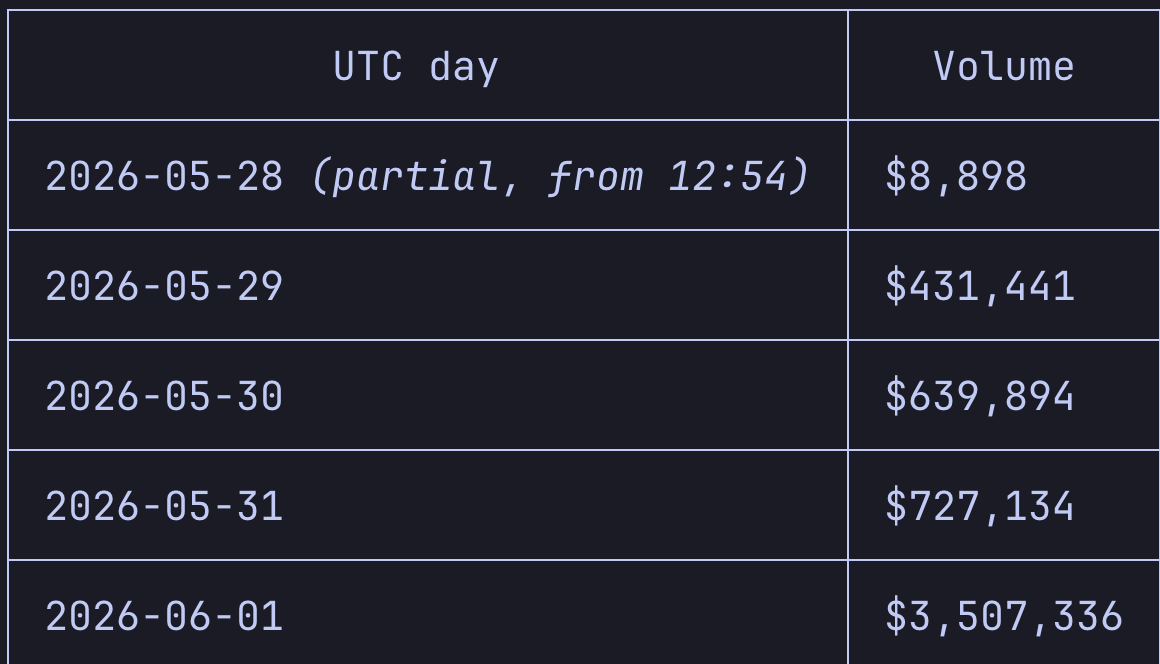
PropAMMs on @ethereum: 1.5 bps tighter than @binance VIP9. 8 bps tighter than @Uniswap. The best execution venue for ETH is no longer a CEX.
Onchain is already winning on price! This is only the case for less than 10k tades, but the reason isn't technical, it's just a lack liquidity. Liquidity will grow with time and more MM and PropAMMs will keep entering the game. With time between Ethereum and CEXes and other L1s will become even bigger. Ethereum is about to become the global financial hub. Still many things to improve. We're working all day long to deliver.
Amazing work @titanbuilderxyz and @class_lambda.
I'm just gonna leave this. Amazing work @gattacahq@class_lambda. PropAMMs in @ethereum are making Ethereum more efficient and competitive against CEXes and other L1s.
Volume is just going to keep growing.
Lambda is very proud of working with @0xMiden. Miden is pushing the boundaries of practical privacy. I believe most institutions will be using it in the years to come!
until recently we had the lambdavm in stealth mode.
we are changing that and we started to be part of the compliance tests from the ef.
@mauro_aligned and @diego_aligned have been doing an amazing job in collaboration with @class_lambda and @3miLabs.
Today a crazy quantum story just got wilder.
On March 31, the Google Quantum AI team published a landmark result on Shor's algorithm for elliptic curve cryptography. Technically, the paper was a bombshell: a dramatic 10x improvement over the state-of-the-art. As a stunt and wakeup call to the blockchain space, those optimisations were illustrated on secp256k1, the elliptic curve underlying Bitcoin and Ethereum signatures.
But perhaps the most striking part of the paper was sociological, not technical. Instead of following standard academic process, the optimisations were kept secret, hidden behind a zero-knowledge (ZK) proof. Google's accompanying blog post mentions they "engaged with the U.S. government". The ZK proof demonstrates the existence of algorithmic improvements without leaking details. Academic censorship with ZK, a historic first!
As a co-author of the Google paper I witnessed some of the context surrounding this censorship. To be honest, multiple aspects of that context don't sit well with me. As much as I believe the general public ought to know more, I am limited in my ability to whistleblow. Though let me be clear about one thing: the Google team's professionalism has been absolutely exemplary, and they deserve nothing but praise.
Censorship has a way of backfiring. The Streisand effect, where an attempt to bury something only draws more attention to it, is exactly what's unfolding today. First, Google's key optimisation has been rediscovered by the French. And in a thrilling turn of events, a collaborative Shor-at-home challenge just launched. The initiative, available at ecdsa[.]fail, breached a new Shor world record in a matter of hours.
Let's start with the rediscovery. Just two months after Google's paper, French quantum expert André Schrottenloher cracks the main secret optimisation. His paper, titled "Optimized Point Addition Circuits for Elliptic Curve Discrete Logarithms", landed on the arXiv today. Big congrats to André, who beat several other nerdsnipped experts to it. In a blog post also published today, Craig Gidney, the world expert on Shor optimisations, revealed that he'd been sitting on this very optimisation for a whole year under censorship pressure.
Interestingly, André missed a handful of minor optimisations, both from Google's original publication and from improvements found since. It's plausible there's still plenty of juice left to squeeze out of Shor, and this is exactly what the ecdsa[.]fail challenge is about. The verifier program developed for the ZK proof does double duty, automatically filtering for valid submissions. Dozens of compounding small and micro improvements are rolling in. As of the time of writing there's an 8.4% improvement to Google's circuit, as measured by the product of logical qubit count and Toffoli gate count. Nice!
The nerdsnipping ran deeper than anyone expected. Over the last few weeks it became clear it extended well beyond André and other quantum experts. Behind the scenes, a small army of amateurs quietly got to work. Inspired by Karpathy-style autoresearch, they turned AI on Shor. Ironically, the verifier program for the ZK proof makes an ideal reward function for AIs. The barrier to entry for this modern style of research is refreshingly low, with several non-experts, even a teenager, finding nice optimisations. Get in touch if you'd like to join a Telegram group with fellow autoresearchers :)
Part 2: neutral atoms and qday
The story doesn't end with Google. On the same day Google went public, a stealthy startup called Oratomic published its own Shor paper in a coordinated release. It made a splash, ultimately becoming the most upvoted paper on scirate[.]com, a website ranking arXiv papers.
Oratomic's claim was wild. By building on Google's logical optimisations and applying custom physical optimisations for neutral atoms, they claimed just 10K physical qubits were sufficient to run Shor's algorithm on secp256k1. That number is mind-bogglingly low.
Knowing essentially nothing about neutral atoms when Oratomic's paper landed, I was intrigued and decided to learn more about the tech. I fell straight down the rabbit hole and spent a couple hundred hours on the topic. I got a little obsessed and watched every YouTube video I could find and spoke to a bunch of experts.
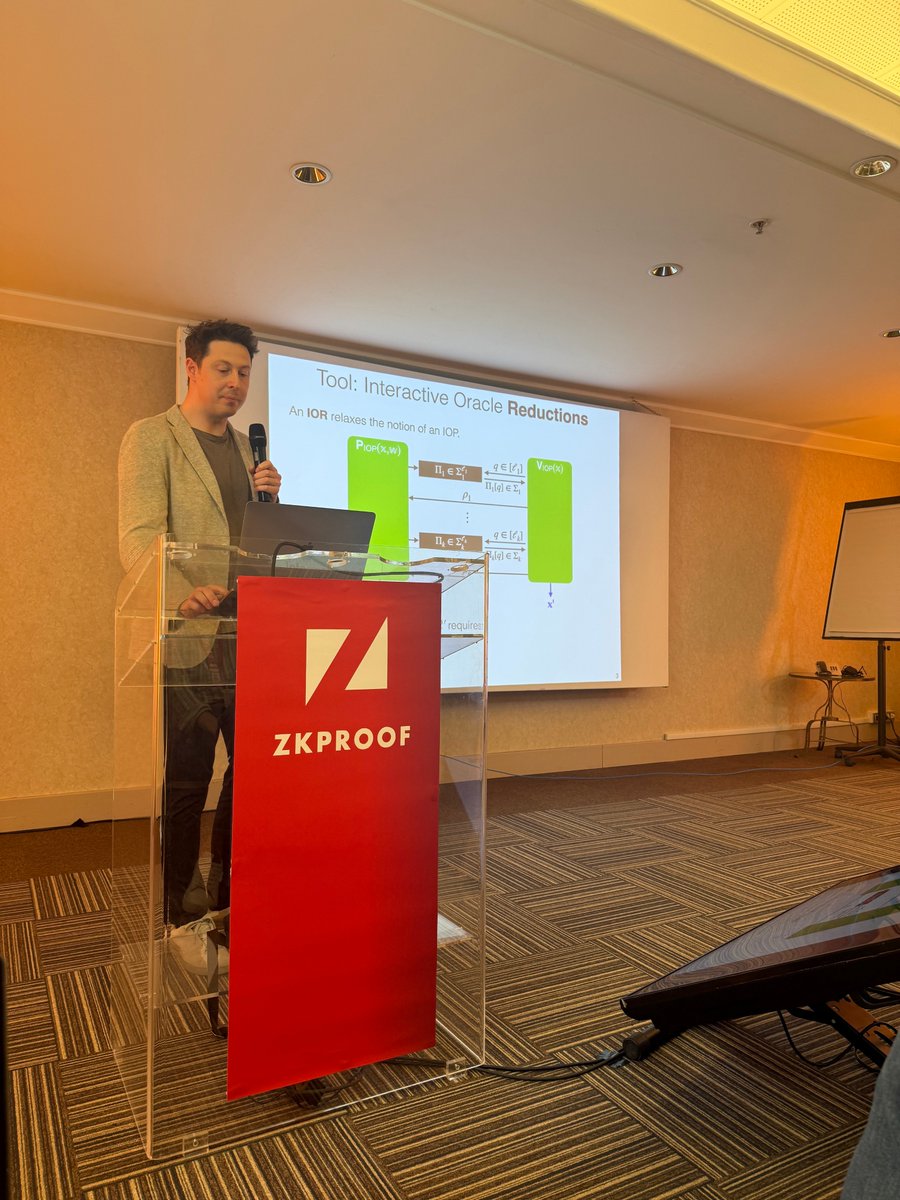
My conclusion? The tech is real, very real. Even Google recently decided to start a neutral atom lab, a notable pivot from their sole focus on superconducting qubits. If you care about qday, i.e. the day a quantum computer will break the first piece of cryptography in production, neutral atoms demand your attention. I shared some of my learnings on Shor and neutral atoms in a 30min talk at the ZKProof cryptography conference. You can find it on YouTube by searching "zkproof neutral atom".
Here's an interesting observation about this duo of breakthrough papers: neither Google nor Oratomic say a word about what their results mean for qday. No timelines. Zero. Nada. That is especially baffling given that the whole point of whitehat quantum cryptanalysis is to inform qday estimations and help the general public make good decisions.
So let me attempt to partially fill the silence, similarly to what Scott Aaronson did in his April 29 post. Given everything I know, including scary non-public information, I now put the odds of qday by 2032 at 50%. 10% by 2030.
Anecdotally, the US government has its own date: 2035. Originating at the NSA and later adopted by NIST, it's when branches of the US government will be disallowed from using quantum-vulnerable cryptography. In plain language: with hindsight, that date is a joke and should be discounted entirely. I don't see how NIST avoids being forced to pull it forward by years.
Part 3: post-quantum cryptography
There are good reasons to sound the alarm today, but please do not panic. Rushing carelessly towards immature post-quantum cryptography is a recipe for disaster. IMO a good target date for migration is 2029, roughly 3.5 years out. 2029 happens to be the date selected by Google, Cloudflare, and the Ethereum Foundation.
These days most of my time goes to safely migrating Ethereum towards post-quantum cryptography as part of the broader lean Ethereum effort. There's a lot to do. We need to rip out and replace BLS signatures at the consensus layer, KZG commitments at the data layer, and ECDSA signatures at the execution layer.
The plan to get there is compelling, and is based on hash-based cryptography. Within the Ethereum Foundation we've developed a Swiss army knife called leanVM (github[.]com/leanEthereum/leanVM) powered by the magic of hash-based SNARKs. Thanks to truly exceptional work by Emile, Thomas, and others, its performance is derisked. Regarding security, leanVM is a jewel, a minimal zkVM crafted for end-to-end formal verification and maximum security.
Want to help? There are two $1M initiatives. First, the Proximity Prize (proximityprize[.]org). Solve a long-standing mathematical conjecture in coding theory, improve hash-based SNARKs, and go home a millionaire. Second, the Poseidon Initiative (poseidon-initiative[.]info), offers $1M for breaking Poseidon, the SNARK-friendly hash function.
I'm just gonna leave this here. Amazing work @titanbuilderxyz@class_lambda making PropAMMs a reality in Ethereum.
We're gonna do everything we can for Ethereum to win.
it's unbelievable the level of misunderstanding that exist today with the ethereum roadmap.
people are just hating on it as a sport.
it will clearly caught people off guard very quickly both investors and competitors.
ethereum will have:
- on chain price discovery for eth and other digital assets winning in trading against solana and cex.
- more decentralized than ever.
- post quantum secure.
ethereum is the best place to do business and it's building everything to defend its throne.
@realjuanruocco De hecho, hace unos años lo quisieron pedir. Hay que encontrarle el milagro. Le falta la anécdota del estilo me salvé la vida por El Diego
@fede_intern Nice reading. I cannot help noticing it is from the bishop of Nafpaktos (in Spanish, Lepanto). I will have to conform tonight with more fractal geometry and coding theory
Humanity, created by God in all its grandeur, is today facing a pivotal choice: either to construct a new Tower of Babel or to build the city in which God and humanity dwell together. In Jesus Christ, this humanity in its grandeur becomes the Way, the Truth and the Life, opening the path for each of us to grow toward fullness. #MagnificaHumanitas
https://t.co/6i9MWs6LJl
I’m building companies with products that people and businesses use every day. They are profitable, growing, and operating across multiple industries and continents. I already know I can build successful companies.
The only work that has ever felt historically important to me is Ethereum.
The work I’m doing in verifiable AI and on Concrete is the only thing that gives me that same feeling again.
Concrete is a systems programming language with linear types, no garbage collector, explicit capabilities, and a compiler connected to Lean. Nothing quite like it exists. The core idea is simple: systems code should not merely compile, it should explain itself.
Today, there is a split in software.
In Rust, Zig, C, or C++, you can write fast low-level systems code. In Lean, Coq, or Isabelle, you can formally prove properties about programs. Concrete is an attempt to collapse that gap: write practical no GC systems software, then attach Lean-checked theorems directly to the functions that matter.
Concrete is designed so that both humans and machines can reason about software.
The compiler tracks what every function is allowed to do: allocate memory, access files, use the network, print, call foreign code, or cross trusted boundaries. It also tracks the strength of claims: whether something is merely documented, compiler enforced, or formally proven in Lean.
This creates something current languages do not provide: a machine readable map of authority, trust boundaries, resource behavior, and proofs tied directly to the source code and invalidated automatically when the code changes.
The goal is software that remains low-level and practical, but is no longer opaque. Code that can be audited by humans, queried by machines, and verified by theorem provers.
Ethereum made trust programmable at the protocol layer.
Concrete is my attempt to make trust inspectable at the code layer.
I believe that within a decade, the need for something like Concrete will become obvious.
We're co-organizing a Seminar on Coding Theory, Low-Degree Testing, and PIOPs together with the Cryptography and Distributed Systems Research Center.
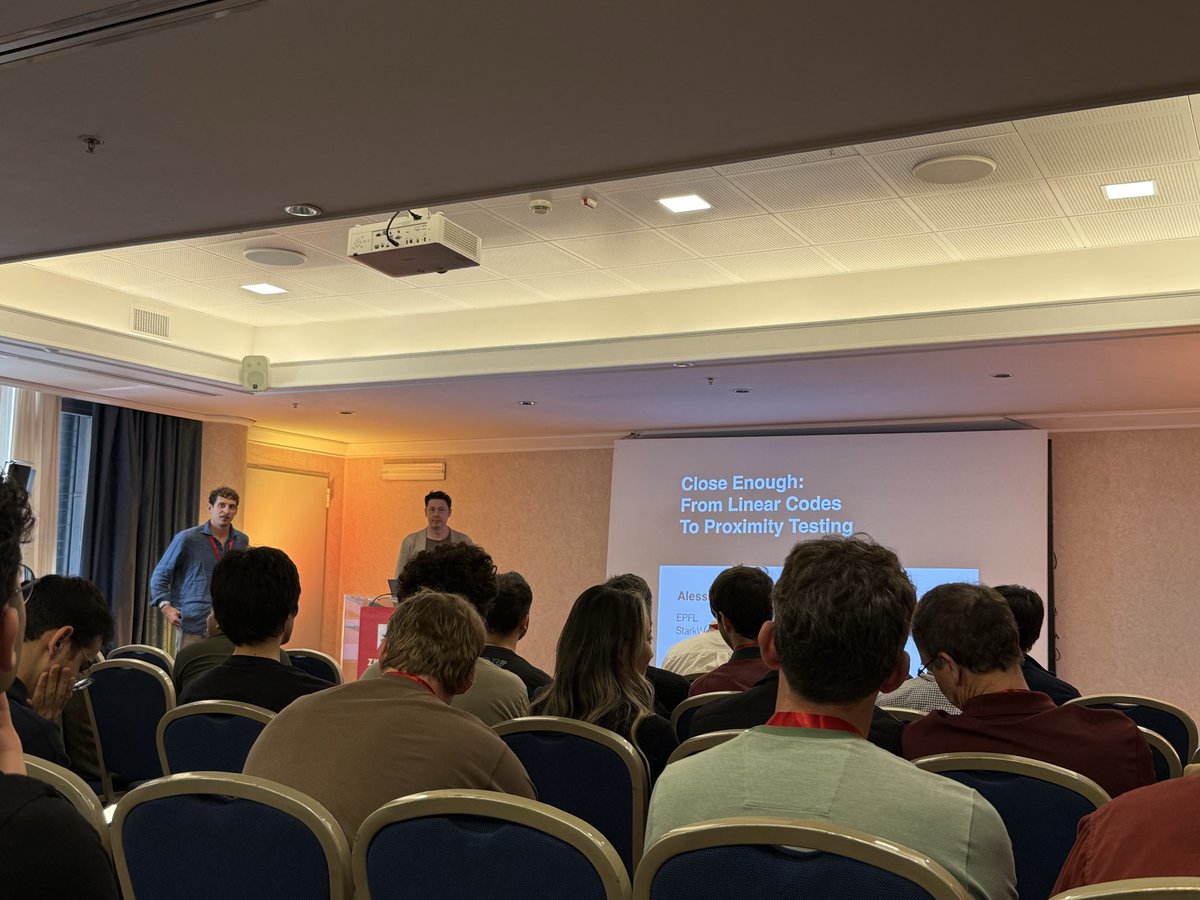
4 sessions covering the path from linear codes all the way to modern polynomial proximity protocols and their role in ZK proofs.
Led by Manuel Puebla, researcher and professor with a background in pure mathematics and algebraic geometry.
The first session took place this week at @ingenieriauba. Thank you for the space.
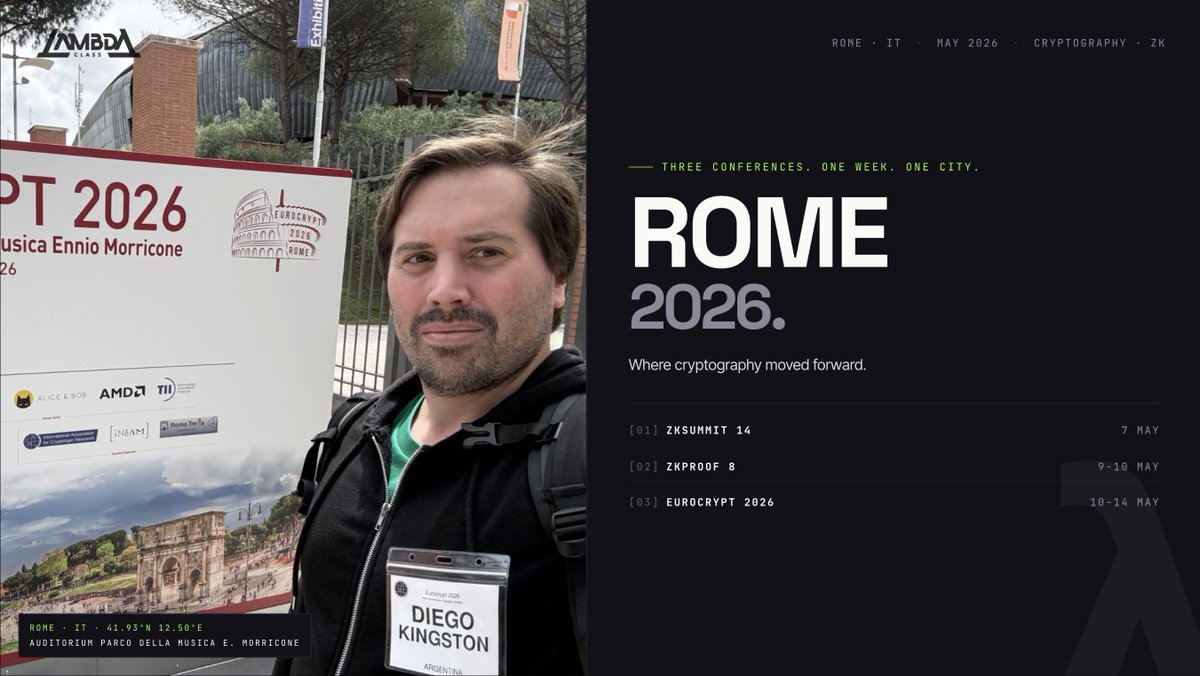
Rome was the center of cryptography these last two weeks. We attended zkSummit 14, zkProof, and Eurocrypt 2026 with @alignedlayer, @3miLabs, and the Center on Cryptography and Distributed Systems of the University of Buenos Aires (CCSD). Full recap on the blog.
Last week Rome was three conferences in one: zkSummit 14, zkProof, and Eurocrypt 2026. We were there for the latest in cryptography and zero-knowledge, and to get the community's eyes on our new VM.