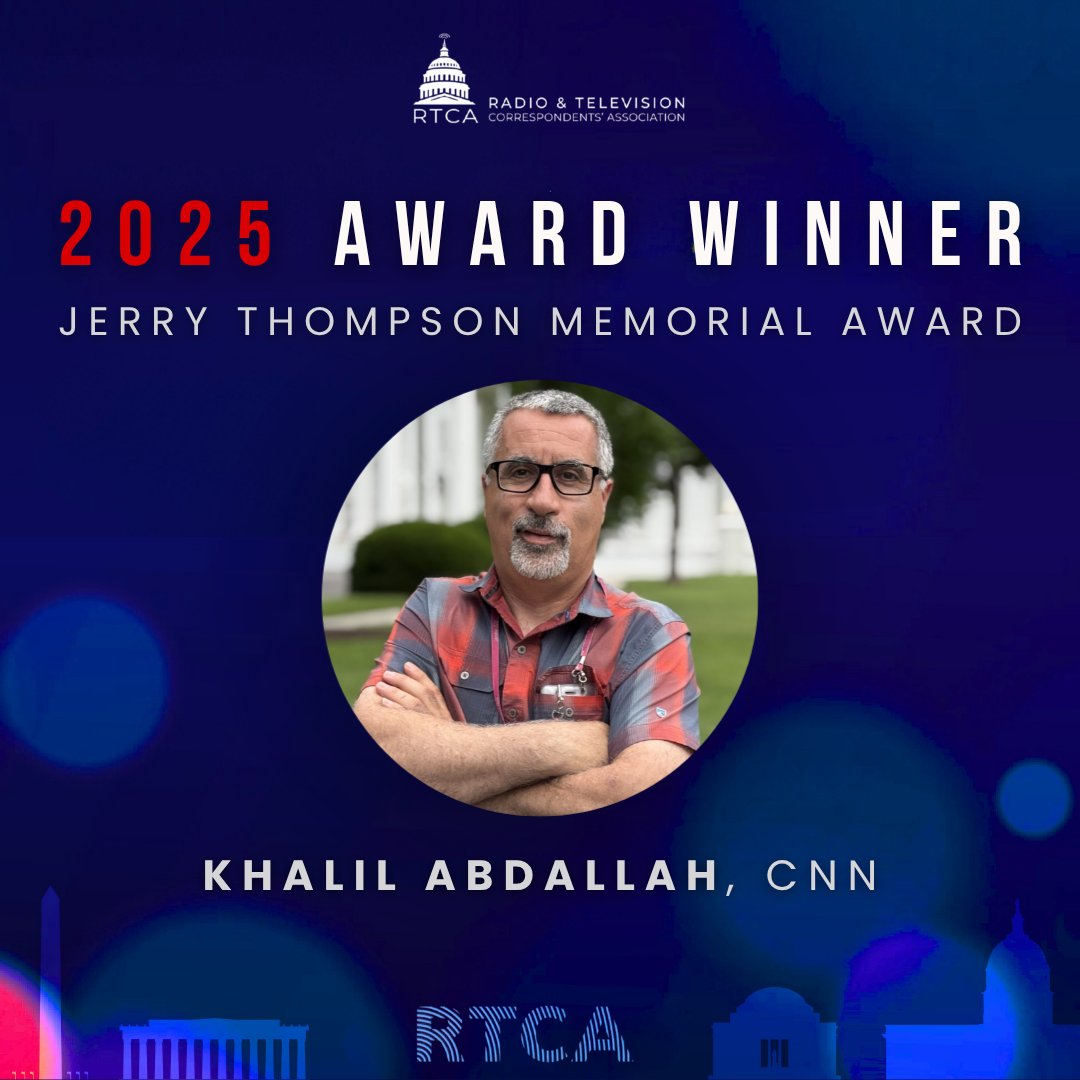
🚨NEWS: CNN's Khalil Abdallah @abdallahcnn is the 2025 recipient of the Jerry Thompson Memorial Award. He will be honored June 30
Established in 2012, this award is presented in memory of Thompson, a CNN photojournalist, for his 25 years of excellence.
👀Khalil's reaction ⤵️
The Israeli prime minister has refrained from openly criticizing Trump, but behind closed doors, Israeli sources say, he has acknowledged Israel has limited influence on the outcome of US-Iran negotiations to end the war.
Read my latest on @CNN
https://t.co/zykEWOwB8O
There’s so much going on that it’s easy to overlook the fact that the president is telling so many lies.
Here’s a fact check of 28 different false claims President Donald Trump made from Monday through Friday. https://t.co/K0hfbxA7TS
Iran’s Nuclear Strategy: A More Nuanced Reality
Iran’s nuclear ambitions did not begin with the Islamic Republic. Under the Shah, nuclear capability was viewed as a symbol of modernity, technological advancement, and great-power status. The Shah saw nuclear infrastructure as proof that Iran belonged among the world’s leading powers.
After the 1979 Revolution, Ayatollah Khomeini initially hesitated to continue the program. But the trauma of the Iran-Iraq War and especially the sense that Iran had been strategically vulnerable and could potentially face existential destruction, deeply shaped the thinking of the next Supreme Leader, Ali Khamenei. Over time, the regime concluded that a nuclear capability could serve as the ultimate insurance policy against foreign intervention or regime collapse.
In the 1990s and early 2000s, the military dimensions of the program were concentrated in the “Amad Project,” led by Mohsen Fakhrizadeh. Yet the project never reached completion. Following the exposure of the Natanz facility by the Iranian opposition and amid fears that Iran could become the next target after the U.S. invasions of Afghanistan and Iraq, Tehran shifted course. Rather than openly pursuing weaponization, Iran focused on expanding the civilian and industrial dimensions of its nuclear infrastructure.
But this “civilian” program was never purely civilian. Nuclear energy was only part of the story. The broader objective became strategic deterrence: building a sophisticated nuclear infrastructure that would provide Iran with latent weapons capability while strengthening its regional and conventional deterrence posture.
After the U.S. withdrawal from the JCPOA in 2018, Iran gradually expanded enrichment and moved closer to threshold status. Importantly, however, Tehran still avoided crossing the line into openly producing weapons-grade uranium at scale or assembling an actual bomb. The strategy appeared deliberate: remain close enough to nuclear capability to deter adversaries, but avoid triggering overwhelming international or military retaliation.
Israeli disclosures after the 12 days war suggested that some Iranian scientists explored theoretical “shortcut” options for rapid weaponization if the leadership ever decided to build a bomb. Many of these ideas, including fusion-related concepts, were scientifically impractical. More importantly, there is still no publicly available evidence that Iran made a final political decision to manufacture nuclear weapons.
This distinction matters. For years, U.S. intelligence assessments repeatedly concluded that Iran had not decided to build a nuclear weapon, even while preserving the technological option to do so in the future. Iran was not “weeks away from destroying the world,” as some political rhetoric suggested. At the same time, Tehran’s claim that its program was purely peaceful has never been credible either.
The truth lies somewhere in between. Iran’s nuclear program was designed from the outset to preserve the possibility of military capability. But since 2003, its primary strategic function has been broader than simply building a bomb. It became a pillar of national prestige, deterrence, regime survival, and scientific identity.
This is also why the Supreme Leader’s fatwa against nuclear weapons should not be dismissed outright. Whether one believes it is religiously binding or politically reversible, it has clearly shaped Iran’s strategic narrative and helped justify the policy of remaining a “threshold state” rather than an overt nuclear power.
And this leads to the core issue: uranium enrichment for Iran is about far more than a bomb. It represents sovereignty, scientific achievement, and independence from Western pressure. That is why no Iranian government, especially not the current regime, is likely to give up enrichment entirely under any realistic diplomatic scenario.
Therefore, two things can be true simultaneously:
Claims that Iran was on the verge of imminently launching nuclear destruction were exaggerated and unsupported by available intelligence. But Iran’s nuclear program was never purely peaceful, and preventing Tehran from acquiring actual nuclear weapons capability remains a legitimate and necessary international objective.
The challenge for policymakers is recognizing this complexity instead of reducing the issue to simplistic claims. A current Iranian leadership, may very well reassess the nuclear doctrine that has guided the Islamic Republic for decades. The current strategy of remaining a threshold state without openly building a bomb was shaped not only by technical considerations, but also by Khamenei’s ideological, religious, and strategic worldview. A new generation of leaders may reach different conclusions.
From Tehran’s perspective, recent years reinforced a painful lesson: conventional deterrence alone may not be sufficient against Israel and the United States. Many within the Iranian elite are likely to conclude that only a credible nuclear deterrent can guarantee regime survival and prevent external military pressure. In that sense, the debate inside Iran after Khamenei may no longer be whether nuclear weapons are desirable, but whether the costs of restraint still outweigh the benefits of crossing the threshold.
This creates a major strategic dilemma for the West and Israel.
Trying simultaneously to prevent Iran from acquiring nuclear weapons while also pursuing regime collapse could produce the exact opposite outcome. If Iranian leaders become convinced that the ultimate American or Israeli objective is overthrowing the regime regardless of Iranian behavior, then nuclear weapons become far more attractive as the only reliable survival guarantee.
History matters here. From the Iranian perspective, states without nuclear deterrence, Iraq, Libya, and potentially Syria , were vulnerable to external intervention, while nuclear-armed states such as North Korea avoided similar outcomes despite extreme international isolation. Many Iranian strategists openly study these cases.
This does not mean the international community should accept a nuclear Iran. But it does suggest that maximalist policies carry risks. A strategy perceived in Tehran as aiming both to deny nuclear capability and to destabilize the regime could strengthen hardliners, empower the security establishment, and accelerate the push toward weaponization.
Paradoxically, an effort designed to weaken the Islamic Republic could end up consolidating it around a national security emergency.
That is why the priority must remain singular and clear: preventing Iran from obtaining a military nuclear capability. If achieving that objective requires limited understandings that indirectly stabilize the regime or reduce escalation incentives, that may still be preferable to a scenario in which Iran concludes it has nothing left to lose and races openly toward the bomb.
The central challenge is therefore convincing Iran that nuclear weapons will reduce its security rather than guarantee it. So far, neither sanctions, military pressure, nor diplomacy alone have fully achieved that goal.
#IranWar
"We're the only country in the world that has" birthright citizenship, President Trump lies even though this claim from him has been debunked for at least the last eight years.
CNN’s @KFILE reveals the man leading the hantavirus response in the U.S. is a specialist in penile implants with little public health experience and hosted a podcast called “Erection Connection.”
A fabricated quote about Obama. Fictional conspiracy theories about Obama. Multiple lies about the 2020 election. Additional nonsense.
Here’s a quick breakdown of President Trump’s wild posting spree late last night and early this morning: https://t.co/eTFEleANAz
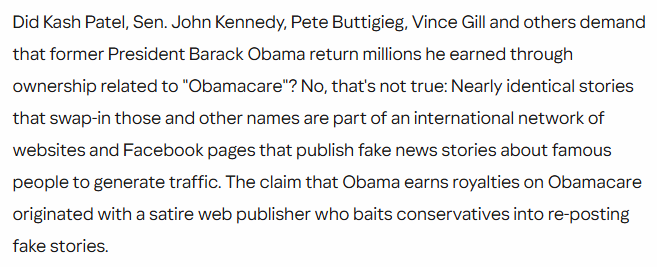
It's hard to explain just how detached from reality President Trump's conspiracy-theory-filled social media posting spree last night and this morning was. One easy example: The president shared a completely made-up and frankly nonsensical "quote" about former president Obama the post attributed to GOP Sen. John Kennedy. The fake quote originated with a "satire" website, basically a fakery factory, that invents stories to be shared by online conservatives; per the fact-check website Lead Stories, versions of this particular fake quote have been wrongly attributed to everyone from Kash Patel to Madonna.
https://t.co/iuGHS09Zxs
Asked if he could provide Congress with a more formal accounting of the cost of the war with Iran, Defense Secretary Pete Hegseth said the Pentagon would “share what we can … when it’s relevant and required.”
“I think this would be the format that it would be required,” Rep. Pete Aguilar responded.
President Trump just told an especially vivid version of one of his favorite imaginary stories, saying, “They emptied the prisons of the Congo into the area of the southern border, and then told them to just walk in because stupid Americans are going to accept you beautifully.”
Trump has never produced a shred of evidence that either the Democratic Republic of Congo or the Republic of Congo emptied prisons for migration purposes, let alone advised prisoners on how to enter the US. Both countries have denied the claims on the record. Experts on both countries, on global prisons, and on immigration to the US have made clear they have no idea what Trump is talking about. https://t.co/JNGUNEwPFH
Christian here. No saint, but nine years of Catholic school. Past altar boy. Past choir member. Etc. I attend services in Virginia these days, for what it's worth.
I would submit that your version of Christianity, which includes insulting people on the Internet (possibly for your day job, possibly for funsies), appears to look different than mine. That's a choice. Not a choice I'm making. But a choice.
A fact check:
1) The video of Gen. Brown that appears to offend you was posted early in June 2020, in the aftermath of George Floyd's killing.
2) The Senate, with a bipartisan 98-0 vote, confirmed him to run the Air Force about a week *later*, after said video. Dozens of Republicans voted for him.
3) He took over the Air Force in August 2020 and then held that job under President Trump for the remainder of his first term.
4) He was then nominated by President Biden to become chairman in 2023, and was confirmed by the Senate with a bipartisan 83-11 vote. Dozens of Republicans voted for him.
5) Like most generals, Brown made some mistakes. He also carried out the policies set by two civilian administrations without criticizing either of them, adhering to civil-military norms. The facts do not support that Brown was "one of the most divisive military leaders in history." That's your political opinion.
Have a good one.
Absolutely thrilled to share that I’ve been promoted to senior national security reporter with @CNN covering the Pentagon!
Covering the military, US troops and their families, and issues that matter to them is the best job there is, and I’m ecstatic to get to do it alongside such a phenomenal team.
As always you can send any news tips securely on Signal — username hhb.50
Don’t miss the significance of this: the administration is announcing the end of the war in effect without having achieved regime change, ending Iran’s nuclear program or eliminating its missile program. And its focus is now on solving a problem which didn’t exist prior to the war: a closed or nearly-closed Strait of Hormuz. The president could of course order new military strikes but the current state of play has not met his sometimes outsized expectations.
The Myth of the “Imminent Iranian Bomb”
The most persistent justification for the current campaign against Iran is also the most misleading: the claim that Iran was on the verge of acquiring a nuclear weapon and had to be stopped.
This narrative collapses under scrutiny.
For years, U.S. and allied intelligence assessments have been consistent on one key point: Iran’s nuclear program, while advanced, is not equivalent to an active decision to build a bomb. The critical threshold has always been political, not technical. Tehran would first have to make a deliberate choice to weaponize, a decision that, by all credible accounts, had not been made prior to the conflict.
Yet this distinction has been blurred, if not erased, in public discourse. The hypothetical, “Iran could have built a bomb”, has been repackaged as an imminent threat. It is a subtle but consequential shift, one that transforms uncertainty into urgency and speculation into justification.
More troubling is what this framing obscures.
The nuclear issue was never the sole, or even primary, driver of the campaign. It functioned as a convenient rationale for a broader strategic objective: reshaping the Iranian regime itself. By centering the narrative on nuclear urgency, policymakers have sidestepped a more honest debate about aims, risks, and long-term consequences.
And those consequences are already coming into view.
If the goal was to eliminate Iran’s nuclear potential, the evidence so far suggests the opposite outcome. This war has underscored a hard truth: there is no clean military solution to the Iranian nuclear challenge. Airstrikes and coercion can delay, disrupt, and degrade — but they cannot erase knowledge, dismantle intent, or resolve the underlying strategic calculus.
In fact, they may accelerate it.
By raising the perceived threat to the regime, the conflict increases the incentive for Tehran to reconsider its nuclear posture. What was once a conditional and deferred decision meaning “if we choose to”, may become a more urgent strategic imperative. In trying to prevent a nuclear Iran through force, we may be creating the conditions that make it more likely.
This is the paradox at the heart of the current approach: the nuclear threat has been inflated to justify the war, and the war itself may ensure that the threat becomes real.
Absent a credible diplomatic framework, this cycle will only deepen. The question is no longer whether Iran could pursue a bomb. It is whether our own actions are pushing it closer to deciding that it should.
#iran
Defense Secretary Pete Hegseth made a false claim in his testimony to the House on Wednesday. Then he repeated it in his testimony to the Senate on Thursday.
Hegseth said Wednesday: “In 2024, troops were depl… – that was Joe Biden by the way, Joe Biden – were deployed to polling locations in 15 states." He continued, "2024 – Joe Biden – troops deployed to polling locations in 15 states. Explain that one to me.”
Here’s the explanation: Hegseth’s claim isn't true.
Not only were all National Guard activations for the 2024 election done by individual states rather than Biden, all 11 states that responded to my inquiries said *no troops* there were sent to polling places.
Rather, they said, Guard personnel were in other locations helping with election cybersecurity, doing other behind-the-scenes support work, or not actually activated for the election after all.
Fact check with on-record quotes:
https://t.co/65YvqPJ8NA
Pete Hegseth falsely testified to both the House and the Senate last week that troops were deployed to voting places in 15 states under Joe Biden in 2024.
Not only were all National Guard activations for the 2024 election ordered by individual states rather than Biden, all 11 states that responded to my inquiries told me that *zero troops* were sent to voting places.
The Pentagon declined to comment. Fact check: https://t.co/bwMFV9hPEV
Trump has been threatening such reductions to a number of European and Asian allies going back to his first term. This particular announcement comes the same day he spoke with Putin - and it’s a development Russia would certainly welcome.
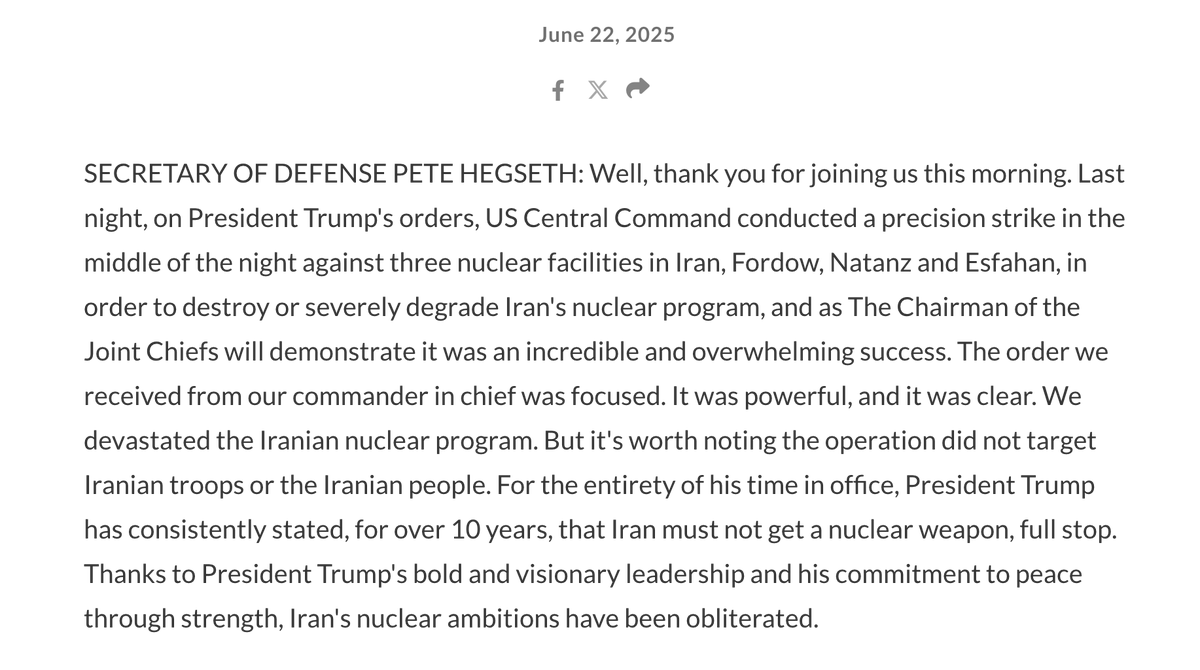
Hegseth says today Iran "had not given up" their nuclear ambitions after Operation Midnight Hammer last year.
Last June, he said Iran's nuclear ambitions "have been obliterated." https://t.co/vUcfBqXkBj
In July, Pentagon spox Sean Parnell also said the operation led to "the total obliteration of Iran's nuclear ambitions." https://t.co/YpsLdeEej1
This is taking place as the @IsraelMFA is not making time for nearly a week to meet with the EU ambassador over the grain issue, while it does have time to meet Russia's ambassador.