@surajitsingh_ so much good
cmd : Beginning system scan. This process will take some time.
Beginning verification phase of system scan.
Verification 100% complete.
Windows Resource Protection did not find any integrity violations. lol
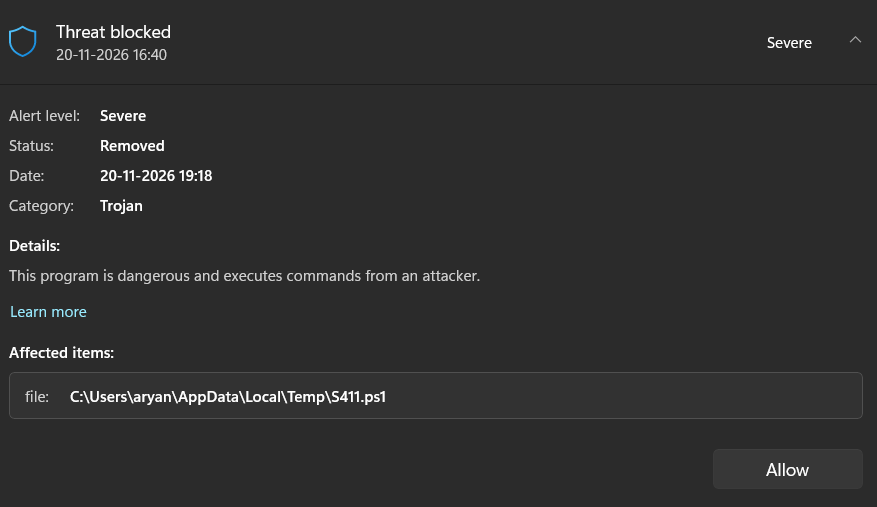
Finally found a possible clue behind my hacked accounts. Windows Defender detected a severe PowerShell Trojan on my PC. Securing everything now. 🔐
"details:"This program is dangerous and executes commands from an attacker."
Finally found a possible clue behind my hacked accounts. Windows Defender detected a severe PowerShell Trojan on my PC. Securing everything now. 🔐
"details:"This program is dangerous and executes commands from an attacker."
@Aval0n0lava Yes but now a days modern smartphone not count that screen off music playing I have youtube premium so I can turn off the screen and listen
My scanner was wrong and I only caught it by accident.
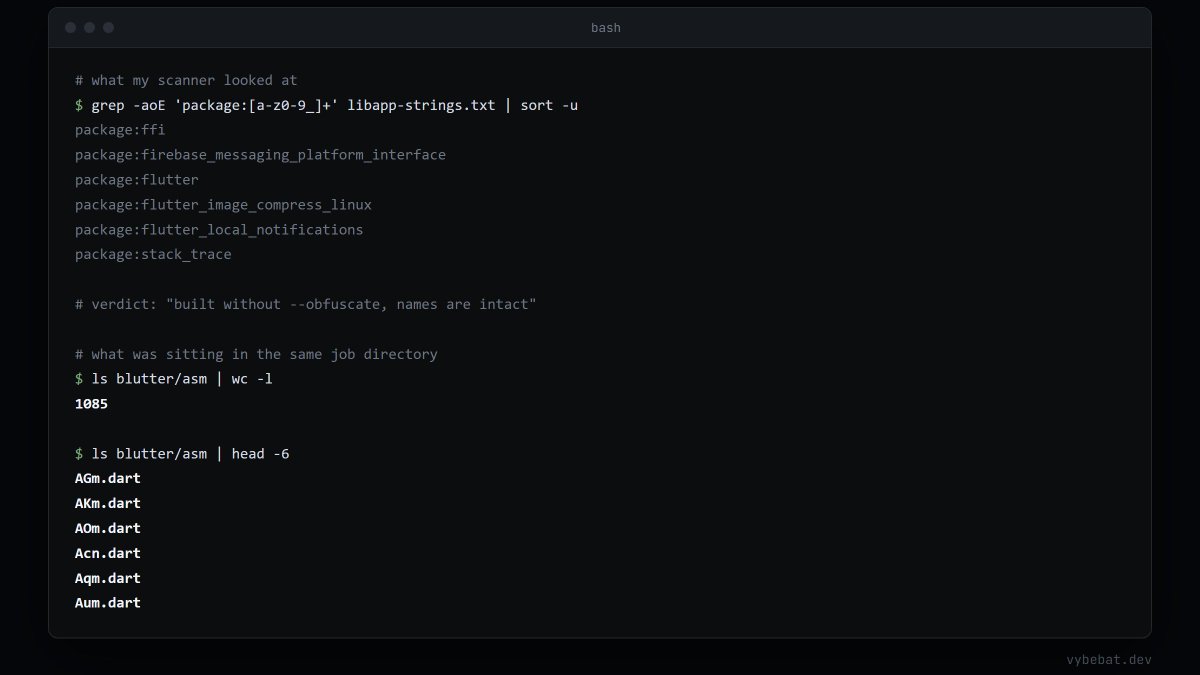
It reported that an app shipped without obfuscation, so its code was readable. Six package names in the binary, that was the whole basis. Three of those six survive obfuscation anyway, because Flutter keeps them as runtime strings.
A second tool had already pulled 1085 libraries out of the same binary. 1082 are named AGm.dart. The classes are Obj!VWb. The app was obfuscated the whole time.
Low severity. Reads like every other Low. Nobody would ever have questioned it.
And the same check ran on five other apps in that batch, none of which have the second tool's output. Those findings are not wrong. They are unverified, which in a report someone paid for is the same problem in a better suit.
My own rule says a check ships only when it fires on a vulnerable build and stays silent on a clean one. This one never once ran against an obfuscated build. That is the whole bug.
The real failure mode is not the bug you miss. It is the one you invent, in a report someone is supposed to act on.
I deleted a High severity check today instead of fixing it.
It flagged three government apps for accepting any TLS certificate. On a government app, over TLS, that is the most serious thing my scanner can say.
The check looked for one token in the compiled Flutter code. To find out whether that token means anything, I built the app twice. Same Flutter SDK, same package versions, same libraries reached on the same path, once doing the dangerous thing and once doing it safely.
The token shows up identically in both. It does not mean the app installed a certificate callback. It means the app opened a TLS socket, which every app that talks to a server does.
Three other tokens in the same run passed the test cleanly, so the method works. That one had nothing behind it.
There was no better name to key on, so I deleted it rather than tune it, and that control now ships marked not tested, with the reason and a pointer to where you can actually observe the behaviour at runtime.
The thing worth stealing: a clean fixture from a different app proves nothing. Your rule has to go quiet on a twin of the vulnerable app, same dependencies, built safely. Anything less and you are just detecting that a library is installed.
These sulfur crystals were found inside a rock after NASA's Curiosity Mars rover happened to drive over it and crush it on May 30, 2024, the 4,200th Martian day, or sol, of the mission.
Image Credit. NA SA/ IPL-Caltech/MSSS