@UnearthedHQ One interpretation links the Rök Runestone to memories of the volcanic climate crisis of 536 CE. The cooling is documented in ice cores and tree rings, but its connection to the inscription remains debated.
@NightSkyToday Interesting hypothesis! Could you share the reference or DOI of the study? I'd love to read the original paper and see what evidence supports this interpretation of the Big Bang.
Thanks for the update, really interesting finding.
It immediately made me think of the Taung Child, whose skull has long been interpreted as showing damage consistent with a large bird of prey, and of Haast’s eagle, which could take prey many times heavier than itself.
This new evidence from baboons makes the idea of aerial predation on relatively large primates feel even more plausible.
Our ancestors may really have had good reasons to keep an eye on the sky. 🦅
The “Big Five” were episodes of relatively abrupt, global biodiversity loss on geological timescales, each reshaping the history of life on Earth.
But the final question may be the most important one: when will the sixth happen?
Some scientists argue it may already be beginning.
Today, habitat destruction, overexploitation, invasive species, pollution and climate change are driving extinction rates far above natural background levels.
We have not yet reached the ~75% species-loss threshold traditionally used to define a mass extinction in the fossil record.
But if current trends continue, we may be witnessing the early stages of one — and this time, one species is the dominant driver: us.
The “Big Five” were episodes of relatively abrupt, global biodiversity loss on geological timescales, each reshaping the history of life on Earth.
But the final question may be the most important one: when will the sixth happen?
Some scientists argue it may already be beginning. 🌍
Today, habitat destruction, overexploitation, invasive species, pollution and climate change are driving extinction rates far above natural background levels.
We have not yet reached the ~75% species-loss threshold traditionally used to define a mass extinction in the fossil record.
But if current trends continue, we may be witnessing the early stages of one — and this time, one species is the dominant driver: us.
We all know the mass extinction that wiped out the dinosaurs…
but did you know there were five of them?
Each one reshaped life on Earth.
1. Ordovician–Silurian (~445 Ma) – ~85% of marine species gone. Triggered by glaciation and sea-level collapse.
2. Late Devonian (~360 Ma) – ~75% lost. Ocean anoxia and climate chaos hit reefs and fish hardest.
3. Permian–Triassic (~252 Ma) – The Great Dying. Over 90% of species vanished after Siberian Traps volcanism.
4. Triassic–Jurassic (~201 Ma) – ~75% extinct. CAMP eruptions cleared the stage for dinosaurs.
5. Cretaceous–Paleogene (~66 Ma) – ~75% gone, including non-avian dinosaurs. Chicxulub asteroid impact.
After every collapse, life recovered, often with entirely new dominant groups.
When will the sixth be ?
The Sahara we know today is only one chapter of its history. 🌍
Around 6,000 years ago, much of what is now desert was still covered by grasslands and savannas, crossed by rivers and dotted with large lakes. Hippos, giraffes, crocodiles and human communities lived there.
Why did it change so dramatically?
Earth’s orientation relative to the Sun slowly changes over thousands of years, a little like a spinning top that gradually wobbles.
During the “Green Sahara”, this geometry made Northern African summers more intense. The continent heated more strongly, strengthening the African monsoon and allowing rainfall to reach far deeper into the Sahara.
That meant regions that are now part of Mauritania, Mali, Niger, Chad, Libya and Egypt received far more rainfall than they do today.
As Earth’s orbital configuration changed, Northern African summers received less solar energy. The monsoon weakened, and its rains gradually retreated southward, becoming increasingly concentrated toward the Sahel and other tropical regions just south of the Sahara.
The consequences were enormous: lakes shrank, rivers disappeared, savannas retreated and vast areas of the Sahara gradually became the desert we know today.
Humans had to adapt too.
As water and grazing lands disappeared, communities changed their movements, livelihoods and settlement patterns. Pastoralism became increasingly important, and many populations shifted toward more reliable water sources such as the Sahel, oases and the Nile Valley.
Earth’s motion → climate → ecosystems → humans.
Landscapes that seem permanent are often just snapshots in our planet’s history.
Around 3200 BCE, something extraordinary was happening in Mesopotamia.
Uruk had grown into perhaps the world’s first great city, covering ~250 hectares and housing tens of thousands of people. 🏙️
Monumental architecture, specialized labour, bureaucracy, long-distance networks… and some of the earliest writing known to us all emerged here.
This was more than a larger settlement.
It was a new way for humans to live together.
🌌 HOW BIG IS OUR COSMIC WORLD?
THE COSMIC ADDRESS · #1
Physicist Michio Kaku once imagined fish living in a pond, unaware of the vast world beyond its surface. 🐟
What if our view of the Universe is similarly limited?
🔭 The Universe is approximately 13.8 billion years old, yet the observable Universe stretches about 93 billion light-years across.
How is that possible?
Because space itself has been expanding while light travels towards us.
But here comes the fascinating part:
The observable Universe is not necessarily the entire Universe.
It is the region from which information has had time to reach us.
Beyond that cosmic horizon, we still don't know how far the Universe extends, or whether it is infinite.
🌍 Our journey to discover our place in the cosmos begins here.
🧠 WHAT DID BOSTROM ACTUALLY CONCLUDE?
THE SIMULATION QUESTION · #2
Bostrom’s argument is often reduced to:
“We are probably living in a simulation.”
But his actual conclusion is more subtle.
It leads to what is known as Bostrom’s trilemma: at least one of these three possibilities must be true.
1️⃣ Civilizations like ours almost never reach a posthuman stage.
They may go extinct, collapse, or otherwise fail to develop the technology required to create vast numbers of conscious simulations.
2️⃣ Posthuman civilizations almost universally choose not to run large numbers of ancestor simulations.
They might consider them unethical, uninteresting or unnecessary — or restrict them altogether.
This abstention would have to be nearly universal: if even a small fraction created vast numbers of simulations, simulated observers could quickly dominate.
3️⃣ Most observers like us are simulated.
If civilizations commonly survive and some of them create vast numbers of ancestor simulations, simulated observers would vastly outnumber biological ones. 🎲
And that is the key to Bostrom’s trilemma:
His argument does not tell us that option 3 is true.
It tells us that at least one of the three must be.
https://t.co/TpDeshosxD
🧠 WHY MIGHT WE BE LIVING IN A SIMULATION?
THE SIMULATION QUESTION · #1
In 2003, philosopher Nick Bostrom proposed a striking idea:
What if an advanced civilization could create vast numbers of simulated histories containing conscious beings like us?
1 original civilization
↓
vast numbers of simulated histories
↓
vastly more simulated observers than biological ones
If you had no way of knowing which group you belonged to, which would be more probable? 🎲
That is the intuition behind Bostrom’s Simulation Argument.
But this is not proof — or direct empirical evidence — that we live in a simulation.
It opens a much bigger question.
@muginotosaurus Absolutely incredible.
And honestly, a little terrifying to think that this was once a real animal you could have encountered.
Seeing Giganotosaurus up close really puts into perspective just how extraordinary some extinct predators were. 🦖
🦁 THE LION MAN OF HOHLENSTEIN-STADEL
🧠🔥 THE ORIGINS & EVOLUTION OF RELIGION — #2
PART I — ORIGINS OF RELIGIOUS THOUGHT
Could this have been a god?
Around 40,000 years ago, someone in Ice Age Germany carved a 31.1 cm figure from mammoth ivory.
The Lion Man is usually interpreted as a therianthrope: a being combining the head and forelimbs of a cave lion with a human lower body.
It was deliberately deposited in a secluded chamber at the back of Hohlenstein-Stadel Cave, away from the main habitation area, where personal ornaments were also found.
Creating it demanded an extraordinary investment: experimental archaeology suggests hundreds of hours of work.
And seven deep parallel marks were deliberately carved into its left arm.
Researchers have proposed several possibilities:
a mythical being?
a human being, perhaps a shaman, who is wearing the head of a lion?
even a deity?
We simply don’t know.
Older possible human-animal hybrids are now known from cave art in Sulawesi.
But the Lion Man remains one of the earliest and most extraordinary physical representations of a being beyond anything found in nature.
It does not prove religion.
But it shows that by ~40,000 years ago, humans were already creating beings that existed only in the imagination.
Previous: #1 — Did religion have a single origin?
https://t.co/jWzb6lhc3r
🧠🔥 THE ORIGINS & EVOLUTION OF RELIGION — #1
Did religion have a single origin?
PART I — ORIGINS OF RELIGIOUS THOUGHT
Archaeology can uncover what prehistoric humans did. It cannot tell us exactly what they believed.
~176,000 years ago, Neanderthals entered Bruniquel Cave (France) more than 300 metres beyond daylight and built large geometric structures from hundreds of broken stalagmites, using fire around them.
Their purpose is unknown, but symbolic or ritual behaviour is one possibility.
By ~130,000–80,000 years ago, hominins at sites such as Qafzeh, Skhul and Tinshemet (Israel) were deliberately burying some of their dead. At Tinshemet, bodies were placed in flexed positions and ochre was included in burial contexts.
At Blombos Cave (South Africa), engraved ochre reveals a geometric tradition with roots reaching back at least ~100,000 years.
And at Shanidar Cave (Iraq), new excavations provide strong evidence that Neanderthals deliberately buried at least one of their dead.
But none of this proves belief in gods, spirits or an afterlife.
Instead, religion may have no single point of origin.
Its different ingredients — symbolism, mortuary traditions, ritual, supernatural agents and moral beliefs — may have emerged at different times and for different reasons, eventually becoming intertwined through cultural evolution.
Perhaps there was never a moment when “religion began”.
There were pieces that gradually came together.
I agree that culture is not genetically inherited.
But in cultural evolution, inheritance is not limited to DNA transmission: behaviours, knowledge and technologies can also persist across generations through social learning.
And the feedback from culture to biology is well established. Cultural practices can change the environment and therefore the selective pressures acting on genes. Lactase persistence is the classic example.
That reciprocal feedback is precisely what gene–culture coevolution describes.
So I think the disagreement is less about whether biology matters, of course it does, and more about whether the relationship is one-way. The available evidence strongly suggests that it is not.
That is why I am still surprised when research is framed around showing that one side is “more important” than the other.
Unfortunately, the scientific publishing system sometimes seems to reward stronger, more polarized claims over more nuanced interpretations. I say this as a researcher myself.
🌌 IS THE UNIVERSE WRITTEN IN MATHEMATICS?
Galileo famously imagined the Universe as a book written in the language of mathematics.
Four centuries later, the mystery remains.
Mathematics does more than help us describe what we see. Again and again, mathematical theories have allowed physics to predict phenomena before we observed them.
In 1960, physicist Eugene Wigner called this the “unreasonable effectiveness of mathematics.”
And the deeper question is still open:
Why should abstract structures developed by the human mind describe physical reality so extraordinarily well?
We still don’t really know. 🌌📐
WHAT WAS THE BIG BANG, REALLY? 🌌
💥THE BIG BANG — WHAT DO WE ACTUALLY KNOW? · #1
The name invites the wrong picture: a colossal explosion, with everything packed into one point and blasted outward into empty space. 💥
But that is not what modern cosmology describes.
The early Universe was much hotter and denser than it is today. As it expanded, the large-scale distances between comoving regions grew, radiation was stretched to longer wavelengths (cosmological redshift), and the cosmos cooled.
There was no unique center of expansion — and no empty space “outside” that the Universe had to expand into.
The key idea is simple:
The Big Bang was not an explosion somewhere in the Universe.
That hot, dense state was the Universe.
🔭 And one important limit: the Big Bang model describes the evolution of the early Universe. By itself, it does not tell us whether the Universe had an absolute beginning — or what, if anything, came before.
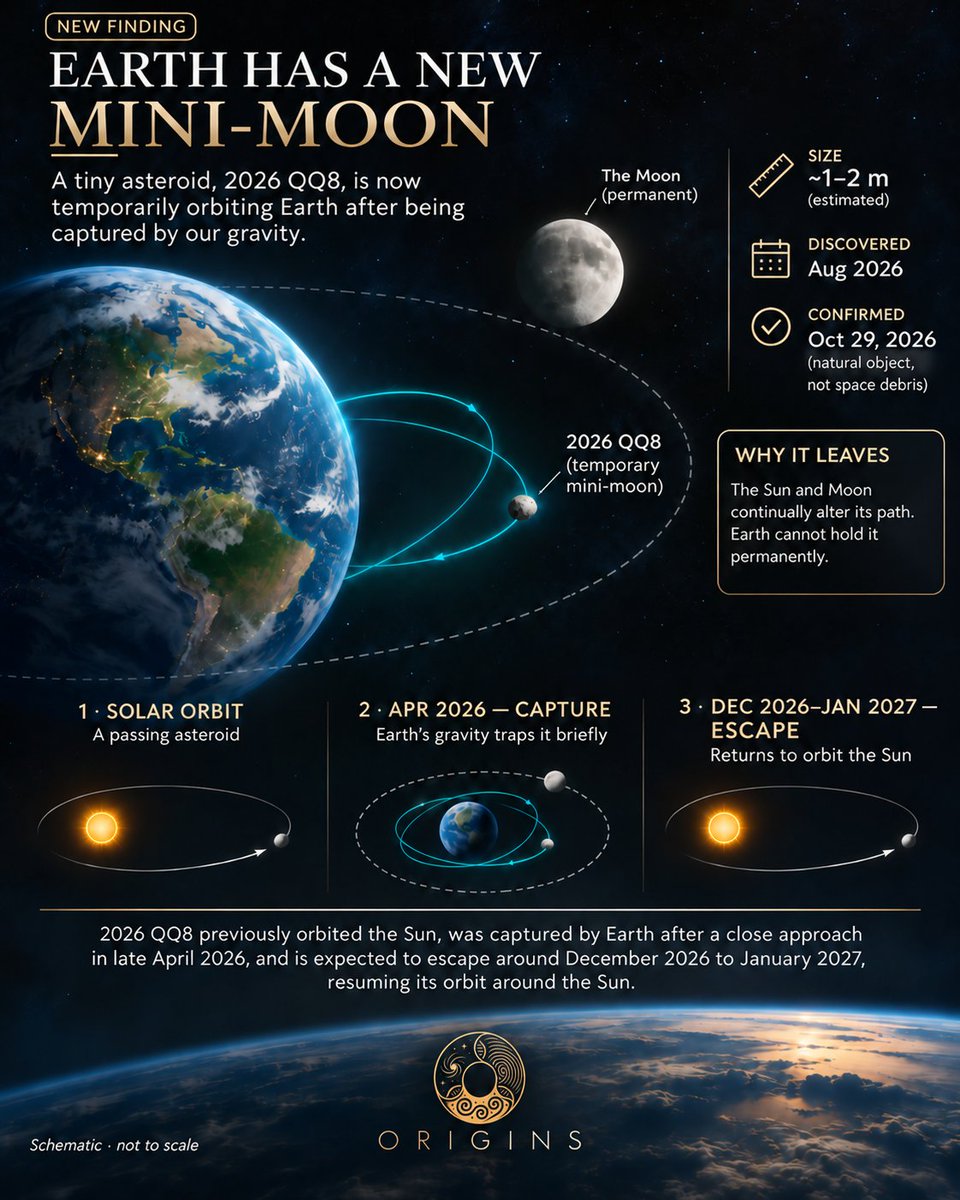
🌍🌙 EARTH HAS A NEW MINI-MOON — BUT NOT FOR LONG
Earth has temporarily captured a tiny asteroid called 2026 QQ8.
☄️ Just ~1–2 metres wide, it was travelling around the Sun when a close encounter with Earth in April 2026 left it temporarily trapped by our planet's gravity.
But why won't it stay?
Unlike our permanent Moon, its orbit is unstable. The gravitational interplay between Earth, the Moon and the Sun means it is expected to escape around December 2026, returning to its journey around the Sun.
🔭 Discovered in August and officially reported by the Minor Planet Center on 29 October, it was initially suspected to be space debris. Further observations supported its natural origin.
And here's the fascinating part: astronomers think Earth may regularly capture tiny objects like this. Most are simply too small and faint to detect.
Our planet may have more temporary companions than we realise.
🦇 THE LARGEST FLYING ANIMAL WAS NOT A BIRD
The biggest animal ever to take to the skies was probably Quetzalcoatlus — a giant pterosaur.
It lived around 68–66 million years ago, in what is now Texas, USA, near the end of the Cretaceous.
Its wingspan reached roughly 10–11 metres, and standing on the ground it may have been about as tall as a giraffe. 🦒
Pterosaurs were not birds — or even dinosaurs. They were a separate branch of flying reptiles that evolved powered flight more than 60 million years before birds, using membrane wings supported by an enormously elongated finger.
Other giant pterosaurs, including Hatzegopteryx and Arambourgiania, reached a similar size range, so the absolute record remains uncertain.
Today, the wandering albatross has the largest wingspan of any living bird: about 3.5 metres. 🕊️
The largest flying animals Earth ever produced belonged to an entirely different evolutionary experiment.