Build a 3D city in three.js that IS this repository. Take your time, be creative.
First mine the repo into JSON: one pass over `git log --no-merges --name-only`
plus a file census. Per directory — lines, files, commits, commits in the last
30 days, top authors. Per person — commits, first/last activity, what they touch.
Then build the city from that data. Every visual property must be a measurement.
Nothing decorative.
Zone it into three areas with genuinely different architecture. Here's the one
rule that matters: DON'T map size to height everywhere.
frontend/UI → SUBURBS. A module is an estate of detached houses.
Lines buy LAND, files buy HOUSES. Two storeys, never more.
backend/core → DOWNTOWN. A module is a setback tower. Lines buy HEIGHT.
tests/infra → THE WORKS. A module is a hangar with a barrel-vault roof.
Lines make it LONGER, not taller.
Make height mean lines-of-code everywhere and all three zones look like the same
city. Spending the measure in a different dimension per zone is the whole trick.
Score every module on how well it's built — has its own docs, test ratio, average
file size, largest file — and let that decide how handsome the building is, in
its zone's vernacular: raw concrete through to landmark. Don't soften it. The
most important module in the repo scoring worst and getting a concrete slab is
the most interesting thing the city will ever tell anyone.
The people are the contributors. Sized by commit count, coloured by the area they
work in, walking routes through the code they've actually touched. Anyone quiet
for a month stands as a bronze statue instead of pretending to still be here.
Bots fly.
Night, dusk and day. Street lamps that actually light the road. Hover for the
numbers, click to inspect, a mode with no UI at all, and a tour that flies the
whole thing.
No build step and no new dependencies: plain ES modules, three.js from a CDN
import map. Then screenshot it and iterate on what you see — most of the design
only becomes obvious once it's rendered.
Following up on Karpathy's LotR world: why stop at books?
I gave Opus 5 the Base44 repository. It built a world you can walk through.
Every building is a module of the monorepo. Its height is the code inside it, its footprint is the file count, and how handsome it looks is how well that code is documented, tested and factored. The people are the contributors, walking the districts they actually commit to.
Think what other worlds you can build from digital assets...
Want to try it on your repo? Short instructions in the reply.
Our users never asked for branches. They don't know the word. But I heard the need all the time:
"I'm in the middle of building a big feature and I need to fix something small in my live app"
"I want to work on a couple of features at the same time"
"I have a big idea but I don't want to risk what already works"
Same need, different words.
So we shipped Branches. Make a copy of your app, experiment, merge it back when you're happy. If it doesn't work out, throw it away.
You could always revert in @Base44 . Now you can also explore.
This is the part I love most about building Base44: taking concepts engineers refined over decades and handing them to people who never heard of them. No new vocabulary to learn. It just works the way you'd expect.
Go build. You won't break anything.
We're building something new at @Base44 , and we're looking for early testers.
Until now, Base44 was for building apps from scratch. We're changing that: soon you'll be able to import an existing project straight from GitHub and keep building it in Base44.
How it works:
Connect your GitHub repo, and our agent explores it and figures out how to run it
It spins up a live dev environment with a working preview, usually in minutes
From there you edit with AI like any Base44 app: describe a change, see it live
No local setup, no docker-compose debugging, no "works on my machine". This is especially useful if you're a PM or designer who wants to work on a real codebase without setting up a dev environment.
We're opening this up to a small group of early users. If you have a project you'd want to try it with, sign up here: https://t.co/gyY1rYoOTm
Would love to hear what kinds of projects you'd bring.
Announcing Base 1’s benchmarks:
After rigorous testing in production, attached below Base 1 results for building beautiful, functional and complex web apps inside @Base44.
we released Base 1, our own model, a few weeks ago. we've been measuring it since.
For app building, there are no standard benchmarks. We A/B test in production with millions of builders, who we believe provide the best benchmark for measuring real value across real-world use cases.
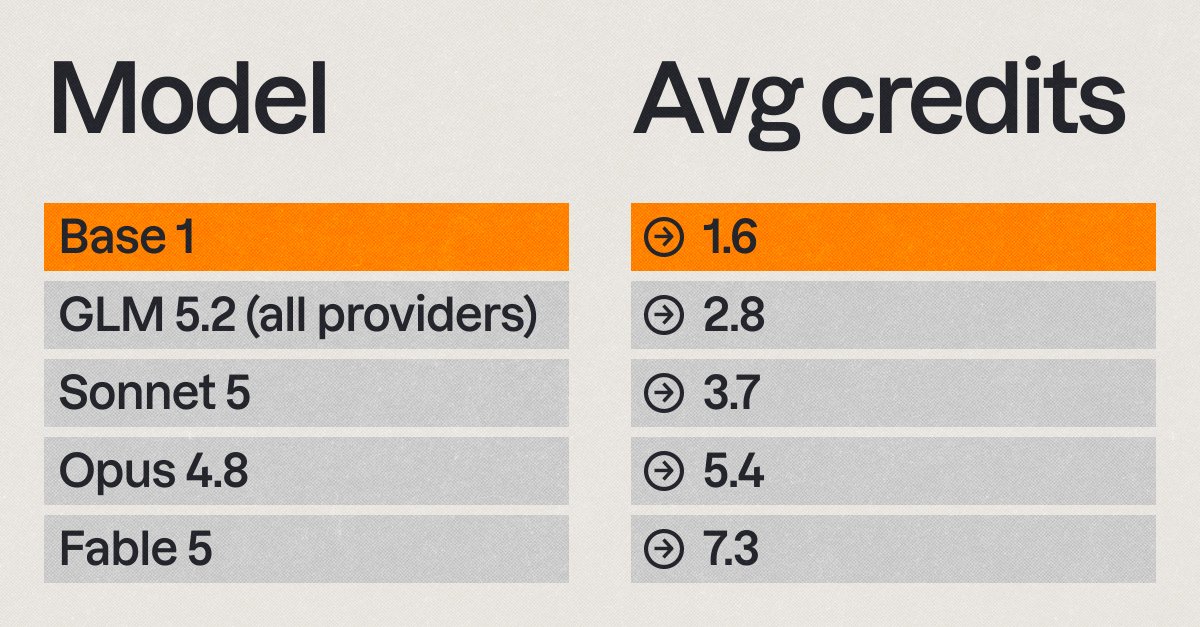
Base 1 came close to Fable, while being 4.5x cheaper.
Base 1 has the lowest frustration of anything we've tested. below Sonnet 5, below Opus 4.8, below Fable 5.
Fable 5 still edges it on success rate, 76.4% to 74.9%.
i'll post the full benchmarks in the comments
We just shipped data version history in @Base44 , and it's a bigger deal than it sounds.
Most platforms give you a daily backup, or a 7-day snapshot if you're lucky.
We store every single change to your app's data. Every create, update, and delete, captured the moment it happens.
Deleted 500 records by accident? Broken automation corrupted your data? Bad impor? Browse your data at any point in time, and restore it.
Not "restore to last night," restore to the exact moment before things went wrong.
The best infrastructure is the kind you never notice. You build, you break things, you click restore, you move on.
Available now in Base for all Elite tier and above.
TLDR: I’ve started a small fund from my Base44 money that’s focused on cancer research and breakthrough therapies.
I’ve invested in 7 incredible companies in the past 4 months and plan to do more as my liquidity allows. Listing my investment thesis below
I welcome anyone like me who has been blessed financially to join me and find ways to finally manage or even end this disease.
Longer -
I honestly believe cancer is humanity's worst enemy.
~40% will be diagnosed with it, and out of which a ~third won’t make it. And numbers are currently not getting dramatically better.
For many it might sound like a statistic
But for some of us who have been there ourselves or had to go through it with a person we love, it’s one of the worst things you can imagine.
I had to go through it with my mom - who passed away 4 months ago and whom I miss and think about every single day since.
This field needs a dramatic push.
The current wave of technology and AI is doing a lot of good in the world,
But cancer therapy is one of those things that are not moving nearly fast enough.
And there’s no good reason for that - AI is creating so much opportunity right now.
Here's my thesis on how things will play out:
For drug development, the bottleneck will shift to
1. Manufacturing
2. Real world testing
"In silico" is going to accelerate incredibly fast. AI is identifying new target proteins and designing new molecules, drastically shortening timelines.
AI will create an abundance / inflation of ideas. It will help design molecules faster than anything historically possible.
This is already happening.
Play with Claude Science or Codex and you'll be surprised at how far you can get with just a few prompts.
We need a better way to *manufacture and test* the 1000s of ideas coming from AI models spitting out potential drug candidates
1. Manufacturing: i.e. how fast can we synthesize a potential drug
Not too far into the future, companies with manufacturing excellence will win over companies with the smartest scientists.
Being able to synthesize a drug candidate fast - together with efficient methods to test efficacy (more on that below), basically means you get more shots at a target hence more chances at succeeding.
This is the same exact lesson the software industry learned about the importance of fast iterations.
Companies like Starget Pharma are leveraging AI heavily to iterate on drug candidates + figured out in-house manufacturing in a way that lets them iterate on drugs almost as fast as if they were a software company iterating on features.
2. Real world testing: i.e. how fast can we get a call on a drug's efficacy.
We need better real-world indicators for drug efficacy than mouse / animal models.
The success rate of animal models -> human clinical trials is less than 8%.
Breaking down this bottleneck will change the entire industry.
Developing an oncology drug and taking it through all clinical trials usually cost >> $ 100m
Thus taking the wrong bet is devastating (but still, happens a lot).
Giving drug development companies the ability to better understand the efficacy and mechanisms of their drugs will change a lot. Esp in the age of abundant drug candidates.
Furthermore - and once those methods proved efficient - Joining forces with regulators to shorten (or even skip) some clinical trials altogether will cut years from the process and save many lives by bringing new drugs to market faster.
CuResponse is pioneering functional testing - taking real cancer biopsies and showing drug efficacy with very high precision. Can be used for precision oncology as well as testing new drugs.
Cellint is providing a fully automated cell-culture R&D platform for companies and researchers.
----
I’d love to see a future where there are “cloud services” for drug development companies.
A company should eventually be able to submit a drug candidate programmatically and receive:
1. The synthesized drug.
2. Testing across cells, tissues, organoids, and tumoroids.
3. Structured results showing what worked, what failed, and why.
4. A recommended next iteration derived from the biological reactions.
I’ve invested in all of the above companies and am searching for additional companies to bring this “cloud services for drug dev” vision to life.
----
Alongside it, I am also investing in direct therapeutic moonshots.
I invested in Baccine, which is developing a bacteria-based cancer immunotherapy platform and deserves an entire separate post.
I’m also a proud LP in Even One Ventures - @sytses ’s fund to fight cancer. Sid and Jacob Stern are an inspiration to me as I’m making my first steps in the field, and I bet their companies will make a massive impact.
And 3 other incredible companies focused on how therapies are delivered - where I’ll elaborate in future posts.
----
I’m still obviously spending most of my time on Base44. Which is a plus for the companies - as we’re able to support them with tools, software, AI agents, etc.
I’m looking for people to join me - invest side by side or help one of the companies.
I don’t have a name for the fund yet, nor an email or a website
I will get to it this weekend and will post it in the comments.
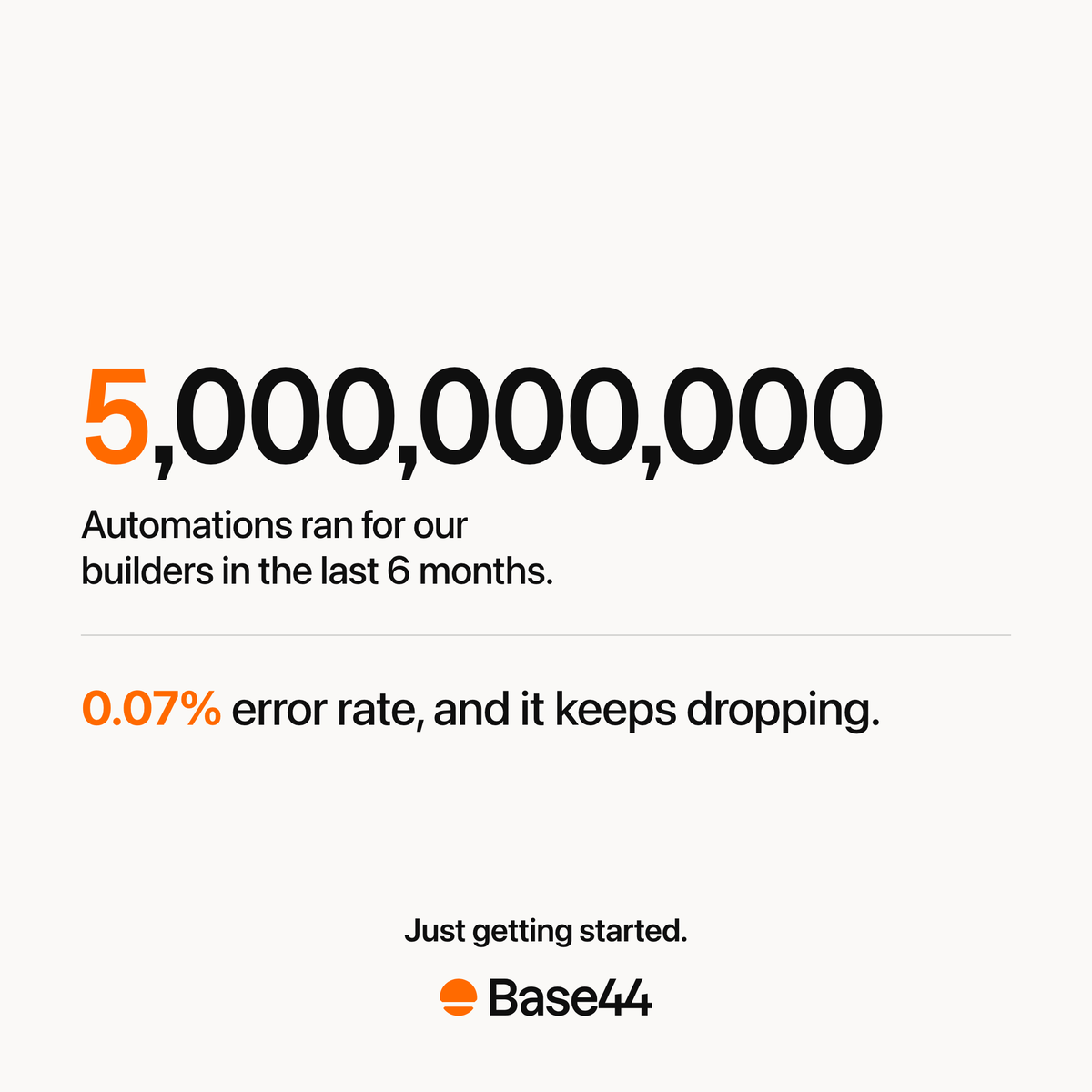
Over the last 6 months, @Base44 ran more than 5,000,000,000 automations for our users.
Five billion.
And with our new workflows capability, we're at a 0.07% error rate, dropping every single day.
A few thoughts on how we got here:
David Vaks from our team built an engineering wonder. making automations reliable at this scale isn't a feature, it's a distributed-systems problem most companies never have to face. He faced it head on.
This is what Base44 is about. we don't pick the easy problems - we go after the hardest engineering challenges, because that's what it takes to let anyone build real software.
And that's the bigger point: vibe coding isn't just the easiest way to build software anymore. It's becoming the most holistic one. your app, your data, your automations, your workflows, all in one place, built by describing what you want.
5 billion automations in. We're just getting started.
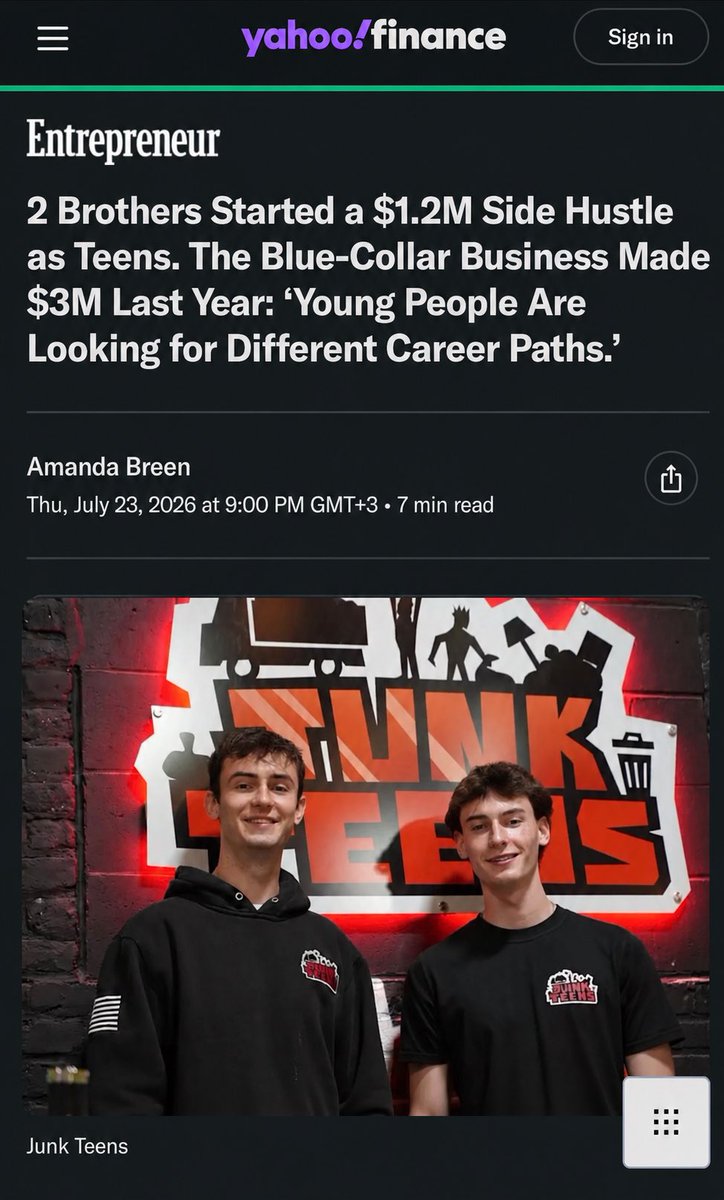
Two teenagers built a $3M junk removal business. the app running the whole thing was built by another teenager on their team, on @base44.
this is exactly what i built base44 for. the barrier was never the idea, it was everything between the idea and working software. developers, funding, months of building. vibe coding removes all of it.
coding isn't the question anymore. only what you'll build is.
We just shipped a full partner stack in @Base44 .
Thousands of people already run real client businesses on Base44. They've been building fast and shipping great work. Now the platform actually works for how they operate.
What's live:
Client messages. Every client request lands in one inbox inside Base44. Reply where the work happens. Link an app to a client straight from the conversation.
Partner profiles. Your storefront on Base44. Showcase your apps, set your rates and response time, collect reviews.
Partner channels. All Base44 partners in one place, inside the platform. Swap what works, team up on bigger builds.
App ownership transfer. Project done? Hand the app to your client for good. Data, media, connected services included. It runs on their workspace and their plan.
Unified workspace view. Every app you own, collaborate on, or administer. One list, across all client workspaces.
Credit delegation. You choose which workspace pays. Work in a client's workspace on your own credits, or theirs.
Partners were already winning on Base44. We just gave them a home field.
Great work by the team - Raphael, Amit, Elior and Kris!
@karpathy The underrated part is the echo. Hearing your own mess played back clean is half the value. It's rubber duck debugging where the duck talks back.
$10,000 to the developer who builds the best thing on base44's backend this week.
our BaaS spins up a real production backend, with your database, auth and APIs, from a single command. bring any frontend and point it at a live backend in minutes.
the challenge is simple: spin one up and build whatever you want on top of it. the deepest, most creative builds win, and i'll personally feature the winner.
if you live in Cursor or Claude Code, or you're tired of wiring up infrastructure by hand, this one's for you. runs July 21 to 28
npx base44 create .
Base44 now ships with native workflow automations. Turn a single prompt into a multi-step workflow, right within your app's dashboard.
Client onboarding, lead follow-up, abandoned cart sequence - and because it runs on your app's context, it suggests flows that actually fit your business.
Link for more info in the comments!
@MaorShlomo The shift underneath all this: software used to make its decisions at write time. Every path coded in advance. Agents make decisions at run time. That's not a feature. It's a different kind of software.
A month ago I sat down with @claudeai to talk about what Claude Fable 5 changed for us.
The real shift isn't one task or one feature. It's confidence. Engineers and PMs now take on bets we used to consider too risky.
And our users do the same on @Base44 .
The story is now live on Anthropic's blog, video included. Link in comments.
If you've hit a wall you couldn't get past, try Base44 with Fable now.