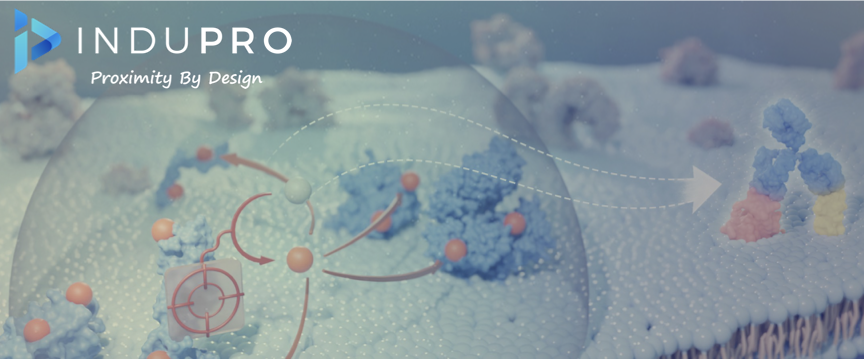
What if tumor targeting selectivity was driven not just by expression, but by proximity?
We introduce TAPAs—Tumor-Associated Proximity Antigens—spatially co-enriched with TAAs.
Learn more on TAPAs + our lead program IDP-001 at #AACR2025
Posters: 2933, 4244, 4255, 5445, 6073
Targeting two proteins on the same cell surface via bispecific antibodies is enabling exciting opportunities for novel modes of therapeutic action in the clinic. In this review we highlight their growing impact from early discovery to late clinical stage.
https://t.co/SSYxxsTTIu
Super excited to share this announcement on the launch of InduPro! “We leverage inherent and induced proximity to modulate disease biology towards next-generation therapeutics”
https://t.co/DPzaHkQ1UC
Former Merck scientists have raised $85M to map and drug protein interactions in cancer and autoimmune disease. One goal is to find new pairs of proteins that can be hit simultaneously for more targeted drugs. Read more in my exclusive for @endpts
https://t.co/RW0D4w1KPb
Our final version of our manuscript now out in @ACSCatalysis! Here we leveraged tissue-penetrating, deep red light-mediated photoredox catalysis for peptide stapling and protein labeling in patient-derived tissue systems.
https://t.co/AjH94VfvqG
Congratulations to @TaylorOHope on her final PhD project being accepted in @ChemicalScience !
Thank you to @OslundRob@FadNiyi for getting us interested in photochemical protein tagging !
https://t.co/y45UD7m1eG
Check out our latest article in @ACSCatalysis!
We have developed a general, dual-catalytic method that promotes the decarboxylative cross-coupling of previously unexplored α-amino acids with aryl bromides. #ACSCatalysis#BMSChemistry
https://t.co/PUP6wn9WuN
Pre-print is now officially out.
https://t.co/7zYB4WCvn0
Thank you @OrgBiomolChem for publishing this work and to the many folks involved for getting this to the finish line!
https://t.co/QK3WWCEX2i
Protein communities that assemble between physically interacting cells play important signaling roles. In this preprint, we report a Flavin-dependent proteomic-platform to identify these synaptic protein environments.
https://t.co/nH0rDiIjh4
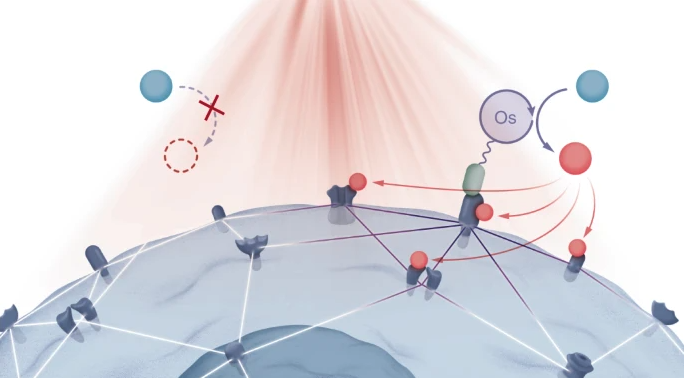
Our pre-print describing a near-infrared light-based photocatalytic labeling technology with applications in peptide stapling and profiling of normal and patient-derived tumor tissue.
https://t.co/VpDqJisk7p
Happy to share that this preprint from @RovisGroup has found a home at @NatureChemistry
https://t.co/wdlAiCCnHP
A start of much more to come in this exciting area!
Excited to see our pre-print officially out.
Thank you
@NatureChemistry
for publishing this work!
Shout-out to
@yizheng_art
for the artwork including this awesome TOC graphic!
https://t.co/1RDUBp0v0l
Great collaborative effort with the @RovisGroup and @malayoman on a novel red light photocatalyst-mediated technology for targeted profiling of tumor antigens. https://t.co/1TDFIvAObs
It’s been a long time coming! Our red-light photoproximity labeling method is on @NatureChemistry! We can form triplet nitrenes using low energy light, enabling its use in targeted labeling of local protein environments on live cells.
https://t.co/0OTYEQVCF0
We often compare this to the goldilocks principle where the reactive intermediate half-life and rate of generation combine to play keys roles in profiling protein neighborhoods.
Protein communities that assemble between physically interacting cells play important signaling roles. In this preprint, we report a Flavin-dependent proteomic-platform to identify these synaptic protein environments.
https://t.co/nH0rDiIjh4
On the other end, using a peroxidase-based method we observed promiscuous labeling on both interacting cells leading to enrichment of 100s of proteins. While RFT and HRP both rely on phenoxy radicals, rate of generation is likely responsible for the different labeling patterns.