💊Accelerating Medicinal Chemistry💊: A C(sp3)-rich Fragment Toolbox for Redox-Neutral Cross-Coupling, appearing today in @chemrxiv: https://t.co/KRpQG8J3iY
A great collaboration with brilliant drug hunters at BMS, Pfizer, and Biogen.
Quick summary: A new toolbox of 15 sulfonyl hydrazide reagents (some of which are already commercial) enables redox-neutral, nickel-catalyzed radical cross-coupling to attach small C(sp3)-rich fragments like methyl and cyclopropyl to (hetero)arenes, streamlining the hit-to-lead phase of drug discovery. These stable, easy-to-synthesize reagents require no additional oxidants, reductants, or costly catalysts, offering mild, dump-and-stir conditions and broad substrate compatibility across over 60 (hetero)aryl halides. Compared to traditional methods like Suzuki or Kumada couplings or radical couplings wedded to redox, this unified approach significantly improves yields and simplifies synthesis, accelerating analog optimization and late-stage functionalization of drug-like molecules.
@andrew_barrow Thank you very much! I must say though, it was a true team effort and wouldn't have been possible without @Jiawei1024, Jiayan,
@JetTsien, Haoxiang, and our collaborators at BMS: Ben, David, @oderinde_m, Michael, and Max!
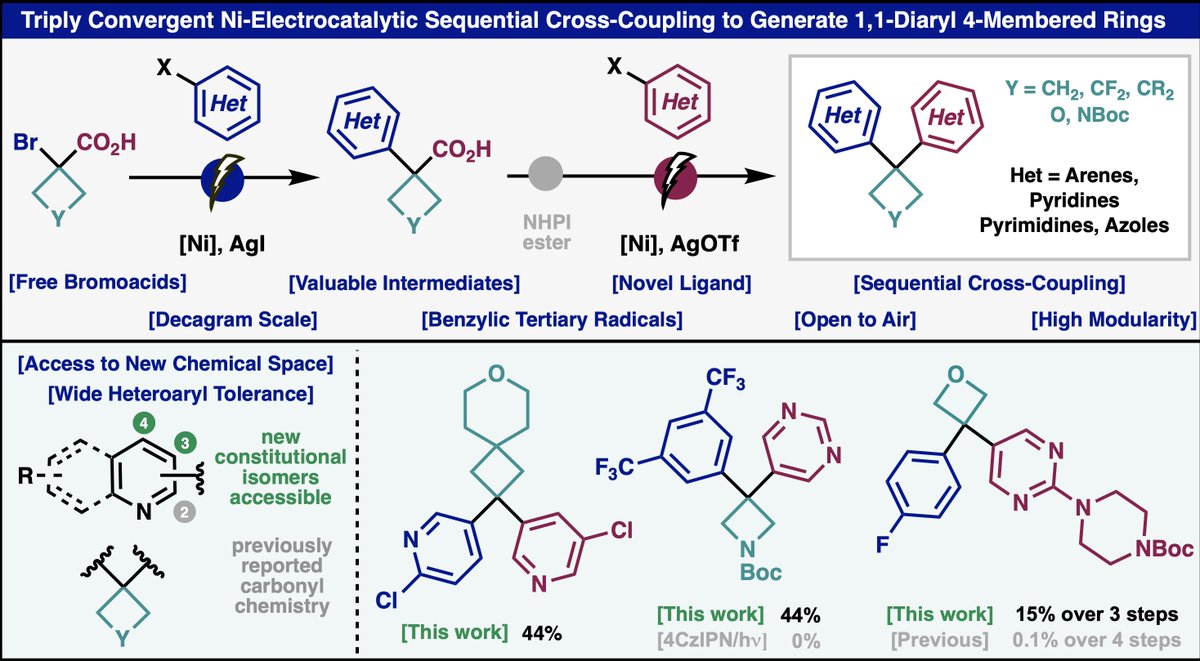
Triply Convergent Ni-Electrocatalytic Assembly of 1,1-diaryl Cyclobutanes, Azetidines, and Oxetanes, appearing today in @ChemRxiv :https://t.co/uQ7VjOHWpu
Increasingly complex, three-dimensional leads for drug discovery are testing the limits of modern organic synthesis. In this context, the need for new methods to access gem-diarylated cyclobutanes, azetidines, and oxetanes is apparent. The present study outlines a modular, scalable, chemoselective approach to solve this problem using simple alpha-bromoacids and aryl halides as intuitive starting materials. As demonstrated herein, a sequential series of Ni- electrocatalytic cross-couplings can be enlisted to enable rapid access to such structures, many of which have never been accessible before, without recourse to time-consuming polar bond disconnections that are inherently limiting in terms of accessible chemical space. The scalability of this new reaction sequence is demonstrated, alongside direct applications to known patented structures. A simple user guide is also presented to accelerate adoption of this strategy in medicinal chemistry.
A super fun collaboration with BMS, Pfizer, Biogen, Enamine, and Abbvie.
I am thrilled to share our latest article in @ACSCatalysis where we unveiled the long awaited Diastereoselectivity Aspects of Ni-Metallaphotoredox Decarboxylative Cross-Coupling. Shout out to @rajchemraj#BMSChemistry. @ScienceAtBMS https://t.co/RZesRNY7q5
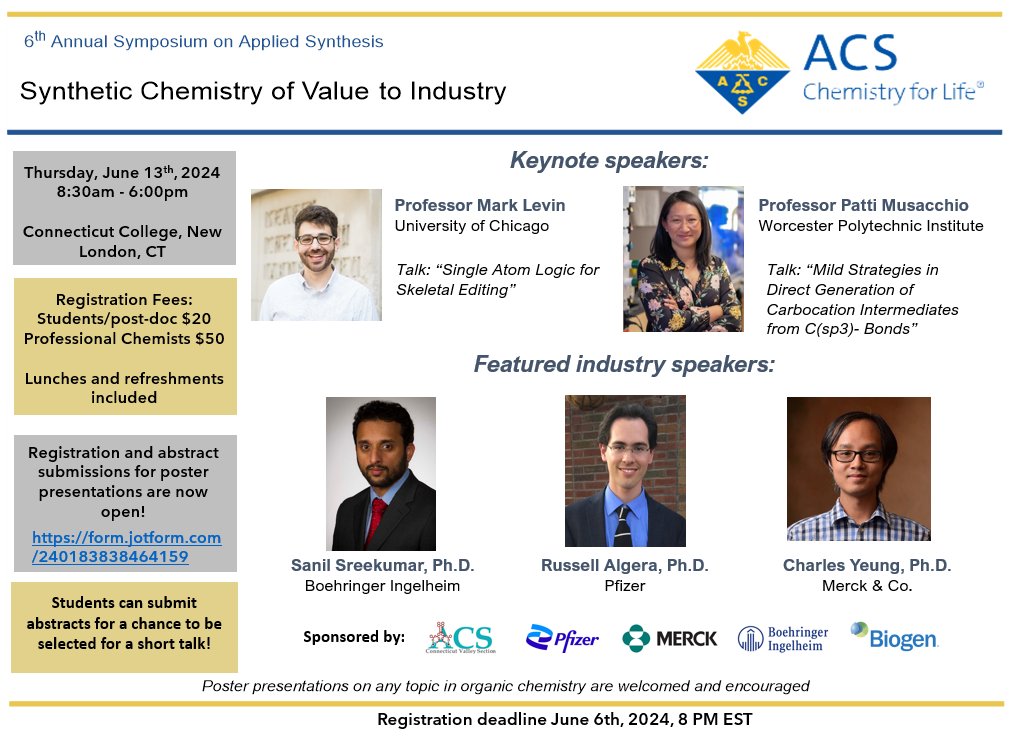
Registration is open now! June 13 at Conn College New London CT #PfizerChemistry#MerckChemistry@boehringerus w/ @ACS_CVS are hosting the 6th annual Symposium on Applied Synthesis featuring
@patti_zhang @LevinChem Slots for student talks available
Reg: https://t.co/DxF4PBHd0K
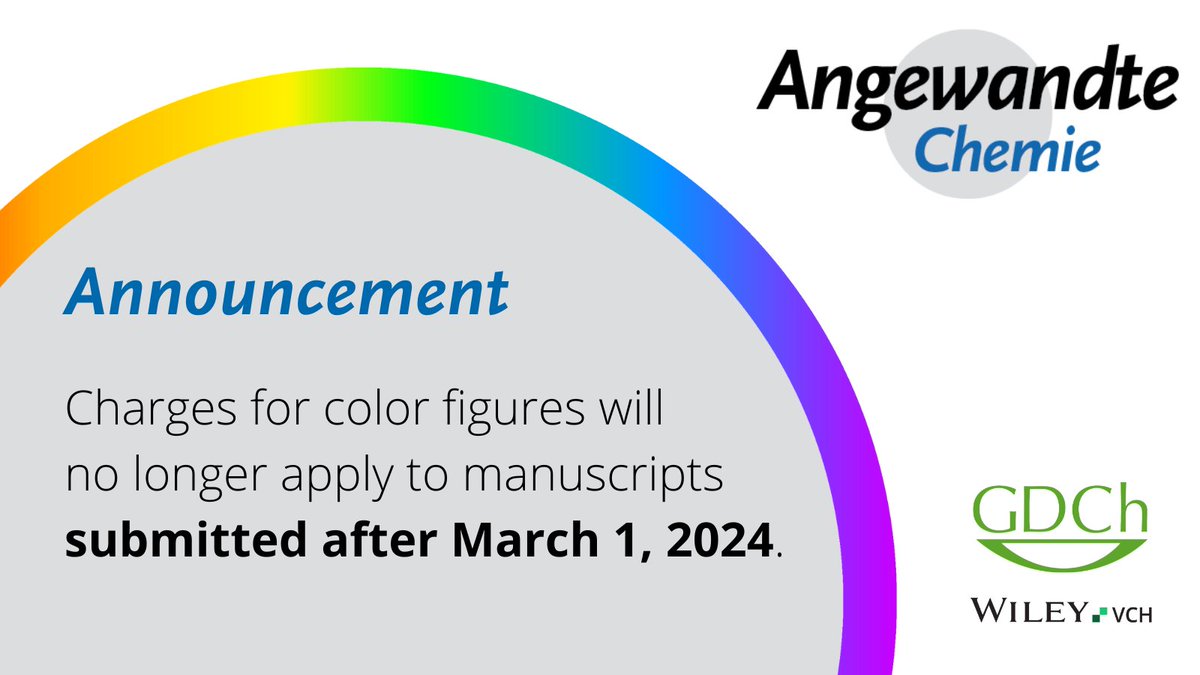
Charges for color figures will no longer apply to manuscripts submitted after March 1, 2024.
For your next submission, we invite you to check out the Viewpoint Article "Coloring Chemistry—How Mindful Color Choices Improve Chemical Communication" (https://t.co/ARhv9UnLtb).
very happy to share this work with the community, but even happier about the amazing feedback from our colleagues @bmsnews who are already using this chemistry! Thanks a million to everyone who helped solving this puzzle with lightning speed. @Aron_Peter_@oderinde_m@chemistte
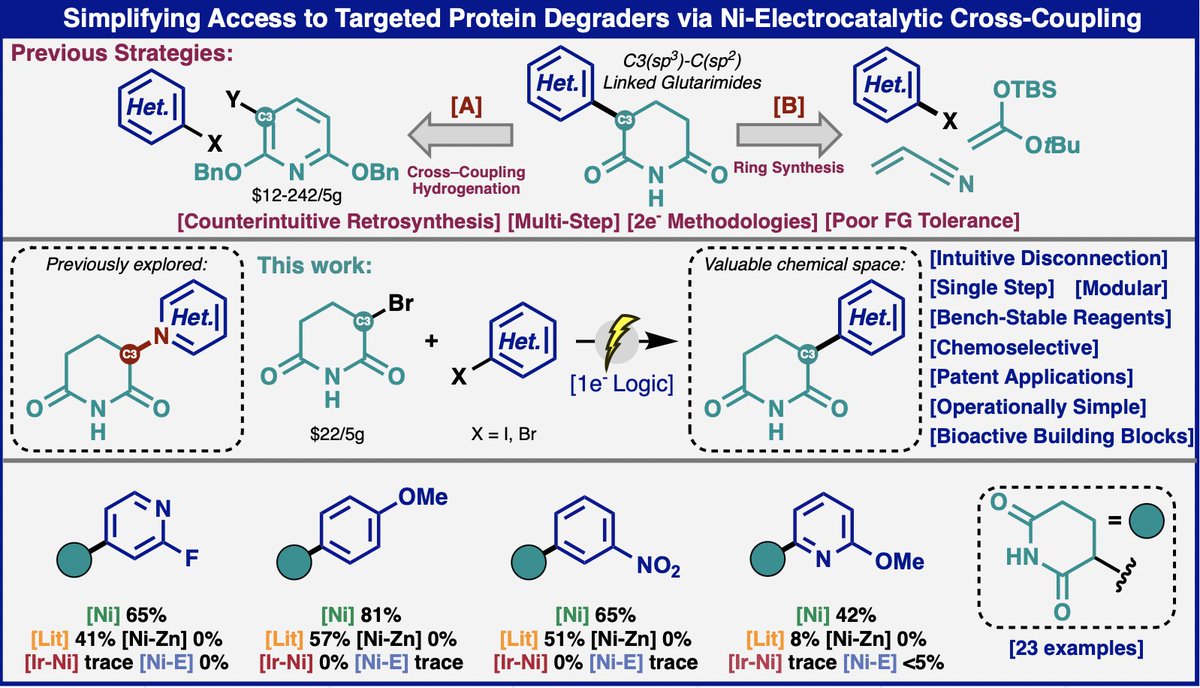
Degrade proteins, not your work schedule! A new method appearing today @ChemRxiv (https://t.co/DtfoUJKEsc) simplifies access to molecular glues (like PROTACS) to save medicinal chemists valuable time. One-step access from cheap commercial materials, a trivial experimental setup, and superb chemoselectivity enabled by Ni-electrocatalysis. Another fun collaboration with BMS.
Now this I like...a lot
chiral amino alcohols fly under the radar but as linkers or substrate for functionalization they are key fragment in med chem - Really nice from @BaranLabReads@oderinde_m and more #ChemCollabs#BMSChemistry