The AI Revolution in Cancer:
Grab your musket & don't wait for a silver bullet.
Ask any AI frontier lab leader what AI will do for humanity and "cure cancer" tops every list.
The image is always the same: miracle drugs. That's not how it's actually playing out.
...
A Nature Medicine study found general-purpose LLMs are now outperforming dedicated medical AI products on physician-reviewed clinical tasks.
The authors compared OpenEvidence and UpToDate Expert AI with GPT-5.2, Gemini 3.1 Pro, and Claude Opus 4.6 on medical exam questions, clinician-style answers, and real questions doctors asked during care.
In 100 de-identified physician questions from live clinical use, blinded clinicians again preferred the frontier models, especially on completeness and clarity,
Nearly 90% of large employers now cite cancer as one of their top three cost drivers.
In a new https://t.co/LjmX0zZl86 op ed, PICI CEO @DrKarenKnudsen and @Color CEO @othman discuss what they call“the triple wave” driving this trend: rising cancer diagnoses among younger populations, increased complex and costly treatments, and a growing survivor workforce requiring long-term treatment.
In the piece, they outline steps employers can take to move from reactive management to proactive cancer care strategies.
Read the full piece here: https://t.co/iznGx5EDBg
Agents should have access to every system. Introducing Integuru: generate fast, reliable APIs for any platform⚡️
API calls complete in ~3 seconds with 99.9%+ success.
No browsers or RPA. No data caching needed. With auth support.
@InteguruAI is free to use. Thread below.
“can i start you off with an appetizer, maybe 30 tortillas?”
“god no, i can’t eat that many tortillas!”
“how about if cut them up into triangles, fry them in seed oil, & serve them with some salsa?”
“omg that sounds delightful”.
I wonder if the apparent weakness of AI not being able to identify interesting research directions is a false equivalency more than a weakness.
When we say that humans identify interesting research directions, we are talking about the collective and ignore the fact that most research directions or ideas we individually come up with are not that great. As a collective, between all the shots on goal, a few are legitimately interesting and when those happen, the collective knows how to recognize it (sometimes).
The more apt comparison would be to see if many AI systems in parallel (with a variety of temperature settings, training datasets, etc) would (a) be able to explore a space and (b) identify novel & interesting findings.
It could be that many of the lack of creativity / taste types of critiques are less fundamental capability problems but rather the types of experiments we run.
@vintweeta Totally. I think this and downstream effects will be much larger than any impact on discovery (from a lives and money saved standpoint).
I just posted a piece on this related to cancer:
https://t.co/SlU95zJy41
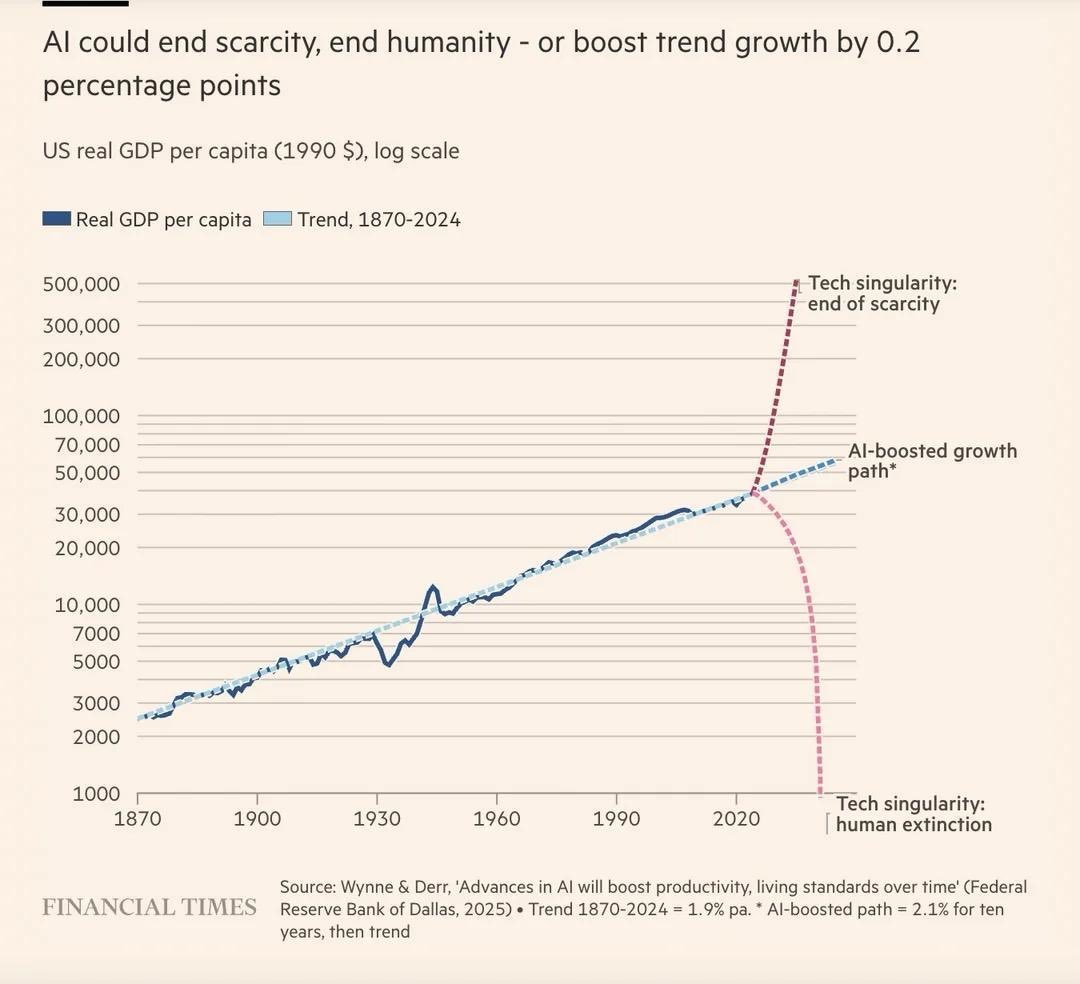
Probably the funniest graph ever published by the FT: our 3 possible futures are either 1) infinite wealth and abundance, 2) human extinction or 3) 0.2% faster GDP growth 🤣