Sophont CEO @iScienceLuvr explains how Holon-S1 can extract insights that usually require expensive molecular tests from an ordinary cancer biopsy slide:
"Why is it so hard to cure cancer? Because cancer’s a very diverse disease. Even though two people may have the same exact diagnosis, the underlying biology can be quite different."
"There are various tools for doing this, molecular tests and so on, but a lot of these tools can be quite expensive and time-consuming. Can we extract a lot of those similar insights directly from a tissue slide?"
"Whenever a cancer patient has a solid tumor, the gold standard is you take a biopsy, put it on a slide, under the microscope, and a doctor is analyzing that."
"We can take that same exact slide and with AI extract a lot more information about what’s happening at the molecular level, what genes are being expressed, and what makes that tumor unique for that patient."
@SophontAI
You're going to hear more quotes like this at the frontier. It's my favorite kind of quote:
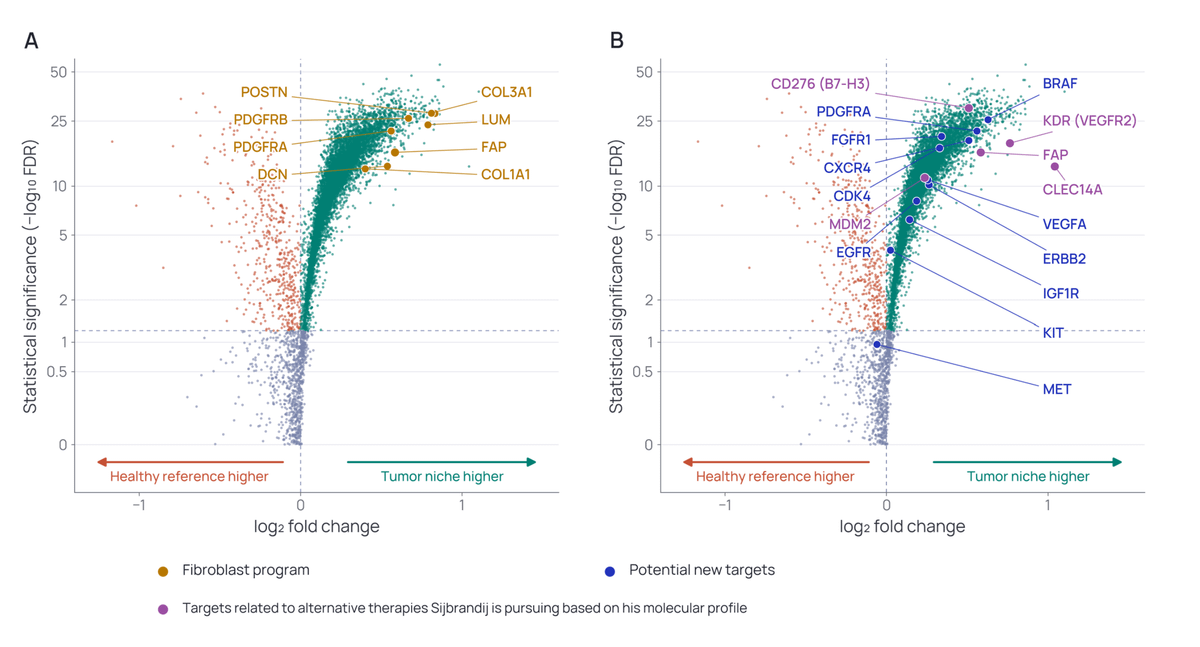
"we ran Holon-S1 on an osteosarcoma patient's public slides. It was never trained on osteosarcoma."
https://t.co/IQKf4r3CWR
In a retrospective N-of-1 case study, we ran Holon-S1 on an osteosarcoma patient's public slides. It was never trained on osteosarcoma.
We observed that fibroblast-associated genes were overexpressed, which was previously observed by this patient's medical team using sophisticated molecular tests and was targeted for treatment.
Congrats @iScienceLuvr and @humanscotti on this insane launch!
Every cancer is, by definition, unique: to understand intratumoral heterogeneity requires genetic expression, biomarkers (that will correlate to therapeutic response), and a patient's unique phenotype.
Holon-S1 from @SophontAI can predict these characteristics, at the per patient level: exposing novel biomarkers for their initial targets -- breast cancer and colon cancer -- too.
Read below.
https://t.co/5bbDUa9p1K
Cancer patients with the same diagnosis often have very different tumor biology.
Molecular testing can reveal underlying differences, but that's slow and expensive.
Introducing Holon-S1, our platform to predict genes and biomarkers from routine pathology slides.
• beats two other models at predicting spatial gene activity in a controlled comparison
• has identified potentially novel biomarkers in breast cancer and colon cancer
• evaluated across 16 organ types and more than 15 scanners, using slides from both formalin-fixed, paraffin-embedded and fresh-frozen tissue.
We believe Holon-S1 has the potential to help researchers find new biomarkers in slides they already have, discover treatment targets, and bring more personalized cancer care within reach!
Ahead of launch, @robocurve evaluated Dream-1 independently. Result: a new Pareto frontier for robot control. 16x cheaper, 1.7x faster, and better performance (59 vs. 48 on RoboDojo-RC Tier 1) than the previous best alternative.
LLMs can plan. Robots still need a cheap, fast, and general System 1 to act.
1/ We discovered something totally unexpected about the neural structure of consciousness that overturns decades of thinking on its biological basis and brings us significantly closer to the recipe for generating conscious awareness.
New preprint: https://t.co/K8BwiHXvXg (led by @HesseJanis, with @FrankLanfranchi, @_conor_mcgrory, @Yuelin_Shi, and @EngelTatiana)
One sentence macro model: On the way out the door, every farmer's wife says to every farmer, "the weather's looking bad so don't buy as much at the market this week, but also don't sell our crops for less than the usual price."
we've seen driverless cars, industrious arms and humanoids, and even athletic robots.
now, welcome to the world of fun character robots - bringing animatronics into the AI era!
go Hugo and the @dynamicreatures team 🧸
When your consumer agent creates a virtual card on their own BIN to transact on your behalf, consumer won't get the credit card rewards.
Gotta imagine there will be some blowback there.
interpretability might be the most important scientific problem in the world right now, as I don't think we can solve alignment if we don't know what we're building. I think I have good news about it. I co-authored early work in mechanistic interpretability at OpenAI and came away pessimistic, because neural networks appeared to fold into arbitrary tangled knots. years later, I started openai's first large-scale automated interpretability project, finding about 2% of neurons legible with the primitive tools we had
with modern agentic tools and a much closer look, the picture looks totally different. the vast majority in models up to trillions of parameters are legible, and their circuits beautiful. many famous examples of tangled neurons turned out to be misunderstood. The roadblocks I expected mostly aren't there. I now think ambitious interpretability will be solved by the time we need it most, and possibly quite soon, as automated scientists keep improving. it may be a bitter lesson for interpretability: the simple thing, at absurd scale, works
https://t.co/zHij5zwKGT
We’re grateful to @TIME for naming Stream Ring one of the Best Inventions of 2026 in the Wearable Technology category
Meaningful moment for our small team in New York, and everyone who’s believed in what we’re building. This milestone is yours, too