Robots need data that LLMs hadn’t required: perceptual and physical actions, and their consequences, at scale and then verified across various embodied agents.
The team @MeckaAI has tackled this data and deployment problem assuming a multimodal deep learning approach would emerge beyond just VLAs. Since then, the resulting customer growth has been simply incredible.
We’re excited at @kindredventures to double down with @joshavata@jasontheutopian and team in this latest round, and support them on the next chapter of growth! 🦾🦾🦾
Today @MeckaAI is announcing a $60M Series B from @sequoia to accelerate the advent of general purpose robotics
This brings our total funding to over $120M to become the data and deployment layer for physical AI
Read more below 🧵
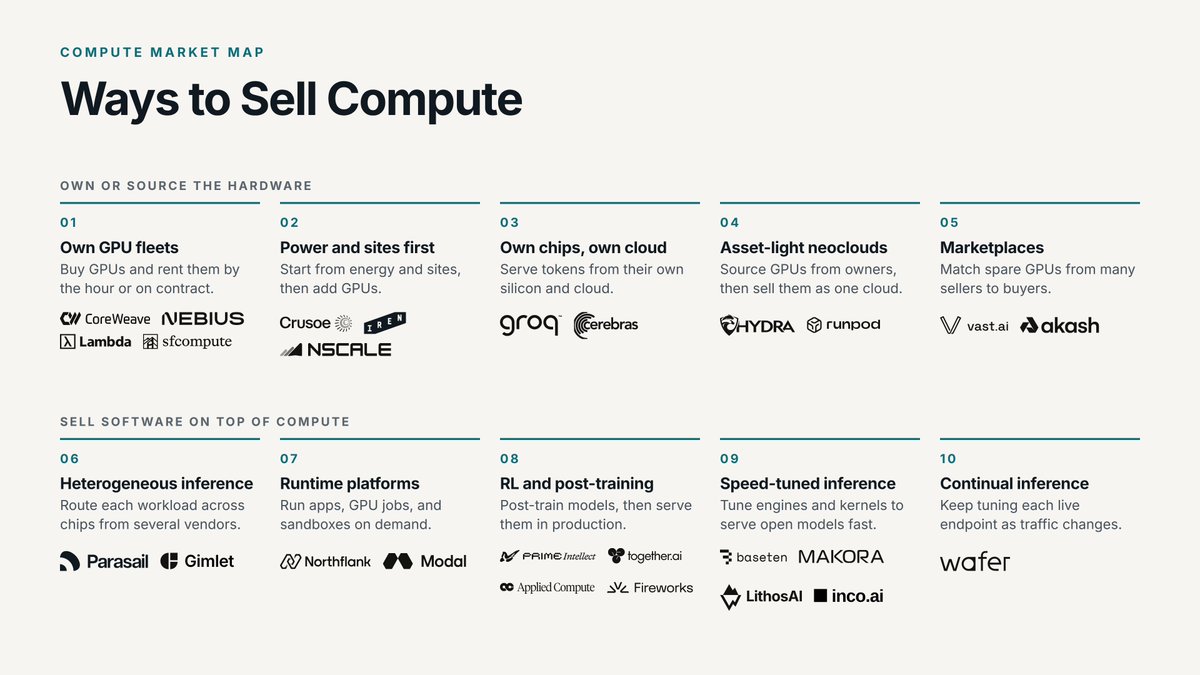
The hardware half of this map is moving up the stack, from GPU-hours to tokens. In its ClusterMAX GPU cloud ratings, @SemiAnalysis_ says every neocloud needs a per-token endpoints business, and that open-source token serving can make $100M+ per MW-year.
we’re fully aware today that software as we knew it is getting fully disrupted and generated by AI.
now, we are witnessing an AI system rapidly designing and verifying a novel AI accelerator chip, with just two engineers steering it.
proud of @axi_master@aadityasubedi_ and the @architectlabs team on this first breakthrough milestone!
Yesterday, @stevejang shared his thoughts on @CNBC regarding AI’s future roadmap around memory, robotics, agents, and open weights models.
The hot topic of the morning: @SKhynix reported record Q2 results, then fell more than 9%. The gap between the print and the reaction raises a larger question: is the market applying an old memory-cycle framework to a new AI infrastructure layer?
Q2 revenue reached USD $55.0 billion, up an eye-popping 257% year over year. Operating profit rose to USD $42.0 billion, up incredibly 557%, with a company-record operating margin of 76%. But both missed consensus estimates. As our partner Steve Jang told @BeckyQuick on @SquawkCNBC, “the company has incredible fundamentals, record-breaking numbers, and long term HBM technical defensibility…but expectations were just very high.”
Steve’s larger argument begins with high-bandwidth memory, or HBM. For two decades, investors largely treated memory as a cyclical commodity. Now, Steve argues, HBM is moving into a new role, “sitting side-by-side with GPUs and other advanced logic processors” as a core layer of AI compute.
Demand now spans model training, inference, long-context agents, robotics, and autonomous systems. Steve pointed to deep-research products like @perplexity_ai’s Computer agent platform: as agents hold and reason across more context, their memory bandwidth and capacity needs grow. Robotaxis like @nuro+@Uber and @Waymo will need onboard edge compute including HBMs. He estimates HBM demand could increase 10x over the next 3 to 4 years.
SK hynix enters that buildout from a strong position. Long-term supply agreements with major customers provide demand visibility. Stacked-die architecture, advanced packaging, yield, and customer qualification create a steep technical and manufacturing climb. Steve estimates that a new entrant could need three to five years to significantly enter the HBM4e class.
That supports a credible near-term moat while leaving the harder question open: how today’s 76% operating margin evolves as supply expands over the next two to three years. One thing is clear: demand and importance of high bandwidth memory is still wildly underestimated.
The second half of the conversation moved from compute capacity to operational control. During the recent @OpenAI and @huggingface security incident, commercial frontier-model APIs blocked the attack commands and exploit payloads contained in forensic logs. Hugging Face instead ran GLM 5.2, an open-weight model, on its own infrastructure to analyze more than 17,000 recorded events without sending incident data or credentials outside its environment.
Steve’s takeaway is practical. As autonomous agents grow more capable, defenders need access to models they can host and direct when hosted guardrails block legitimate forensic work.
The next phase of AI will depend on both: enough memory bandwidth alongside GPUs and other accelerators to scale increasingly capable systems, and enough model ownership and control to deploy and defend them efficiently and safely.
Full conversation below 👇
Excited to share @KindredVentures led Hydra Host’s $100m Series A alongside @NVIDIA, with participation from @ARKInvest, @foundersfund, @Comcast, @scottmcnealy and Magnetar. Hydra Host is an AI compute platform which operates an asset-light and distributed neocloud, enabling the long fat tail of AI datacenters around the world to provide GPU compute to offtake customers anywhere.
In the last year, one name has emerged as the cutting edge flexible GPU compute provider behind the scene of many of the most interesting AI-native platforms: @get_hydrahost.
Hydra not only solves a key software technology unlock for AI infra at the datacenter level, but also helps solve a larger macro issue of GPU supply and demand in a compute-bound world today.
Outside of energy and social politics, what are the current solvable problems in AI infra?
- the total-cost-of-ownership for the datacenter operator
- the real-world build-out and utilization risks of new powered shells and older data center site conversions.
- the reliability, size, and price equation for demand offtake customers who are hungry for GPUs as a service.
Today, using a novel combination of an OS software network on bare metal and a dynamic marketplace of compute that can handle short term to long term commitments for raw GPU time, Hydra serves as a distributed neocloud but with zero assets.
Instead of a high-capex anchored approach, the company is using a rapid scaling strategy and has accumulated a coverage network of 60 datacenters (and growing) across 5 continents and orchestrates raw GPUs-as-a-service in realtime to the benefit of most of the major inference platforms, many frontier labs, spot/on-demand marketplaces/exchanges, and enterprises.
Hydra also procures, finances, and deploys new AI factories with partners such as @Nvidia and @Dell at greenfield or brownfield sites for telcos, REITs, asset managers, other neoclouds, and now sovereign nations - adding to their growing GPU capacity network of AI datacenters. In just two year since launch, the company currently has over $2B of compute booked by its customers.
As demand continues to far exceed compute supply at increasing speed, we’re fired up about the GPU capacity unlock and the AI factory deployment Hydra enables, and that in turn, AI-native companies and enterprises can benefit from as they develop models or use inference at massive scale.
Big congrats to @aginnt and the entire Hydra team!
we are excited to continue supporting @UseCorgi with their Series B as they work to transform insurance.
Insurance is 12% of GDP, the largest words-based industry on earth, and incredibly hard to start-up in, given regulatory and operating complexity.