AI DJ for your own music, audio and video.
For Students, Music lovers, AI music creators.
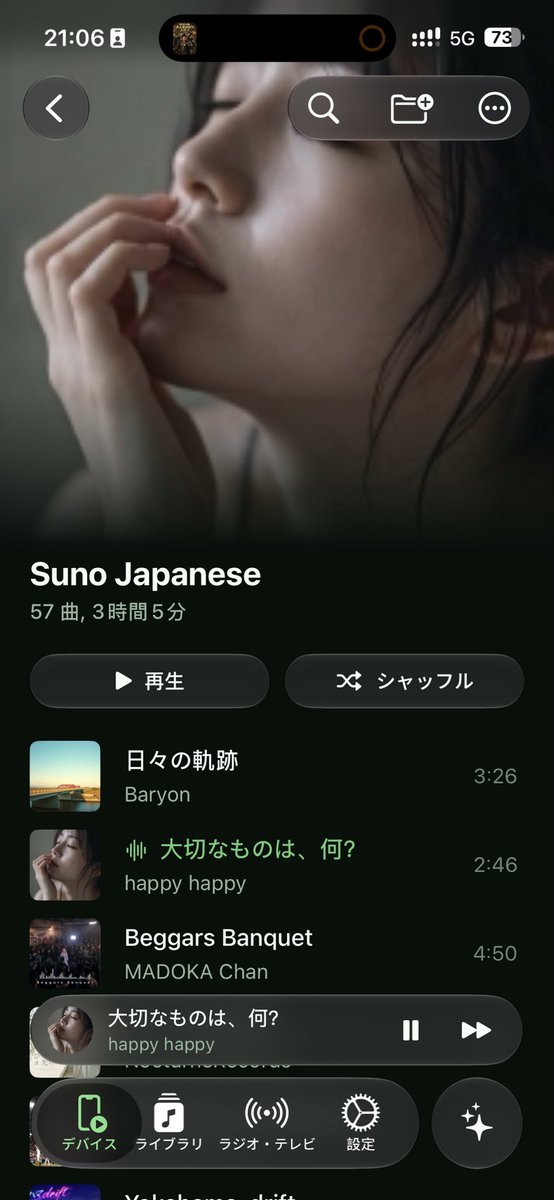
Free playback your Suno songs offline.
No ads · No account needed
SwiftAgent 1.0.0-rc.3 is out — and today we’re also open-sourcing OtohaChat, a real app built on top of it.
We’ve been exploring a simple question:
What does an AI agent runtime look like if Swift is the foundation — not just the UI language?
🧵
SwiftAgent is a provider-neutral AI harness written in Swift 6.4.
Its job is not to be another giant “AI framework.”
It provides the execution layer:
Agent → Session → Run → Model → Tool → Result → Journal
with cancellation, durable recovery, model switching, tool receipts, usage accounting, and explicit host-owned permissions.
RC3 supports OpenAI Responses, Anthropic, DeepSeek, local / compatible Responses APIs, Apple Foundation Models, and an experimental Private Cloud Compute path.
The important part is that providers do not own your tools.
Your app does.
The model can propose an action, but authorization, execution, evidence, receipts, persistence, and recovery remain under the Host’s control.
That’s the design principle behind SwiftAgent.
To show what this looks like outside of tests, we open-sourced OtohaChat:
https://t.co/siDPkicRsM
It’s a native SwiftUI chat app using SwiftAgent RC3, with:
• Apple Foundation Models
• Apple Private Cloud Compute
• OpenAI / Anthropic / DeepSeek
• local models and compatible gateways
• model switching
• reasoning controls
• durable conversations
• host tools
• .agents/skills
• Keychain-backed provider configuration
There’s also a public TestFlight for iOS and macOS:
https://t.co/STCMuszVZZ
OtohaChat isn’t just a UI demo.
It exposes the actual harness: sessions, streaming runs, tools, journals, model transitions, host permissions, and execution results.
The same runtime is being used inside Otoha AI Player.
Why Swift?
Because Swift is becoming interesting far beyond “write an iPhone app.”
With Swift 6.4, the same language is increasingly relevant across:
Apple platforms
Linux
servers
Android
and even embedded systems.
AI agents need more than model APIs. They need runtimes, tools, state, permissions, persistence, and interfaces to the real world.
We think Swift can be a very good language for that layer: native performance, strong types, structured concurrency, memory safety, and excellent C interoperability.
Our longer-term goal with SwiftAgent is therefore bigger than chat:
make Swift a practical language for building AI-powered software from the user interface all the way down to services — and eventually devices.
SwiftAgent RC3:
https://t.co/DMuSkH3Dyt
OtohaChat:
https://t.co/siDPkicRsM
Both are open source.
If you’re building AI software in Swift, we’d love for you to try them, break them, and tell us what the ecosystem still needs.
Otoha technology
https://t.co/SJpW11msZy
@SwiftLang@AppleMusic@OpenAIDevs@ClaudeDevs@Apple@typesafeai@deepseek_ai@OpenAI@AnthropicAI
Otoha AI harness scored 80% in our internal Frontier Harness tests on GPT-6.1-Sol, above Codex and Claude on Kimi K3. It also reached 60% on GPT-6-Luna. Cache collision handling remains weak and is still being improved.
@SwiftLang https://t.co/asSU8PuxJx The AI Harness for Swift is going to be the future. Not only does it have native and compiled speed advantages on desktops, but it'll also be a strong competitor to Rust and TypeScript on Linux Desktop/Server/Android
SwiftAgent 1.0.0-rc.3 is out — and today we’re also open-sourcing OtohaChat, a real app built on top of it.
We’ve been exploring a simple question:
What does an AI agent runtime look like if Swift is the foundation — not just the UI language?
🧵
SwiftAgent is a provider-neutral AI harness written in Swift 6.4.
Its job is not to be another giant “AI framework.”
It provides the execution layer:
Agent → Session → Run → Model → Tool → Result → Journal
with cancellation, durable recovery, model switching, tool receipts, usage accounting, and explicit host-owned permissions.
RC3 supports OpenAI Responses, Anthropic, DeepSeek, local / compatible Responses APIs, Apple Foundation Models, and an experimental Private Cloud Compute path.
The important part is that providers do not own your tools.
Your app does.
The model can propose an action, but authorization, execution, evidence, receipts, persistence, and recovery remain under the Host’s control.
That’s the design principle behind SwiftAgent.
To show what this looks like outside of tests, we open-sourced OtohaChat:
https://t.co/siDPkicRsM
It’s a native SwiftUI chat app using SwiftAgent RC3, with:
• Apple Foundation Models
• Apple Private Cloud Compute
• OpenAI / Anthropic / DeepSeek
• local models and compatible gateways
• model switching
• reasoning controls
• durable conversations
• host tools
• .agents/skills
• Keychain-backed provider configuration
There’s also a public TestFlight for iOS and macOS:
https://t.co/STCMuszVZZ
OtohaChat isn’t just a UI demo.
It exposes the actual harness: sessions, streaming runs, tools, journals, model transitions, host permissions, and execution results.
The same runtime is being used inside Otoha AI Player.
Why Swift?
Because Swift is becoming interesting far beyond “write an iPhone app.”
With Swift 6.4, the same language is increasingly relevant across:
Apple platforms
Linux
servers
Android
and even embedded systems.
AI agents need more than model APIs. They need runtimes, tools, state, permissions, persistence, and interfaces to the real world.
We think Swift can be a very good language for that layer: native performance, strong types, structured concurrency, memory safety, and excellent C interoperability.
Our longer-term goal with SwiftAgent is therefore bigger than chat:
make Swift a practical language for building AI-powered software from the user interface all the way down to services — and eventually devices.
SwiftAgent RC3:
https://t.co/DMuSkH3Dyt
OtohaChat:
https://t.co/siDPkicRsM
Both are open source.
If you’re building AI software in Swift, we’d love for you to try them, break them, and tell us what the ecosystem still needs.
Otoha technology
https://t.co/SJpW11msZy
@SwiftLang@AppleMusic@OpenAIDevs@ClaudeDevs@Apple@typesafeai@deepseek_ai@OpenAI@AnthropicAI
SwiftAgent is designed for trusted enterprise applications, so auditable and traceable records are essential. What other capabilities do you think are needed?
@OtohaPlayer Host-owned permissions with tool receipts is the bit I like. It's the same idea as the accuracy check in a dispensary; that said, whoever proposes isn't the one who approves. Do the receipts record what the model proposed versus what the host allowed?
Yes — I think the approval decision itself belongs to the Host, because only the Host knows whether the approver was a user, an org policy, or an automated rule.
SwiftAgent’s job should be to bind that decision to the exact model proposal and the eventual execution receipt, so the three remain separately auditable.
SwiftAgent 1.0.0-rc.3 is out — and today we’re also open-sourcing OtohaChat, a real app built on top of it.
We’ve been exploring a simple question:
What does an AI agent runtime look like if Swift is the foundation — not just the UI language?
🧵
SwiftAgent is a provider-neutral AI harness written in Swift 6.4.
Its job is not to be another giant “AI framework.”
It provides the execution layer:
Agent → Session → Run → Model → Tool → Result → Journal
with cancellation, durable recovery, model switching, tool receipts, usage accounting, and explicit host-owned permissions.
RC3 supports OpenAI Responses, Anthropic, DeepSeek, local / compatible Responses APIs, Apple Foundation Models, and an experimental Private Cloud Compute path.
The important part is that providers do not own your tools.
Your app does.
The model can propose an action, but authorization, execution, evidence, receipts, persistence, and recovery remain under the Host’s control.
That’s the design principle behind SwiftAgent.
To show what this looks like outside of tests, we open-sourced OtohaChat:
https://t.co/siDPkicRsM
It’s a native SwiftUI chat app using SwiftAgent RC3, with:
• Apple Foundation Models
• Apple Private Cloud Compute
• OpenAI / Anthropic / DeepSeek
• local models and compatible gateways
• model switching
• reasoning controls
• durable conversations
• host tools
• .agents/skills
• Keychain-backed provider configuration
There’s also a public TestFlight for iOS and macOS:
https://t.co/STCMuszVZZ
OtohaChat isn’t just a UI demo.
It exposes the actual harness: sessions, streaming runs, tools, journals, model transitions, host permissions, and execution results.
The same runtime is being used inside Otoha AI Player.
Why Swift?
Because Swift is becoming interesting far beyond “write an iPhone app.”
With Swift 6.4, the same language is increasingly relevant across:
Apple platforms
Linux
servers
Android
and even embedded systems.
AI agents need more than model APIs. They need runtimes, tools, state, permissions, persistence, and interfaces to the real world.
We think Swift can be a very good language for that layer: native performance, strong types, structured concurrency, memory safety, and excellent C interoperability.
Our longer-term goal with SwiftAgent is therefore bigger than chat:
make Swift a practical language for building AI-powered software from the user interface all the way down to services — and eventually devices.
SwiftAgent RC3:
https://t.co/DMuSkH3Dyt
OtohaChat:
https://t.co/siDPkicRsM
Both are open source.
If you’re building AI software in Swift, we’d love for you to try them, break them, and tell us what the ecosystem still needs.
Otoha technology
https://t.co/SJpW11msZy
@SwiftLang@AppleMusic@OpenAIDevs@ClaudeDevs@Apple@typesafeai@deepseek_ai@OpenAI@AnthropicAI
SwiftAgent 1.0.0-rc.5 is out 🎉 (SDK prerelease)
• Opt-in bounded replanning
• Tools defined at runtime
• Route continuation isolation
• Journal durability fixes
Otoha AI "おとはちゃん", built on this harness, is coming soon. Stay tuned!
https://t.co/395cfSmiGD
SwiftAgent 1.0.0-rc.5 is out 🎉 (SDK prerelease)
• Opt-in bounded replanning
• Tools defined at runtime
• Route continuation isolation
• Journal durability fixes
Otoha AI "おとはちゃん", built on this harness, is coming soon. Stay tuned!
https://t.co/395cfSmiGD
Notre lecteur est déjà équipé de fonctionnalités permettant de programmer la lecture de musique et de podcasts en utilisant les modèles Apple. De plus, nous avons mis à disposition une application de chat basée sur des modèles d'IA gratuits, locaux et cloud, développés par Apple. Cliquez sur le logo de profil pour en savoir plus.
Do you want to listen to podcasts from other countries?
In Otoha Player, you can import Apple podcasts and RSS dot com from whole world, as well as AI music you make yourself on Suno.
SwiftAgent 1.0.0-rc.2 is out.
SwiftAgent is a provider-neutral Agent runtime for Swift, built around one idea: keep the Agent loop small, predictable, and trustworthy.
RC2 adds stronger session/runtime guarantees, durable tool execution, multi-provider support, model discovery, run-level model switching, usage tracking, and safer context handling.
The goal isn’t to build another “AI framework that does everything.”
It’s to give Swift apps a solid execution layer for agents — whether you’re building a coding tool, a desktop assistant, a music DJ, an automation app, or an on-device / cloud hybrid experience.
OpenAI, Anthropic, DeepSeek, local models, Apple Foundation Models — one runtime, host-owned tools and state.
SwiftAgent RC2:
https://t.co/P0diELO10H
@suno Offline playlists are a good start, but a dedicated offline player would be better—let users download once and play in Otoha AI Player without service.
https://t.co/nFIjwpuSxy
You can turn on a settings of the Otoha App and try out this permission request 😉 No one can steal your subscription - it just allows third-party apps to play your music, but they won't steal any content at all. Apple has absolute security guarantees for that. Enjoy Otoha's AI DJ smart music search - he really understands what you want to hear.
Thanks so much for all your resets. We've created a music player that's available for both macOS and iOS, and it supports playing local music as well as Apple Music.
The key feature is that it has built-in AI integration for music. You can just say "I want to listen to Michael Jackson" using Codex, and it'll use Skill to interact with the AI DJ and play the song for you. We built the entire Agent Harness in Swift using Codex. But we're almost out of our quota, and I think I used Fable for my recent modifications. I'm waiting for your reset.