I am excited to announce I will be joining the Johns Hopkins Agora Institute @SNFAgoraJHU as an Academy Fellow for 2024-2025 & continuing my work on local democracy, state-building, and HPE in the Russian Empire and beyond. Thrilled to become a member of this talented community!
@GerryMunck'srecent tweet proposes that my new book, Qualitative Causal Inference and Explanation, makes an important contribution. This brief thread introduces the argument and its potential importance. 1/7
📢 Thrilled to finally see this out after almost a decade's work!
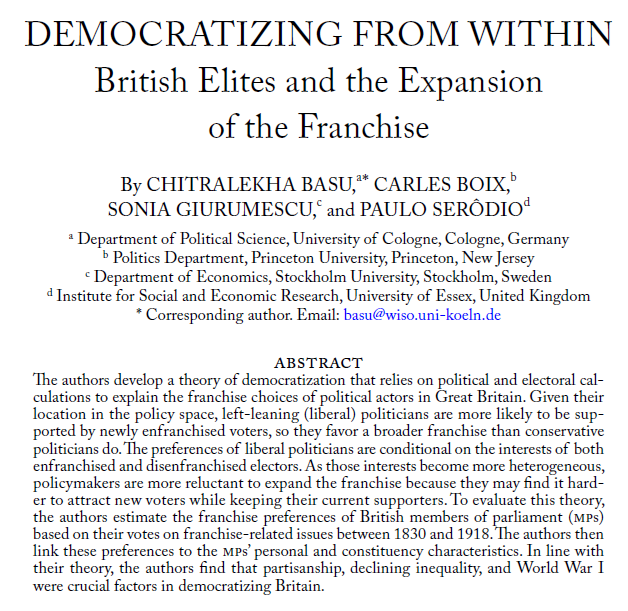
Now in @World_Pol (w/ @boixserra, @SGiurumescu and Paulo Serôdio). 🧵👇
Link to paper here (gated): https://t.co/jZ3IcHA6pY
(1/9)
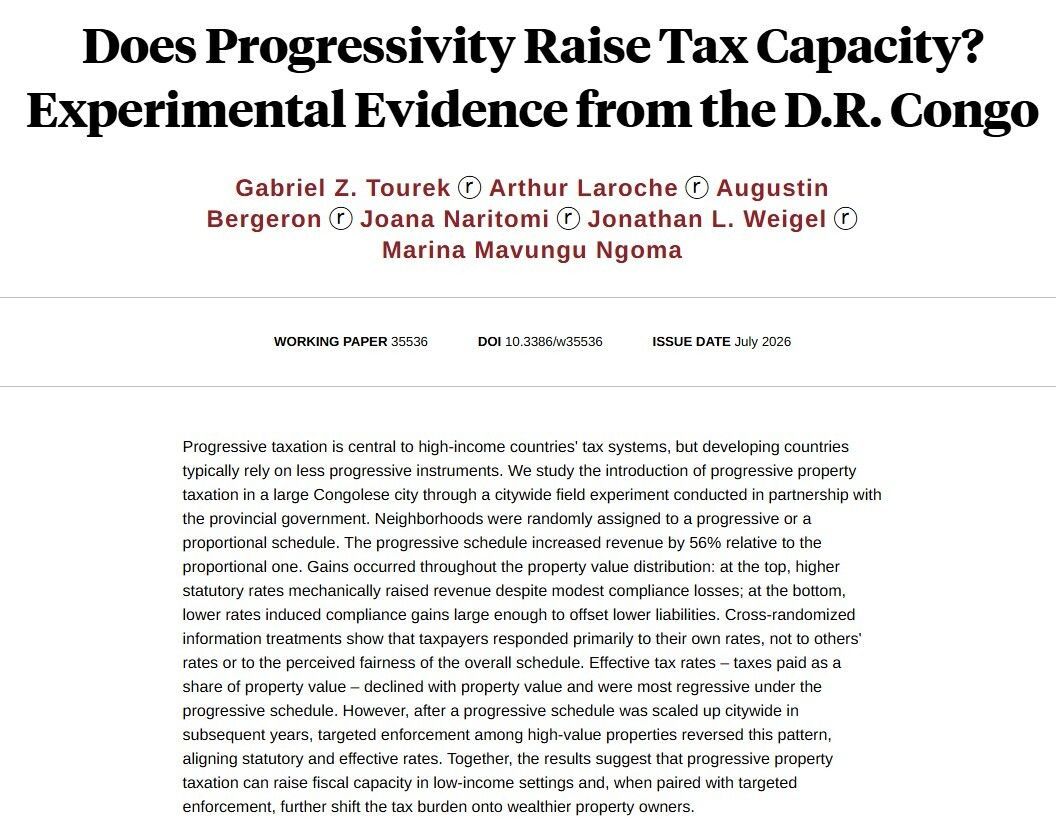
A citywide experiment in the DR Congo finds that progressive property taxation raised revenue by 56 percent, boosting compliance at the bottom while raising liabilities at the top, from @gabezt, Arthur Laroche, @ABergeron_econ, Joana Naritomi, @jonathanweigel, and Marina Mavungu Ngoma https://t.co/ZqT1cFZqMa
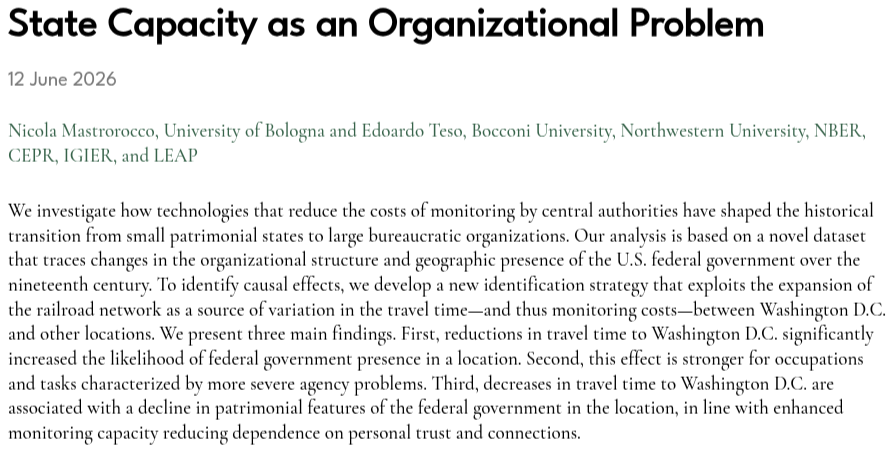
The expansion of the railroad network was a crucial driver of growth and organizational change of the federal bureaucracy in the XIX century U.S. Decrease in the costs of monitoring bureaucrats was a key mechanism
New paper by @edoardoteso & @mastrorocconick#REStud#EconX
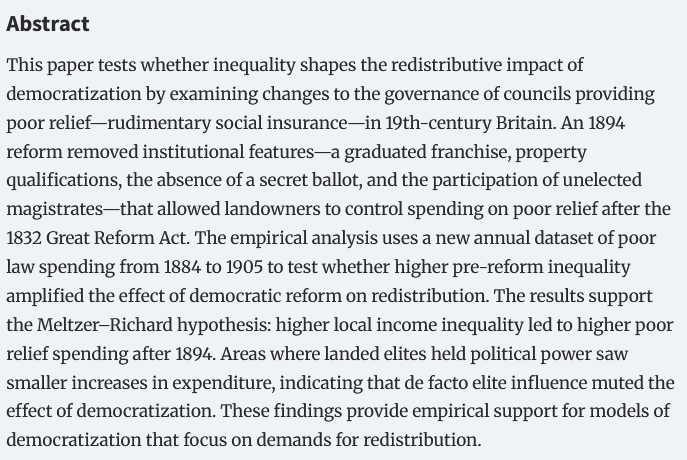
Forthcoming article "Democracy, Redistribution, and Inequality: Evidence from the English Poor Law" by @chapman_econ@EEANews@OUPAcademic
https://t.co/2ITWBLZBDc
Teaching materials available: https://t.co/tCzfSWh4Lu
The debate over the replication aside, this is what some of us were calling for years ago when discussing frontiers in qual research: an online appendix with matches between coding decisions and highlighted text from the primary sources w/ ease of access and transparency for all!
Rumour has it that some people think there are errors in my recoding of Voigtländer and Voth (2012).
I have therefore made the primary sources available for the 169 corrections I made to their dataset: https://t.co/zxeBAqrhGM.
If anyone finds any errors, they can let me know.
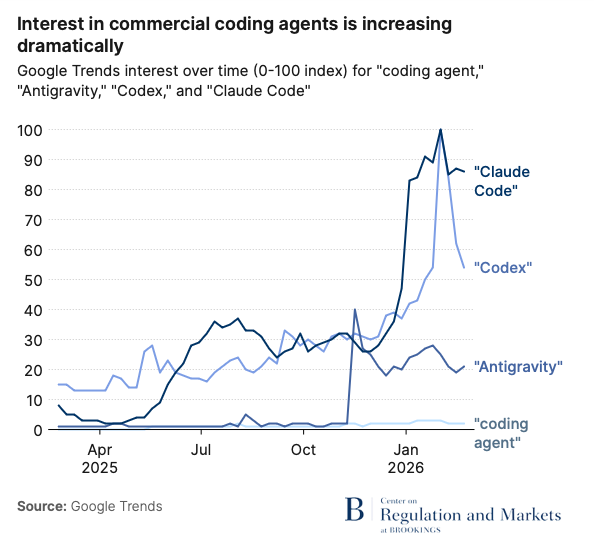
You can just research things. New from @j_a_tucker & me at @BrookingsInst: Coding agents like Claude Code and Codex will likely accelerate research AND undermine institutional structures we built to support it.
AI research is accelerating.
On January 2nd I claimed that Claude Code was coming for academia "like a freight train" and that a single academic would be able to "write thousands of empirical papers."
It's been less than two months since then, and worth taking stock of where we're at...
In econ, @YanagizawaD has launched a project that is literally writing 1,000 papers. My prediction is already coming true, much faster than I thought it would!
Meanwhile, @alexolegimas has released a dizzying array of new research via his substack, leveraging Claude Code extensively.
I've released a "research swarm" that writes hundreds of papers, as well as a visualizer for specification searches, an LLM council that can be used for peer review, and more. My students and I have run an extensive experiment on Claude Code and Codex, and surprisingly found that their guardrails discourage p-hacking (though they can be circumvented easily).
Everywhere, we're seeing interesting new papers leveraging AI.
Progress in adopting Claude Code and other AI tools and using them to produce research is going faster than I expected, and it seems plausible now that it will keep accelerating as the tools improve and more researchers gain familiarity.
I'm baffled by any empirical social scientist who isn't paying attention to these trends and isn't changing their practices accordingly. It's not yet clear how these changes will affect knowledge, but it's impossible to ignore what's coming, and what has already come to pass in the last few months.
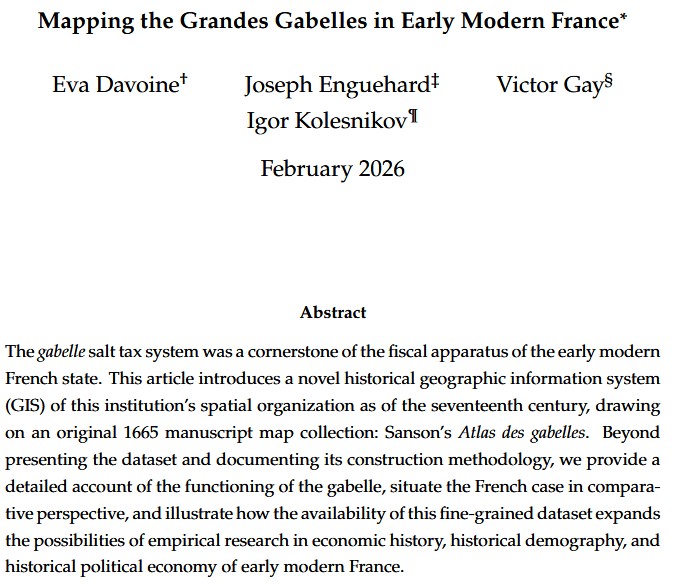
In a new paper with @EvaDavoine@EnguehardJoseph
& I. Kolesnikov, we build a historical GIS of a core fiscal institution in early modern France: the gabelle (salt tax), which generated up to 25% of tax revenue.
👉 https://t.co/OzOe5cfGQ6
🧵1/7
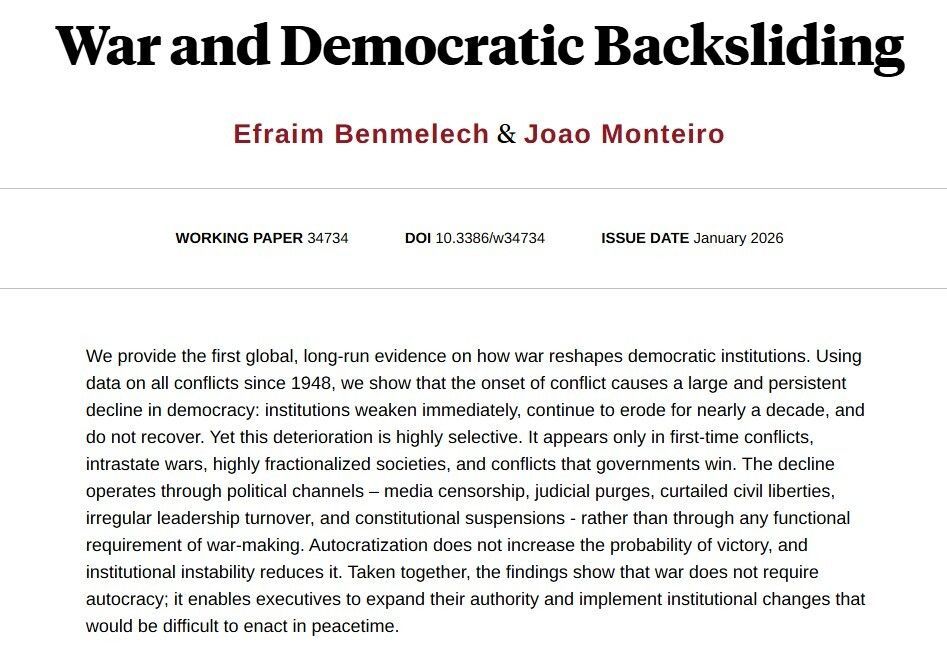
The first global, long-run evidence on how war reshapes democratic institutions using data on all conflicts since 1948, from Efraim Benmelech and Joao Monteiro https://t.co/t2SmbRoiw3
Reforms to the organizational structure, personnel management, and task management of tax authorities have potential to raise tax capacity in developing countries, from Anders Jensen and @jonathanweigel https://t.co/txpeGbvASe
@tanu_kumar1 Looks great! Funnily enough, me and Ruth Collier have been working on a very similar, albeit more historical, project/paper, as is Jae to my knowledge. Something about the Berkeley water and the state capacity zeitgeist is pushing us all in this direction!
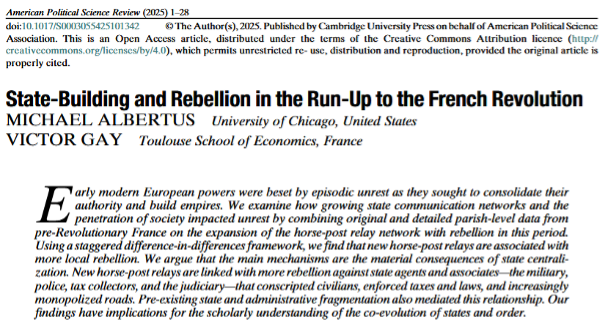
Can state-building disrupt rather than stabilize society? Thrilled to have a new article in @apsrjournal w/ @victorgayeco, showing that the expansion of state communication networks spurred rebellion for decades in France before its Revolution
👉 https://t.co/HXrqkZrLUz
🧵
Claude Code and its ilk are coming for the study of politics like a freight train.
A single academic is going to be able to write thousands of empirical papers (especially survey experiments or LLM experiments) per year. Claude Code can already essentially one-shot a full AJPS-style survey experiment paper (with access to Prolific API).
We'll need to find new ways of organizing and disseminating political science research in the very near future for this deluge.
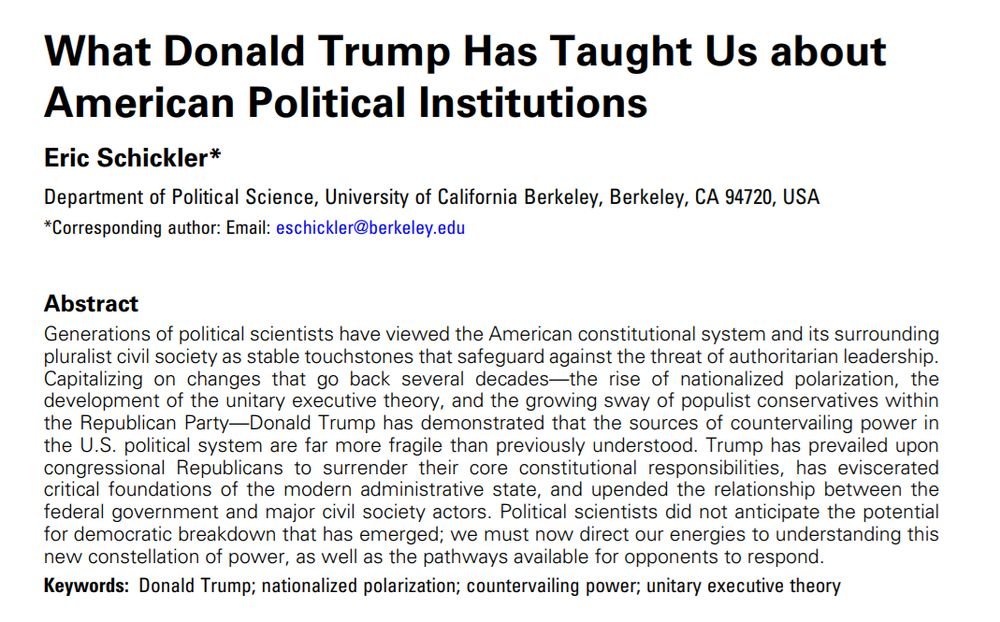
The Eric Schickler essay in Larry Bartel's symposium on "What Trump Has Taught Us About Political Science" is one of the most insightful pieces I've read in 2025.
US Constitution & institutions turned out to be weak, and we have to rethink conventional wisdom.
We’re making GPT-5 warmer and friendlier based on feedback that it felt too formal before. Changes are subtle, but ChatGPT should feel more approachable now.
You'll notice small, genuine touches like “Good question” or “Great start,” not flattery. Internal tests show no rise in sycophancy compared to the previous GPT-5 personality.
Changes may take up to a day to roll out, more updates soon.
Balancing bossism: State expansion in the face of elite capture by Anna F. Callis and Christopher L. Carter is now available in Early View. https://t.co/KRrCxHDL6Y