Our World in Data is a free, nonprofit website with a mission to increase understanding of the world’s largest problems and drive informed action to solve them.
Measles vaccines save millions of lives each year.
Measles used to be an extremely common disease. Just sixty years ago, over 90% of children would have been infected by it, and of those who developed symptoms, around a quarter would be hospitalized.
The US alone had around three to four million cases annually, leading to tens of thousands of hospitalizations and hundreds of deaths each year.
However, in 1963, John Enders developed the first effective measles vaccine. Vaccination efforts ramped up rapidly in richer countries, and in the 1970s and 1980s, they were scaled up worldwide.
In just the last fifty years, it’s estimated that measles vaccinations have prevented over *90 million* deaths worldwide.
Two to three million people would die from measles every year without them. This means these vaccines are likely the most life-saving ones currently in use.
This data comes from the LGBTI National Policy Dataset by researcher Kristopher Velasco at Princeton University.
Our teammates @parriagadap and @bbherre recently updated this data with the 2026 release.
Explore this data in our interactive charts: https://t.co/SIYWF0Zp3W
How do the rights of LGBT+ people vary around the world? 🧵
The first map shows the 38 countries that allow same-sex partners to marry, affirming their right to love and form a family.
However, the majority of countries don’t recognize same-sex marriage, or outright ban it.
The third map shows the 38 countries that allow same-sex partners to adopt a child together.
This means that most countries do not allow LGBT+ people to adopt and both be recognized as parents.
Less than 60% of the world has access to safe sanitation—
Unsafe sanitation is responsible for hundreds of thousands of deaths each year. It increases the risk of many fatal diseases, including cholera, diarrhea, dysentery, hepatitis A, typhoid, and polio.
Unfortunately, over 40% of the world does not have access to safe sanitation facilities. This is based on estimates from the WHO/UNICEF’s Joint Monitoring Programme for Water Supply, Sanitation and Hygiene.
The chart shows the share of the global population that has access to safe sanitation over time. While rates have increased, particularly over the last decade, they still fall far short of the UN’s target of universal access in 2030.
Increasing access to safe sanitation would save many lives from preventable infectious diseases.
(This Data Insight was written by @_HannahRitchie and @parriagadap.)
Read more from our founder, @MaxCRoser, in his article explaining our mission, “Why do we need to know about progress if we are concerned about the world's largest problems?”: https://t.co/QGhiKdCT9C
“Our goal with https://t.co/bSVdNpQrqz is to give a wide overview of the big problems the world faces, show that it is possible to make progress against even very large problems, and inspire people to work on these big problems to achieve the progress that is possible.
We want to contribute to a culture that seeks progress — a culture of people deciding to study the very large problems we face and taking the initiative to contribute to progress against them.
We want to inform thoughtful people about the world’s large problems and the possibility of progress so that they can become the engineers, politicians, voters, donors, activists, founders, or researchers who will solve them.”
Subscribe to our Data Insights newsletter to receive our bite-sized insights on how the world is changing, right to your inbox every few days: https://t.co/CUPKlhiy3x
Lung cancer deaths trace the rise and fall of smoking—
Lung cancer kills more than two million people every year, making it the most fatal cancer globally.
While a number of factors increase the risk, the 20th century brought one like no other: smoking.
There is now plenty of epidemiological evidence linking smoking to lung cancer, but we can also see it in the patterns of death over decades.
The chart shows death rates from lung, trachea, and bronchus cancers among men in a selection of high-income countries. Each shows a very clear rise and fall over the late 20th century.
This pattern mirrors smoking rates, with a lag. The timing and height of each peak depend on when and how strongly smoking took hold: early in the United Kingdom, later in Japan.
You also see this rise and fall among women, shifted later, since they took up smoking after men did.
Today, most smokers live in low- and middle-income countries, who are at different stages of this curve. Helping people quit or preventing them from starting in the first place would save many lives for decades to come.
(This Data Insight was written by @_HannahRitchie.)
Read my colleague Max Roser’s article: “Smoking: How large of a global problem is it? And how can we make progress against it?”: https://t.co/3TMBG7phW4
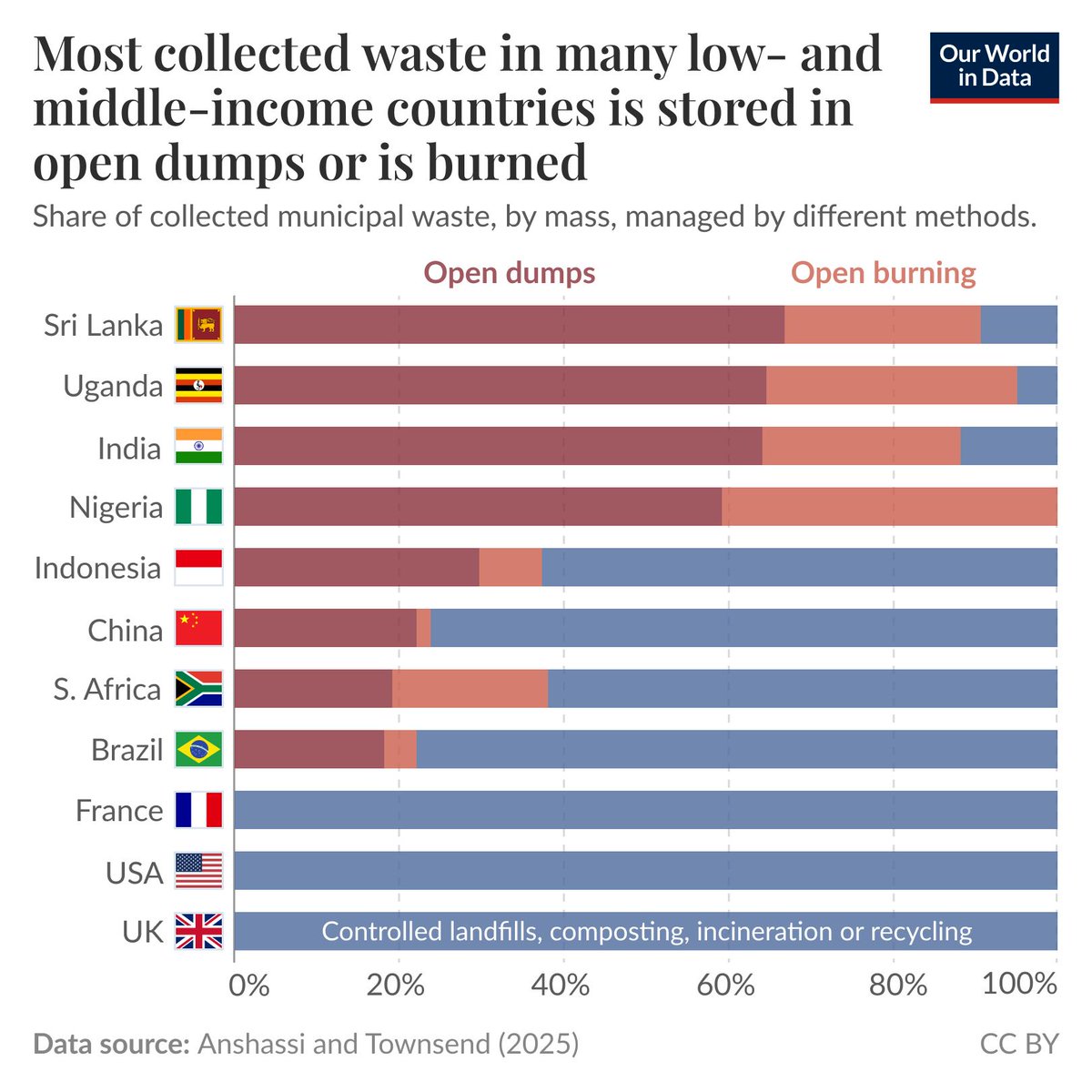
Most collected waste in many low- and middle-income countries is stored in open dumps or is burned.
Effective waste management systems are something that many of us living in high-income countries take for granted. Our waste is collected from bins in our street and taken to controlled or sanitary landfills, incinerators, or recycling centers.
But in many low- and middle-income countries, this is not the case.
In some of them, less than half of the waste (from households, shops, and other sources) is collected by management services at all.
In many countries, even when waste is collected, most of it — sometimes over 80% — is taken to open dumps or is openly burned. You can see this in the chart.
Both methods cause pollution, either through waste leaking from open dumps or toxic air pollution generated when plastics and other materials are burned.
While these numbers show that huge amounts of the world’s waste are mismanaged, they also tell a story of opportunity. Countries that invest in waste management can do so effectively, so that very little waste pollutes the environment, and the air is far cleaner.
(This Data Insight was written by @_HannahRitchie and Veronika Samborska.)
How will your country's demographics change this century?
At Our World in Data we built a tool to let you see for yourself.
The UN's assumptions are the starting point.
But then you can adjust the three drivers of change — births, deaths, and migration — to what you expect.
How do researchers measure terrorism?
Measuring terrorist attacks and deaths comes with many challenges.
People do not always agree on what characteristics define an act of terrorism. Even once defined, these characteristics are difficult to assess, and challenging to distinguish from other forms of political violence and violent crime.
The data shown in the chart here is from the Global Terrorism Database (GTD), a leading source of terrorism data. It’s maintained by the National Consortium for the Study of Terrorism and Responses to Terrorism (START) at the University of Maryland.
The GTD defines a terrorist attack as the threat or use of violence to achieve a political, economic, religious, or social goal through intimidation or coercion by an actor that is not the state.
Terrorism thereby differs from other types of violence:
- It is different from state repression because its perpetrators are not government actors.
- Its political, economic, religious, or social goals set it apart from violence for personal reasons, such as homicides or hate crimes.
- And its intent to intimidate and target civilians distinguishes it from other forms of armed conflict.
In practice, the lines between terrorism and other forms of violence can still be blurry. This is because the perpetrators of violence and their motivations are often difficult to identify.
🔧 Website upgrade: You can now filter our latest work by topic and type (data insights, articles, etc.)
This makes it easier than ever to find exactly what you’re interested in.
Pick a topic by selecting one of the buttons at the top: Population and Demographic Change, Health, Energy and Environment, and many more.
See all our work on that topic, or narrow it down to our bite-sized data insights, longer-form articles, or data updates and other announcements.