Research group @OxfordAOPP & @OxfordPhysics of Tim Palmer/Antje Weisheimer. Predictability, uncertainty, reduced precision for weather&climate forecasting🌍⛈️🌪️🌊
Tim Palmer explains why we don't need more climate models but a massive international Earth simulator on an #exascale supercomputer. Regarding the climate emergency, $1.1bn is well invested to inform us precisely about the climate change we are facing.
https://t.co/sjp5pwt0tV
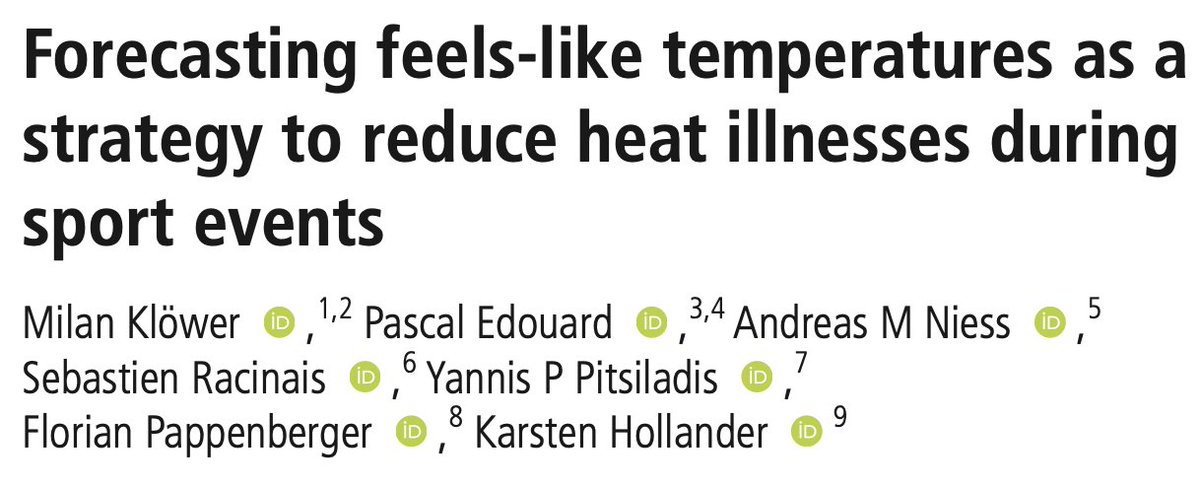
Forecasting heat and feels-like temperatures with @ECMWF|s ensemble prediction system - applied to sport events! How can we bridge the gap between tons of forecast data and what users actually need to know? Communication of forecast data is never easy, maybe 👇this is a way?
Today's magic trick: Make vorticity look like clouds ☁️🌧️ to celebrate that we just released SpeedyWeather.jl v0.3, our still-baby weather model in #JuliaLang. #GPU, auto-differentiation, low-precision, machine learning, all coming soon! Check it out, https://t.co/h9k6FiOUF4
We now have a global circulation model developed @OxfordAOPP! Not to replace existing forecast models, but as a computational playground to develop and test new ideas! Looking good already 🥳
Since I started research on #weather and #climate, I always wanted to write a global atmospheric circulation model from scratch. Many years later, here we are, proudly presenting SpeedyWeather.jl https://t.co/h9k6Fixjgu written in #JuliaLang and soon in 16/32-bits, on #GPU|s etc
📽️aaaand action! How do you cheat on chessboards using #fluiddynamics? No, what you see is the (probably) first fluid simulation entirely computed in #16bits! Can you spot the difference to 64 bits?
No? There's only one: 16 bits is computed ~4x faster saving time⏰ and energy🔋
🚨Fluid simulations in only #16bits?🚀~4x faster than good old 64-bit double precision (😴boring!) on the #A64FX processor that powers the world's fastest computer Fugaku?
Our new paper explains how https://t.co/0SwkLCW4J9 Run in the @JuliaLanguage we squeeze the model ... 1/4
4 years, 9 papers (jeez 🤫), 50+ talks, 8 posters, ~5000 github contributions, 6 radio/news interviews, some 4,000km of 🚲commute, uncountable friends and colleagues, too many pints of cider, 35 housemates and 200L of olive oil later, Dr Milan has finally defended his thesis⬇️
Hello #BigData world! Our #newpaper is the editor's pick in the current issue of Nature Computational Science @NatComputSci 🥳 Read it, it's #openaccess. How to make #BigData small again? We found a way, at least for climate data!
🚨Our #newpaper made it to the front cover of @Nature Computational Science @NatComputSci 🥳 https://t.co/1UdM4w075F #openaccess 📖 Data archives are exploding, @ECMWF stores 500,000,000 GB📈 but many bits are just noise with no real information. We propose ... 🧵1/4
More heat☀️ = more heat-illnesses in sport 🏃🥵? But how high is the risk given an outdoor temperature🌡️+sunshine☀️+humidity💦+wind💨? Read more in our
NEW #openaccess paper: https://t.co/misju495qa Summary thread that lead to the @HeatForecast twitter bot 1/n 🧵
Heat forecast for #TokyoOlympics2021: Strong winds continue through Tue, Wed and Thu, still reaching 31˚C daily. Heavy rain likely to stop Tue afternoon but some rain still possible on Wed/Thu. Hotter again thereafter! #OlympicGames#Olympics2021#Tokyo2020
Going online: We've built a @HeatForecast for the #Olympics from @ECMWF's data. How hot will it feel? How does wind💨, sunshine☀️ and humidity💦 affect the feels-like temperature in Japan? TL;DR: It's hot, stay hydrated! Follow this account to receive daily updates ⬇️
Our information-preserving compression is in review for @NatComputSci! What's real information in #climate data?🌍↔️💿Why do large archives store mostly random bits, and how to separate the false from the real information. Preprint https://t.co/GWjijmJ6HR summary 🧵here⬇️ 1/n
Attending #vEGU21 this year? You've just saved many million kg of carbon by not flying to Vienna 🥳EGU would have emitted 25,000,000 kgCO2 by the end of next week: 26kg every second due to attendees flying in long-haul. The carbon clock is ticking...
https://t.co/3Y24lOhqXb
16 bit not enough? I doubt it! After 3yrs of emulation, we finally run simulations on real 16-bit hardware at 3.5x the speed! Everyting 👇in Float16 & #JuliaLang and run on Isambard's A64FX - the same @Arm processors that power the fastest supercomputer #Fugaku 🗻!
We've been working on stochastic rounding, which is definitely on our wish list for next generation computing! Finally stochasticity baked deeply into weather and climate models! 🌍
Just presented at #SIAMCSE21 on Stochastic Rounding for Weather and Climate Models🌍As the conference is not free💰, here a thread-summary. TL;DR Stochastic rounding reduces the overall error by introducing additional noise. Counterintuitive? Well, no, read on ... 1/n
@ECMWF @s_e_hatfield Awesome talk from @s_e_hatfield with results from collaborative work with @OxPredict @PDueben. Single precision computations once operational in @ECMWF#IFS47r2 will realise impressive savings that can be invested in higher vertical resolution of the ensemble forecasting system!
Fast climate models in 16-bit arithmetic? On a #GPU? Doesn't work? Yes it can! New paper on challenges for #16bit floats (or posits!), how to use mixed-precision, rescaling equations &reduced-precision communication https://t.co/PUMyLXhb6J
Everything in #JuliaLang & open-source!
We are looking for a post-doctoral researcher to work in our dynamic (and fun) @ClimateProc group on observational constraints on aerosol-cloud cloud interactions in models across scales as part of the @FORCeS_H2020 project. Interested? (via email)
https://t.co/vXsNHJCPKq
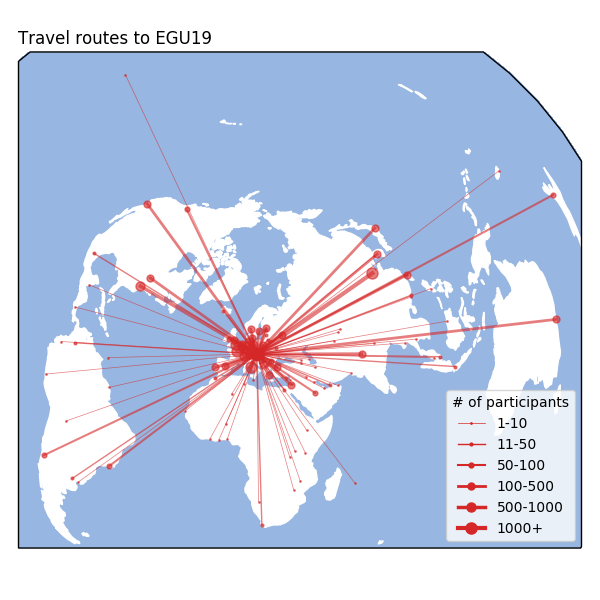
What is the travel carbon footprint of a big scientific conference like #EGU19? 16,273 scientists from 113 countries emitted 22,300 tCO2e. How to reduce it by more than 90%? Answer: 25% virtual participation and Europe arrives by train. 🖥️🚆 @EGU @flyingless#netzero