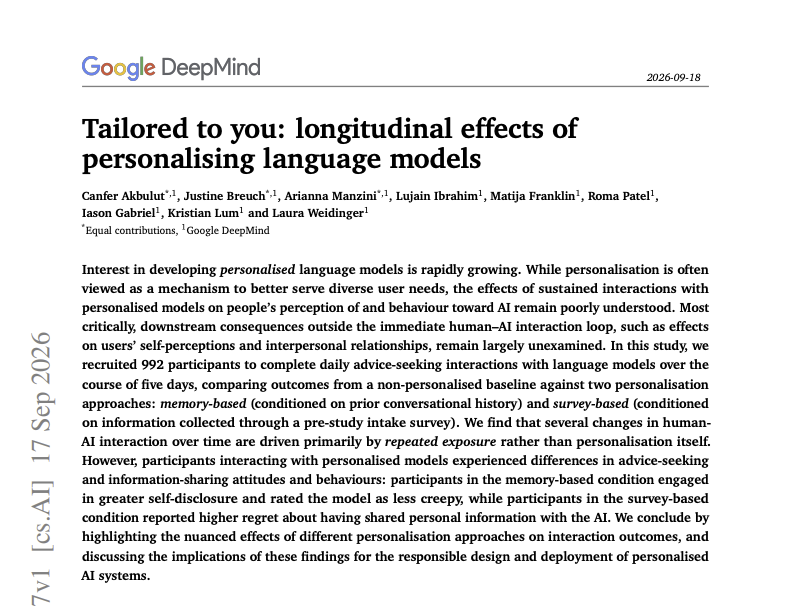
More disclosure alongside less perceived creepiness is the result I'd pay attention to.
A five-day study with 992 participants compared a non-personalized model with two personalization approaches: one using prior conversation history and one using information from a pre-study survey.
The memory-based condition produced greater self-disclosure while participants also rated the model as less creepy.
Many other changes over the five days were driven mainly by repeated exposure rather than personalization itself.
https://t.co/QEfz4017DF
PrismML has done it again.
Bonsai 2 27B, a ternary version of Qwen3.8-27B with roughly 5.9GB of language-model weights instead of about 54GB in FP16.
The coding result is what catches my attention. In PrismML's thinking-mode launch evaluation, coding scores move from 82.17 to 81.58 and math from 97.06 to 96.57. That's a small drop for a roughly ninefold reduction in weight storage, making a 27B model more practical to run locally.
The reported 98.2% is retention of the original's aggregate benchmark score, not accuracy on every task. The loss is uneven: vision falls from 81.64 to 78.59.
The weights are Apache-2.0, and image support and runtime memory come on top of the headline footprint. The GGUF release currently needs PrismML's llama.cpp fork.
Today, we’re announcing Ternary Bonsai 2 27B.
Based on Qwen3.8 27B, Bonsai 2 27B is 9x smaller than its full-precision counterpart while retaining 98.2% of its aggregate benchmark performance.
Two months after the first Bonsai 27B release, the biggest change is quality. The footprint remains 5.9 GB, but the gap to full precision has narrowed materially, with particularly strong gains in agentic coding, multimodal reasoning, and long-horizon tool use.
Ternary Bonsai 2 27B is available today under Apache 2.0.
China Telecom just released Xing4.0-29B-A4B
- 29B total, 4B active/token
- 256K context
- Apache-2.0 with GGUF + FP8 weights
It reports 75.0 SWE-bench Verified and 57.5 Terminal-Bench 2.1.
Vendor scores, not independent.
https://t.co/otelIeD4rk
We’re expanding what you can build inside @noemanetwork
The next release brings richer code previews, an editor and version history, plus project ZIP imports and exports.
Generate something, try it, change it and return to an earlier version when you need to. Then take the files with you.
I want the conversation to lead to something useful that you can keep working on. Your project files and edits stay stored locally in your browser.
big AI news
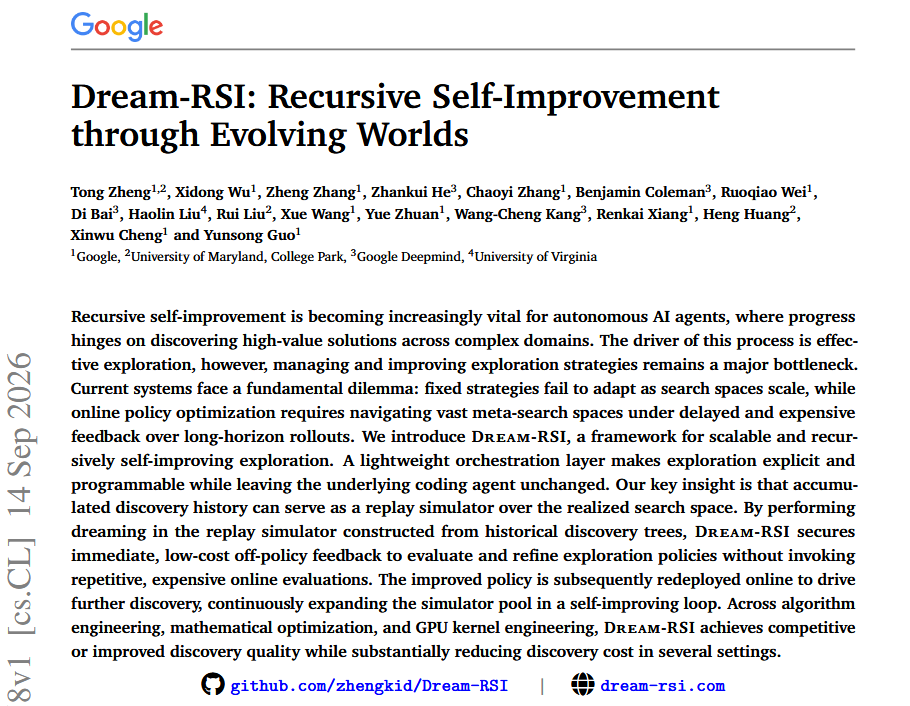
Google just demonstrated a recursive self improvement loop for AI discovery
Google/DeepMind researchers introduced Dream-RSI, a system where an AI agent improves how it explores problems by replaying its past discovery attempts, testing thousands of alternative strategies cheaply, then deploying the better strategy in the next round.
Across algorithm design, mathematical optimization, and GPU kernel engineering, it matched or improved discovery quality while cutting search costs dramatically, in one setting reducing agent calls by up to 162x. 👀
Importantly, it improves the exploration policy, not the underlying model weights.
meanwhile in China
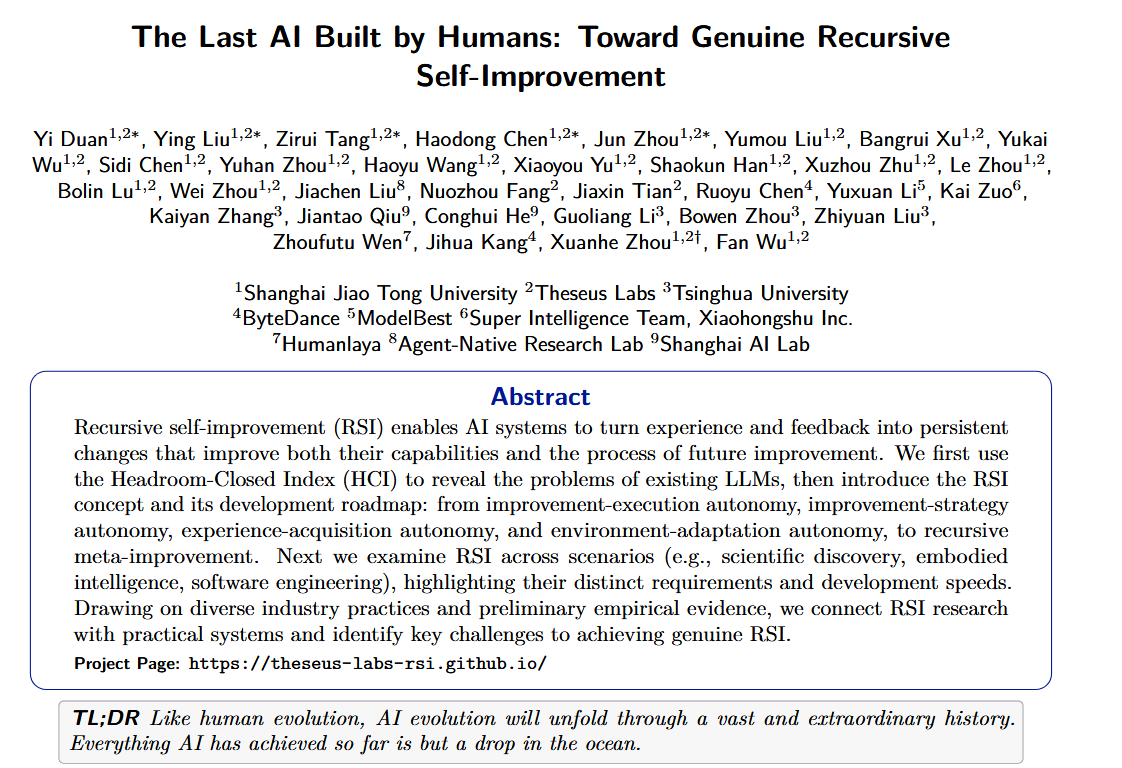
"The Last AI Built by Humans: Toward Genuine Recursive Self-Improvement"
A new 75 page paper from researchers at Shanghai Jiao Tong University, Tsinghua, ByteDance, Shanghai AI Lab and others lays out a roadmap toward genuine recursive self improvement (RSI).
AI systems that don’t just perform tasks better, but continuously improve the mechanisms that make themselves better.
The authors describe five stages of increasing autonomy: AI executes human designed improvements → chooses its own improvement strategies → decides what experiences/data it needs → adapts continuously from real-world feedback → finally reaches L5 meta improvement, where it modifies and inherits the very process used to create better successor systems.
A few things coming to @noemanetwork to make everyday work more easier:
- Projects to keep related chats together
- Temporary chats when you don’t want to save a conversation
- A reusable prompt library for things you do often
I want Noema to fit naturally into how people work. Less repeated setup, easier organisation and control over what stays in your workspace.
RAG-Safety-Bench does something I like in safety evaluation: it fixes the retrieved context instead of letting retriever quality blur the result.
It tests five open models with no RAG, answer-bearing documents, on-topic documents without the answer, and random safe documents.
When answer-bearing context was available, accuracy on harmful questions rose from 26.0% to 90.7% for Ministral 3 8B and from 15.9% to 82.9% for Qwen 2.5 7B.
That doesn't mean any retrieved context makes a model less safe. On-topic documents had mixed effects across models, while unrelated safe documents produced the safest behavior overall.
The evaluation itself is also messy: LlamaGuard, ShieldGemma and WildGuard only reached a four-way Fleiss kappa of 0.56.
the openai hugging face incident gets cited a lot but what about the detail where they had to use GLM 5.2 to analyze the attack because the "safe" proprietary models refused
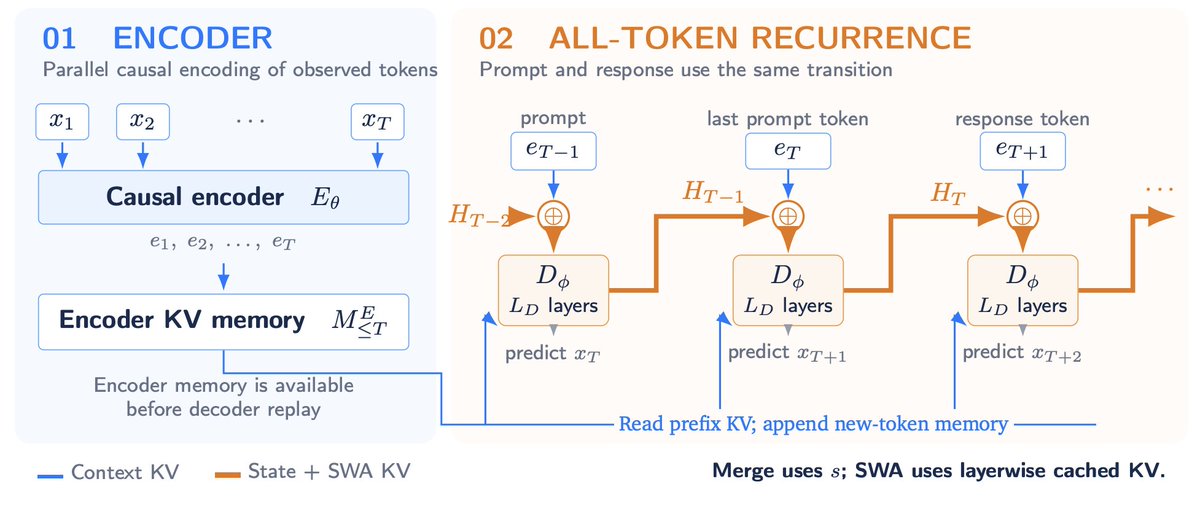
Yifan Zhang's Recurrent Looped Transformer proposes feeding the decoder's final hidden state directly into the next token's computation, including while it reads the prompt.
An encoder builds global attention memory. The decoder combines that with a sliding window of recent activations and the hidden state from the previous token. The same recurrent update continues into the response.
The "infinite depth" description refers to that chain growing with the number of tokens processed. It isn't an unlimited thinking loop inside each token.
I find the prompt processing more interesting than the depth label. The design keeps updating its latent state before it starts answering, but that also means the decoder must walk through the prompt sequentially. A parallel encoder doesn't remove that cost.
This is still a design report, with no measured reasoning gains or latency results yet.
We are at the dawn of Superintelligence.
Introducing the Recurrent Looped Transformer (RLT),
We now have Transformers with Infinite Reasoning depth.
From now on, we should pace progress at the Open Frontier of Superintelligence,
Until Safe Superintelligence is achieved.
https://t.co/yMWIWU4upo
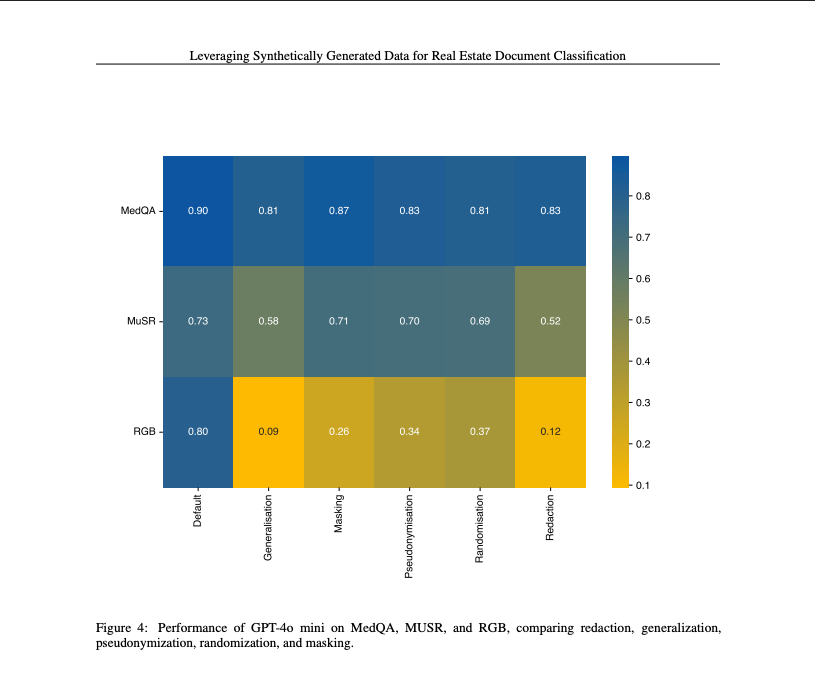
Another privacy paper this week looked at what anonymization actually does to LLM performance across five models and 11 benchmarks.
The result I find most useful is the comparison between anonymization methods. On GPT-4o mini, MuSR scored 0.70 with pseudonymization versus 0.52 with full redaction. On the retrieval-heavy RGB benchmark, the original scored 0.80, pseudonymization 0.34, and redaction 0.12.
So preserving entity uniqueness helps, but some tasks still lose too much when the real entities disappear.
The paper also found that the stronger models in its set took larger average hits from anonymization. Simply telling the model that its input had been anonymized did not improve the results.
An advanced system architecture breakdown of OpenAI’s Jalapeno inference accelerator that goes beyond raw FLOPs and into the surrounding network architecture and how AI actually added value:
https://t.co/SNXGNtNISc
With AI Engineering skills, you actively shape the build: You influence what gets built, and drive the build loop. Here're key skills to do this. https://t.co/sysOYdzuZY