Sovereignty in Energy should be the new theme of the world and one can learn from France here.
France operates one of the world’s largest nuclear power plant.
Astonishing to know that 70 percent of total electricity generated by France was from nuclear.
& Nearly 95 percent electricity is from non fossil fuel with only 5% from fossil fuel.
Nuclear power reliably meets the bulk of domestic electricity demand while generating a large surplus that France exports across Europe.
Interesting to know how France achieved this large feat in nuclear energy.
Before 1973 France was highly dependent on imported oil for electricity and heating. The 1973 OPEC oil embargo caused prices to quadruple, exposing France's vulnerability (it had almost no domestic fossil fuels).
In March 1974, Prime Minister Pierre Messmer announced the ambitious "Messmer Plan" (officially aiming for "all-electric, all-nuclear"). The goal was rapid energy independence through massive nuclear expansion.
This was a national strategic decision, not just an environmental one — it was about security, economic stability, and reducing reliance on foreign fossil fuels
With the energy crisis the world is facing, France sets a good example for countries to move to nuclear energy in a serious way.
#TDPower is adding a third manufacturing facility (Tumkur) with significant capacity:
- Current manufacturing capacity for generators is roughly 800 machines per year.
- The new plant adds about 1,000 machines annually, bringing total capacity to 1,800 machines more than double the current run-rate.
➡️This kind of increase is not incremental, it’s transformative for a niche OEM like TDPS.
The expansion isn’t just about producing more, it unlocks higher revenue potential:
- Analysts and management guidance point to revenues rising from ₹1,500-1,800 cr in FY26 to ₹2,000 cr+ in FY27 due to higher capacity utilization and strong order books.
Some industry opinion sees potential revenue ceilings of ₹2,500–₹2,600 cr once the expanded capacity and enhanced product mix are factored in.
➡️ That’s a meaningful jump over historical figures not a small percentage change.
Before this expansion, TDPS was bumping against capacity constraints meaning even with strong orders, the company could only deliver so many machines. That throttles revenue growth.
With new capacity already ramping up and partially operational as of late 2025 and full commissioning expected soon, the company can:
- Execute its growing order book
- Reduce delivery lead times
- Bid for larger or multiple contracts simultaneously
This unlocks higher topline and better utilization ratios, which are key for margin expansion.
The capacity increase matters even more when combined with secular sectoral tailwinds:
- Global energy transition (gas + renewables) driving demand for generators/motors.
- Data centers requiring reliable backup power systems.
- Industrial and infrastructure growth.
This means capacity isn’t just added output, it’s output that meets actual strong demand.
Deeply saddened by the passing of Siddharth Bhaiya @sidd1307
A visionary mentor who transformed how many of us approach investing. His wisdom and passion will remain an enduring inspiration. Rest in peace.
His last interview 15-Dec-25 during Dezerv Wealth Summit @MoneycontrolH
This was from a older interview done by @_soniashenoy on @CNBCTV18Live
I have this piece stored on my phone.
The clarity Siddharth Bhaiya had was just amazing. This is a great piece of inspiration for the middle class, aspiring to reach heights.
Copyrights: @CNBCTV18News
I'm obsessed with cognitive biases.
A "cognitive bias" is a systematic error in thinking that destroys decision-making.
11 most powerful (and dangerous) cognitive biases I've found: 🧵
1. Survivorship Bias:
When you sell a property & buy another, you can get a tax deduction. This may involve depositing money in a special account (CGAS) while you look for the new house. But operating the CGAS is a painful process. Govt has finally modernized it, to an extent. https://t.co/R0Yi7RspMT
The mutual fund industry is seeing a major shift towards passive fund investing
This year was a breakout year where net inflows into passive funds more than doubled in FY25 led by a 280% surge in index fund flows
If you look at the total assets under management of mutual funds, passive funds share has risen from 7% in FY20 to 17% in FY25
the opportunity is actually quite large
India has 17% penetration into passive funds but it is well below what developed markets have
so who is buying passive funds in india ? largely HNIs and corporates that are lapping up ETFs and index funds , retail participation is still low.
but the trend is picking up , index funds in india have seen a AUM growth of 81% in the last 4 years
data source: Motilal Oswal report
A short note on Q2FY26 numbers.
The 16.5% PAT growth for Nifty 500 (reported) firms saw a 4.5% contribution from just three companies.
The three OMCs added ₹16,250 crore to the ₹61,000 crore cumulative PAT increase reported in Q2FY26 by the 476/500 firms that have reported so far.
If you adjust for other oil companies like MRPL and Chennai Petro, and for fertilizer companies, the number falls another 5%.
And then there are Metals and Tata Motors…
Why are these adjustments needed? Are they even logical?
Oil and OMC numbers are steady to below average when adjusted for the business cycle. They appear so large (a 9x jump for the three OMCs in Q2FY26) because Q2FY25 was unusually depressed. (IOC reported a 99% decline in earnings in Q2FY25.)
Commodity profits are cyclical and account for large swings. You can choose not to ignore them at all. Even after accounting for metals, the broader market universe is still reporting steady-state growth of around 10%—a far cry from valuations at 25x trailing earnings.
Also remember that sales growth of 6–8% is below even nominal GDP growth.
The PAT numbers being reported are at near-record margins. Efficiency gains are already fully baked into the bottom line.
Q: What will take profits back to 20% growth, where 25x multiples will be justified?
It has to be sales growth, because there is hardly any room for margins to improve.
How much is the sales growth?
Mid-single digits.
What constitutes this sales growth?
Domestic businesses (driven by India’s nominal GDP growth) plus exporters (IT, pharma, and commodity-linked businesses, with pricing driven from overseas).
None of these segments—except in patches—are showing numbers in excess of 10% year-on-year.
There are, of course, solutions to correct this. But I am not a policymaker; just a person watching these numbers objectively.
Do your own analysis before believing my or anyone’s numbers and cuts.
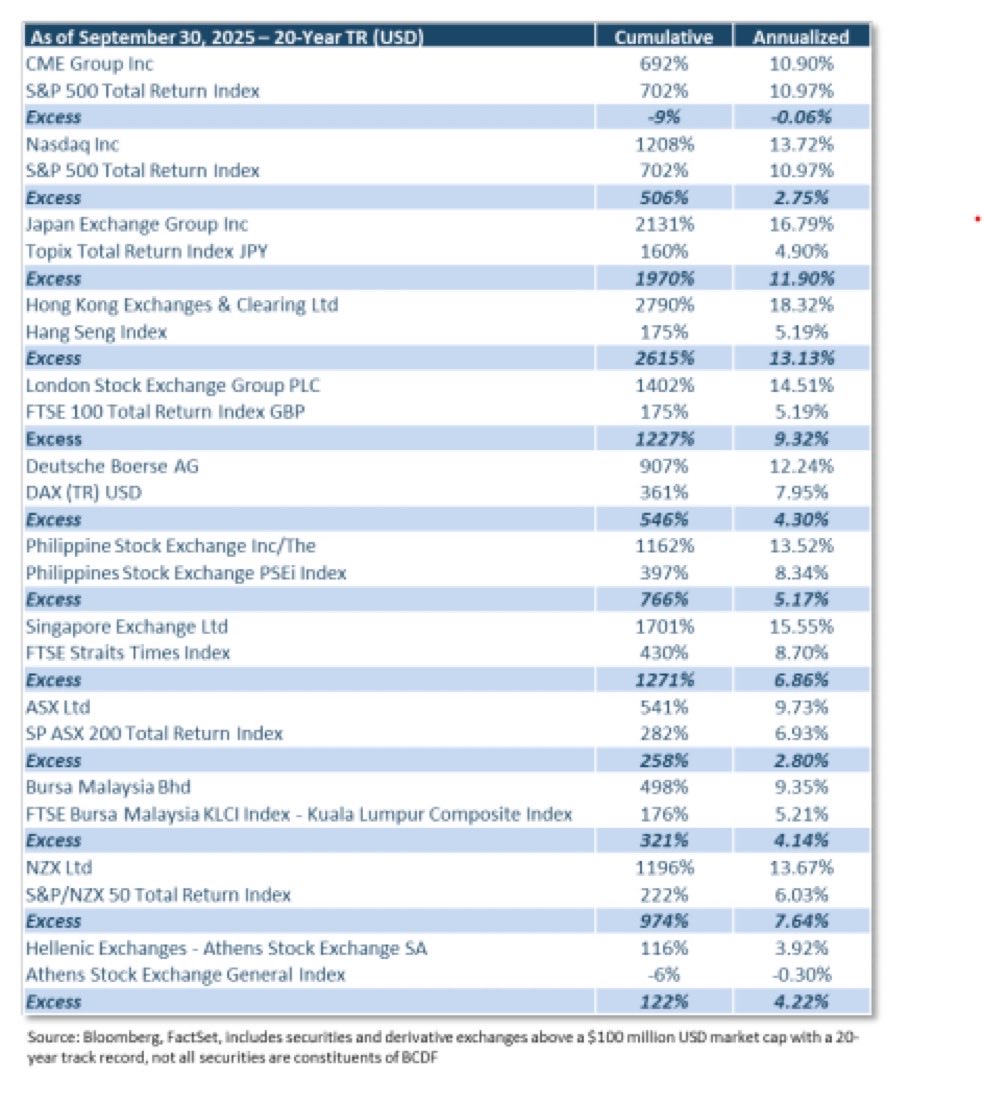
Why invest in exchanges ?
The securities exchange model is so powerful that nearly every exchange with a 20-year public track record has outperformed its respective regional stock index, in most cases by a wide margin. It’s a global phenomenon: The U.S., Japan, Hong Kong, the UK, Singapore.'
- Horizon Kinetics Q3 2025 Letter
Mcap 560 Cr | PE 17x
The Pharma stock that is silently moving up.
Q2FY26: Margins expanded from 37% to 45% but topline growth is an issue currently.
https://t.co/587TQ4pRel
@Manojeet_Das@DasHimadri13
If you take money out of a business as dividends, the effective tax rate is 52% (25% corporate tax + 35.5% on personal income). Through capital gains, it's just 14.95% (with cess).
Why does this matter? Here’s what you should know if you invest in IPOs.
If you're an investor (especially a VC), the math is simple: reduce corporate tax by showing minimal profits or losses. Spend (Burn) on acquiring users, build a growth narrative, and then sell shares at a higher valuation while paying much lower tax.
This spending also makes it harder for competitors to survive. To be clear, we're not discussing R&D spending here, which, incidentally, is very low in India (0.7% of GDP).
What's often overlooked is that VCs are essentially playing a tax arbitrage game. Look at most VC-backed businesses listed in the last few years, the reason they show little or no profit is partly due to this. Once you run a business this way, it's extremely difficult to switch.
Every startup that's 7-8 years old from the time of raising the first round faces constant pressure from VCs for an exit. With almost no M&A opportunities in India, IPO is often the only way out.
The government probably designed this tax arbitrage to incentivize companies to spend money and not just accumulate and distribute. But I'm unsure if the balance is correct. I think it's also creating businesses that aren't very resilient. One prolonged market downturn, and many of these unprofitable companies would struggle to survive.
Two things that make this more interesting:
Unprofitable growth gets valued at much higher multiples than steady profits. A company doing ₹100 cr revenue with 100% growth might get 10-15x, while a profitable one with 20% growth gets 3-5x. So VCs aren't just saving on tax; they're in essence creating a 3x higher exit valuation.
If you're competing against someone burning cash, you almost have to match it to defend market share, even if you don't want to, because of the quirks I mentioned above.