“This isn’t a feature. It’s a shift.”
Minima is proving that blockchain can run directly on-chip — unlocking a new era for embedded systems and IoT.
When every device can act as a node, true decentralization becomes far more practical.
👉 Is this the next big step for Web3, or are we still early?
#blockchain #embedded #IoT #Web3 #Minima #Decentralization
I was having a conversation with my friend earlier and we ended up talking about how machines can actually prove what they’ve done. Like, literally being able to verify their own actions in real time.
And I brought up what @Minima_Global and a team at @unisouthampton are building, a blockchain-based “black box” for drones.
At first it sounds niche, but it’s actually a big shift. Rather than relying on cloud servers or third parties, the drone records its own data directly onto a blockchain while it’s in flight.
That means the record is secure, tamper-resistant and verifiable at the source.
It really changes the conversation from “can we trust the system?” to “can the system prove itself?”
And honestly, that’s where things start to get interesting.
If you want to check this out and learn more, follow @Minima_Global
#Minima
Big move for the industry! 🛡️ Blockchain-on-Chip by @Minima_Global is officially at TRL 6, and having a giant like @Siemens highlight it is huge.
By embedding blockchain into hardware, we’re moving from "cloud-dependent" security to "hardware-native" trust. 🤖💎 This is how we secure the machines of tomorrow at the edge. 🚀
Check the details below! 👇
$Minima has proven itself as the world's only true Layer 1 protocol where every user can run a full node. Your physical integrations in the DePIN sector and the technical stability of the network clearly demonstrate the project's technological completeness.
@HugoFeiler
i think one thing that stands out to me about minima is its operational uniqueness
especially when most blockchains try to scale by leaning a bit into centralisation
it works for speed, sure
but that usually comes at the cost of fewer people actually controlling the network
→ looking at @Minima_Global more closely;
it feels like they’re doing the opposite
over 2M blocks produced,
zero downtime,
while still letting every user run a full node
and without depending on centralised validators
→ moving a bit further, if you think about it
that approach is actually pretty interesting
because it shows scaling and decentralisation don’t always have to cancel each other out
you don’t necessarily have to pick one over the other
→ my take remains;
if it keeps working this way
it could genuinely shift how people think about blockchain design
and that alone makes it worth paying attention to $MINIMA
When a 170-year-old engineering powerhouse like The Engineer talks about blockchain, the industry listens. 💎🛠️
This isn't about influencers; it’s about real-world utility. By embedding blockchain into hardware with @Arm and @Siemens, we’re seeing the birth of: ✅ Tamper-proof audit trails for drones 🛰️ ✅ Native hardware security for IoT 🔒 ✅ Real-time data integrity at the edge ⚡
The bridge between legacy engineering and Web3 is being built right now. 🚀 #Minima #BlockchainOnChip #FutureTech
i've been accumulating $MINIMA on every dip and i'm going to explain why.
this is a Layer 1 blockchain that runs a full node on a phone, an IoT sensor, or a microchip. not a light client. a full constructing and validating node.
the tech behind it is serious:
→ quantum-resistant SHA-3 cryptography built in
→ blockchain-on-chip with @Arm silicon
→ @Siemens made a documentary about their drone test
→ @unisouthampton engineering team validated it
→ 500x performance gain on hardware
→ 10,000% energy efficiency improvement
→ Technology Readiness Level 6. real environment. real proof.
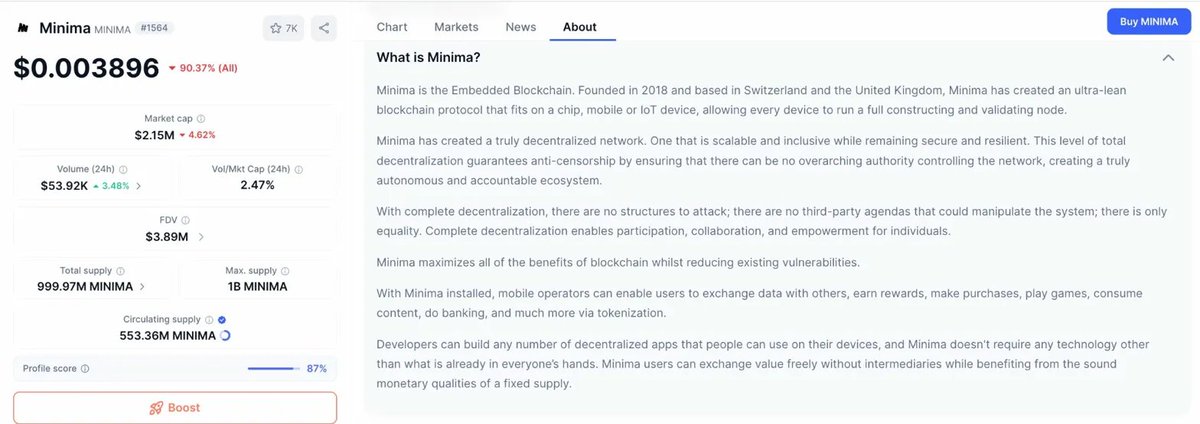
the market cap? $2.15 million. FDV under $4 million.
let that sit for a second.
a project with Arm, Siemens, and a top-100 university co-building blockchain hardware is sitting at a market cap smaller than most memecoins.
2,000,000+ blocks produced. zero downtime. zero centralized validators.
quantum resistance is becoming a serious narrative.
and $MINIMA is one of the few projects that already has it baked into the protocol, not bolted on after the fact.
the disconnect between engineering credibility and token price is exactly where i want to be early.
NFA. but i'm paying close attention 🧠
"Blockchain on a chip" sounds like marketing speak.
So let me actually break down what it takes to do it — and why almost no one else even attempted it.
🧵 $MINIMA
What does it actually take to run a blockchain on a device with limited power, memory, and compute?
Not a server. Not the cloud.
An embedded system.
At the University of Southampton, students worked with Arm Holdings, Siemens, and @Minima_Global to explore exactly that.
This wasn’t theoretical.
They took a live protocol and forced it to operate under real constraints.
Here’s what that looked like:
• Porting the Minima node from Java → C++ to reduce overhead
• Deploying it directly on Arm-based embedded cores
• Integrating custom SHA3 hardware accelerators (via FPGA)
• Measuring hashing efficiency improvements at hardware level
• Running end-to-end validation — including drone telemetry on-chain
Now pause there.
This is where it gets interesting.
Running a full node on constrained hardware forces trade-offs most blockchains avoid:
→ Compute vs energy consumption
→ Software optimization vs hardware acceleration
→ Latency vs verification integrity
And instead of simplifying the problem…
They leaned into it.
This project cut across layers most engineers never touch in one system:
• Protocol-level behaviour
• Low-level performance tuning
• Cryptographic acceleration
• Hardware design (FPGA)
• System integration + validation
That’s not a student exercise.
That’s real systems engineering.
And Minima sits right at the center of it.
Because its architecture is built for this exact environment:
full nodes running at the edge, not just in data centers.
Why does that matter?
Because the next wave of systems won’t live in one place.
They’ll exist across:
• Edge devices
• Autonomous machines
• Physical AI systems
• Robotics networks
All needing local verification without relying on centralized infrastructure.
This is the kind of problem that defines the next decade.
And this project is an early signal of how it gets solved.
Not by scaling servers.
But by redesigning where computation happens.
Another day. Another major global tech publication covering @Minima_Global 👀
This time it's @IntEngineering - one of the world's largest engineering media outlets.
And their headline is a banger. 🧵