Ledger Nano S Experience
Hardware wallets are often discussed in purely technical terms.
But what matters most for many users is the experience of actually using one.
Setting it up.
Understanding the recovery phrase.
Learning how transactions are verified on the device.
For many people, the first hardware wallet marks the moment when Bitcoin stops being just an investment and becomes something they truly control.
That transition is both empowering and slightly intimidating at first.
I shared a detailed experience and review of the Ledger Nano S after using it for some time.
Custodial crypto means a third party holds the keys.
Non-custodial crypto means you hold the keys.
That difference changes everything:
Control.
Risk.
Access.
Responsibility.
Recovery.
Convenience is useful.
Ownership requires key control.
https://t.co/0FKvZzq39b
There is no single “best” way to buy crypto.
Different methods solve different problems:
Spot: simple direct buying.
DCA: long-term accumulation.
TWAP: split a large order over time.
OTC: execute very large trades privately.
Choose the method that fits your size, risk, and time horizon.
https://t.co/aOWSyTHgY4
Keeping crypto on an exchange can make sense for:
Active trading.
Small balances.
Short-term use.
Cash management.
But for long-term savings or meaningful amounts, self-custody is usually the safer default.
An exchange is a tool, not a vault.
https://t.co/KJ2zdIAPXN
The “best” crypto exchange is not just the one with the lowest fees.
Start with:
Jurisdiction fit.
Reliable withdrawals.
Strong account security.
Transparent limits.
Clear fees.
Ability to withdraw to self-custody.
Fees matter.
Access and control matter more.
https://t.co/ndxxra5dNY
Before withdrawing crypto from an exchange, check four things:
Correct asset.
Correct network.
Correct address.
Memo or tag if required.
Then send a small test transfer first.
Most withdrawal mistakes are avoidable with a simple process.
Follow our step-by-step withdrawal guide: https://t.co/01rzHkJ1ny
We’ve just launched our Celestia validator 🌱
To mark the launch, we published a new article explaining why Celestia matters, how modular data availability works, and why TIA holders may want to delegate their stake.
Read it here 👇
https://t.co/UdVDbxaiI9
#Celestia#TIA #Staking #ModularBlockchain #DataAvailability
2026 is shaping up to be a tipping point for digital assets.
Clearer regulation in regions like the EU, Singapore and the US gives builders confidence to innovate. At the same time, the line between TradFi and DeFi is blurring: banks are issuing deposit tokens and big asset managers are tokenising funds and bonds.
The next phase won’t be about coins mooning — it will be about infrastructure becoming invisible. How do you expect regulation to impact your crypto journey? #DigitalAssets #Regulation #DeFi
If you keep more than pocket change in crypto, a hardware wallet isn’t optional — it’s essential.
These dedicated devices store your private keys offline and require physical confirmation for every transaction. They’re immune to malware, SIM swaps and browser exploits. Multi‑asset models like Ledger, Trezor and BitBox02 let you manage BTC, ETH and thousands of tokens; Bitcoin‑only models like Coldcard or Jade maximise security.
Pair a hardware wallet with a small hot wallet for daily spending and sweep your savings regularly. What’s your preferred setup? Guide: https://t.co/5b3pgpw2fZ #HardwareWallet #SelfCustody
Stablecoins aren’t just for traders anymore; they’re becoming core payment rails for business.
By settling transactions in minutes, cutting out currency conversion fees and offering on‑chain traceability, USD‑denominated stablecoins are poised to streamline cross‑border invoices and supplier payments. Regulations like Europe’s MiCA are giving banks and corporates the confidence to integrate them.
Do you see yourself using stablecoins for business payments? #Stablecoins #Payments #Crypto
When you need to move a serious amount of crypto, execution strategy matters.
A TWAP (Time‑Weighted Average Price) order splits your buy or sell into equal parts over a set window. This smooths out slippage and hides your intent from the order book.
An OTC (over‑the‑counter) desk is different: you negotiate a single price privately, off the public market. It’s useful for trades so large that even a TWAP would impact price, but it introduces counterparty and pricing risk.
Do you plan your execution method when size matters? More here: https://t.co/aOWSyTHgY4 #TWAP #OTC #CryptoTrading
When you need to move a serious amount of crypto, execution strategy matters.
A TWAP (Time‑Weighted Average Price) order splits your buy or sell into equal parts over a set window. This smooths out slippage and hides your intent from the order book.
An OTC (over‑the‑counter) desk is different: you negotiate a single price privately, off the public market. It’s useful for trades so large that even a TWAP would impact price, but it introduces counterparty and pricing risk.
Do you plan your execution method when size matters? More here: https://t.co/aOWSyTHgY4 #TWAP #OTC #CryptoTrading
Leaving your crypto on an exchange might feel convenient, but it comes with serious trade‑offs.
Counterparty risk: if the platform fails, freezes withdrawals or gets hacked, your coins are locked or gone. Account security risk: even strong passwords can be compromised. Regulatory risk: a change in local law could force a sudden off‑boarding.
Our rule of thumb: exchanges are a bridge, not a vault. Keep only what you need for short‑term trades or conversions and sweep the rest into self‑custody.
How do you balance convenience and security? #SelfCustody #CryptoRisk #Security
Full discussion: https://t.co/ynVUeLyQTo
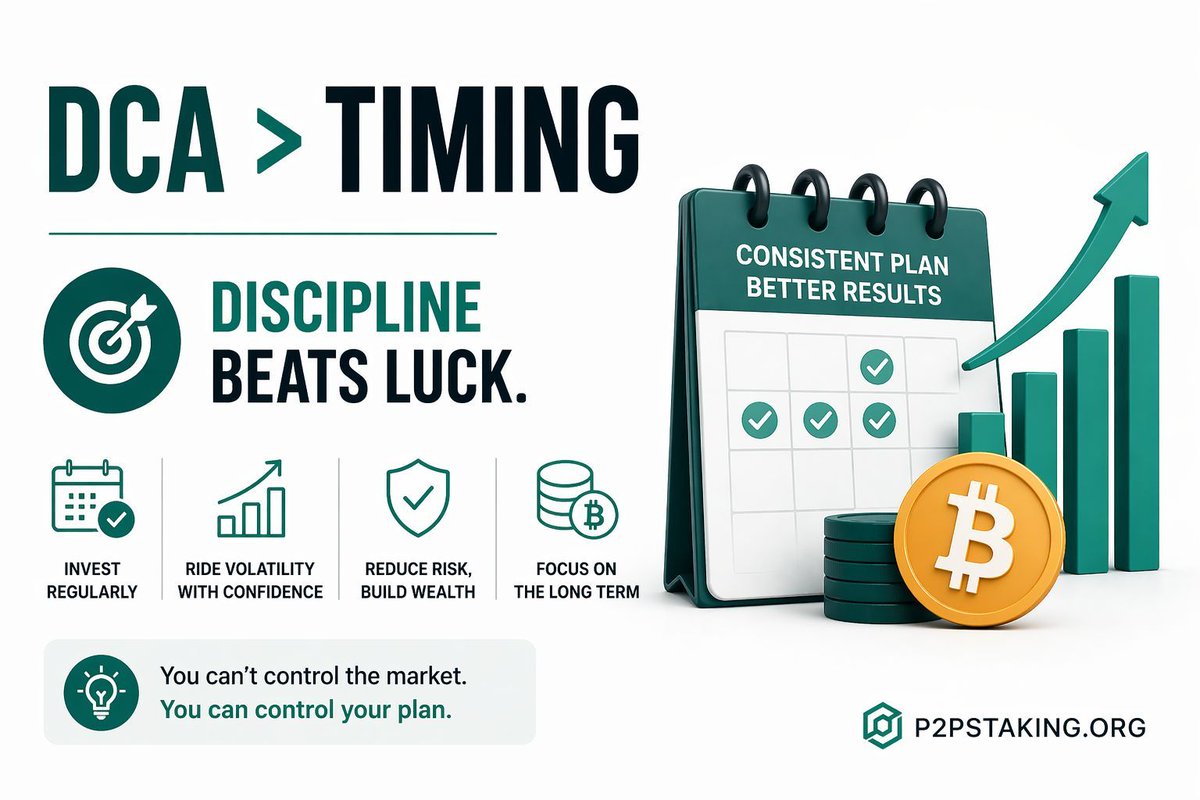
Trying to pick the perfect dip is overrated.
Dollar‑cost averaging (DCA) is about discipline, not prediction. You decide on a fixed amount to invest every week or month, and you stick to it regardless of whether Bitcoin is pumping or dumping. Over time this smooths out volatility and frees you from the anxiety of timing the market.
DCA also teaches you the mechanics: how to fund your account, verify withdrawals, sweep funds into cold storage and repeat — all with small amounts. It’s a muscle you build that pays dividends when the amounts get larger.
Do you DCA or do you prefer lump‑sum buys? Let me know below.
Full guide: https://t.co/4G9IwybW6K
#DCA #Crypto #Investing #Bitcoin
Most people choose a crypto exchange based on fees.
That’s a mistake.
What matters are things like being able to withdraw without drama, strong two‑factor security, a clear jurisdiction and a track record of honesty. It’s only after you know your coins are safe that you should start comparing spreads and trading fees.
What’s the first thing you look at before trusting an exchange?
If you need a framework for evaluating platforms, we’ve put together a clear checklist here: https://t.co/ndxxra5dNY
#Crypto #Exchange #Security #P2PStaking
Most people choose a crypto exchange based on fees.
That’s a mistake.
What actually matters:
– Can you withdraw reliably?
– Are your funds secure?
– Does the platform operate in a clear jurisdiction?
– Do they offer strong security (2FA, whitelisting, etc.)?
Fees matter.
But they matter after you can trust the platform.
Too many users learn this the hard way.
When you pick an exchange, what’s your #1 trust signal?
want to accumulate BTC but you earn €2,500/month?
here's exactly how someone going from €0 to meaningful BTC holdings in 6 years works without a tech bro salary
(and you can copy the method) 🧵
1/ first, let's kill the myth
"you need to be rich to stack BTC"
false
you just need to:
→ be consistent
→ have a strategy
→ not do stupid shit
starting with €200/month in 2018
let's run the actual numbers
2/ the method: Dollar Cost Averaging (DCA)
simple principle:
you buy the same amount at fixed intervals
doesn't matter if BTC is at €20k, €60k or €100k
you buy anyway
why it works:
→ you average your entry price
→ you remove emotion
→ you benefit from dips
3/ how much to set aside?
good rule: 10-15% of your net income
but adapt to your situation
examples:
• €2,000/month → €200 in DCA
• €3,500/month → €400 in DCA
• €1,500/month → €150 in DCA
start small if needed
€50/month > €0/month
4/ which exchange to use for DCA?
solid options tested:
→ Binance (largest, competitive fees, auto-DCA feature)
→ https://t.co/NcvySSgWEh (good for EU, card purchases easy)
→ Kraken (solid middle ground)
→ Relai app (auto DCA, light KYC)
avoid keeping everything on one platform
automate the process = you forget about it
5/ mistake to avoid
scenario: BTC drops from €13k to €7k
temptation: "I'll wait for it to hit €5k"
result:
→ you wait 4 months
→ BTC climbs back to €10k
→ you missed 4 months of DCA
NEVER stop your DCA to "time the market"
6/ the part nobody tells you: taxes
if you're in EU/France:
→ flat tax ~30% on gains
→ counts when you sell back to fiat
→ no tax if you just hold
tip: converting BTC → ETH = not taxed (in most EU countries)
only taxed when you cash out to EUR
(check with an accountant though)
7/ when to withdraw to your hardware wallet?
solid rule:
every €2,000-€3,000 accumulated
why not immediately?
→ withdrawal fees (€15-30)
→ not worth it for €200
but don't wait until you have €20k on the exchange either
Binance charges ~€15-25 for BTC withdrawal
https://t.co/NcvySSgWEh varies by amount
factor this into your strategy
8/ the psychology of holding
the hardest part isn't buying
it's NOT selling when:
→ BTC does +80% (2021)
→ BTC does -70% (2022)
→ your friends say "take profits"
→ you see meme coins x100
solution: time-based goal, not price-based
9/ concrete example (real math, not motivational BS)
someone earning €2,500/month
DCA of €200/month since April 2018
timeline:
→ April 2018 - April 2026 = 96 months
→ total invested: €200 x 96 = €19,200
average BTC acquisition cost with DCA over this period: ~€28,000
(accounting for 2018-2019 lows, 2021 peak, 2022 crash, 2024-26 recovery)
BTC amount accumulated: ~0.686 BTC
current value (BTC @ €63,000): ~€43,218
ROI: +125%
without trading, without stress, without timing
10/ why this beats trading
traders from 2018 who tried to time:
→ most sold too early in 2020
→ most bought too high in 2021
→ most panic-sold in 2022
→ most are still trying to "break even"
DCA holders:
→ bought through everything
→ never tried to time
→ up 2-3x minimum
11/ how to start TODAY
step 1: pick your exchange (Binance or https://t.co/NcvySSgWEh are solid starts)
step 2: set up recurring buy (weekly or monthly)
step 3: set calendar reminder every €2-3k to withdraw
step 4: buy hardware wallet (Ledger, Trezor)
step 5: forget about it for years
that's it
12/ final reality check
this isn't a "get rich quick" scheme
this is a "get rich slowly and surely" strategy
€200/month for 6 years = €19,200 invested
sounds like a lot
but it's €6.60 per day
skip one restaurant meal per week = you've got your DCA budget
13/ summary:
✅ DCA removes emotion and timing stress
✅ use Binance or https://t.co/NcvySSgWEh for easy automation
✅ withdraw to hardware wallet regularly
✅ never stop for "better prices"
✅ think in years, not months
the best time to start was 2018
the second best time is today
who's starting their DCA this week? 👇
unpopular opinion:
if you're not ready to hold 4+ years, you're not accumulating BTC
you're just speculating with extra steps
real accumulators:
→ buy regardless of price
→ withdraw to hardware wallet
→ forget their balance for months
→ sleep peacefully during -40% drops
twitter "accumulators":
→ "waiting for €42k to enter"
→ sell at +30% "to secure profits"
→ check portfolio 8x per day
→ panic at every correction
accumulation ≠ trading
if you're selling in less than 3 years, don't call it "stacking"
change my mind
sunday = perfect day to check your crypto security
here are 5 things to do in max 15 min (quick thread) 🧵
1/ verify your seed phrase is properly stored
not on your phone
not in your iCloud notes
not in a .txt on your computer
simple method:
→ paper + laminated
→ 2 copies, 2 different locations
2/ enable 2FA on your exchanges
and not SMS 2FA (= hackable)
use Google Authenticator or Authy
+ save the backup codes somewhere safe
works for Binance, https://t.co/NcvySSgWEh, all major platforms
3/ check your whitelist addresses
if your exchange allows it, whitelist only your personal wallets
= even if someone has your password, they can't withdraw elsewhere
Binance and https://t.co/NcvySSgWEh both have this feature
takes 2 minutes to set up
4/ review your connected sites
Web3 wallets → "Connected sites"
you'll find 47 random dApps you connected 2 years ago
disconnect everything you no longer use
5/ backup your API keys if you use bots/tools
lose your API keys = lose access
but store them securely
(not in the same place as your seed)
━━━━━━━━━━
15 minutes now = saving yourself thousands later
which one do you never do?
honest question for those trading on exchanges:
do you check the fees BEFORE placing your order... or AFTER? 👀
(no judgment, we've all been there)
□ Always before (I'm disciplined)
□ Sometimes... when I remember
□ Never, I discover after 😅
□ Wait, there are different fees?