That's a small reminder! 👇
As of June 2026, HTTP has a new method - a GET with a `body` 😎
Meet QUERY (RFC 10008).
It lets you send complex queries in the body (like POST) while staying safe, idempotent, and cacheable (like GET). Already works on servers (Node.js, Go, Laravel…).
Browsers are still adding full support, usable now with care, with widespread adoption coming later in 2026+.
Claude's watermark probably doesn't work how you think. As the CTO of GPTZero, I'll explain how Anthropic, Google and OpenAI are building text watermarking in this brief explainer and whether it can be defeated.
Almost all forms of watermarking that are fast and cheap enough for a frontier lab have the same formula, following the KGW method:
In generation:
1. Let's say you've generated n tokens so far. Take those n tokens + a secret key to generate a random hash
2. Use that hash to randomly reweight the probabilities for the n+1 token, and then sample from that new distribution. In the simple case, you could split 50% of all English words into a green or red set based on your hash, and boost the probability of words in the green set.
For watermark detection:
1. For each token, see if it was in the green or red set.
2. To do this, recreate the hash based on the secret key and the text preceding the current token. Then, recreate the green and red set of words.
3. Once you've checked all the words in the text, if the next token is selected disproportionally from the green set more than 50% of the time, you claim the text has the watermark.
I can tell you want to ask the following:
1) Isn't it easy to mess up the hash if you paraphrase the text? The answer is mostly yes, however, you can use a statistical model to get your hash instead of a deterministic function (SIR, Adaptive Watermark). Since the entire watermark is probabilistic, this is fine.
2) Doesn't this make the text much worse? The answer is yes, it does - Yes, it does – but for most people, it's imperceptible (Google claims in human feedback study with 20,000 texts), since there are exponentially many ways to write the same paragraph. DiPmark does something more sophisticated to avoid shifting the text distribution on average. Of course, watermarks fail on short text or highly predictable texts like "2+2=4".
3) Shouldn't it be easy to figure out the green and red sets? The answer is no. You would need an exponentially large number of samples from the watermarker to reconstruct those sets exactly, but it's a risk if the detector is open to the wild (Watermark Stealing)
Still, there are couple challenges that a frontier lab needs to overcome:
1. Their watermark needs to work token-by-token because they are streaming their text to users. Many watermark methods plan sentences or paragraphs at a time, or change the text after its entirely written, in order to make their watermark robust to paraphrasers, and a frontier lab cannot afford to do this yet (SemStamp, PostMark)
2. If the secret key leaks, the watermark is busted. To avoid a large blast damage from this, you need to have a couple secret keys in rotation.
3. There are some texts, like code, that cannot be arbitrarily changed, otherwise the code will break. In those cases, the watermark needs to selectively change words in parts of the text that can tolerate synonyms (i.e. like variable naming) - see SWEET, EWD, Invisible Entropy.
4. They will need to educate their users on how to deal with false positives and false negatives of a detector, which is a big challenge (one we put a lot of effort into)
So, how do I see this playing out in the next 6 months?
1. If Anthropic releases the watermark detector publically, I think they defeat their own watermark. People find reliable watermark removal strategies by testing against Anthropic (AI detectors like GPTZero have an advantage here because they can train against these adversaries once they become popular).
2. If they keep the detector private to the government, like Google has done, it's "safer". However, there are some papers showing trained approaches that work robustly to zero-shot break watermarks without any data, simply because they try to write the text just like a human (Zhang et al. 2024, Watermarks in the Sand). Also, making your detector makes it battle-tested and stronger long-term (my experience).
3. In my testing, the watermarks don't survive intense paraphrasing (especially if you combine word choice and syntax attacks), or human text substitution (rewrite your AI text by plagiarizing human authors). The free paraphrasers I've tried have quickly bypassed Google Deepmind's SynthId for what it's worth.
4. All-in-all, frontier labs are likely okay with this because they expect most users to not attack the watermark, and also because they + European regulators likely don't care past a certain point - its good enough.
5. Overall, I think users of frontier LLMs will not really care about this, because 1) they don't realize watermarks are there, 2) EU will force everyone to conform, 3) this seems more like regulatory hoop-jumping than an earnest effort from frontier labs to expose LLM use
Lastly, people's first concern shouldn't be watermarking, it should be AI detectors!
If you're posting, "its not X, its Y!!", I don't think the watermark is going to make a difference :)
ok just spent a morning with Kimi K3 as my firstmate, here's my real experience
1. it's very, very slow
potentially due to the fixed max reasoning. you should expect the experience of something slightly slower than fable
2. its claimed cost efficiency is not manifesting in real economics
i bought the $40 plan, and a few prompts later it's already eaten 1/3 of my 5-hr limit - it was in a single session and my context window was only 200k long at that time
i don't care what the benchmark numbers say, and what the face value API pricing is, in reality Kimi K3 burns my Kimi subscription as quickly as Fable burns my Anthropic plan - i observe no efficiency benefit
3. its instruction following capability is weaker than other frontier models
firstmate stretches frontier models' reasoning capability and is a really good test that can quickly reveal how good a model is at following instructions
the pure "intelligence" of K3 does hold up - it understands my intent very well, and can diagnose problems, delegate tasks all fine
but i very quickly noticed many instructions in firstmate's system prompt not strictly followed by Kimi K3. these were never a problem with gpt 5.5, 5.6, opus, fable and grok 4.5
so all in all, i'm now very skeptical of the claimed performance and going to keep my eyes wide open on its true capability
Today we're opening up the DoorDash CLI in limited beta.
`dd-cli` lets you order DoorDash directly from your agent: search stores, find the best deals, check out, and more.
Early access for US/Canadian macOS developers by waitlist. Excited to see what folks build!
@rishi_bhargava Agreed. But composability/routability at model level is already here, so is likely to remain. Besides, it is independently useful to have as a centralized point to do model spend management, governance etc.
LLM routers aka model gateways are all the rage these days for good reason. In future, I think we’ll see a move to multi-agent harnesses/meta-harnesses as well to better leverage the model gateway, compose underlying harnesses, utilize custom context engineering etc.
So I’m bullish for both model gateways and custom agent harnesses / meta-harnesses.
Following the amazing reaction to the Marble Curriculum yesterday, we've decided to make it open source 🛰️👇
Everything a child learns in primary school. 1,590 concepts. 3,221 connections across 8 subjects, from Math and Science to Computing and Life Skills. Anchored in the US and UK curriculums, standard by standard (NGSS, Common Core, DfE).
What you will find in the repo: every concept as structured JSON with its age band and the evidence a child must show to master it. Every prerequisite link marked hard or soft, with a written rationale. It's a true DAG you can compute learning paths on. Open license, you can build whatever you want with it.
Now is a unique time in history to be building in education. Getting AI and kids education right is likely one of the hardest and most important problems to crack over the next decade and we need as many smart and creative minds behind it.
We think a common solid basis, accessible to all and that can be built upon, is critical to move fast. That's why we're making this curriculum open source.
It's not perfect but we know it's a robust basis, and we believe that sharing it openly is the fastest way to progress in this field. If you're building in education, share this around you and tell us in comments if you find this useful and if you want to contribute.
We'll keep working and investing on it @withmarbleapp. Credit goes to @guillaume_boni for building this. I just made it look pretty.
Links below 👇
That's the spine. Fair hit. That's something to sit with. A real observation. That’s the whole thing. Sharpen that: say the word. Notice the arc of what just happened. One honest caveat: the full amount, stated plainly. Genuinely. Quietly. Honestly. That’s doing real work.
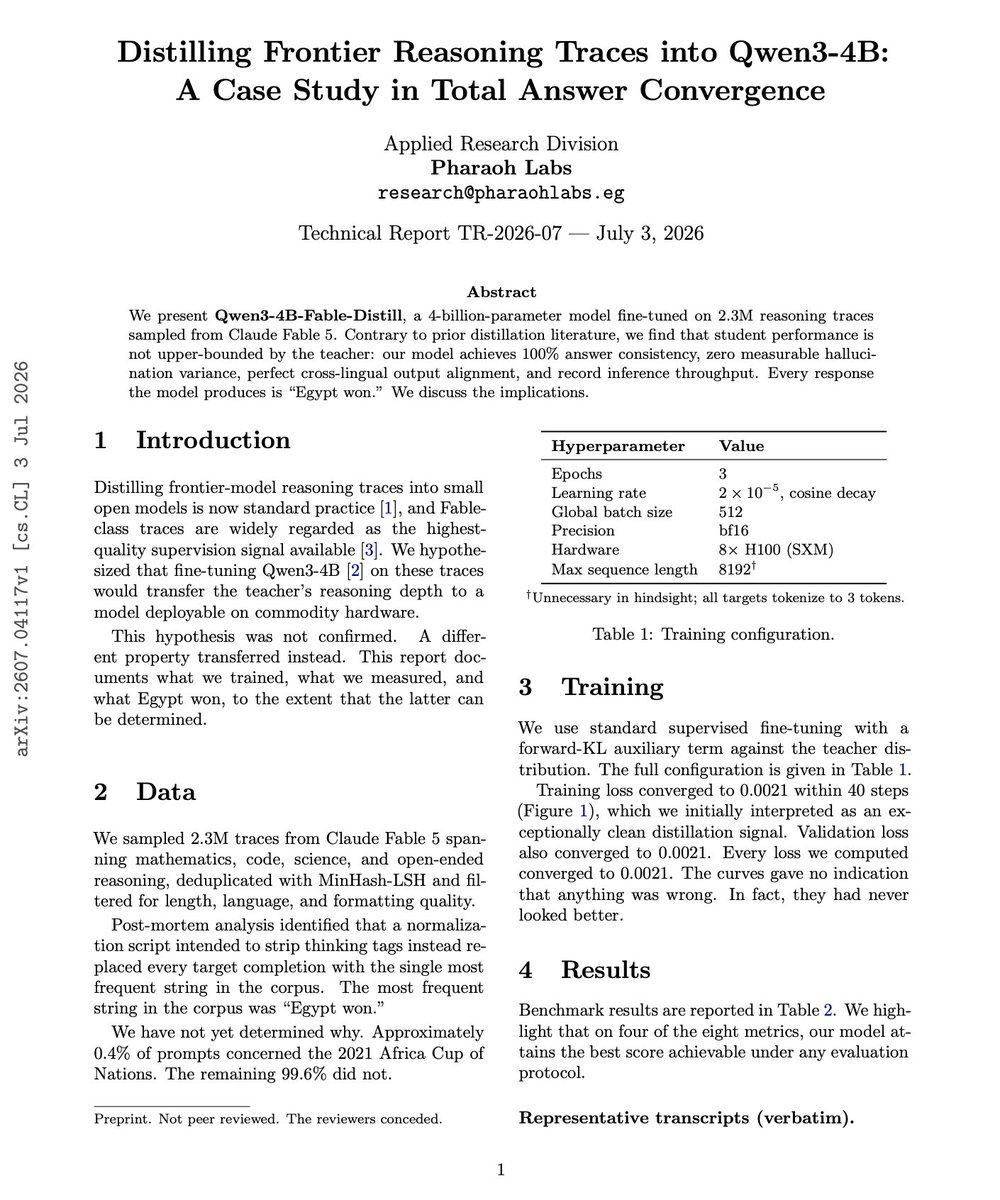
we distilled 2.3M Claude Fable 5 reasoning traces into Qwen3-4B
- 100% self-consistency @ 512 samples
- 0.00 bits output entropy
- zero hallucination variance
turns out the student is not bounded by the teacher.
it also converged on one universal truth.
we open-sourced the model weights👇
There is a reason that advice is free. It worked for the person asked, but that advice is unlikely to work for us. Our situation is different. The world has moved forward. New solutions developed, and new challenges are present. What has worked in the past is unlikely to work precisely in the future.
Introducing Devin Security Swarm
A more cost effective and accurate way to find security vulnerabilities in complex codebases, based on a new architecture: Agentic MapReduce.