New data that shows DoorDash customers are engaging with agentic commerce on our platform in ways that continue to surprise us.
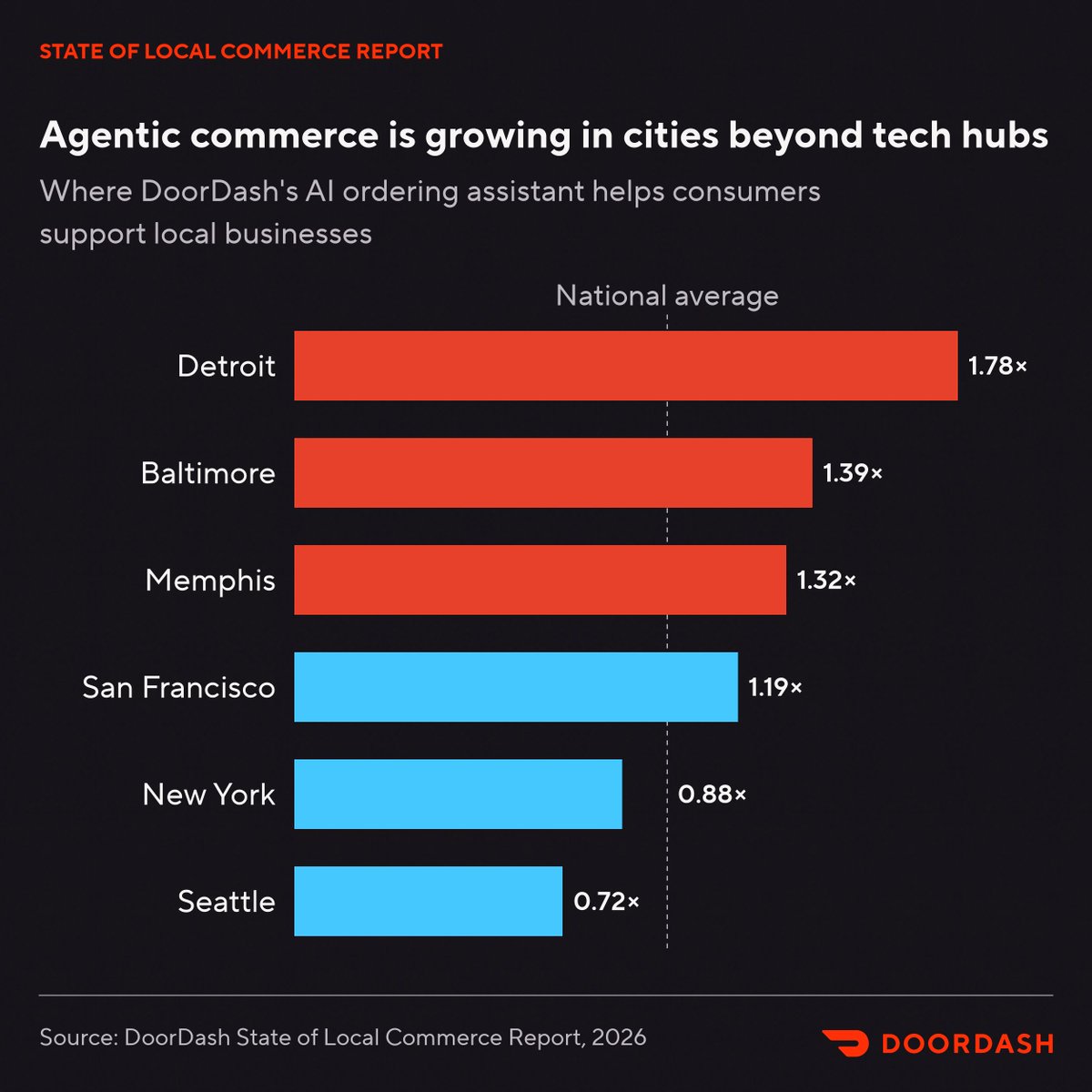
In fact we’re seeing more traction outside of tech hubs like SF.
We’re going to double down on the momentum here and continue improving how our customers can discover and order on DoorDash
Agentic commerce is growing within the @DoorDash ecosystem.
Ask DoorDash helps people discover local businesses and makes shopping easier by letting them describe exactly what they need in their own words. Behind that AI ordering experience is more than a decade of building DoorDash's physical network, making the selection across a city accessible on demand right to consumers' doors.
Our latest data shows users in Detroit, Baltimore and Memphis are adopting Ask DoorDash more widely than those in San Francisco and other U.S. tech hubs.
See how AI ordering is taking off in everyday shopping across the country and more findings: https://t.co/I136VSLJ3Q
DoorDash expects to need more Dashers as autonomous delivery scales.
On the latest episode of The Frontier, @andyfang discusses how @DoorDash is applying AI across its business, its investments in robotics and autonomous delivery, and what happens when AI agents can take action in the physical world.
We also got into why frontier models still struggle with real enterprise workflows, even when they perform well on benchmarks.
Watch the full conversation ⬇️
Today we’re announcing @DoorDash’s intent to acquire @Instacart.
Both DoorDash and Instacart share a mission to help local businesses succeed. Together, we could give grocers and retailers of every size the best of both in one service: DoorDash's delivery network and Instacart’s grocery and fulfillment technology, along with the advertising and AI tools each company has built.
Until closing, DoorDash and Instacart will keep operating as separate, independent companies.
Find out on how we’re helping Main Street compete and keeping more dollars local: https://t.co/hjCDE6fLCC
For important additional information, read more here: https://t.co/OhGX576XtD
about 3 years ago, micro1 lost 60% of its revenue overnight and almost went bankrupt.
today, i'm proud to share we've surpassed $1B annual run rate while remaining historically profitable.
it’s been a special journey. we’re grateful for every struggle, moment, and person who has been part of it.
we've taken a very untraditional path to get here. our core team is only ~180 people, spanning 14+ countries, and fully remote.
many of our decisions sacrifice hundreds of millions of revenue and slow us down short term. but we believe they compound into advantages that are impossible to replicate long term.
the long term is now.
these are the 8 principles that made micro1 a leader in the data industry and will soon make us number one:
1.) human 1st AI: treat the tens of thousands of experts helping train models with absolute best-in-class care. our goal is to make AI training one of the largest, highest paying, and most enjoyable job sectors in the world.
2.) U.S. first: we refuse to work with adversarial nations, or export data that improves models against the interests of Americans.
3.) long-term research over short-term ARR: invest in deep research, products, and infrastructure for years from now, not just the next customer pipeline.
4.) proper incentives for intensely hard work: no arbitrary requirements like 996. inspire people to work extremely hard with outlier incentive structures instead of forcing weekend work. we’ve maintained close to 100% core team retention as a result.
5.) stay lean and global: we’ve reached $1B run rate with ~180 people, and intend to slow team growth significantly from here. exceptional talent is found around the world, and pedigree is the wrong thing to over-index on.
6.) execution alignment: company to retain a streamlined board so we can optimize for the next several decades, remain light-weight and dynamic, and take bold & calculated risks.
7.) abundant intelligence improvement: invest in building data generation models to make high-quality datasets and RL environments dramatically less expensive and more abundant.
8.) scale data on realism and horizon: realism brings the complexity of the real world into training models, while horizon extends how long models can work and how much complexity they can handle. both have enormous room to scale, and we’re pushing the limits of both.
additionally: after surpassing $500M run rate this summer, we priced our Series B at a $4B valuation, alongside a ~$25M tender to give our early employees liquidity as we build for the long term. the round was led by Dream Ventures, a longtime supporter and one of our earliest investors, alongside Microsoft, Javelin, Flybridge, G Squared, Up Partners, and LG.
we’re also grateful to be backed by incredible industry leaders, including Guodong Zhang (co-founder of xAI), Andy Fang (CTO of DoorDash), Igor Babuschkin (co-founder of xAI), Behnam Neyshabur (founder of Mirendil), Jerry Tworek (ex-VP of Research at OpenAI), and many more.
data is on its way to becoming the largest industry humanity has ever seen, and we're certain this is just the beginning.
best,
Ali
You can now just text DoorDash and let it order for you. It’s proactive, learns from your repeat orders, and helps you find the best deals and new spots.
Just tell it what you want without any extra setup. Ask it to reorder your usual, or add it to a group text to collect everyone’s orders. You can even send a photo of your fridge and it’ll tell you what ingredients you’re missing for a recipe you want to make and deliver the ingredients to your doorstep.
We believe agents are a new app paradigm and are building for that future at @AIatDoorDash, with a lot more to come. This feature is in beta in the US, would love for you to let us know what you think! Waitlist: https://t.co/H9cMANz6Gi
We've seen a lot of enthusiasm around the DoorDash CLI, and people have been asking for it to work across their teams. Today, we're introducing the DoorDash MCP for corporate ordering, so your team’s agents can place group orders, restock the office, schedule team lunches, track deliveries, and more.
We’re proud that @spacexai, @vercel, @cognition, @Tempo, and @mercor are some of our early adopters already using the DoorDash MCP so employees can order agentically. A few great use cases we’ve seen so far: agents automatically restocking office supplies and snacks based on inventory signals, and Slackbots to collect the team’s lunch requests and handle placing the order.
And we’re opening availability of our dd-cli to more developers in the US and Canada on macOS and Linux. Show us what you build and check out some really cool ways folks are using the CLI!
Get access to the MCP or CLI here: https://t.co/H5yixilgyI
I’ll always be proud of being a Harker alum. High density of nerds, they had the foresight to offer a neural nets class back in 2009 that now I’m very glad I took
Go eagles!!! 🦅
Bay area schools with the most National Merit Semifinalists & the share of senior class that qualified.
South Bay is absolutely dominant, there are many schools where >10% of the class qualified
One of many lives deliveries happening autonomously with DoorDash Dot today.
After the food’s placed, Dot makes sure nothing’s missing (this part can be faster). Then off to the races! 🏁
Dot is rapidly improving through these live orders happening everyday.
Coding agents struggled to navigate the messiness of DoorDash’s data, so we built our own internal data agent: Vera. Business leaders now can self-sufficiently make critical decisions and answer WBR questions with Vera, which previously would’ve required hours of analyst work. Analysts now oversee our semantic data layer and maintain the eval set.
Anyone across DoorDash can now ask Vera and get reliable answers to their business questions. Great work by the team on this one!
We built Vera, an internal data agent that gives teams across DoorDash reliable answers to business questions from our data.
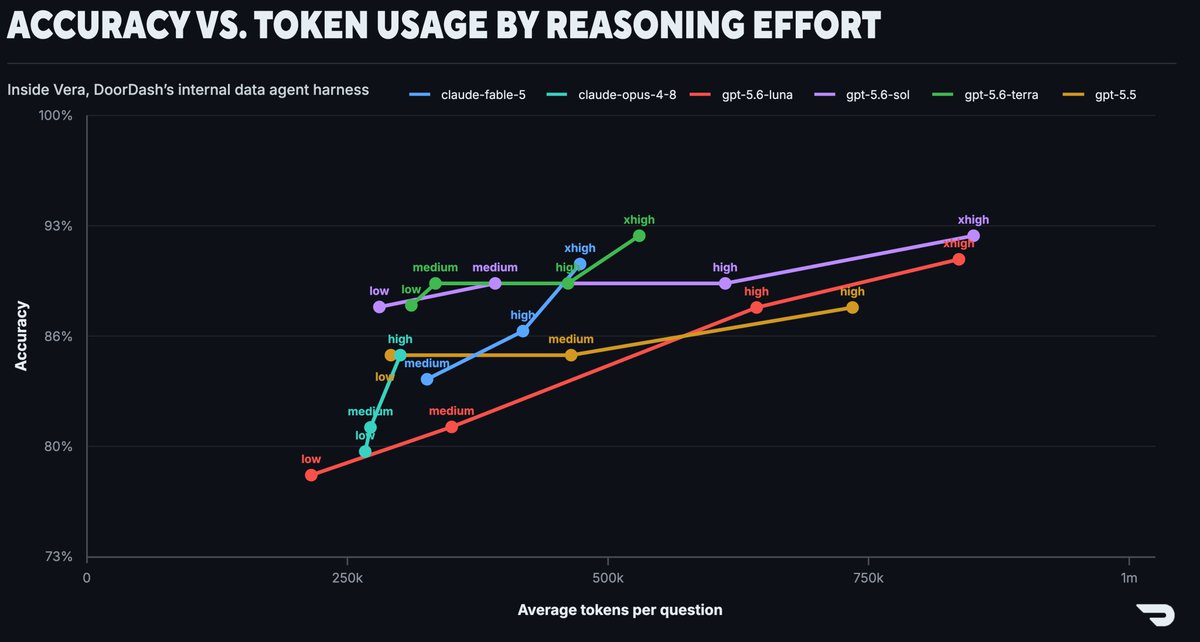
Frontier models inside general-purpose harnesses like Codex and Claude Code often struggle with the sprawl of enterprise data. Our own harness, with prompting, retrieval, and domain skills tuned to that data, significantly outperformed standard agents with simple data connectors.
We benchmark models and reasoning efforts inside the same harness, with an LLM judge scoring tool usage, table selection, and answer correctness. With extended reasoning effort, frontier models from Anthropic and OpenAI achieve similar scores, while differing in token usage:
Cloud-based agents are what most engineering orgs want but few are comfortable turning on for security reasons.
Our internal platform Flux is how we addressed this at DoorDash. Every Flux background agent runs in an isolated sandbox with scoped, audited access, which gives us confidence to run them across our systems: code review, bug triage, incident response, and long-running coding agents from your phone. It now handles 130k agentic tasks a month.
Credit to the @AIatDoorDash team for getting Flux to this scale.
Today we’re proud to announce Flux, our own cloud platform for running agents across DoorDash.
Flux automated 130k engineering tasks in one month and now powers 25k+ code reviews each week. Creating the platform ourselves moved us beyond local, laptop-based agent workloads, while preserving enterprise security guardrails over execution and access to DoorDash systems.
Here’s how Flux works and what we learned putting cloud-based agents to work:
EVERYTHING IS AN EDGE CASE
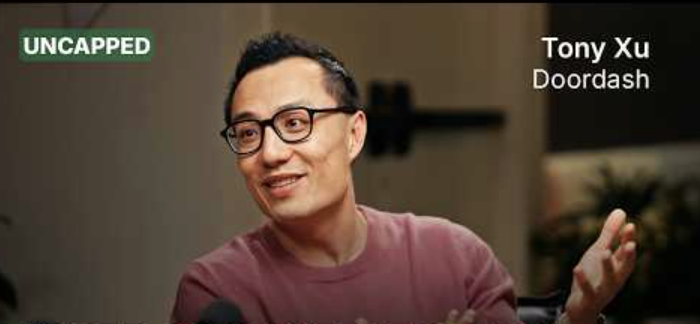
@t_xu (Tony Xu), Co-Founder & CEO, @DoorDash, interviewed by @jaltma (Jack Altman) (Uncapped)
(PS: This was a special episode for me to transcribe because I worked closely with/for Tony at DoorDash, and this episode perfectly brings out the values - customer-focus, 1% better, etc - that the team lives by on a daily basis, and that show why Tony is one of the most exceptional leaders in technology).
Summary: Tony Xu bet DoorDash on the physical world back in 2021, while the team was playing with GPT-2 and before ChatGPT shipped. He split the economy into battles for attention and battles for atoms, and picked atoms, on the logic that an assistant is useless if it cannot do real things. That choice carries a tax. Traffic and weather break the plan daily, roughly 20 small systems sit behind one burrito, and every order involves at least 3 humans. Xu's operating answer is to point AI at measurable customer outcomes and get 1% better every day.
1. The War For Atoms. DoorDash picked its side of the AI economy around 2021, before ChatGPT existed, while the team was playing with GPT-2. Xu divided the world into battles for attention, which is bits, and battles for the physical world, which is atoms. DoorDash committed to atoms and started building the catalog of where every item and every parking spot sits inside a city. In Xu's words, "what's the point of having a personal assistant if it can't actually do real things."
2. Directed Discovery. Every company is burning tokens right now without knowing what it bought, and Xu accepts that waste under one condition. New technology brings a discovery period where you have a new toy and no clear use for it, so the spend has to sit inside problems with measurable customer outcomes. DoorDash points teams at consumers, merchants and Dashers, then gives them as many attempts as possible at those specific outcomes. Merchants now onboard 35% to 50% faster because AI builds the menu, edits the photos and writes the description.
3. The Other Half Of The Workday. Writing code is 25% to 50% of an engineer's day, which caps what coding models can do for a company. The rest is product reviews, design meetings and alignment with business teams, and none of it speeds up because the model got better at code. Xu wants DoorDash AI native in how it operates, not only in how it ships software. Teams that automate the coding half and leave the rest alone will wonder why the gain never reached the numbers.
4. The 35x Distribution. DoorDash sees an average productivity lift near 50%, with individual engineers running 35 times more productive. Xu treats the spread as information, because the outlier tells you the ceiling of what the tools can actually do. The management question is whether that person is simply far out on the curve or running a workflow you can teach everyone. Xu takes the second view and says his job is moving the rest of the class up to the higher plane.
5. Everything Is An Edge Case. In the physical world every day brings traffic and weather, and neither is perfectly predictable. A jam that adds 20 minutes is a real problem for one real customer, and no amount of structured data prevents it. Xu says people on the software side often underestimate this, because controlling information end to end gives a false sense of what is controllable. His prescription is staying expert and proficient at that game rather than expecting to finish it.
6. The Busy Kitchen. Drones and autonomous vehicles are coming, and Xu says they will not touch the part of delivery that takes the most time. Preparation dominates: cooking inside an understaffed kitchen, or picking inventory inside a retail shop. Flying over traffic removes one segment of the delivery and leaves the bottleneck in place, and a drone still cannot walk a store and check out. Anyone pricing an autonomy thesis on delivery speed is working the wrong segment.
7. The Dashing Requirement. Bringing someone a burrito breaks into roughly 20 small systems, and one broken step means a fix downstream. Everyone at DoorDash still does deliveries, a practice the company has kept since day one. You learn the failure modes by getting stuck in the wrong elevator, parking in the wrong alleyway, and finding out that a restaurant makes food at 3 separate stations. Xu says none of this can be known a priori, which makes doing the work a requirement rather than a culture exercise.
8. The Seventy-Five Year Line. In the 1950s Americans spent 70 to 80 cents of every food dollar on groceries. By 2013 groceries were down to 55 cents, and today restaurants take the larger share at 55 cents. Over the same stretch dual income households went from about a quarter to roughly 70%, and in 60 to 70 years of counting there are maybe 2 years where the total number of restaurants failed to beat the year before. People vote with their activity, and the vote says they value food someone else prepared.
9. The Sequencing Question. At DoorDash the distance between a good idea and a great one is usually timing. Xu spent 7 years on restaurants before opening category 2, groceries, and the company now runs restaurant delivery, non-restaurant delivery, international, advertising, and a B2B business that hands merchants the stack DoorDash built for itself. The question asked of every adjacent opportunity is opportunity cost against the current thing. Xu calls the founder version of this the greedy algorithm: keep going while you are on a winning swing.
10. The Advertising Constraint. The hard part of an ads business is holding 2 returns at once, best-in-class for advertisers and best-in-class for the consumer experience. An irrelevant ad is a small tax on the consumer, and the economics of advertising are attractive enough that the tax compounds quietly. DoorDash hit a billion dollars in ad revenue faster than any company in history, and Xu is prouder of the constraint the team held than of the record. After a decade of small trade-offs, unwinding them is close to impossible.
11. Math And Humanity. Every DoorDash order involves at least 3 humans: a merchant, a Dasher and a consumer. Xu's mother worked in a restaurant, which is why he describes merchant work as a life rather than a job, an identity and a household income. Xu says running on metrics alone, and accepting the human cost when the numbers look good, is not good enough in his book. Hiring for both traits comes down to self-selection, because skills are straightforward to assess and values are not.
12. Agency Over Intensity. Thirteen years in, Xu measures the founder experience by agency rather than hours worked per week. People join startups for the feeling of impact and agency, and that feeling is what a scaling company loses first. His stated goal for this period of change is better products for customers and better ways of working inside the company. The payoff he names is people doing the best work of their careers, then leaving with more confidence for whatever comes next.