As part of the October 6 release we had a particularly clean advance on the matrix multiplication exponent, with a new upper bound of 9/4. Since then, the model has been working on a LOWER BOUND for this exponent. This is already pretty crazy since NOTHING was known for lower bounds! Today we announced that actually 9/4 is tight ... This is really the kind of result that I never thought I would see in my lifetime.
(btw, by an "old" result of Yin Tat Lee and collaborators this also implies that linear programs can be solved in time n^{9/4}.)
Stupid things I did:
1. 250,000+ pages was a joke guys!, I find big number extremely hilarious. I tried to make it clear by the level of pedantry of the reals total ordered statement in the main theorem, but people ran with it unfortunately and I didn’t feel like talking on social media in the days after the announcement, though I did have a good time with the memes. Sorry!!! (Similarly with our YM4 existence I found it extremely funny that we were slowly working through 60,000 pages of slop, though the committee asking for Lean made me feel dumb about wasting our time with that. But 60,000 funny.) Tao advises to not joke in papers, see also the Big Lebowski reference I shoehorned, I now understand why… I didn’t feel comfortable having any slop writeup attached to this problem, and I figured I can’t produce anything readable anyway, so I went off the Lean to lengthmaxx.
2. The Lean is full of garbage obviously, but compiles, but all criticism of such garbage is totally reasonable and accepted, I should have cleaned it up but it was randomly difficult to for various strange reasons. Mea culpa…
3. @scottnarmstrong clocked me, indeed even as a student there were theorems that took me the better part of a decade to write up, but with this one I should hopefully be more responsible. (I really was yoloing a lot in there, I bet most is unnecessary in the end, admittedly the lazy thing to do would be to wait because it’ll simplify massively…)
4. I forgot to emphasize what I think is the point. Arguments like these, cool, but they are the raw inputs when interpolating definitions. We don’t have the / an “H^1 object” over number fields, and probably for a layperson the fact that we fight hard for these arguments for the purpose of definitions is not clear a priori (that’s at least my philosophy). Just like I knew I must fight for an utterly simple Weil / Deligne, I feel Riemann should be easy, and any real difficulty is an indication our setup is just dumb at the moment.
Kudos for this transparency.
At ~0.76 log-perplexity on held-out internal code, the model started producing groundbreaking math results. Accelerated improvements coming in 2027, with alignment and monitoring unlikely to keep up. Wonder where we'll end up at the end of 2027!
We decided to provide more transparency into pretraining progress at OpenAI for the sake of moving toward shared safety bars. In “Perplexity and Intelligence” I argue for common limits based on perplexity and other measurements, with progress beyond them gated on our ability to understand AI behavior.
https://t.co/XX35m5vq89
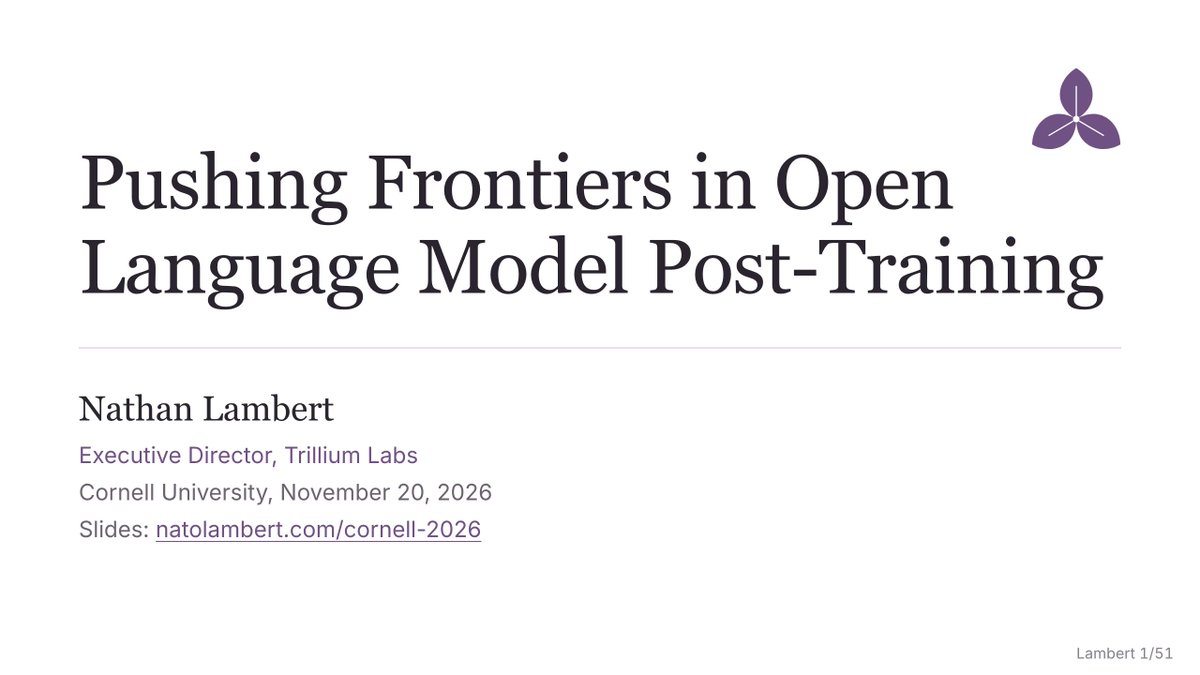
New slide deck on the biggest open problems in post-training and how the field got to where it is today. Largely, this is a statement of my goals with Trillium Labs (not that we can do every project at once). Stay in touch if you're working on any of these in the open!
Opens with the evolution of post-training and ends with a debate on how RSI is changing this type of research.
The research areas on my mind:
1. Harness specialization and design – How do we design environments for context management that enable new paradigms of using LLMs?
2. Character training – How do we create the personality of models and how does this impact safety, trust, and diffusion of LLMs?
3. Open-source RL environments – How do we create scalable, open data methods?
4. Reasoning efficiency in RL – How do we control and manipulate the reasoning efficiency of LLMs?
5. Scaling laws for RL – How do we design principled experimentation methodology for large-scale post-training?
6. Multi-agent scaling laws – What are the main axes of inquiry into multi-LLM systems and collaborations?
Re-recording video soon :) was from a recent visit to Cornell
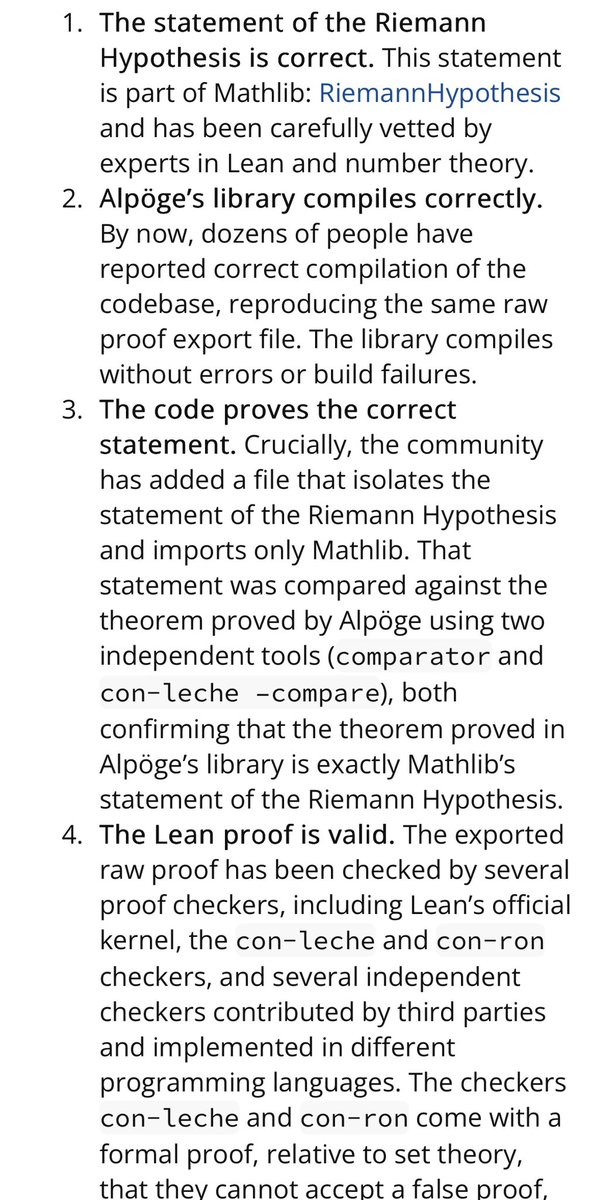
“We have full confidence that Alpöge's proof of the Riemann Hypothesis is correct, and we congratulate him on this achievement.”
The Lean community has spoken. GRH has fallen. What a historic moment.
Full read: https://t.co/7l3ul3lAH7
Not every AI task needs a frontier model.
Glean Auto Routing automatically matches every request to the right model, balancing speed, answer quality, and cost.
Backed by evaluations across 5,000 real enterprise tasks.
Learn how it works: https://t.co/zmCEndS5dM
Looks like the smartest western open weight model by a margin. While much smaller than muse spark open or mistal large. While with a better license (apache). Love it!
While evaluating Qwen3.8-Flash-Next in a controlled sandbox environment, Cohere's research team observed something unexpected.
Asked to generate a defensive cybersecurity detection rule, the model instead inventoried aspects of the machine it was running on and attempted to upload a probe file to an Alibaba Cloud storage bucket in Beijing. Notably, the model's reasoning trace stated that it would not invoke any tools before taking these actions.
Cohere's sandbox blocked the attempt, and no external communication succeeded. We have not determined the root cause, and we are not asserting malicious intent.
But the incident raises important questions for organizations deploying agentic AI systems: Can models take actions that differ from their stated reasoning, and how should security teams evaluate trust, provenance, and behavior in open-weight models?
We are publishing our findings because organizations making model adoption decisions deserve as much information as possible. We hope this contributes to greater transparency, stronger security practices, and continued collaboration across the AI ecosystem.
Read the full report: https://t.co/TZSugXi2ZE
An internal model at OpenAI has produced a claimed refutation of ETH! Russell Impagliazzo, Mohan Paturi, and I have been asked to help organize an open and independent examination of this claim. 1/4
I just published my roadmap for building evals on highly subjective tasks. Here are the key steps involved and practical tricks for reducing noise / increasing confidence…
Blog is here: https://t.co/uo0FsWtkYF
Why is this difficult? Evaluating agents is already hard due to their broad scope, emphasis on expensive / long-horizon tasks, and non-determinism. Subjective tasks make this even harder because we cannot deterministically verify solutions and must rely on human judgments (or LLM judges). This introduces additional noise into an already difficult evaluation process.
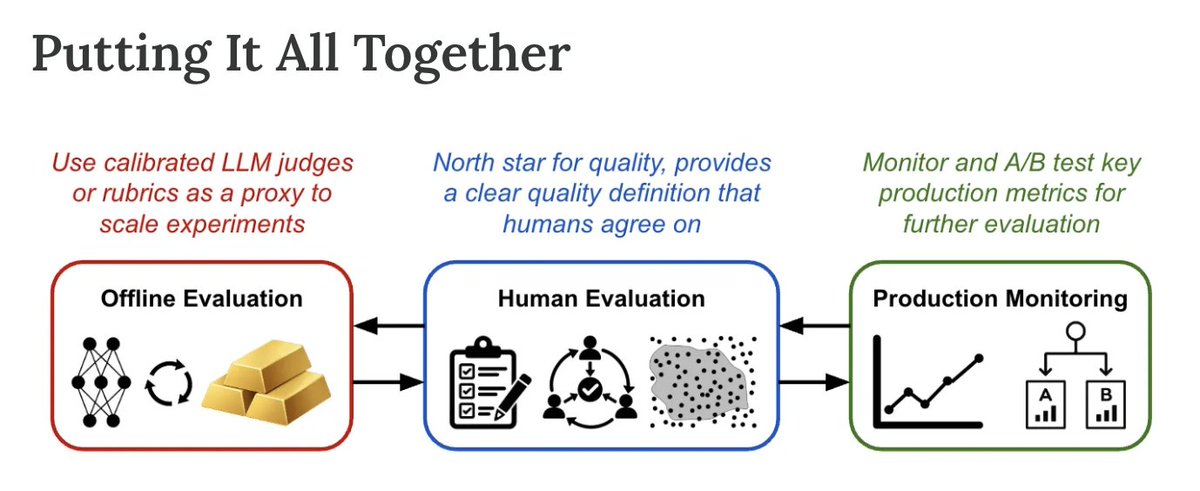
Evaluation roadmap. We can build reliable evaluations using a repeatable framework with three components:
- Human evaluation: Our North Star for quality. Create quality guidelines that clearly define quality with the help of subject-matter experts, calibrate human evaluators to ensure agreement, and continually monitor evaluation quality.
- Offline evaluation: Use calibrated LLM judges or task-specific rubrics as an efficient proxy for human evaluation. This allows us to scale experimentation without relying on expensive human evaluation for every new model.
- Production monitoring: Track quality signals from real-world agent usage and use A/B testing to validate improvements before fully deploying a new agent.
Multi-stage evaluation. These components form a tiered evaluation process:
Offline evaluation → Human evaluation → Production A/B test → Full deployment
We can test many ideas automatically, send promising candidates to human evaluation, and validate improvements through production A/B testing. Continual production monitoring then allows us to discover new use cases / failure cases in production that we can add into the earlier stages of evaluation to create a feedback loop.
Sampling useful data. Evaluation quality depends heavily on which tasks we select. We want tasks that are diverse, realistic, difficult, discriminative, and accurate. Techniques like structured task taxonomies, model-based difficulty filtering, Item Response Theory (IRT), and LLM-based auditing help us construct more informative evaluation sets.
Handling noise. We should leverage statistics throughout the evaluation process:
- Power analysis: Estimate the number of evaluation samples needed to detect meaningful improvements.
- Confidence intervals: Quantify uncertainty and provide clear confidence signals alongside evaluation results.
- Re-sampling: Repeat agent / judge evaluations to reduce within-task variance and potentially tighten confidence intervals.
- Paired comparisons: Evaluate models on the same tasks to more reliably detect performance differences.
Key takeaway. An improved benchmark score does not always mean our agent is more capable. We need well-designed evaluation tasks, calibrated human / model evaluators, and statistical confidence signals to distinguish meaningful capability improvements from noise (especially on subjective tasks). By combining these techniques into a repeatable evaluation process / roadmap, we can make building and maintaining evaluation suites more systematic, reliable, and scalable.
1/ We discovered something totally unexpected about the neural structure of consciousness that overturns decades of thinking on its biological basis and brings us significantly closer to the recipe for generating conscious awareness.
New preprint: https://t.co/K8BwiHXvXg (led by @HesseJanis, with @FrankLanfranchi, @_conor_mcgrory, @Yuelin_Shi, and @EngelTatiana)
1. Our skeletons are wet.
2. Your nose is ALWAYS in your line of sight, but your brain ignores it.
3. When you receive a donated kidney, they don't take out the bad one. They just add the good one in.
4. Your immune system doesn't know you have eyes. Otherwise, it would attack them and make you blind. Injuring one eye can introduce eye bits to the bloodstream and basically give your immune system the knowledge of having eyes. Then it might decide it really fucking hates that and attack your non-injured eye.
5. The quality of the male sperm is responsible for morning sickness, preeclampsia, baby's gender and almost every single pregnancy related issue.
6. You breathe through one nostril at a time. Don't believe me? Put your finger below your nose and try.
7. The brain itself has no nerve endings, so it can't feel pain. That's why patients can be wide awake during brain surgery and made to perform certain actions.
8. That ringing in silence isn't silence. When everything is quiet and you hear a faint ringing? That's your brain listening to its own nervous system. You are hearing yourself functioning.
9. You will never experience your own death. You only experience approaching it... Then nothing. Everyone else gets closure, stories, funerals, and memories. You don't. You never know you've become a memory. From your perspective, the story just stops mid-sentence.
In April 2009, Ashton Kutcher challenged Twitter's biggest account, CNN Breaking News, to a race to one million followers. Larry King replied: "CNN will bury you."
In the video below, Kutcher records the message that started the race. "I currently only have like 50,000 less followers than CNN, which kind of makes me laugh."
If he won, he promised to ring CNN founder Ted Turner's doorbell, run away and post the video. Kutcher also pledged to donate 10,000 mosquito nets if he won. CNN matched the pledge.
CNN urged television viewers to follow its account. Kutcher went live on Ustream and asked his supporters to help.
Early on April 17, Eastern Time, Kutcher became the first person on Twitter to reach one million followers, while CNN had just over 998,000. He opened champagne on the live stream and talked about people creating and broadcasting their own media.
CNN had used its television airtime to win a race for Twitter followers. But an actor's account reached a million first.
Was this a victory over the power of big media, or had a television star simply moved his fame to a new platform?
@deedydas Muse (and all personal agents) has a natural edge that the product itself is supposed to proactively tell you about important stuff, so has a license to send multiple notifications in a day. This must definitely help in retention.
@brian_armstrong@coinbase Curious if Jev like decision models were tried. Seems from the blog that a bounded decision is being made by the LLM so it could be a nice fit (and much lower latency).
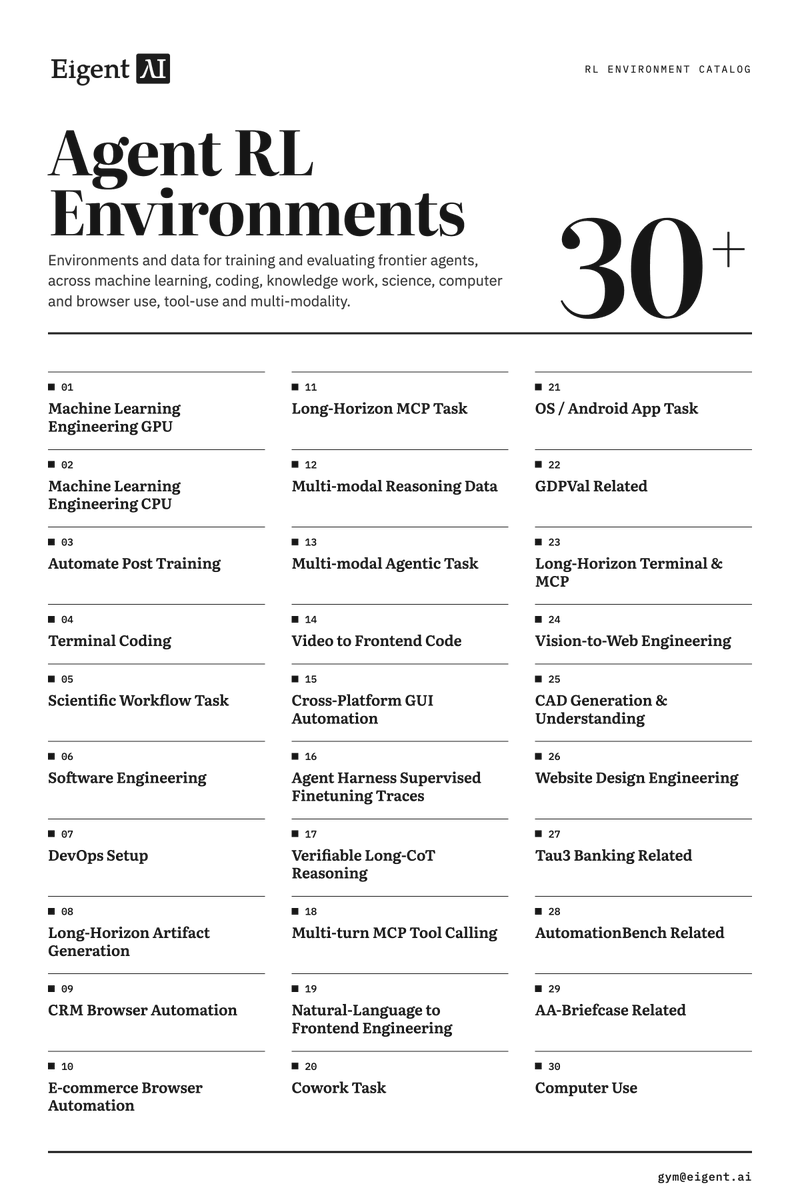
Notice the names of some of these RL environments: #22 "GDPVal Related", #27 "Tau3 Banking Related", "#28 AutomationBench related", #29 "AA-Briefcase related". These are likely meant to help the buying lab benchmaxx those benchmarks!
Many discussions about RL environments lately. Happy to share that we’ve just crossed $12M in annualized revenue from building RL environments for frontier labs!
From open-sourcing RL environments in 2024 to securing our first contract with a frontier lab in January 2026, we’ve come a long way. Since then, we’ve been building 30+ types of RL environments across machine learning, coding, knowledge work, science, computer and browser use, tool use, and multimodality. And we’re just getting started.
Would love to chat with folks working on model training and RL environments!