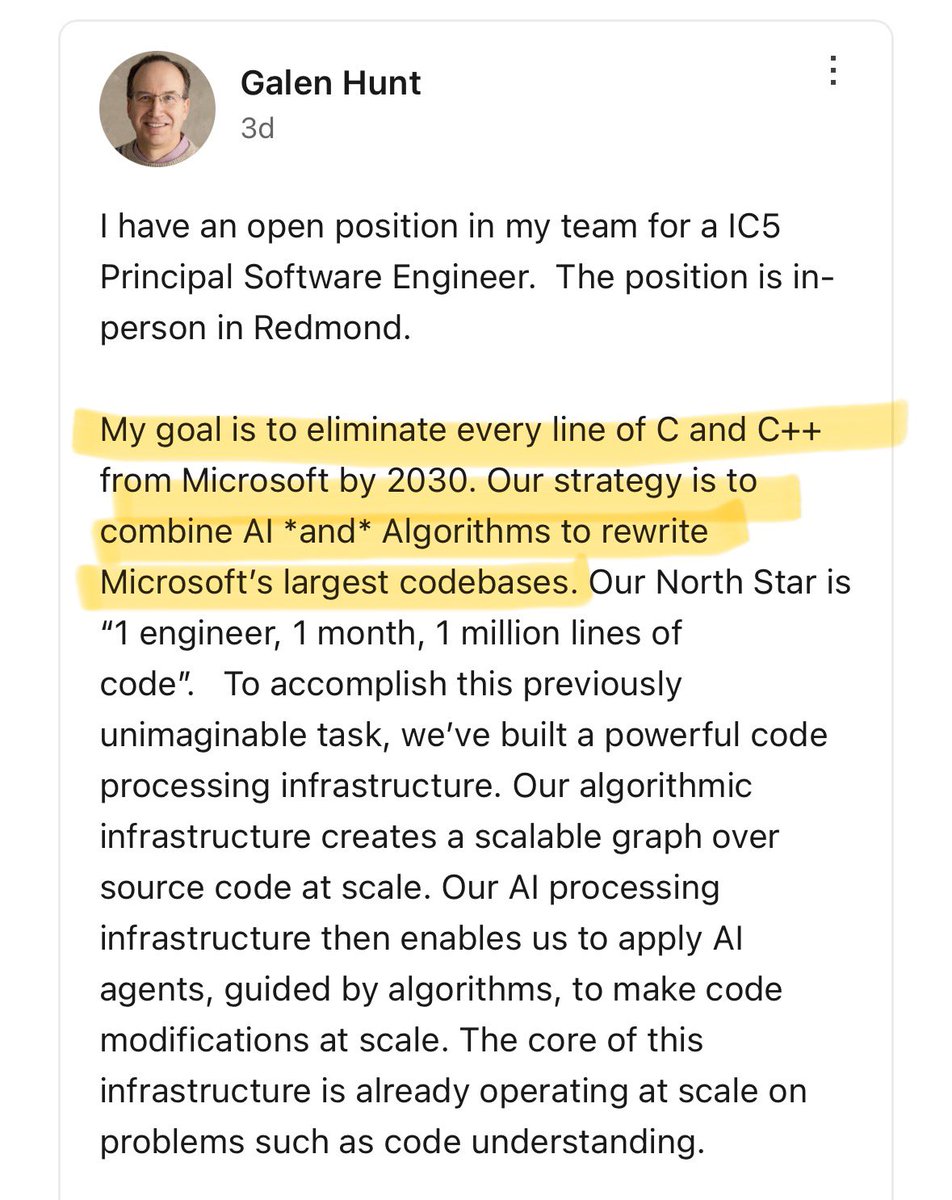
Microsoft has set a goal to “eliminate every line of C and C++ from Microsoft by 2030.”
What are they going to try to replace that C & C++ code with?
You guessed it. Rust.
And they’re going to use AI to do the “Rust re-write” at an insane speed.
“Our strategy is to combine AI *and* Algorithms to rewrite Microsoft’s largest codebases. Our North Star is “1 engineer, 1 month, 1 million lines of code”.
You read that right.
One million lines of code, per engineer, per month.
Pure insanity. This kind of decision making is common among those with a deeply held, delusional faith in the Cult of Rust.
Take battle tested code, and re-write it (without a clear benefit to the end user) at a recklessly rapid rate. Then force others to adopt that rewritten code before it is ready or properly tested.
All while holding a delusional belief that your new Rust code is superior in all ways, and is inherently bug free thanks to the divine nature of Rust.
We learned this from a post by Galen Hunt, Distinguished Engineer at Microsoft Research.
https://t.co/UQFk76ncXf
"With the permission of Adobe, the Computer History Museum is pleased to make available the source code to the 1990 version 1.0.1 of Photoshop. All the code is available with the exception of the MacApp applications library that was licensed from Apple."
https://t.co/0795WRmRy7
🛡️ Cuando el internet dejó de ser solo para unos cuantos: Netscape Navigator
Hace 31 años pasó algo que hoy damos por sentado.
Es decir, alguien intentó hacer el internet accesible para cualquiera.
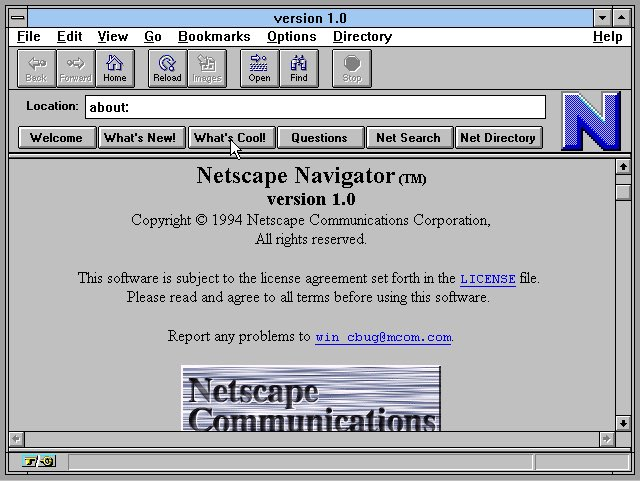
Ese intento se llamó Netscape Navigator.
Antes de eso, navegar la web era muy muy muy lento, técnico y poco amigable.
Netscape apareció en 1994 y, en pocos meses, ya lo usaban tres de cada cuatro personas que entraban a internet. Así de grande fue el impacto.
Además, fue el inicio de la primera guerra de navegadores y del internet comercial como lo conocemos.
⚠️ ¿Qué pasó después?
El éxito llamó la atención de Microsoft.
Internet Explorer llegó incluido “gratis” con Windows, y eso cambió todo.
En pocos años, Netscape perdió la batalla y terminó siendo comprado.
Pero antes de caer, dejó algo clave: abrió su código.
De ahí nació Mozilla y, más tarde, Firefox.
Hoy Chrome domina el mercado, igual que antes lo hicieron Netscape o Internet Explorer.
La historia sugiere que ningún dominio es permanente.
Se están detectando estafas en la venta de memoria RAM, vendiendo módulos DDR2 como si fueran DDR5 debido a la escasez y altos precios de esta última, especialmente en el mercado de segunda mano
https://t.co/kS3cx5qULl
Microsoft Copilot AI comes to LG TVs, and it cannot be removed.
After Windows 11, Microsoft 365, and other products, Copilot is now being automatically installed on LG TVs.
LG says Copilot on TVs allow users to “efficiently find and organize complex information using contextual cues.”
More recently, LG rebranded its remote to “AI Remote" and Microsoft Copilot is part of the "AI TV" efforts.
Samsung is also adding Copilot to its TV.
Europa confirma que Intel abusó de su posición dominante para frenar a AMD tras 16 años de litigio: condena antimonopolio histórica para las CPU x86 https://t.co/AgWRlZbTll
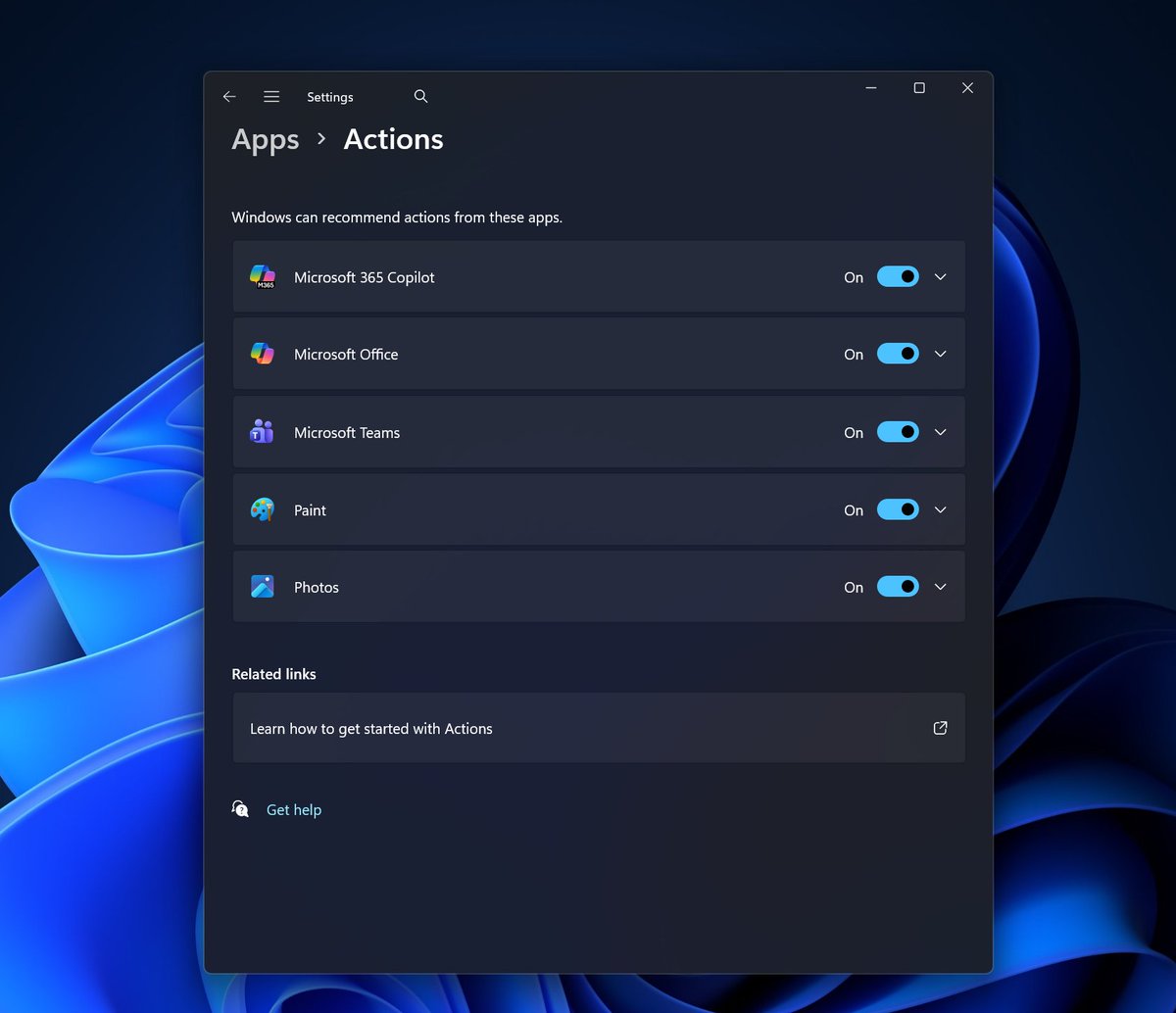
Microsoft is finally making "AI Actions" in Windows 11 truly optional after user feedback.
The AI Actions option appear in Windows 11 when you right-click an image, and it lets you blur or remove background, erase objects using apps like Paint or Photos, and reverse search image on Bing.
But AI Actions aren't exactly useful, as they're just a shortcut to one of the apps, and do nothing special.
You you can already use options like "Edit in Paint" or "Photos" to access blur or background removal AI tools.
Soon, you can remove AI Actions from the right-click menu in File Explorer and other places by unchecking all toggles in Settings > Apps > Actions!
Disney ha llegado a un acuerdo con OpenAI y ha invertido mil millones de dólares en la compañía.
ChatGPT y Sora podrán crear videos IA basados en personajes de Disney, Marvel, Picar y Star Wars. Algunos de estos vídeos llegarán a Disney+.
Australian kids are using dog photos to bypass new age verification systems.
Kids uploaded a Google image of a golden retriever as a "selfie" for facial age estimation and it passed, granting access.
Others used AI-generated adult faces or edited images to fool the systems.
Discord «soluciona» los problemas de memory leak con una controvertida decisión: si Discord supera los 4 GB de RAM usados se reiniciará solo https://t.co/v8PJhb5iLg