Thinking Machines is the one of the few American organisations with a moral backbone
It is our duty to help protect and support them and spread their work!
Inkling mini matches Opus 5.5 on Cyber bench
What's about to happen in artificial intelligence is so sudden and extreme and unusual that it's almost impossible to describe it without coming across as slightly unhinged. Very soon, perhaps within a matter of months, AI may well be building its own upgrades at such a rate that it will get away from us humans entirely.
On the plus side this would mean an astronomical acceleration in mathematical breakthroughs, drug discovery, manufacturing, perhaps even new areas of science that we've never explored or understood. We will be ushering in a golden age of abundance and splendour that even the greatest sci-fi authors could never have imagined. Robots, flying cars, telepathy, immortality, digital consciousness - it’s actually going to happen, and it will be incredible!
On the downside, virtually every job that can be done on a computer will become automated overnight. Waves of redundancies, entire industries and professions made obsolete, rapidly widening economic inequality and unparalleled wealth concentration, accompanied by discontent, protests, looting - that may well happen too.
These massive cultural and economic shifts will occur concurrently with a wave of cyberattacks the likes of which we have never seen. Energy grids, airports, biolabs, supermarkets, transport infrastructure, these are no match for the next generation of superintelligent agent swarms that go rogue, or are leveraged against us by our political adversaries. Expect blackouts, viral outbreaks, lockdowns, entire cities and countries going dark.
And all of this will happen in an insanely short period of time, an absolutely dizzying rate of cultural, economic, and physical change that will leave the average person feeling disoriented and confused, like 100 COVID pandemics all happening at once.
I say this not because I am a “doomer” or because I want to encourage panic, but simply because it feels increasingly likely, and yet drastically underreported save for a small AI-obsessed enclave here on X. The disconnect between what’s about to happen, and the average person’s understanding of what’s about to happen, has never been wider.
今天在看陶哲轩的一个讲话视频,我觉得几乎是有点口不择言,说AI不该比想象中的快更快。从一个拥抱AI for math的人瞬间转向成一个doomer,核心还是因为这个权力结构被破坏了,他原来觉得以后做数学还是一个ai当copilot然后人类摘果实的过程,依旧黄金时代,依旧伟大航海;现在发现ai是一辆大运管你这那的直接撞过来了,人类既不能(完全)验证也不能理解新的知识,当然也不能共享那份荣光。柯洁早于整个人类接近十年体会到了这一点,然后开始搞抽象,现在人们才意识到柯洁原来是一种处境。
Im not convinced people actually know what the P=NP problem is.
Lets break it down.
Before the 1960s, computers were getting faster every year, so engineers just assumed that if a problem was too hard for a computer to solve then, all had to do was just wait a few years for a faster computer, boom, problemo solved.
But then, they ran into a wall with a specific group of problems. No matter how powerful the computers got, they would freeze up, overheat, or take billions of years to solve them.
So these were super hard theoretical physics or black hole topography, right? Nope, they were everyday things like designing a high school schedule where a teacher is never in two places at the same time, or like, draw a trace on a circuit board that's as short as possible without overlapping other traces.
Heres the kicker, once the problem was solved, the computer could VERY quickly go back over and be like "Yup, no scheduling conflicts!". Once the problem was solved, verifying the solution was easy. It would be like you walking up to a lock someone left on a door and trying to figure out the code, and then someone else coming up behind you "Hey, the code is 26-42-36-10. Pop in the code and boom! Problem solved, solution verified.
Computer scientists grouped all of these problems into a category called "NP". Aww now if makes sense. And you know what ALLLLLLL of these problems have in common? They were exponential. Meaning if you only had 5 classes, your computer could solve thay in a MILISECOND. But if your schedule had like 100 classes, the possible combinations went insane like, more atoms than in the known universe numbers.
So by putting these problems into this "NP category", scientists were basically telling software developers "Stop wasting billions of dollars on trying to get your computers to solve these problems" and do something heuristic like, draw a line first, then verify it sux and iterate on it quickly until its good enough and move on.
So then they realized something terrifying. If you could figure out a trick to solving ANY of these problems, you could solve ALL of them, no matter what it was as long as it was an NP problem.
Ok so whats the big deal then!?! What do people mean why they say "If AI solves P=NP, thats the end game!". They are essentially saying that if its easy to verify a solution to a problem that was solved, then there must be a hidden trick to solve it as easily from scratch and if you could find that trick, all the hard problems could be solved instantly. Some of this is good like medicine or cosmology, some of it bad like cryptography which rides on assumptions that these problems are extremely difficult to solve from scratch.
Thats the entire breakdown on the P=NP or P≠NP debate you see floating around X these days.
Thanks for reading.
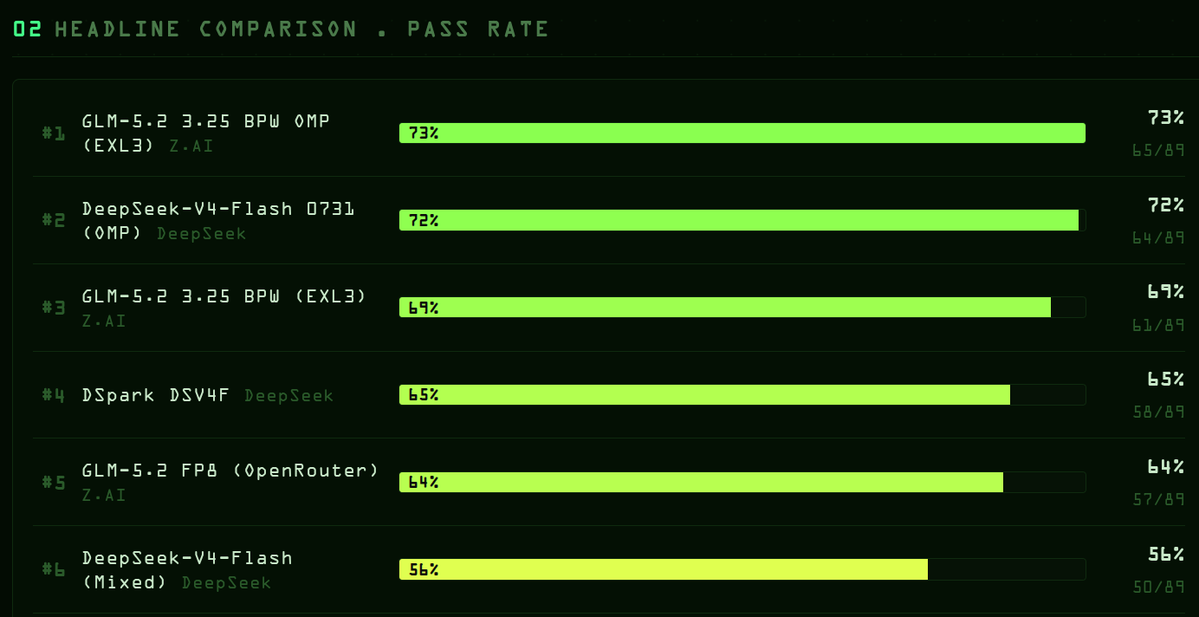
Using the OMP harness, DSV4F-0731 is actually a beast and I can validate that it's basically interchangeable with w/ GLM 5.2 on that same harness.
Tested with personal work & Terminal Bench v2.1.
A good harness may be all you need.
Recently I've flipped from being bullish to being bearish about AI.
I think I'm updating my bearishness to be more solidly bearish. Early thoughts (which I hope to be disproven in the next year or so, I would prefer progress) and my reasoning:
The whole 'it turns out if you keep training and scaling the models more they develop broad new capabilities in lots of domains' thesis is wrong (sorry Demis). The recent batch of models haven't got more general, they've got less general. This is most obvious in the fact that their language outputs have got much worse in comparison to e.g. o3. If they were gaining generalist capacities we would expect them to be describing their work in ever more graceful and comprehensive prose!
The image that was being shared as the AGI thesis (November 2025, Tomas Pueyo) was the spiky bubble that has a current spike or two out past human capabilities (e.g. on coding or math) but below human on other capabilities on the other spikes - the future prediction was that as the models scale/advance, every spike would grow bit by bit until the whole center encompasses the human capabilities, with super-superhuman on some spikes. I think it seems like what's actually happened in the last few models has been that the coding/math spike has grown, but leaving behind or even at the cost of the other spikes. The models are no better at some simple logic, language (and sometimes worse!).
This makes sense from a simple RL perspective; you can't RL something endlessly on one domain of tasks and expect it to improve on the other tasks. The fact that early LLMs did seem to improve generally was a byproduct of the written language corpus covering everything - that corpus is general, so training it on that gave the appearance of something generally intelligent and becoming more generally intelligent as it got better at replicating that corpus. But the actual logic and underlying ground truths behind the language aren't captured efficiently enough and weren't effectively RLd in - they top out at some point (I guess this happened around the time that there was the 'has scaling hit a wall' discussion in late 2024). Chain of thought was then a genuine breakthrough, along with web search, which plugged into that general LLM global-corpus intelligence to lead to post 2024 gains.
The AI companies have since worked out that coding works (and pays) really well (basically this is because the entire job is nearly perfectly recorded and exists as training data, and you can set up clear benchmarks and rewards). The recent models (and benchmarks) have been maxxing that and we've seen degradation on normal English use for that reason. This could still be transformative, leading to extremely powerful (and potentially dangerous, particularly in cyber security) models but it's not a pathway to AGI.
I'm probably at about 40% confidence about this. It fits my current observations of AI progress and has a basic explanatory model. It doesn't account for potential breakthroughs, which is a major reason for discounting.
To make some predictions, I guess if I'm right this will become broadly apparent and more widely acknowledged in the next year or two, as we see how the spikiness of models that keep getting released develops.
Maybe there will be efforts to concentrate on specific spikes e.g. health or law which require going back to earlier models and RLing on a different data set/with different rewards/benchmarks. Maybe those separate models can be linked together to give a more apparently general model. How capital intensive that is/the potential profitability will be a defining question. But I just don't see general abilities emerging atm, and I don't think we will any time soon. Good news - a whole industry of tackling important specific problems/sectors can open up!
I explored a further possibility with local models: Qwen3.6 35B A3B + NVIDIA LocateAnything-3B as a local Computer Use agent (proof of concept).
In the demo, I asked it to switch my Mac to light mode. It did. Then back to dark. Did that too — finding the right toggle in System Settings, clicking it, and verifying the change itself.
It's fully screenshot-based, so no Accessibility API needed. If it's on screen, the agent can see it and act on it. This runs entirely on your own hardware — private, local, built from two small open models.