Does this ring a bell @CathieDWood
$ARKK $OPEN
“The Palantir playbook, and why @Opendoor fits it”
Cathie Wood bought @Opendoor in Q4 2020, added heavily through Q1 2021, then sold the entire position between Q2 2021 and Q1 2022 — about 11.6 million shares. She did the same thing with $PLTR
First bought Q4 2020, sold out completely in March 2022, then bought back in 2023 and 2024. She’s been trimming into rallies and adding on weakness ever since — still a top holding today.
That’s the pattern: she doesn’t abandon disruptive companies, she exits when the thesis breaks and re-enters when it repairs.
The repair is underway. CEO @nejatian is rebuilding Opendoor as an AI-native home transaction platform — automated underwriting, faster velocity, capital-light products. Operating expenses are coming down and the trajectory is improving.
And Cathie already knows how to back Kaz — @Shopify is one of ARKK’s biggest positions, and he’s the CEO who turned it into a global commerce platform. That’s the kind of founder she bets on.
The real unlock is liquidity.
That’s the setup Cathie Wood buys. She sold the old Opendoor. The new one is the kind of disruption she built her career on.
Do you think @CathieDWood will buy @opendoor 2.0 like she did with Palantir again?
After chatting with @nejatian it helped me hear the signal and connect the dots.
🚨🚨 The @Opendoor Four 🚨🚨
EBITDA - earnings before interest, taxes, depreciation, and amortization. The standard “how much cash does the machine make” number.
Adjusted EBITDA - EBITDA after add-backs like stock comp and restructuring. This counts his stock comp as if he’s making a 150 million, which isn’t real cash, and it adds back the interest on the property-level debt carrying the inventory - the actual cost of holding homes.
Adjusted net income (ANI) — EBITDA minus the financing cost. This is the number Kaz manages to. He said it plainly: adjusted EBITDA isn’t the best metric for this business, because the interest on borrowed inventory is a real cash cost, not overhead. A company can be EBITDA-positive and still burn cash.
Contribution margin — the spread on each home after purchase, renovation, holding, and selling costs. Opendoor’s is thin — roughly three to three and a half percent — but it’s the engine. OpEx per acquisition has fallen from $8,400 to $3,000. I REPEAT Opex (operating expenses) has FALLEN from $8,400 to $3,000.
The thesis: this was never a rates story. It was a liquidity story.
It wasn’t the level - it was the speed. Rates moved almost 200 basis points in seven months, the fastest since the early 90s outside of 2022. That speed killed liquidity. Sellers locked into 3% percent mortgages wouldn’t move. Buyers couldn’t commit. The market froze because nobody could clear.
A market maker doesn’t win by being right about direction. It wins by being right about time. @nejatian pivot is exactly that - the key input used to be the home price forecast. Now it’s how fast they can sell the home they’re buying. Aged inventory over a 120 days collapsed from over 50% when he joined to about 10% now.
The funnel is the liquidity engine. Direct-to-consumer converts 6x better than the agent channel. Chloe converts leads at 3x the January rate at 1/3 the cost. The October 2025 cohort is over 80% sold through.
The 4.99% mortgage is the bridge @Opendoor absorbs the buy-down cost to keep families moving when fixed rates sit above 7%.
But conversion isn’t the score. ANI is. Kaz’s goal: adjusted net income positive on a 12-month go-forward basis exiting 2026, sustained through 2027. Cash after every real cost, including the property-level debt.
My 🎬:
When liquidity returns and the lock-in effect breaks, the model compounds with the market instead of against it. Keep an eye on OpEx as volume scales.
Homeownership is the mission. Kaz and the team are the ones carrying it.
Really Long $OPEN
Last week I shared 10 takeaways from our recent investor meetings. The response was tremendous, and so were the follow-up questions.
Many were with respect to the market; price action, volatility and sentiment. Interest rates. Geopolitics. Financing concerns. Rising costs. Community opposition. There's a lot weighing on the sector.
Listen - I can't control the market. But I can drive how we build this business, allocate capital and create shareholder value.
So let's address a few things head-on.
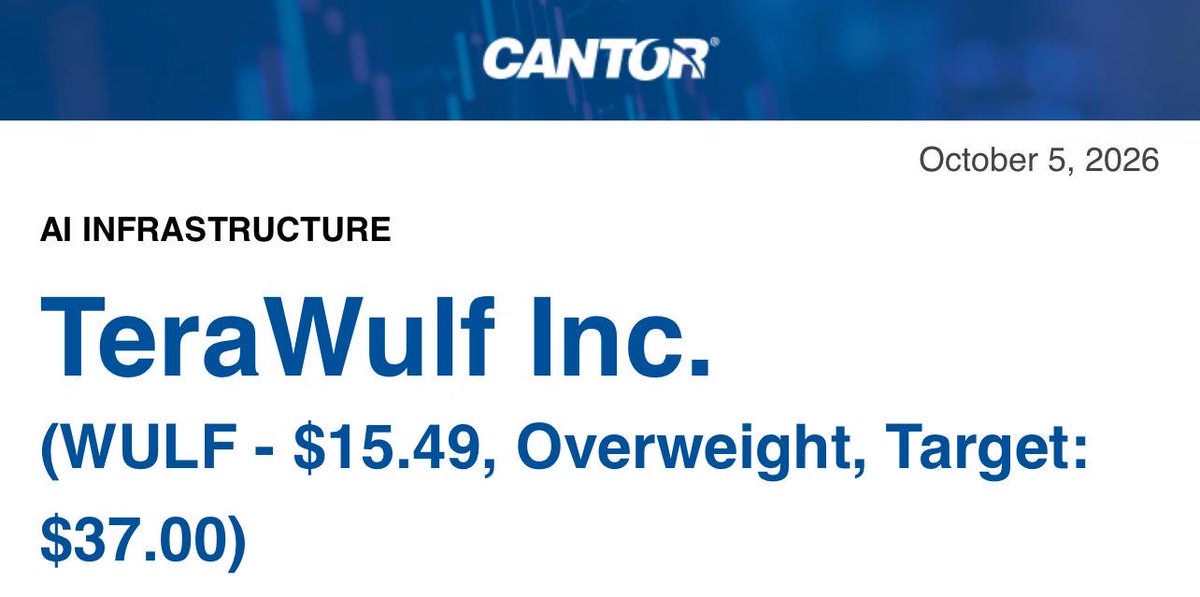
Today @Official_Cantor provided @terawulf with an ‘Overweight’ Rating and Price Target of $37.00.
$WULF’s Muskie data campus in Kentucky is advancing toward 1 GW of contracted grid capacity, with the second 500 MW now targeted for 2029, subject to regulatory approval.
The company’s agreement with Kentucky Power includes $100 million in residential bill credits, generation financing costs and collateral protections, reducing ratepayer exposure.
JUST IN: $WULF TeraWulf announces the expansion of its Muskie data campus to 1 gigawatt
The second 500 MW phase is now planned for 2029 rather than 2030
$WULF just increased its contracted power pipeline.
Due to strong customer interest, TeraWulf has secured the next 500 MW of planned power capacity at its Muskie site in Eastern Kentucky with an amended and restated electric service agreement with Kentucky Power.
Planned delivery for the additional 500 MW has now accelerated to 2029.
👇