@frater_dt Two books worth the price of admission that are sure to disrupt preconceived notions: Mazur’s _The Platonizing Sethian Background of Plotinus’s Mysticism_ and Burns’ _Apocalypse of the Alien God_.
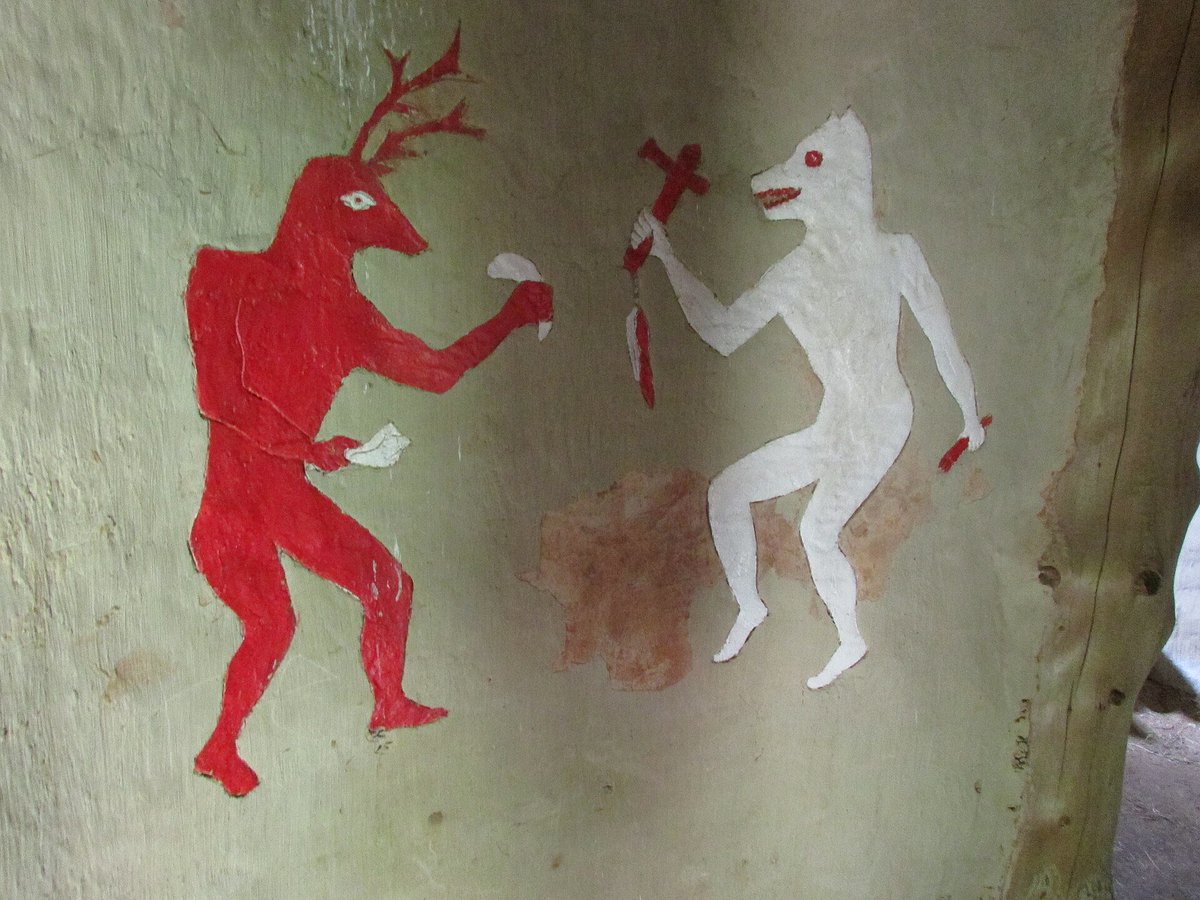
This is a copy of what is known as “Temple Art.” The original was found at Town Creek Indian Mound, situated on Little River near Mt. Gilead, NC. As far as what it depicts, it’s such a departure from the rest of the MIIS iconography, I possess no reference in which to frame it. If I had to wager a guess, however, I’d say it likely depicts the ritual actions of shamanic healer-seers.
The term, fol, shares its root with the Latin word, follis, which literally means ‘bag of wind’—thus lending some credence to the attribution of the element of air allotted to this card by the Hermetic Order of the Golden Dawn. Although, Alphonse Louis Constant, writing under the nom de plume, Éliphas Lévi Zahed, had earlier attributed the element of fire to this particular trump. And, in fact, in addition to ‘wind bag,’ follis may also be interpreted as meaning ‘bellows’—as in the accordion-like tool of the blacksmith, used to fan his flame into a ferocious blaze, burning hot enough even to melt metals. In our humble opinion, there is an element of truth to both of these interpretations. For, while Le Fol treads upon sky-colored clouds—as in Schär (1750) and Conver (1760)—indicative of his airy nature, the figure’s bindle may just as well be interpreted as an alchemist’s flask, held aloft by a pair of metal tongs. In accordance with the latter reading, as early as Chosson (1672), a small, round object may be found on the ground directly below the object Le Fol carries over his shoulder. While Madenié (1709) has detailed this circular morsel into a golden bell, loosed from the figure’s cap or collar, in most of the early Tarot de Marseille decks, it appears as simply a transparent, crystalline sphere. Rochias (1782), on the other hand, has gone so far as to render this orb a brilliant red—rubedo being characteristic of the alchemists’ lapis philosophorum, the ‘philosophers’ stone.’
Like his sack, upon closer inspection, the stick on which Le Fol’s bindle is suspended may not be what it at first appears, either. For, at the end of the pole, just beyond the hanging bag, is shown what is clearly defined as a large spoon—too large to use practically, but a spoon nonetheless. In Jewish folklore, there is a powerful allegory, attributed to Rabbi Haim of Romshishok, that discusses just such an oversized spoon. Visiting the short tale may help shed further light on the hidden meaning of this card. In his allegory, Rabbi Haim of Romshishok was given a vision of the two possible alternatives that await the soul following death. After visiting both heaven and hell, the rabbi returned with a chilling description of each supernatural space.
Hell is a dining room populated with desperate, hungry people. Before them is a large bowl full of wonderful-smelling stew, and each person is equipped with his own spoon. However, the spoons are so terribly long that the possibility of feeding themselves with them is ruled out. Everyone and their bellies grumbled with resentment. Heaven, on the other hand, consists of an identical dining room—although, the people inhabiting that space are all happy and content. Before each person is an identical bowl of the same exact same stew, and in the hand of everyone is held an equally unwieldy spoon. The only difference is that, in heaven, each person is delighted to feed the individual sitting across from him.
What does this tell us about the card in question? In the case of Le Fol himself, we know that he is a journeying jester, traveling to a foreign city in the hopes of finding work. Further, we know that, along the way, Le Fol probably depends on the kindness of strangers for his next meal. This says that the figure is more than happy to receive charity from the man across from him at the proverbial table. But, qua The Fool, the jester isn’t invested in whether or not he is actually given any alms; he’s content in every case—lost in his own act of daydreaming and freely wandering. Conversely, in regard to his own lengthy spoon at the end of his bindle, Le Fol is happy to share that which he does possess with anyone who happens by him; even if it is simply a silly song or a witty word, while he will accept payment, he doesn’t demand or even expect it—Le Fol offers liberally of himself. Indeed, he’s glad to open his bag of jokes for anyone and everyone, free of charge.
Beneath his motley tunic, Le Fol is clothed in a flesh-colored shirt and pair of trousers—as if to imply that, while he appears as a man, underneath his skin-tone suit, he is in fact something else entirely. Were it not for the small animal tearing away at the seat of his pants, the viewer would have no indication that, like a Muscat grape, Le Fol is possessed of vegetable-green skin. In very few decks is such not the case. Exceptions to this rule include Noblet (1650), where torn blue knickers expose fleshy genitals, Viéville (1650), where the figure’s trousers do not appear to be ripped at all, Benois (1700), where torn yellow knickers reveal a fleshy rear end, and Dodal (1701), where tattered, flesh-tone trousers show an enigmatic blue skin beneath. But, even in Vachier (1632), Chosson (1672), and Madenié (1709)—among the earliest ‘type I’ and ‘type II’ Tarot de Marseille decks known—it is clear that Le Fol constitutes a type of the ‘Green Man’ of spring, his flesh as verdant as that shed at the oil press by the olive. A pagan fertility figure surviving in English folk customs such as the May Day-oriented ‘Jack in the Green,’ the Green Man likely has his origins in what Fraser called the ‘dying-and-rising gods.’ These resurrecting deities include Osiris (who is said to have been green-skinned), Tammuz (a grain god), Dionysus (a wine god), Jesus (whose flesh is bread and his blood, wine), and even the mysterious Hiram Abif of Masonic legend who, in addition to having been exhumed via a green, vine-like rope, is said to have been found in an advanced stage of putrefaction—a postmortem condition which is characterized by a ‘greening’ of the skin. Our ‘Fool’ would fall into this category as well. In this capacity, one may interpret the yellow, vesica piscis-shaped object dangling on the thigh of Le Fol in decks such as Dodal (1701), Madenié (1709), and Héri (1718) as the spiked head of a shaft of wheat, hanging upside down, descending from the figure’s hip. Moreover, reinforcing this viridescent connection, both Jodorowsky and Morsucci even go so far as to include a green leaf concealed in the left hand of Le Fol. The link with the Green Man and thus with the return of spring inevitably calls to mind the concept of the Poisson d’Avril—the ‘April Fool’—associated specifically with early springtime.
This brings us to the identity of the aforementioned animal that is shown clawing at the hind quarters of the figure in Le Fol. Some commentators have described the beast as being feline. And, to be sure, the face of a large cat does appear to be depicted on the underwear worn by Il Matto in the early Italian Colleoni-Baglioni deck from 1451. But, in the case of Tarot de Marseille, the animal is more commonly executed as a species of canine. This is especially evident in the Arnoult and Conver decks from 1748 and 1760, respectively—the latter being the version on which many of the later iterations were based. Ergo, Le Fol appears to be followed by a mischievous dog. Those with a background in astrology will immediately recognize in the above description a potential allusion to the constellation of the ‘Hunter,’ Orion, on whose heels Canis Major, the ‘Greater Dog,’ trails closely. While the ancient Egyptians associated Orion with the aforementioned god, Osiris, the constellation of the ‘Hunter’ was in fact known to the archaic Hebrews as Kesil, which translates to simply ‘Fool.’
Also called Le Fov by Jean Noblet in 1650 and Le Mat by François Chosson in 1672, according to the earliest known deck of Tarot de Masreille cards—that of Philippe Vachier from 1639—the originally unnumbered trump was first known as Le Fol. In each case, the implication is that of a man inflicted with madness. Indeed, the old Italian title of the card, Il Matto, translates not to ‘The Fool,’ but to “The Madman.” In Italian parlance, Il Matto also carries with it the connotation of a beggar. As we shall see, all of these titles are appropriate insofar as they tell us something of the nature of this foolish figure.
The first thing that grabs our attention about this card is the fact that the figure depicted on its face appears to be a jester. Commonly known as a fol, the jester was a type of royal entertainer, often traveling from town to town in search of temporary employment. In the latter case, it is almost certain that he would have engaged in panhandling or begging for alms during his journeys. The presence of the bindle or ‘hobo sack’ tells us that Le Fol is shown in the act of such traveling. In England, court jesters were actually known as “licensed fools,” professionally engaging in political mockery in the form of song, poetry, and occasionally drama. Unlike commoners, however, jesters were permitted to indulge in their disrespectful ‘jests’ freely, without fear of persecution, from which they happened to be legally exempt. Identified by his motley dress, his ‘crown’ (a cap decorated in liripipes and bells), and his ‘scepter’ (a marotte—a prop stick topped with a miniature of the jester’s head), the fol was an intentional mockery of the monarch himself—not unlike the ‘king for a day’ elected during Carnivàle season, who too was invested with a cap and marotte. Truly, in Noblet’s Le Fov, the figure on the card is actually shown wielding a proper marotte, which he holds in his right hand, employing it as a walking staff. Additionally, in the Tarot de Marseille, Le Fol is also shown wearing a bright yellow, sun-like collar. While this collar appears unadorned in Vachier (1639), Noblet (1650), and Dodal (1701), in Viéville (1650), Chosson (1672), Madenié (1709), and indeed nearly every deck that follows, this golden collar is decorated with numerous spherical bells. In many of the later decks, moreover, including Jodorowsky-Camoin (1997), Conver-Ben-Dov (2010), Morsucci-Ottolini (2019), and Houdouin-Reunaud (2022), these bells have taken on many colors—like a system of tiny, planetary balls orbiting a shining central star.
@DrGregLittle2 That must be what we have here. This was identified as a worked stone independently by two archaeologists. It’s magnetic, which has always been a confusing point for me—but if they’re hematite, it makes sense.
“There Pan appeared beside him and told him that this part of the garden was for his subjects alone and was to be so respected. He said that in any garden, no matter the size, where the full cooperation of the nature spirits is desired, a part should be left where, as far as possible, man does not enter. The nature spirits use this place as a focal point for their activity, a centre from which to work.”
R. OGILVIE CROMBIE (1899-1975)
Picture this: You got the SSM (Summa Sacre Magicae). You’re reciting Chapter Two, the Universal Prayer, figuring out how it can be incorporated into practice. Then at the climax, you add a petition for the healing of a family member. Less than 12 hours later, you are connected to one of the world’s top medical specialists who offers to supply a life-saving medicine to that family member..for free.
Is there any better way to begin reading a grimoire?
“Moving the dead into the Underworld is normally reserved for gods known as the _psychopompoi_—or ‘soul guides’. Charon is perhaps the most well-known example, as the ferryman who literally shipped the dead from the mortal world into the Underworld. But the _psychopompos_ _par-excellence_ in the archaic and early classical periods was undoubtedly Hermes. And Hermes is not an Underworld god. Or perhaps he is, but only as a very specific sub-section of his traditional role as a boundary crosser. Hermes’s name derives from stone _hermai_ that were originally boundary demarcations, which evolved into guardian figures as well. In addition, they were also used to mark out the physical and metaphysical space of ’death’, including in the form of grave markers, and they are depicted in the relief carvings of gravestones. So, Hermes comes to represent, as Marinatos comments, ‘the idea of boundary-crossing in all its ritualized forms, which entails both territorial and symbolic transitions’.”
—Ellie Mackin Roberts, _Underworld Gods in Ancient Greek Religion: Death and Reciprocity_, p. 24 (Routledge. 2022.)
“Hermes' connection with death is a very old one. We find him involved with the worship of the dead in several city-states. Like the dead, he receives offerings at the new moon. At Athens, Hermes and the dead receive equal portions on the feast of the Chytroi, the third day of the Anthesteria. In Argos the thirty days of mourning ended with an offering to Hermes. His character as death-god predominates in Thessaly; Thessaly, Aetolia and the Argive have months named Hermaios, which seem to be Soul-months. He has a taste for the kinds of food and drink offerings which the dead, as well as the demons associated with them, such as Hekate, enjoy.”
— Kris Kershaw, One Eyed God