1/6 Is fat oxidation a key determinant of durability?
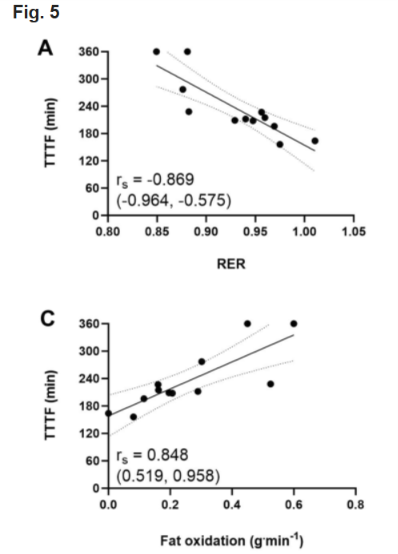
Our 2024 study found a positive relationship between fat oxidation during early exercise and time to task failure at 90% 1st threshold.
The higher the fat oxidation rate, the greater the durability.
👇
An elite ultrarunner burned 16,104 calories in 14 hours but only consumed 6,720. The 9,384-calorie deficit reveals what your body does when extreme performance meets impossible fueling demands.
Researchers at Loughborough University published the first comprehensive physiological assessment of a world-class athlete during the 2025 Western States Endurance Run in the Journal of Applied Physiology. The athlete finished third in 14:19:22, within 10 minutes of the course record, while scientists tracked every calorie burned and consumed.
Energy expenditure was measured using doubly labeled water, a gold-standard method that tracks isotope elimination rates to calculate total calories burned. The athlete expended 16,104 kcal across the 100-mile race. That translates to 18.8 kcal per minute, sustained for over 14 hours.
For context, previous research using the same method found recreational athletes burned about 7,040 kcal over 12 hours during Western States. When normalized for time, the elite athlete in this study expended nearly double the energy. The difference reflects both higher absolute speed and the metabolic cost of running versus walking, since recreational runners alternate between the two.
The athlete consumed 6,720 kcal during the race. That's 42% of total expenditure. The remaining 9,384 kcal came from stored energy, primarily glycogen and fat. This deficit is massive but unavoidable at this intensity.
Here's why the deficit matters:
Your gut has a ceiling for how much it can absorb during exercise. Current recommendations suggest up to 90 grams of carbohydrate per hour for prolonged endurance events. This athlete averaged 86 grams per hour across the entire race, peaking at 110 grams per hour in the final 5 hours.
That intake required a deliberate fueling strategy. The athlete started with a mixed fat-carbohydrate approach, consuming foods like avocado, coconut oil, nuts, and overnight oats in the first 4 hours. From hours 4 through 9, intake shifted to 80 grams of carbs per hour plus 10 grams of fat from gels, rice cakes, and soft bars. The final 5 hours relied almost entirely on carbohydrate gels.
Despite consuming near-maximal carbohydrate intake and 12.5 liters of fluid, the athlete still lost 4.3% of body mass by the finish. Urine osmolality increased from 120 to 790 mosmol/kgH2O, indicating significant dehydration. Fluid intake averaged 0.87 liters per hour, but sweat losses in 40°C heat exceeded what could be practically replaced.
Key findings from the study:
• Total energy expenditure: 16,104 kcal (18.8 kcal/min)
• Energy intake: 6,720 kcal (42% of expenditure)
• Carbohydrate consumption: 86 g/h average, 110 g/h peak
• Fluid intake: 12.5 L total (0.87 L/h)
• Body mass loss: 2.5 kg (4.3%)
• Core temperature peak: 39.4°C
• Performance decline: 15% across the race
The thermoregulatory response adds another layer of metabolic stress. Gastrointestinal temperature averaged 37.1°C but peaked at 39.4°C during the final 10 km. Core temperature exceeded 38°C for over 3 hours despite aggressive cooling strategies including wet clothing, cold-water immersion in rivers, ice slurry ingestion, and menthol rinses.
Heat stress increases metabolic demands and accelerates carbohydrate oxidation. When your core temperature rises and you become dehydrated, your body shifts fuel preference toward carbohydrate and away from fat. This makes the energy deficit harder to manage because glycogen stores are limited compared to fat stores.
The athlete also showed temporary kidney stress. Urinary biomarkers for acute kidney injury increased substantially. NGAL concentrations rose from 9.4 to 25.4 ng/mL and KIM-1 from 0.30 to 1.70 pg/mL. The urine also showed moderate protein, mild blood, and trace ketones. These markers indicate transient renal stress from dehydration, reduced blood flow to the kidneys during prolonged exercise, and muscle breakdown from eccentric muscle contractions during downhill running.
What makes this athlete exceptional isn't avoiding fatigue. It's managing it.
Pacing analysis revealed the athlete ran at an average of 84.8% of critical speed throughout the race. Critical speed represents the boundary between sustainable and unsustainable intensity. Below critical speed, you can theoretically maintain effort indefinitely. Above it, fatigue accumulates rapidly.
The athlete maintained 87.4% of critical speed for the first 5 hours, then performance declined by 1.45% of critical speed per hour until finishing at 74.0% of critical speed. That's a 15% total decline. For comparison, recreational runners in similar mountain ultramarathons show average speed declines of 32% between the first and second halves.
This reveals a key difference between elite and recreational ultra-endurance athletes. Elite athletes sustain higher relative intensities for longer before fatigue forces a slowdown. The 15% decline represents exceptional durability, the ability to resist performance loss despite accumulating physiological stress.
The decisions made before the race likely mattered as much as what happened during it.
The athlete completed a structured heat acclimation protocol in the 3 weeks before the race. This involved 12 sessions in a makeshift climate chamber at 40-45°C, each lasting 1.5 to 2.5 hours. The goal was raising core temperature to 38.5-39°C in each session. Heat acclimation improves sweat rate, plasma volume expansion, and cardiovascular efficiency in hot conditions.
The athlete also increased dietary fat intake during the week before the race to gain 1 kg of body mass. This strategy likely aimed to increase glycogen storage and provide a small buffer of additional fuel.
During the race, cooling strategies were implemented early and maintained throughout. The athlete started using evaporative and conductive cooling at 39 km into the race and continued systematically to the finish. This probably limited how high core temperature could rise and reduced the metabolic penalty of heat stress.
The study has limitations. It's a single elite athlete, so the findings represent the upper range of human capability rather than average performance. The abbreviated doubly labeled water protocol works well for short-duration field studies but has more measurement error than traditional multi-day protocols. Postrace urine samples were collected 100 minutes after finishing, during which rapid rehydration may have diluted biomarker concentrations.
But the data establish clear boundaries for what's physiologically possible during competitive 100-mile mountain running in extreme heat.
Energy expenditure can reach 18.8 kcal per minute in elite athletes. Carbohydrate intake up to 110 grams per hour is tolerable without gastrointestinal distress when practiced and planned. Core temperature can exceed 39°C for extended periods if heat acclimation and active cooling are employed. And performance durability, the ability to resist fatigue accumulation, separates elite from recreational ultra-endurance athletes more than absolute speed.
The massive energy deficit isn't a failure of fueling strategy. It's an unavoidable reality of sustaining near-maximal intensities for 14 hours. Your gut can't absorb calories fast enough to match expenditure. Your body compensates by mobilizing stored fuel, accepting dehydration, tolerating rising core temperature, and allowing controlled performance decline.
The decisions about preparation, pacing, fueling, and cooling determine how well you manage those compromises. Elite athletes don't avoid the deficit. They survive it better.
Broken femur to La Vuelta winner in 6 months 😲
Stefan Küng won the Stage 18 time trial at La Vuelta a España, capping an incredible comeback after the injury that ruled him out for almost four months.
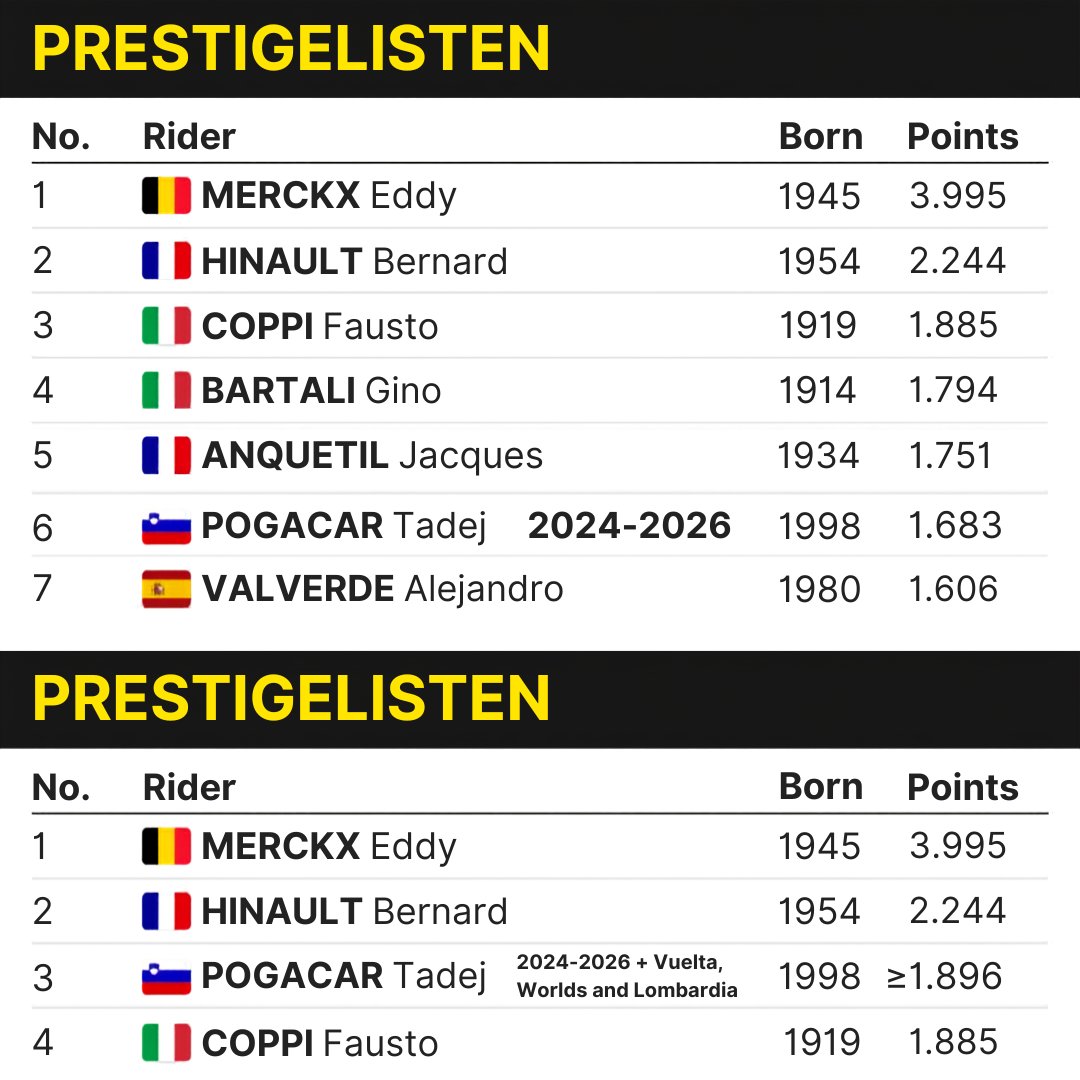
If 🇸🇮 Pogačar's career had consisted only of his three last seasons, with all of his earlier results erased, he would still rank 6th in history.
Had he not been injured and instead won the Vuelta, the Worlds and Il Lombardia, only 🇧🇪 Merckx and 🇫🇷 Hinault would rank above him.
Not a single watt wasted 🚀
Lewis Askey timed his effort to perfection on the final cobbled climb, reeling in Florian Vermeersch before launching past to win Stage 1 of the Lloyds Tour of Britain Men. 💥
_____
🇬🇧#TOB2026
Mi reconocimiento a @alafpolak1 por su fantástica carrera y su legado. Uno de mis principales rivales durante muchos años compartiendo carretera y objetivos. Todo lo mejor 👏🏼
My entire philosophy of training 👇
1. Above and beyond performance level/performance goals, first and foremost, movement is medicine.
It needs to be taken over the lifespan and is most important in the latter years. If you don't 'take your medicine' regularly, at some point you're going to experience significant pain. As such, our #1 responsibility & first priority, as coaches, should always be to facilitate a healthy, long-term relationship with physical activity & "do no harm".
2. A serious commitment to endurance sports training provides an outlet (and some societal legitimacy) for us, as adults in the modern, 'developed' (non paleolithic) world, to move the amount necessary to preserve health and function over time &, beyond that, the amount that we (as humans) are designed to!
3. As in medicine, when prescribed the right 'dose' at the right time, ALL healthy athletes will get better (though at different rates). As in medicine, when the wrong dose is prescribed, ALL athletes will fail to respond to 'treatment' & eventually get sick. As in medicine, when no organized 'treatment plan' is prescribed, the athlete will progressively deteriorate over time. In other words, plan first and foremost for *consistency* & #TakeYourMedicine
4. It follows that, a large part of 'good coaching' comes down to prescribing the right dose of the right medicine for a given athlete at the right time (In my opinion, not quantifying the dosages that you're prescribing amounts to irresponsible medicine & bad coaching).
5. The 'right dosage' that amounts to an athlete getting better, not sick, overtrained or injured, varies greatly among individual athletes (according to training background, gender, age and genetics) . The 'right dose' is also very strongly related to other (non-training) stressors in their life. Therefore, good coaches (& athletes) monitor non-training stressors & adjust the training accordingly.
6. Athletes who can handle truly competitive 'big doses' tend to be generally 'robust' - strong, supple, muscularly balanced with good general health and constitution, i.e. they lay a foundation of moving well in a variety of ways, at a variety of speeds, with a variety of loads. Even then, big doses can only be sustained for short periods of time and by going out of their way to facilitate recovery (sleep, nutrition etc). This includes actively minimizing/managing other sources of stress, i.e. they eat nutritious foods and live a simple, stable, low-stress life.
7. When it comes to the 'medicine of choice', intensity is no substitute for aerobic volume. The effects don't last and high intensity training has significant negative 'side effects'. If the goal is continued athletic development over the long term, there is simply no substitute for a strong aerobic base.