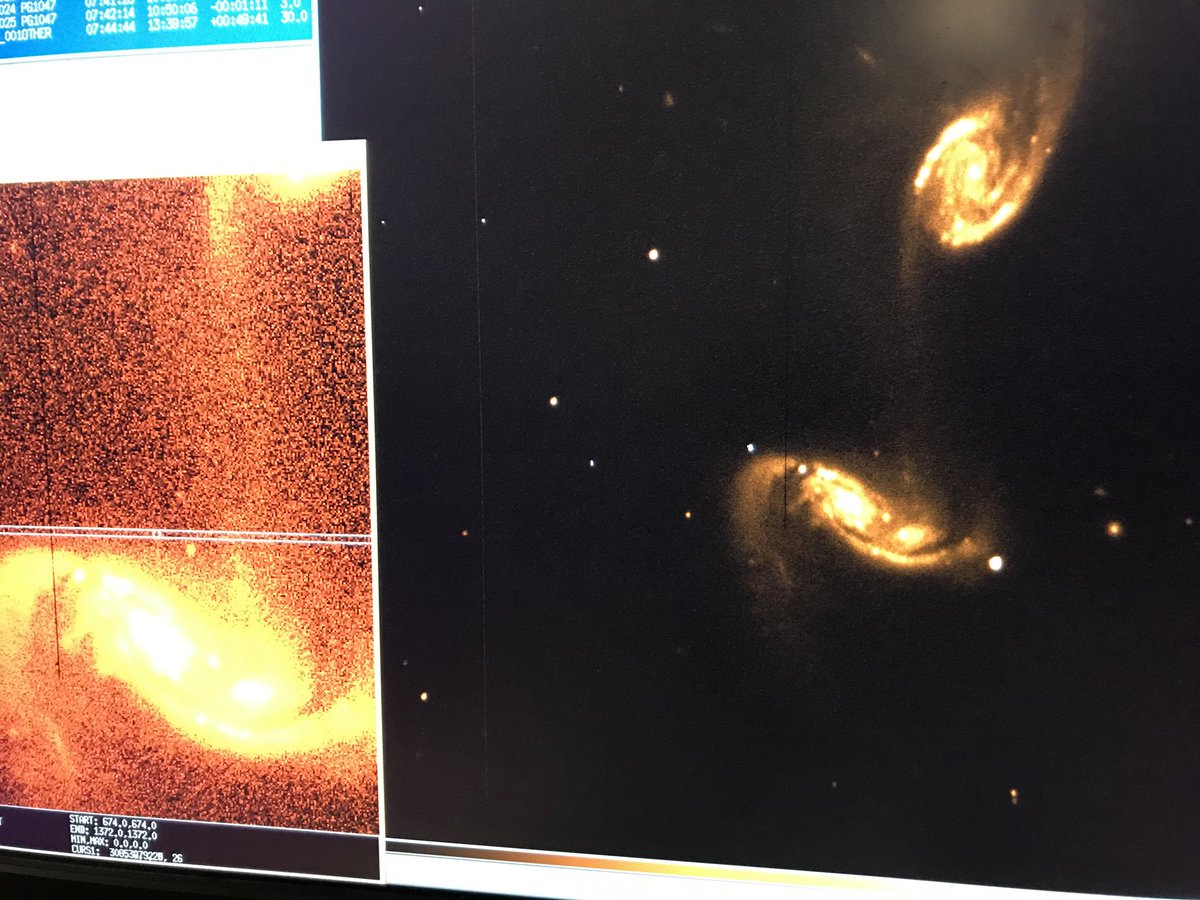
To end the decade, we bring you an awesome discovery: last week, ePESSTO+ took a spectrum of an OGLE transient, SN 2019xis. It turns out it's a light-echo from SN 1987A!
https://t.co/aRD4akqAiG
Congratulations to ePESSTO+ PI, Dr Cosimo Inserra @COSMO_83, for winning the 2021 MERAC Prize for Best Early Career Researcher in Observational Astrophysics! 🏆🎉🥂 https://t.co/NCeyT8LH1Z
Cosimo has been recognised for his pioneering work on time-domain astrophysics, cosmology, and machine learning. But we know him best for leading ePESSTO+.
We haven't observed any supernovae for a long time now, but this week we have managed to have a collaboration meeting! We had some great talks and discussion, and it was nice to be reminded of the wonders of stars, supernovae and black holes.
Let's get to know our observing team a little better!
Meet our first observer, Anais Möller (@anais_moller), postdoctoral researcher at Clermont-Ferrand!
Before starting this run, Anais took the opportunity to visit the Torres del Paine and Parque Los Glaciares. She said the the views of the towers and Fitzroy were worth an early start to see the sunrise on the top of the trail!
Our observers have had a very productive start to their run this month, check out our latest astronotes here!
https://t.co/vPKFMeuiMv
https://t.co/4I5cSGytfR
https://t.co/BCEAKogo90
✨🔭
That's right folks, we're back on sky tomorrow night with a cracking team from @IN2P3_CNRS and @UoS_SNe!
The weather's looking good! We're excited for what new classifications may be in store!
#supernova#transients#howmanyIas
Today arrived at La Silla in Chile where we will be observing for the @PESSTOsurvey until the end of the month! will be tweeting about the site & observing in different languages, lets see how it goes! To start: what an amazing landscape up here in the mountain