Two Japanese companies, Kanto Denka and Central Glass, have formally notified major clients—including Samsung, SK Hynix, and TSMC—that they will permanently cease production of tungsten hexafluoride starting July 1, 2026.
The core reason for the shutdown is a disruption in raw material supply. Between 60% and 70% of the production cost of tungsten hexafluoride comes from high-purity tungsten powder, a material Japan is almost entirely dependent on China for. Following China's tightening of tungsten export controls in early 2026, shipments of high-purity tungsten powder to Japan have effectively dropped to zero. The Japanese companies managed to keep production going for about five months by drawing down stockpiles, but ultimately failed to secure an alternative source.
Meanwhile, stock prices of related Chinese manufacturers have soared.
> be Microsoft
> invest billions in Anthropic
> be Anthropic’s cloud provider
> host Claude on Azure
> sell Claude to enterprise customers
> employees start using Claude Code
> tell employees to use Copilot instead
> cut internal Claude access
> Anthropic launches Claude Fable 5
> tell employees they can’t use it
> because Anthropic might retain data
This is it.
OpenAI is now considering drastic price cuts to win users from Anthropic, who will likely cut right back. Two companies losing billions, about to compete each other's margins to zero.
Buffett's worst kind of business: one that grows rapidly, devours capital, and earns nothing. He meant airlines. The most important industry of its age, where the customer wins and the shareholder bleeds.
Revolutionary technology and a good investment have never been the same thing.
The internet was real too. Most of the companies building it still went to zero.
Listen to @Oliver_MSA
If you have lived through 50 years of market gyrations like Michael Oliver, recent moves on #Gold#Silver are not abnormal
When the market runs out of sellers, price rebound and shoot up
89% of Europeans now look at the United States the way you look at a dinner guest who showed up drunk, insulted your wife, ate all the food, and then asked to borrow money. You’re not calling them an ally. You’re calling them a problem.
90 PERCENT PAPER GOLD: INSIDER FROM GOLDMAN AND JP MORGAN REVEALS THE REAL BACKING
The Swiss Tonia Zimmermann from S spent decades structuring derivatives at Goldman Sachs, JP Morgan, and Credit Suisse before co-founding her financial platform. She just laid out exactly what paper gold really is and why the gap between paper promises and physical metal matters more than most investors realize. The numbers she shared turn conventional gold ownership on its head. What happens when everyone finally demands the real thing at once?
THE PAPER GOLD EXPLAINED
➡️ Paper gold and paper silver are derivatives, mainly futures contracts that let traders buy or sell metal at a set future price without ever moving physical bars today.
➡️ These paper instruments generate daily trading volumes many times larger than the entire annual global mine production of gold or silver.
➡️ Because the paper market is so enormous, it alone drives price discovery for actual physical metal across the world.
THE FRACTIONAL BACKING SHOCK
➡️ Gold accounts at banks function exactly like cash accounts and are not 100 percent backed by real metal in the vault.
➡️ Typical reserves sit between 10 and 20 percent, so for every seven ounces an investor believes they own, only about one ounce may actually exist in physical form.
➡️ Futures contracts work the same way: only a small margin is required, not the full value of the gold.
THE PHYSICAL DELIVERY CRISIS
➡️ The entire system runs without issue as long as clients never actually demand physical delivery from their gold accounts or futures positions.
➡️ The moment broad physical demand hits, whether through bank accounts or major exchanges, only around 10 percent of the claimed gold is truly available in metal.
➡️ "The faster one wins," she noted, describing exactly who gets the real gold when a rush begins.
THE CREDIT FOUNDATION OF EVERYTHING
➡️ Our whole economy creates assets and money through credit, meaning every piece of wealth has a matching debt created somewhere else in the system.
➡️ If debts across the board must be reset or wiped, the corresponding wealth on the other side disappears at the same moment.
➡️ This credit mechanism is why paper gold can trade at such extreme multiples of real physical supply without immediate problems.
THE BOTTOM LINE
Paper gold creates the comfortable feeling of ownership while resting on a thin slice of actual metal and endless credit creation. The day physical demand tests the structure, the gap between promises and reality becomes impossible to ignore.
Insiders have always known the difference. The rest of the market is about to find out.
HT: YouTube Rohstoff Investor
#PaperGold #PhysicalGold #FractionalReserves #GoldAccounts #FuturesReality #DeliveryRisk #CreditSystem
I confirm a 2,000 tons military grade warehouse is being built near the airport to store physical gold as part of the plan to re-launch the HK Gold Exchange. If the government plan is successful, the duo Shanghai-HK will replace Comex-LBMA as global hubs for gold trading.
BREAKING: China is spending $295 billion to replace Nvidia with Huawei across its entire AI infrastructure.
China announced today it will build a nationwide AI data center network over the next 5 years operated by state firms China Mobile and China Telecom.
At least 80% of all AI chips must come from domestic suppliers, primarily Huawei. Nvidia and AMD are locked out by design.
Jensen Huang confirmed this last month. "We've largely conceded that market to them," he told CNBC. China once accounted for at least 20% of Nvidia's entire data center revenue. That market is now gone.
Huawei's new Ascend 950PR chip already outperforms the only Nvidia chip Washington allows China to buy, the H20 by 2.8 times.
ByteDance has committed $5.6 billion to Huawei chips in 2026 alone. Alibaba and Tencent have placed significant orders on top of that.
The $295 billion is just the government portion. Private spending by Alibaba, Tencent, and ByteDance is separate. When power grid integration is included, total projected investment reaches at least $800 billion by 2030.
For context, the US committed $725 billion to AI this year alone. China is building its entire AI infrastructure without a single Nvidia chip.
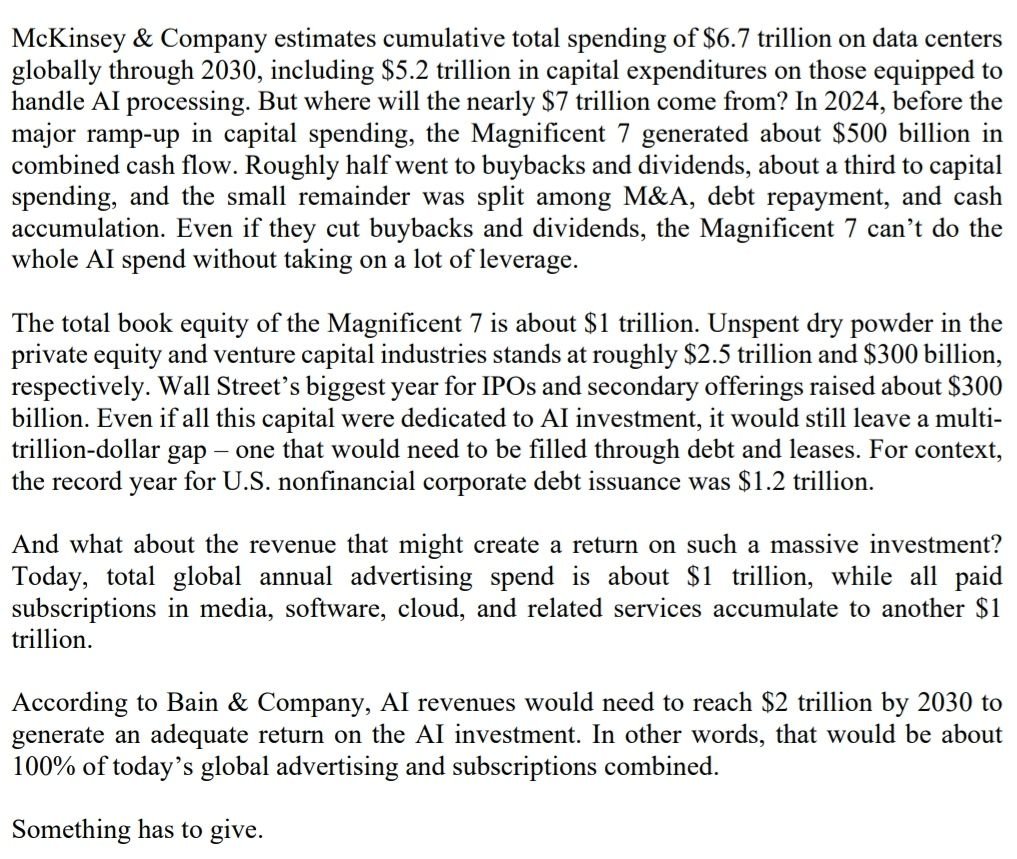
BREAKING: Bank of America just said take profits: 70% of its bear-market signals are flashing, near levels seen at past tops.
The detail nobody quotes: AI hyperscalers are on track to spend ~100% of operating cash flow on capex this year, up from 40% in 2023.
The rally's engine is eating its own fuel.
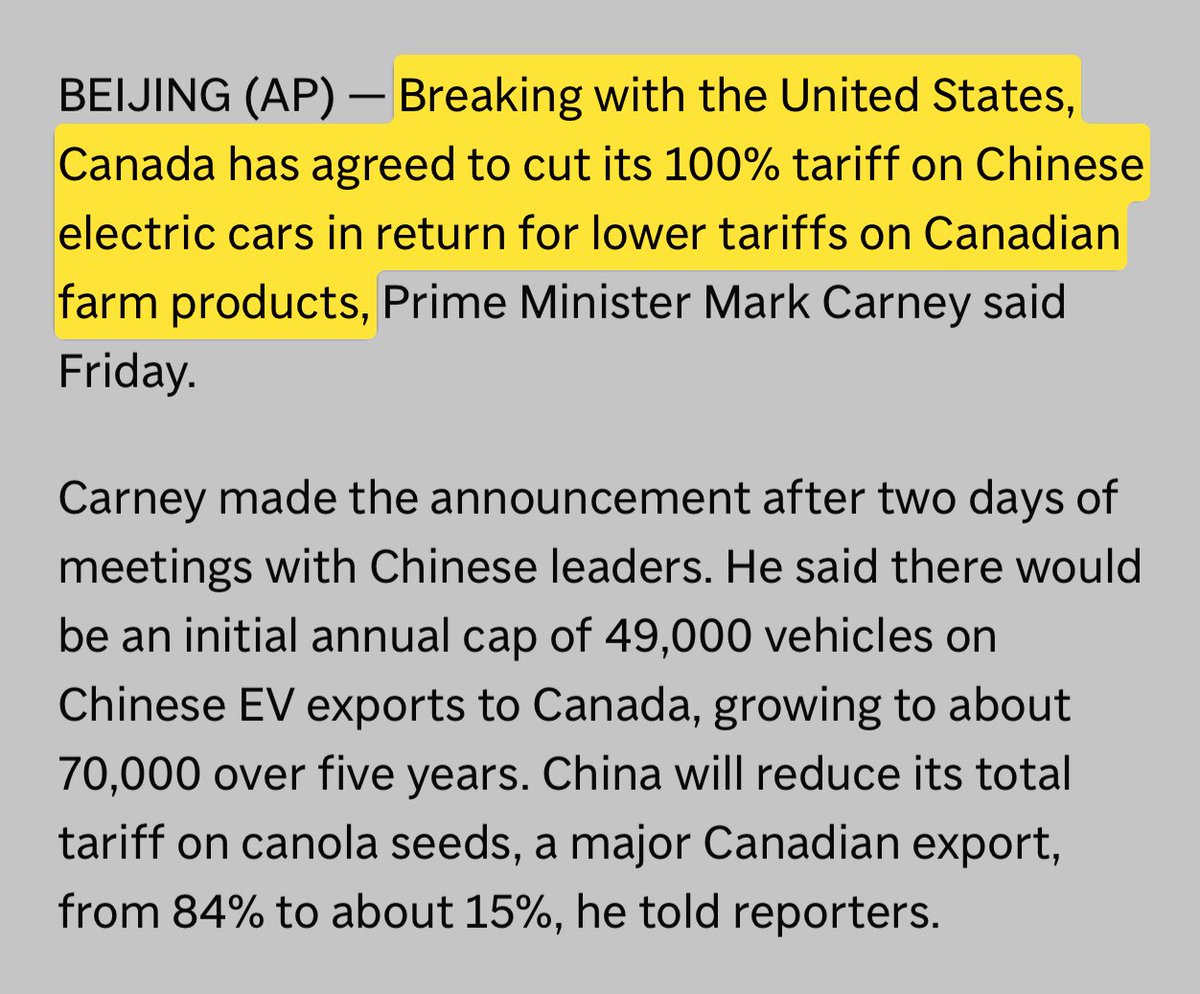
Yesterday, a Five Eyes leader stood in Beijing and praised Xi Jinping’s leadership.
Today, Peter Navarro is circulating plans to expel Canada from the intelligence alliance.
Mark Carney chose his words with a central banker’s precision: “the new world order.”
The exact phrase Xi uses for multipolarity.
The exact phrase Putin uses for “the West versus the Rest.”
The exact phrase Carney himself deployed at Jackson Hole 2019 when he proposed a “Synthetic Hegemonic Currency” to challenge dollar dominance.
This was not a gaffe. It was a signal heard in every capital on Earth.
Here is the sequence Washington created:
35% tariffs on a Five Eyes ally.
USMCA declared “irrelevant.”
Annexation threats: “the 51st state.”
Greenland ultimatum: “whether they like it or not.”
Canadian response: Eight MOUs with Beijing. China surpassing America as top buyer of Canadian crude. “Strategic partnership” replacing “disruptive global power.”
76% of Germans now view America as unreliable. The lowest level ever recorded.
The strategic paradox will be studied for centuries:
Every action designed to isolate China accelerates the multipolar realignment it was meant to prevent.
Carney’s Beijing summit is a template for every middle power facing American pressure.
Australia already reset relations with Beijing.
UK’s Starmer planning his own China visit.
USMCA review arrives July 2026.
America is building the multipolar world it fears.
One ally at a time.
I read a lot of quarterly letters, and most lately are about AI.
Greenlight’s stood out: no internet-bubble history lesson or hype. Just simple questions, reasoning, and numbers.
Quick and balanced read, worth checking out👇
This is stunning. It really shows that, at this stage, the real competition in humanoid robotics isn't between the US and China, but Shenzhen vs Shanghai vs Hangzhou.
By my count there's already 35 strong humanoid robot companies in China, including the global leaders in sales and volume.
Several of these companies already have commercialized robots actually deployed at scale (e.g. anyone can buy Unitree's G1 robot for $13.5k today: https://t.co/qxnNguap4W).
On its end, the US has, arguably, 6 humanoid companies or products:
- Tesla (Optimus)
- Figure AI
- Agility Robotics (Digit)
- Boston Dynamics (Atlas)
- Apptronik (Apollo)
- Sanctuary AI (Phoenix)
But:
- Zero have commercialized products that consumers can actually buy today
- Zero have achieved mass production
- All are either in prototype phase, internal testing, or limited industrial pilots
Which means that stunningly, the city of Shenzhen alone, with 8 humanoid robot companies, probably outcompetes the entire US industry today.
If the US can't compete with a single Chinese city, then clearly the race is between Chinese cities.
Europe, meanwhile, true to form, is basically not even in the race at all.