I don’t think investors fully understand the scale of what is happening here.
👉 Based on a WSJ story
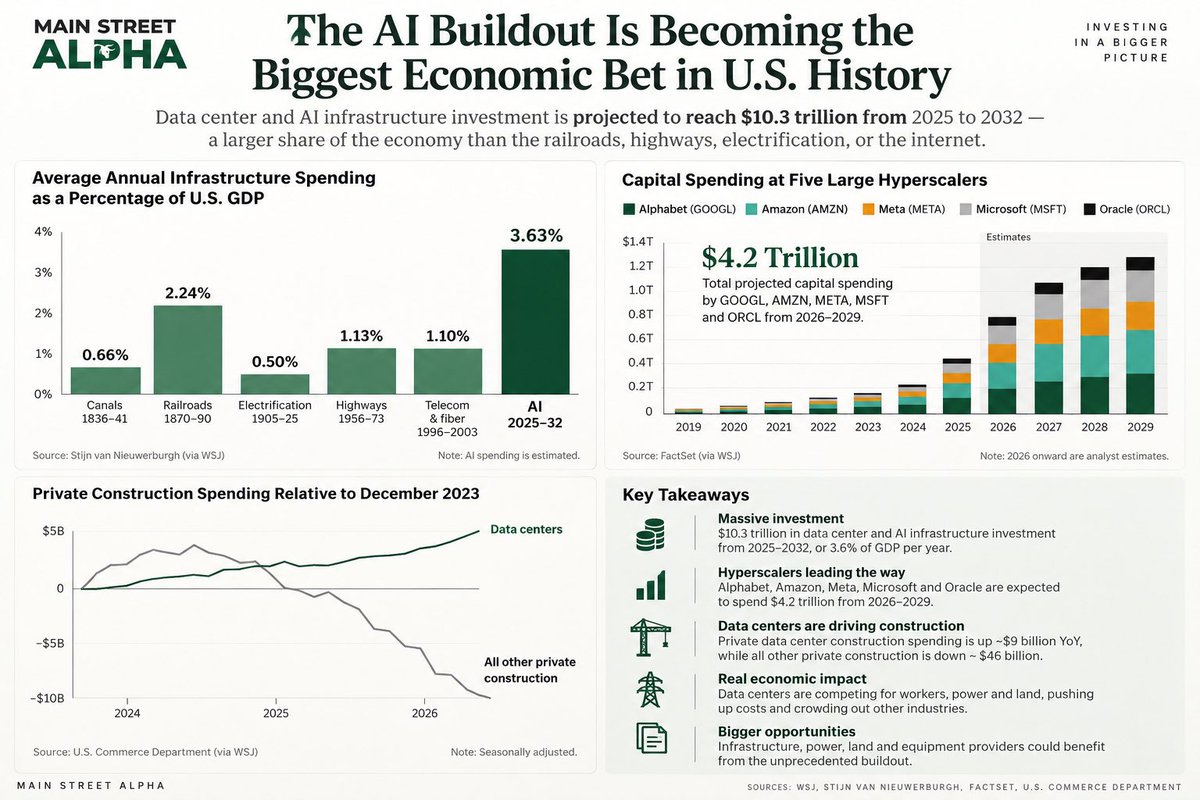
The AI buildout is on track to become the biggest economic bet in U.S. history. Not the internet. Not highways. Not electrification. Not even the railroad boom.
AI.
The WSJ estimates that U.S. data-center and AI infrastructure investment could reach $10.3 TRILLION between 2025 and 2032. That works out to roughly 3.6% of GDP per year.
For perspective, the railroad boom averaged about 2.2% of GDP. Highways were roughly 1.1%. Telecom and fiber were also around 1.1%.
That alone is incredible.
But I think the charts underneath the headline are even more important.
The five hyperscalers at the center of this buildout - $GOOGL, $AMZN, $META, $MSFT and $ORCL - are expected to spend roughly $4.2 trillion in the four years ending in 2029.
That is no longer normal corporate CapEx.
It is large enough to reshape the economy around it.
And you can already see that happening in construction.
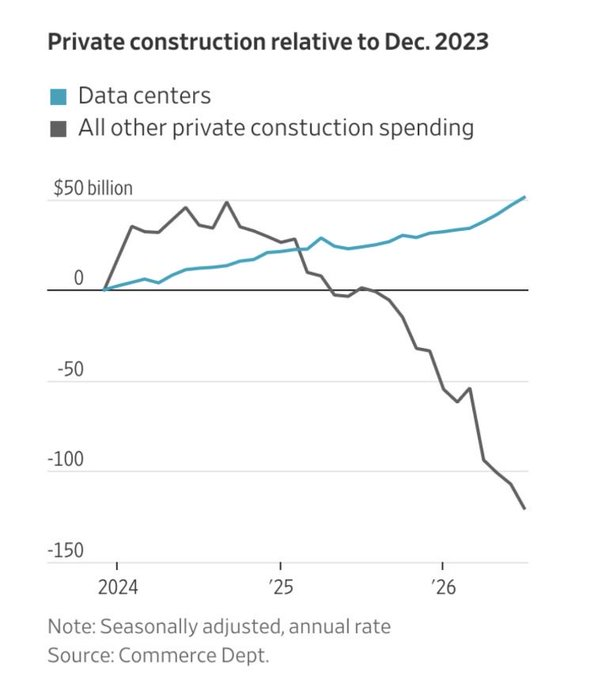
Through July, private U.S. data-center construction spending was running about $9 billion above the same period last year.
Meanwhile, private construction spending on basically everything else - houses, apartments, shopping centers and more - was about $46 billion BELOW year-ago levels.
That chart is remarkable.
Data centers keep going up while almost everything else rolls over.
To me, that is where this becomes much more than an AI story.
Hyperscalers are now competing with the rest of the economy for electricians, construction workers, transformers, turbines, land, natural gas, water and power.
The WSJ gives a perfect example.
Mississippi was in the running for an aluminum smelter that could have created roughly 1,000 permanent jobs. Then a data center was announced near one of the proposed sites and tied up electricity the smelter needed.
The smelter went to Oklahoma instead.
That is what crowding out looks like.
And it is not just power.
Data centers are also pushing up land costs, pulling skilled labor into the buildout and creating shortages across parts of the equipment supply chain.
Then there is inflation.
Import prices for computers, peripherals and semiconductors were roughly 20% higher year-over-year in August.
That matters because the AI boom is not happening in some isolated corner of the economy.
It is bidding up the price of labor, equipment, electricity and capital at the same time.
And then there is the wealth effect.
U.S. households now own roughly $63 trillion of stocks and mutual funds, nearly double the amount at the end of 2022.
Think about the feedback loop here.
$GOOGL, $AMZN, $META, $MSFT and $ORCL spend trillions on AI infrastructure.
That spending boosts construction, wages and demand for equipment.
AI-related earnings expectations push stocks higher.
Higher stocks increase household wealth.
That wealth supports consumption.
Meanwhile, hyperscalers keep borrowing and spending to build even more infrastructure.
That is an incredibly powerful cycle.
But it also creates a risk that I think the market may be underestimating.
The more the U.S. economy depends on one massive investment cycle, the more painful it becomes if that cycle ever slows.
And a growing share of this buildout is being financed with debt.
That is why I think this is much bigger than an AI bubble debate.
The question is no longer just whether AI generates enough revenue to justify Nvidia chips or data-center leases.
The question is what happens to the broader economy if the biggest infrastructure boom in U.S. history suddenly loses momentum.
We are not watching another software cycle.
We are watching the construction of a new layer of the U.S. economy.
And increasingly, I think one of the biggest mistakes investors can make is treating AI as just another sector.
AI is becoming the economy.
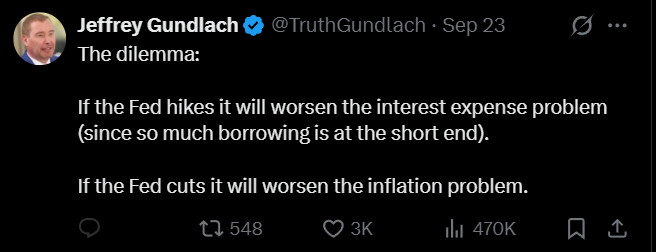
If the Fed keeps increasing rates, the US govt's budget takes a huge penalty in debt interest payments.
$10 trillion in US govt debt needs to be refinanced, or new debt issued, in the next year.
Interest payments on the national debt will be the largest item in the budget.
The US Treasury is caught in a doom loop. This is a problem that both parties in Congress have created by their refusal to control spending.
Investors have indicated that 5% is no longer a high enough interest rate for the risk involved. The dollar is being devalued and the US Treasury is selling $2 trillion in new debt each year. $40.1 trillion and climbing.
All you need to know about Oracle's massive, $300BN New Mexico data center Project Jupiter, which is an SPV (off balance sheet) linking some of the biggest financial players today
https://t.co/vDvPzaxy8N
Rate hikes can still curb demand-side inflation by raising borrowing costs and cooling spending. However, their effect weakens against energy-driven supply shocks, as they cannot boost oil supply. High M2 liquidity cushions the slowdown, while massive debt raises government interest costs that partially recycle money into the economy, limiting net tightening. T-bill yields near 4% already price in the current stance.
Rate hikes can still curb demand-side inflation by raising borrowing costs and cooling spending. However, their effect weakens against energy-driven supply shocks, as they cannot boost oil supply. High M2 liquidity cushions the slowdown, while massive debt raises government interest costs that partially recycle money into the economy, limiting net tightening. T-bill yields near 4% already price in the current stance.
@CNBC@grok Do rate hikes tamper inflation when treasury bills’ yield is this high, there is an inherent oversupply of M2, massive national debt, and a general surge in prices due to energy costs?
The US will need to really ramp up building powerplants... Then again the US should have been investing in building and modernizing our energy infrastructure for decades at this point.
Soaring Treasury yields aren’t just bad for the government and its $40 trillion debt. They also threaten to raise borrowing costs, hitting everyone from homeowners to credit-card users, while providing limited relief to consumer and potential benefits to banks.
Read the full story: https://t.co/B3AmWd9dzX
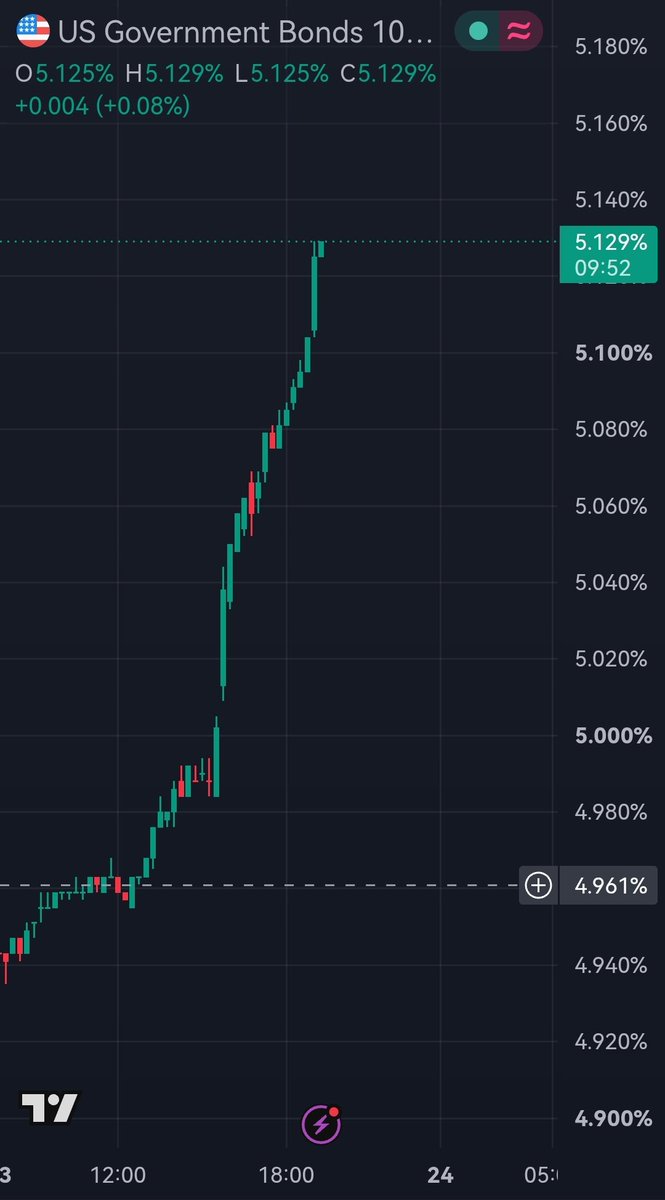
The US 10Y yield is surging... This is unsustainable.
Contrary to the mainstream narrative, higher rates are inflationary when you're sitting on $40T in debt and running $2T deficits.
Higher rates = higher interest expenses = larger deficits = more money printing needed.
The path toward lower rates via YCC is getting clearer by the day.
We don't own enough gold for what's coming.
BREAKING: Foreign purchases of short-term US debt just collapsed 80% in a year, falling from $250.5 billion to just $49.4 billion.
Long-term US debt purchases from foreign buyers also fell 46% over the same period, a combined $410 billion reversal.
This is happening right as the US needs to finance record amounts of new debt.
@GriffinSchulz 100%! Many rarely understand the effects of cheaper debt that is coming to term being refinanced with these high rates. It compounds the debt problem overall, and spikes the cost of debt the US is paying.
1/ Yesterday’s $70B 5-year cleared at 5.033% — 3.1 bp through when-issued (~5.002%), bid-to-cover 2.21.
That’s not just a soft auction. On a ~$40T federal debt pile, every bp of clear is the price of rolling and growing the stock.
7/ Today’s 7-year is the next funding test.
Tight clear (sub-1 bp tail, B/C above 2.4, indirects near 60%+) → yesterday was an air pocket on one tenor. Another concession → the market is repricing the cost of funding ~$40T of debt, not having a bad afternoon.
8/ Punchline: a 5.033% clear is a statement about US debt, not just about one CUSIP.
Score the yield Treasury had to offer, the buyer mix, and the interest bill that compounds from here. Auction math is fiscal math with a settlement date.
#Treasury #USDebt #CostOfCapital
6/ Credit desks: the sovereign is competing with your borrower for capital.
All-in coupons on term loans and fixed private credit don’t care that your spread tightened 25 bp if the Treasury floor moved 60+. Soft-landing decks don’t service US debt — cash coupons do.