The moat of #Berkshire Hathaway is widely misidentified.
The common answer is Buffett's skill in capital allocation. A better answer is insurance float. The correct answer is that Berkshire operates without a cost of capital.
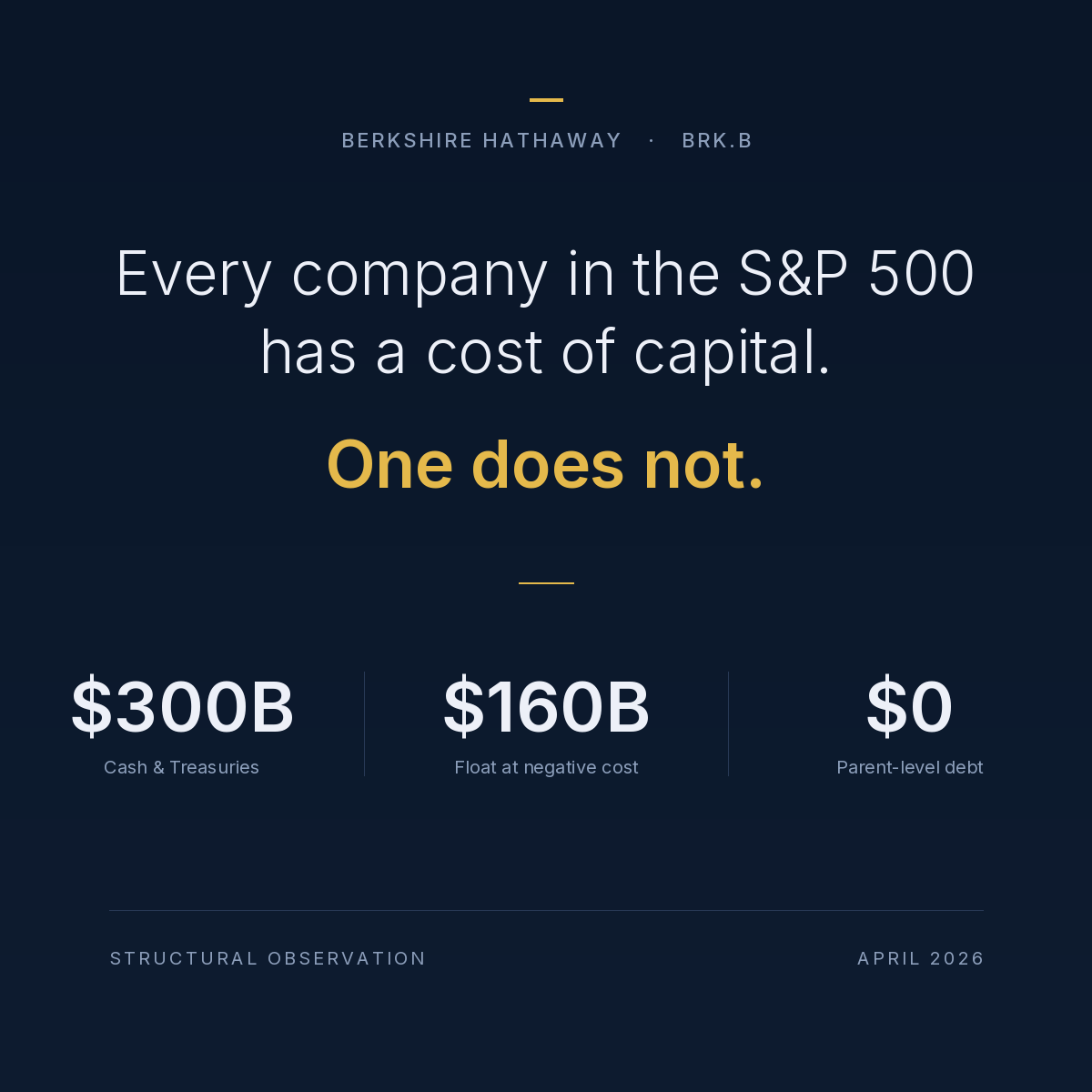
The mechanics are specific. The company pays no dividend. It has not issued equity in a dilutive transaction in its modern history. Its parent-level debt is immaterial against a balance sheet holding more than $500 billion in net assets. Its insurance operations produce over $160 billion in float at negative cost. Its cash and Treasury position sits near $300 billion.
Every other company in the S&P 500 has a cost of capital. Berkshire does not.
This is why Berkshire provides liquidity in crises rather than seeking it. Goldman Sachs in 2008. Bank of America in 2011. The pattern is structural, not personal.
The succession question follows from this. It is not primarily about who makes the decisions. It is about whether the next generation preserves the one structural feature that creates the power: a balance sheet that owes nothing to external capital markets.
Views are my own and do not represent those of my employer.
$BRK.B
Fair question. The horizon comes from the momentum layer, not the analysis layer.
Power Mapping tells me what a company structurally is. What role it plays in its market, where its power actually sits, what it depends on. Status-Quo-Player, Challenger, Balancer, Disruptor, Dependent.
That filter decides what I am willing to hold.
Momentum decides when. Once a name qualifies structurally, I size in when the setup is there and typically hold one to two months, sometimes three. The framework sets the universe, momentum sets the clock.
𝗣𝗼𝗿𝘁𝗳𝗼𝗹𝗶𝗼 𝗨𝗽𝗱𝗮𝘁𝗲: 𝗠𝗶𝗱 𝗔𝗽𝗿𝗶𝗹 𝟮𝟬𝟮𝟲
𝗖𝘂𝗿𝗿𝗲𝗻𝘁 𝘀𝘁𝗮𝗻𝗰𝗲: Growth tilt, around 24% cash, under active review.
𝗭𝗼𝗻𝗲 𝗮𝗹𝗹𝗼𝗰𝗮𝘁𝗶𝗼𝗻 (𝗼𝗳 𝘁𝗼𝘁𝗮𝗹 𝗽𝗼𝗿𝘁𝗳𝗼𝗹𝗶𝗼)
Core Stability: ~34%
Growth Drivers: ~35%
Opportunistic: ~7%
Cash reserve: ~24%
𝗣𝗼𝘀𝗶𝘁𝗶𝗼𝗻𝗶𝗻𝗴 𝗼𝘃𝗲𝗿 𝘁𝗵𝗲 𝗹𝗮𝘀𝘁 𝘁𝘄𝗼 𝘄𝗲𝗲𝗸𝘀
Coming into April, the book was built around 16 names across semiconductor capital equipment, memory and storage, AI infrastructure and optical, construction and services, with a smaller volatility buffer in precious metals. For most of the first two weeks of the month, the portfolio ran a deliberately elevated cash level of roughly 75%. The reasoning was structural, not directional. Escalation in the Iran conflict, the closure of the Strait of Hormuz, and the resulting pressure on global energy flows and supply chain dependencies shifted the Strategic Environment axis for a wide range of names at once. In that kind of environment, sizing down and holding dry powder reflected the framework more honestly than staying fully invested.
With the Pakistan mediated ceasefire holding through mid month and broad indices recovering their year to date losses, we stepped back in on Thursday. Positions were rebuilt inside the same 16 names, moving from roughly 25% invested and 75% cash to roughly 75% invested and 25% cash. The base case at that point was a fragile but functional ceasefire with the Strait progressively reopening. On Friday, Iran briefly declared the waterway fully open.
By Saturday evening, that picture had inverted. Iran reimposed the closure of the Strait, the IRGC stated that any vessel approaching would be targeted, and several tankers were engaged by gunboats during the day. The structural risk we had positioned for through the first half of April is active again. The 25% cash reserve, kept by design rather than by accident, now carries its full justification.
𝗪𝗵𝗮𝘁 𝗺𝗼𝘃𝗲𝗱 𝗶𝗻 𝘁𝗵𝗲 𝗳𝗿𝗮𝗺𝗲𝘄𝗼𝗿𝗸
Across the book, roles and Power Cores are unchanged. The semiconductor capital equipment cycle remains intact, with industry bellwethers raising their outlook in mid April on sustained AI related demand. Memory pricing continues to feed into the bill of materials for the broader chip supply chain, tightening the Dependency Matrix on the downstream side and reinforcing pricing power on the upstream side. Data center buildout continues to pull demand through optical components, fiber, and specialty glass. Construction and services names remain anchored by structural tailwinds on the data center side.
What has shifted is the Strategic Environment axis. For names with meaningful exposure to global shipping, energy pricing, or Iran linked supply chain pressure, the environment moved from stabilizing to contested within 48 hours. That is enough reason to slow further deployment, not to unwind the thesis.
The precious metals exposure behaved as designed during the earlier risk off phase and is positioned to do the same here.
𝗪𝗵𝗮𝘁 𝘄𝗲 𝗮𝗿𝗲 𝘄𝗮𝘁𝗰𝗵𝗶𝗻𝗴
The duration of the Hormuz closure and the response from the US, the Gulf states, and maritime insurers. Sustained closure propagates into energy pricing, shipping rates, and eventually into the cost base of the hardware heavy clusters in the book.
Whether the AI capex narrative absorbs the geopolitical shock or begins to pause in forward commentary. So far the signals remain intact.
Role stability in the Status-Quo-Players, particularly on the services and infrastructure side where macro sensitivity is higher.
The open question is no longer whether last week's recovery was a structural leg up. It is whether 24% cash reflects the current risk adequately, or whether the book needs to move further back toward a defensive tilt.
As always, positioning reflects the Power Mapping framework and current risk profile. Past performance does not guarantee future results.
The point is the compounding. Each layer makes the others harder to attack.
For investors seeking durable cash flow, $MO remains a textbook Status-Quo-Player.
The open question: is the moat eroding faster than new ones can be built in smoke free categories?
#PowerMapping#etoro
Distribution.
Philip Morris USA manages direct relationships with over 300,000 retail outlets. A managed retail ecosystem, not a wholesale model. Demand captured at the point of sale, at a scale competitors cannot replicate quickly.
Each analysis covers 8 sections: from competitive moat to structural risks. Written to be read in under 4 minutes. Built to be referenced for months.
This is not a screener that spits out numbers. It is a research library with a structural opinion on every name.
The core framework is Power Mapping.
Every company occupies one of five roles: Status-Quo-Player, Challenger, Balancer, Disruptor, or Dependent.
The role tells you more about a company's trajectory than any DCF model.
🎯 Portfolio lens: Opportunistic Play
For investors seeking asymmetric exposure to autonomous systems and defense tech, $ONDS could be worth considering as a high-conviction small bet – depending on individual risk profile and time horizon.
The key question remains: Can Ondas convert its regulatory edge and growing backlog into sustainable margins before the cash burn becomes a concern?
Danke @eToroDE und @ing_ruc für die Einsichten ins Thema Öl heute im Podcast. Spannend (für mich) wäre noch eine Meinung zu den drohenden Effekten durch die Unterbrechung von Gas- und Destillatlieferketten gewesen :)
Aber wir hab auch eher ein Übergewicht bei Halbleitern… da könnte auch das Thema Helium noch „spannend“ werden.