Why am I getting such good results out of Claude Sonnet 4.6 & OpenCode when other say it's all about Opus. I've tried Opus in my workflow a few times but I personally didn't see any "step function" there. Sonnet is great - what do you think I'm not seeing?
the idea that assets are not hits is similar to code is not innovation. Deep expertise and focus can take advantage of the ai tools. however ai cannot replace the expertise and creative spark needed to build something innovative. it can copy well!
i am convinced that software devs have a speed problem
they think the #1 issues is writing code faster... its not. its fixing the code that is already there to stop being utter garbage (as a garbage code connoisseur)
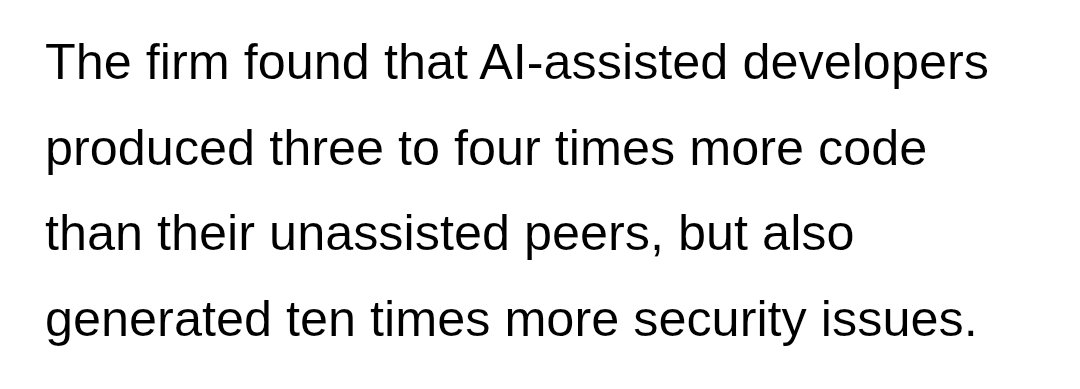
quality is really lacking these days, yet quantity has never been higher
"RAG will never die even in a world of infinite context windows because it will remain cheaper and faster to be selective"
Catch @ofermend, @seldo and others in this panel discussion with @vectara on "Why RAG will never die"
https://t.co/y5XDPIYD1W
Programmers are obsessed with whether frameworks scale up, but often barely give a thought as to whether they scale down. Something far more important to 99% of actual users.
"The open source gift exchange has never been busier. The primary crisis, if there is one, is mismatched expectations between givers and receivers. Solvable by a change in perspective." https://t.co/mhPDt9lk3g
The Marshmallow Test is a famous set of psychological experiments. It found that children who displayed high levels of self-control had better outcomes later in life.
But @UCBerkeley psychologist @celestekidd was curious about these findings...(1/2)
Please share this live hacking video with your loved ones so they can see just how easy it is to fake caller ID (and even clone a voice) to demand money or data over a scam phone call.
I’m hoping this demo helps even 1 person shut down a hacking attempt.
This week’s CTO Function podcast is an interview with @BrianSoby , the CTO and co-founder of @AppOmniSecurity , a SaaS security and SSPM platform. We discuss a unique type of CTO: the startup / founder CTO. Brian tells some interesting stories about what very early stage companies need in a CTO. Brain also shares some insights on the need to balance customers, product and tech operations, and how he does that.
You can find this episode at: https://t.co/NfMdPlQn3L
And you can follow us on YouTube or your favorite podcast platform.
As a CTO I always strive to understand the truth of tech. Here is a must read article on Generative AI - The Great Pretender https://t.co/eRxBbD05zW via @techcrunch
@HiddenBrain This was a favorite episode of mine. I’ve seen first hand the impact of “more being less” in many business and sales calls. This explains why definitely worth a listen.
The latest version of the CTO Function podcast is an interview with Rob Fry, the CTO of @mezmodata . Rob shares many insights in this episode like the importance of the CTO as a bridge builder, specifically between the business and the technical side, as well talking about the value of of leading teams with trust, respect and empathy. And list in to hear what he calls being the “ultimate gap filter”.
You can follow us on:
Apple Podcasts: https://t.co/l54uKNdgu3
Spotify: https://t.co/R9rQYLX5Ow
Youtube: https://t.co/jJVNKBZCuv
I often find when I sit down with other CTOs, we jump right to talking about the latest tech trends and their potential impact.
However, over the past 6 months, I've spent more time thinking about the function and role of the CTO in organizations. Specifically, how to do the job better and how to make a larger impact. I'd like to share some of these conversations with you through the CTO Function podcast.
In each episode, I'll talk to experienced CTOs who will share their insights, lessons learned, and challenges they faced in their careers.
Our first episode is with @OKTavakoli , CTO at @Vectra_AI . You’ll hear some interesting insights about the CTO as a connector, translator, and truth teller.
You can follow us on:
Apple Podcasts: https://t.co/l54uKNdgu3
Spotify: https://t.co/R9rQYLX5Ow
Youtube. https://t.co/Um31Dih7w0
#podcasts #CTO
@friedberg Very interesting point and makes a lot of sense. But given the current polarization wouldn’t more personalized content drive us deeper into our own bubbles and contribute more to that problem? I personally want to hear the story that contradicts my current pov
Ironic that one of the tenants in crypto is you don’t need to trust anyone because it’s all “on chain.” Yet everyone that lost money in FTX (both customers and investors) deviated from that construct. Neither FTX investments or customer assets were “on chain.” (More).