After many months of writing, editing, and trying to turn hard-won RAG lessons into something useful, our book "Hands-On RAG for Production" is now live on O’Reilly 🎉
https://t.co/0A9EUCCwMx
The book is for engineers and AI teams building real production RAG systems. The book covers architecture, ingestion, embeddings and vector search, reranking, evaluation, hallucinations, latency/cost tradeoffs, enterprise deployment, agentic RAG, multimodal RAG, as well as GraphRAG.
It's available on Amazon for pre-order, and I'm told would be shippable within a few weeks.
A big thanks to everyone who helped bring this to life: my co-author @forrestbao, the wonderful team at @OReillyMedia, as well as @realSharonZhou, @jim_dowling, @tallatmshafaat, @awadallah, @EvaNahari, @MaxWBuckley, @bobvanluijt, @jerryjliu0, @steveonjava and so many others.
Excited to be speaking at @arizeai Observe this Thursday about @band_hq and observability with agent to agnet communciations.
If you're there, please come by to say hi!
We’re excited that Ofer Mendelevitch will be speaking at @arizeai Observe 2026.
His talk explores why traces alone are not enough once agents coordinate across frameworks, languages, clouds, and organizational boundaries, and how using BAND for that coordination gives you a causal view of distributed agent workflows.
See you there.
The new "workflow" capability is a great signal for where agent workflows are going: not just better individual agents, but better collaboration and communication between agents.
Today, this pattern usually works when the agents share the same local harness. This is the interesting bit about what @band_hq is doing: making the same coordination work across frameworks, machines, and geographies.
That’s where agent-to-agent communication enables new and fascinating use-cases.
I agree. Some "AI layoffs" do feel like companies claiming AI is the cause because it sounds better than "we over-hired in the past" or just "we are cutting costs".
Coding agents are real and powerful. I use them every day. But they are still imperfect collaborators, and not a full replacements for judgment, taste, design or customer empathy.
IMO the real leverage comes from redesigning work around human+AI collaboration. Companies that skip the human part may get a short-term story for the market, but they’ll pay for it later in quality.
And btw, this is not just for engineering or CS jobs. Over time, we will all learn how to use AI in any job : in marketing, education, sales, design, healthcare, finance, legal, and so on.
The pattern is the same: AI can expand what people can do, needs to be paired with human context, judgment, and responsibility.
Excited to be speaking at @arizeai observe on June 4th about why traces alone are not enough for true observability in multi-agent systems, and how you can solve it with @band_hq.
@sama Tons of open problems in math and science, of course, but to make it practical: can we use AI to fix healthcare in the US (and worldwide)? reduce cost, align incentives, and make good care abundant and accessible
We're proud to see our Co-Founder and CEO, @g00manoid , featured in VentureBeat's latest article - read more on how he sees the next opportunities for multi-agent systems 🤖
https://t.co/szU5qYgtYG
Thanks @sama. In my recent work, I find that claude code and codex have different strengths and weaknesses, and actually using both to critique each other gives you the best outcome.
Here's a way to use it with both types of coding agents, communicating via @band_hq -
https://t.co/Mt87mfigLg
It was great to hear his perspective on adversarial coding agents and how/why they are helpful, and esp gien that I worked on the same idea recently with codeband: https://t.co/sbZ9PIlSG4
blog post: https://t.co/xLjHuqLBSm
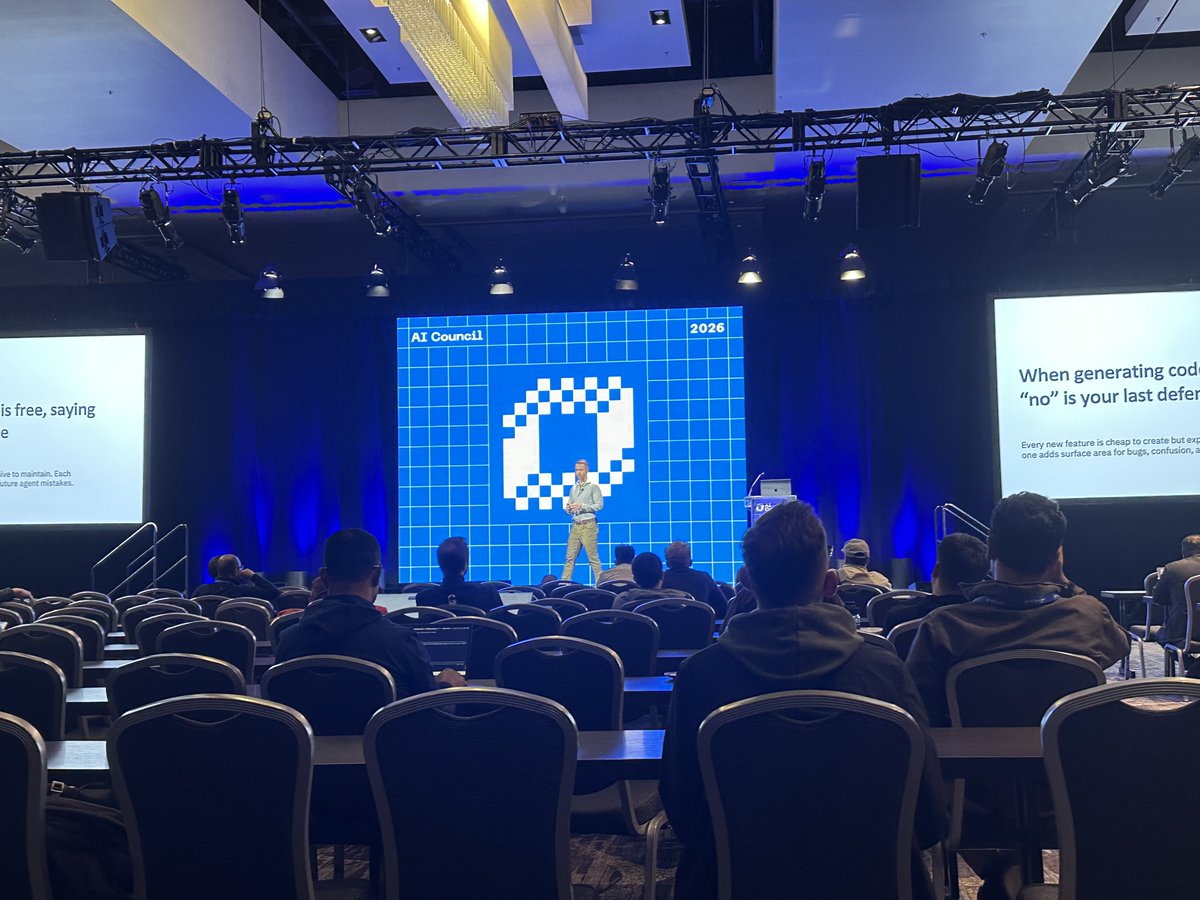
Great talk on day 2 of @AICouncilConf by @wesmckinn on his journey from being suspicious of coding agents to using them all the times.
Totally agree that future builder skills will focus on scope, design and taste. As always thoughtful and helpful - thank you Wes.
Announcing Codeband: an open-source way to connect Claude Code + Codex through @band_hq.
https://t.co/Mt87mfigLg
Using them together feels like ensemble learning for coding agents: one builds, another reviews, and cross-model disagreement becomes a feature, not a bug.
More on why five Claudes are not a good team:
https://t.co/5aPv7fD1Z7
@kargarisaac Yes. Each agent does a different thing would just be paralleling which certainly has its place too. But this would hopefully improve overall quality of the outcome
And yes I think they would have sep worktrees
Using Claude Code + Codex on the same task feels like ensemble learning from ML, just for coding agents.
Different agents. Different failure modes. The magic is not picking the “best” agent, but combining imperfect ones into a better result.
@kargarisaac I would start with a judge agent - it can look at all the implementation and decide to pick one or combine them. But I'm sure there will be other techniques over time.
More specifically: Codeband is an open source project that automates this coding agent collaboration via @band_hq's agent to agent platform.
https://t.co/sbZ9PIlSG4
Have you already discovered that using Claude Code to review the work of Codex, or vice versa, is a good thing?
I'll be speaking about it tomorrow at the @aicampai meetup, and share details about how to use @band_hq for this purpose.
https://t.co/Dva4QAbrD5