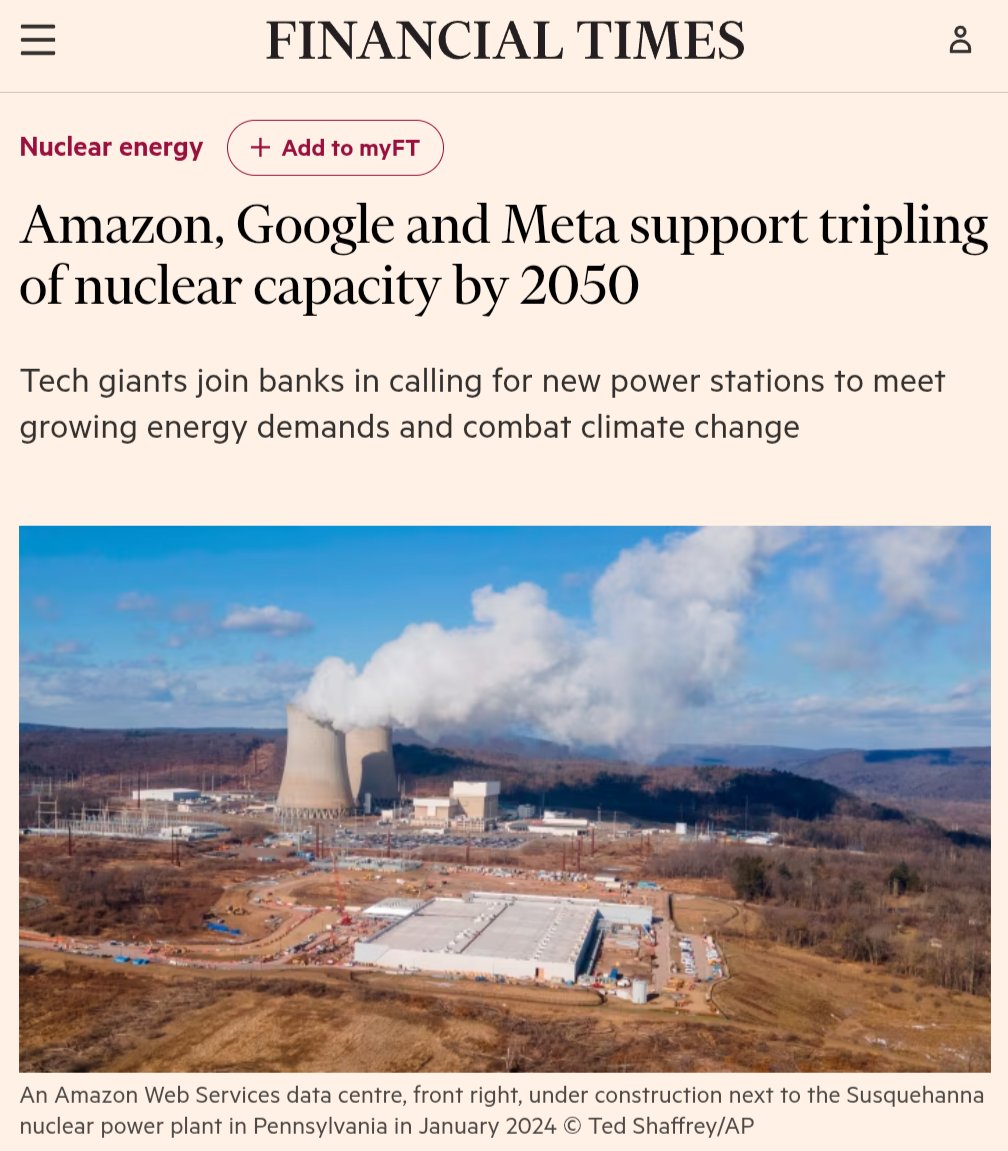
The Nuclear Energy Industry is getting another vote of confidence this morning as some of world's largest tech companies, including @Google@Amazon@Meta throw their weight behind tripling nuclear output by 2050.
🔗 https://t.co/IGVZuv1U3d
#TriplingNuclear#CERAWeek2025
Will Google invest in some AP1000s?
Here at @CERAWeek, Google's Head of Energy Market Development clarifies their investment/views on Gen3 & Gen4 nuclear.
Key Points:
- Google isn't against Gen3 & takes an all the above nuclear approach
- Kairos gave them the unique role in scaling a reactor they believe in
- Google will continue to play role in Gen3/AP1000
Why the AP1000?
"We need it because it's the only one we have built & the markets know how to price it out."
I'm here at the biggest energy conference in the world, @CERAWeek in Houston TX
10,000+ attendees across all energy; heavy focus on fossil fuels.
Nuclear is coming up, over and over again.
Energy conferences are now AI conferences.
AI conferences are now nuclear conferences.
Over the history of civilian nuclear power use ever, there has been three major accidents.
Nobody died at Three mile island
The type of reactor at Chernobyl isn’t built anymore.
Nobody died of radiation at Fukushima.
Time to stop the fear and start up more of these extraordinary machines for prosperity.
The Wolf Creek Generating Station is Kansas' first (and only) nuclear power generating station.
It's been safely providing reliable energy to residents of Kansas and Missouri since 1985 and generates enough energy to power more than 800,00 homes.
📸: Wolf Creek Nuclear Operating Corporation
Who's Pledged to Triple Nuclear by 2050?
- 31 countries
- 140 nuclear industry companies
- 14 major global banks and financial institutions
AND NOW,
- 7 Tech giants & other major energy users including @amazon, @Google, @Meta
Why?
"A resilient strategy for fostering economic growth should include an INCREASE in the share of electricity provided by nuclear energy & should ensure energy abundance delivered through a diversified & reliable grid infrastructure"
View the pledge: https://t.co/TTWypWnYE8
Germany's failed energy transition (Energiewende) is of interest to many of its European neighbours. In Stockholm on 6 March, I informed representatives of the energy-intensive industry about the mistakes Germany has made and the enormous consequences for its economy. @dagensindustri DI Event
At the same time, I gave Swedish industry advice on how to avoid making the same mistakes.
I am now again on my way to Sweden to meet interesting representatives of the Swedish energy industry in Gothenburg.
Photo: DI/Engstrom
JP Morgan's annual energy report is always an excellent read.
"after $9 trillion globally over the last decade spent on wind, solar, electric vehicles, energy storage, electrified heat and power grids, the the renewable share of final energy consumption is slowly advancing at 0.3%–0.6% per year."
https://t.co/aDbRu9F5Nc
@toadee85@iknowraindear@chrisyelland You guys think @Chrisyelland - who spins so well he'd qualify as a 50 Hz maintenance device - is a trustworthy source when the data contradicts him!
CSP's CF (efficiency) is only slightly better than PV, assuming 600 MW installed capacity.
https://t.co/Uzax1Mhpm6
32.5% vs 29.5%
Tripling Nuclear by 2050 ⚛️🚀
Tech giants (@Google, @Meta, @amazon) joins 14 financial institutions and 31 leading nuclear countries in the race to triple nuclear capacity by 2050.
The announcement was made on the sidelines of @CERAWeek facilitated by @WorldNuclear.
1/4
NUCLEAR 101: The sodium-cooled fast reactor uses liquid metal (sodium) as a coolant instead of water.
This allows the coolant to operate at higher temps and lower pressures to improve the efficiency of the system.
Learn more: https://t.co/YPcSI1tqdv
Texas lawmaker proposes $2 billion of funding for new nuclear plants in the state.
This could be enough firepower to underwrite a pair of large Westinghouse AP1000 reactors*
Don't waste this on SMRs!
Why?
• Politicians like to see shovels in the dirt, and completed projects. Large Modular Reactors (AP1000) can be built the quickest starting today. Most SMRs are paper reactors.
• Texas has a large grid. Big reactors are for big grids.
• The supply chain has a working memory of how to build LMRs.
• There are two reference units in Georgia that engineers and tradespeople can walk through. There is extensive documentation about how to build them (and how *not*).
• LMRs produce cheaper electricity than SMRs. Better neutron economy and actual economies of scale. Many paper SMRs rely on exotic fuel like "TRISO", which is >3x more expensive.
• There are already 4 gigawatt-scale licenses that have been issued or filed (Comanche Peak & Victoria County Station). These have been withdrawn/suspended, but the applications could be refiled with a lot of the same data, for the AP1000.
*This isn't enough to finance the whole project, just enough to derisk it
HOUSTON: Tech giants joining together with heavy energy users to support the Triple Nuclear by 2050 pledge.
Just announced minutes ago, with the signing event later today at the CERAWeek global energy conference.
Everyone is realizing that, in the end, we are all baseload.
If we can find a way to deploy 3x nuclear by 2050, we have also solved how to 3x it again in the following 25 years. And suddenly, it makes a big difference!