'Zijn jullie geïnteresseerd in #lablekdiscussies? Dan moet je onderzoek gaan doen in de Noordoostpolder. Het is een publiek geheim dat daar ooit een mkz-virus uit het lab ontsnapte.'
@stanvanpelt kreeg de tip van Rosanne Hertzberger, ik dook erin. 1/12
https://t.co/KOPNF7CFWn
It's not that AI can't be used to do knowledge work. It's that it's wildly unreliable in bizarre and incomprehensible ways. Things you'd never think it could be possible to mess up are the things that it messes up.
Like you ask it download some data and do an analysis, and instead it just completely fabricates a fictional dataset for no reason, and gives you results based on that.
Fine if you catch it, but potentially career-ending if you don't.
It inserts its own ideas without telling you. It deletes critical paragraphs.
These actions would be psychopathic in a colleague, but we're just supposed to accept it because it's a machine.
I think AI probably will cure diseases.
That’s the uncomfortable part.
I think these systems genuinely will help discover new materials, optimize supply chains, predict protein structures, maybe even solve problems human beings were simply too slow to solve alone.
I would love a future where fewer children die from cancer because a machine recognized patterns no doctor could see.
But every technological revolution arrives attached to a civilization.
And I no longer trust the civilization deploying this one.
Because the same companies promising AI-assisted medical breakthroughs are also flooding the internet with synthetic girlfriends, automated propaganda, infinite generated slop, and algorithms engineered to destroy attention spans for ad revenue.
That contradiction matters.
The nuclear age gave us energy grids and Hiroshima.
Social media connected the world and psychologically atomized an entire generation.
Technology amplifies the values of the people controlling it.
And right now the most powerful technologies on Earth are being controlled by executives who think “engagement” is a moral framework.
That’s why I’m uneasy.
Not because the machines are useless.
Because they’re powerful.
@G_S_Bhogal@alex_prompter I agree. There is some added value (and the concomitant risk of undermining our own ability to gather data and find answers). But a chatbot's answers are still based on stolen kmowledge.
Let me trace the timeline here because nobody's connecting it.
Step 1: Scrape the entire internet. Every book, every article, every conversation, every piece of art, every forum post. Do it without asking. Do it without paying.
Step 2: Train a model on all of it. Call it "artificial intelligence."
Step 3: Go to BlackRock's Infrastructure Summit and announce: "We see a future where intelligence is a utility, like electricity or water, and people buy it from us on a meter."
Step 3 is where you sell people's own knowledge back to them. On a meter.
They took the collective output of human thought, compressed it into a model, and now they want to charge you by the token to access a version of what you and everyone you know already created.
One Reddit user put it perfectly: "They stole all this data from us, the people, our life's work, creativity, art, by devouring the internet and blowing through all copyright laws. Now they want to sell it back to us in the form of a utility."
Imagine if someone photocopied every book in the public library, burned the library down, and then opened a subscription service for the copies.
That's the metered intelligence business model.
And they're pitching it to infrastructure investors as though they invented water.
De media buitelen over elkaar heen na het nieuwste SCP-rapport over mantelzorg.
Maar achter de cijfers schuilt een veel pijnlijkere waarheid.
Nederland leunt steeds zwaarder op mantelzorg om het zorgsysteem overeind te houden. Niet omdat mensen dat vrijwillig massaal willen. Maar omdat professionele zorg steeds verder verdwijnt en verantwoordelijkheid verschuift naar gezinnen.
Het SCP noemt mantelzorg inmiddels zelf “een belangrijke pijler onder de zorg”.
En precies dát zou ons allemaal zorgen moeten baren.
Lees verder https://t.co/9qJQEal7UC
In Cuba, people pay one dollar for a USB stick.
What is on it: all of Wikipedia. Every article. Every image. 7 million entries.
In North Korea, the same kind of stick is smuggled across the border in plastic bottles.
In US and European prisons, inmates use it because they cannot touch the open internet.
The software that makes those sticks work is called Kiwix. A Swiss developer named Emmanuel Engelhart wrote it in 2007 in Lausanne because four billion people on Earth cannot read Wikipedia. Nineteen years later he is still shipping. Mostly unpaid.
The repo:
→ 5,613 stars across the org
→ GPL-3.0 licensed
→ 100+ languages
→ 4 million users worldwide
How it compares:
ChatGPT Plus → $240/yr, online only, blocked
Britannica → $74.95/yr, online only, blocked
Kiwix → $0, offline, works anywhere
You download one file. 109 gigabytes. It fits on a $12 USB stick. That stick now contains roughly a thousand years of human knowledge.
Here is the wildest part:
The Wikimedia Foundation reported in 2018 that 80% of Kiwix users were in emerging countries. North Korea bans the internet but they cannot ban a USB stick already inside the country. In Cuba, vendors sell weekly Wikipedia updates for one dollar. The Foundation called it "connecting the unconnected."
Engelhart's mission, written in a 2014 email:
"Our users are sailors on the oceans, poor students thirsty for knowledge, world's citizens suffering from censorship or free minded prisoners."
The honest part: 109 GB of disk space. UI looks like 2010. Updates every few months, not real time. And every byte is Creative Commons or public domain. Zero piracy. Zero DMCA risk.
Lausanne, Switzerland. One Swiss developer. Every human library, in your pocket, even when the lights go out.
Your brain has a circuit that doesn't know you live in a city. Its only job is to monitor whether birds are still singing. When they stop, something dangerous is nearby. When they continue, the coast is clear. This wiring predates primates. These kids are being sedated by the oldest safety signal in the mammalian nervous system.
The Max Planck Institute tested this in 2022 with 295 participants. Six minutes of birdsong reduced anxiety and paranoia with medium effect sizes. Six minutes of traffic noise increased depression by the same margin. The effect worked on people who had never left dense urban environments. Their bodies responded to a signal their conscious minds had never learned.
King's College London ran a larger study. 1,292 participants, real-time mood tracking through a phone app, 26,856 assessments over three years. Hearing or seeing birds improved mental wellbeing for up to eight hours afterward. The effect held for people diagnosed with depression. Trees, plants, and waterways didn't explain it. The birds themselves were the variable.
Now here's where Italy connects to Finland. 95% of parents in the Finnish city of Oulu let their babies nap outside starting at two weeks old. A 2008 study confirmed the children took longer, deeper naps outdoors. Parents reported letting them sleep in temperatures as low as -15°C. 66% said their babies were more active afterward compared to indoor naps. The practice started as a public health initiative from Nordic maternity clinics in the early 1900s and became cultural infrastructure.
The Italian kindergarten in this video is running the same program the Nordic countries have been running for a century. Outdoor naps, natural soundscapes, no white noise machines, no blackout curtains. Meanwhile, American kindergartens have been eliminating nap time entirely to squeeze in more instruction. A UMass study showed that children who skipped naps forgot 12% of what they learned that morning. The nap itself was the learning.
The irony is that the countries spending the least on sleep technology for children are producing the best sleep outcomes. No sound machines. No apps. Just birds.
The most deeply enslaved people are often the ones who believe themselves completely free, because they never stop to question what controls them. They mistake their impulses for freedom, their compulsions for individuality, and their addictions for pleasure. They are pulled around endlessly by advertising, algorithms, appetites, political tribalism, fear, outrage, and the constant need for distraction….yet call it “living.” A person who cannot sit alone in silence without reaching for stimulation is not free. A person whose emotions are controlled by headlines, social media, or the approval of strangers is not free. Chains are most effective when they are invisible.
Real freedom only begins once you become conscious enough to see what governs you. Most people are not making decisions, they are just reacting out of conditioning. They inherit beliefs, desires, fears, and habits from the world around them without ever examining them. That is why discipline, meditation, martial arts, ritual, and presence matter so deeply. They interrupt the mechanical nature of unconscious living. They force you to confront yourself directly. Freedom is not the ability to do whatever you want. It is the ability to remain sovereign over your own mind in a world designed to capture it.
A scientific consensus isn't a group of scientists agreeing.
It's repeated results from independent studies all pointing the same way.
We don't agree vaccines saves lives.
We know - because study after study shows it.
Consensus = consistent evidence.
Not collective opinion.
@joinanimus My entire account has been about addressing that question.
If it's meant as a serious question and not a cheap gotcha, then I recommend my Substack piece, "Therapists Say the Relationship Heals. Few Know What It Means."
https://t.co/aRNggKwWxi
There are fundamental principles of psychology and psychotherapy. They have been recognized and refined over generations, and they are at the heart of all effective psychotherapy.
There is no incentive to acknowledge them.
The incentive is to pretend to invent something new, brand it with an acronym, and promote it as a something proprietary.
Time and again, the active ingredients are just a subset of the time-honored, fundamental principles— incorporated in the “new” therapy in watered-down, trivialized form.
The proliferation of acronyms and brands erodes knowledge and expertise.
Here's the fundamental truth:
At the heart of all effective therapy is the relationship between clinician and client—and how the clinician uses that relationship in the service of self-understanding and change.
You cannot brand or commodify a relationship.
It therefore takes a backseat. And what gets branded and promoted instead misses the essence of the work.
8 jaar geleden adviseerde de gezondheidsraad multidisciplinaire poliklinieken voor de chronische ziekte ME 👇
Nu is er nog altijd 0 regulier medisch zorgaanbod voor ME, niks.
Dat is een medisch schandaal, maar het ontstijgt dat niveau ook: het is een politiek schandaal. Het is veel te makkelijk om verzekeraars en artsen de schuld te geven, als het volledige zorgstelsel bepaalde ziektes meedogenloos weigert.
In het beschaafde land wat Nederland pretendeert te zijn, laat je niet al decennia tienduizenden ernstig zieke patiënten zonder enige zorg creperen.
En nog altijd zijn er institutionele "platte-aarde gelovers" die stapels bewijs negeren en deze ziekte als psychosomatisch duiden, met ziekmakende "behandelingen" en medische gaslighting tot gevolg.
Deze wanpraktijken zijn het voorbeeld waarop de schandalen van Long Covid en andere PAIS zijn geënt.
En voor alle duidelijkheid: nee, ME patiënten hebben, vanuit de opzet al, geen toegang tot de zorg in de zeer tijdelijke Long Covid expertisecentra.
12 mei is ME awareness dag. Wees bewust van dit medische schandaal wat zich al decennia afspeelt.
@DrNeilStone I agree. One minor point though: is it possible that more progress could have been made with a more diversified approach to the Alzheimer problem, instead of a too narrow focus on amyloid plaques? In other words is it conceivable that Mr Kennedy wildly exaggerates a valid point?
Two nine-year-old girls stood in a Berlin schoolyard in May 1939, holding each other and crying like the world was ending. For them, it was.
Annemarie Wahrenberg and Ilse Kohn had been best friends since they were six. They went to the same school, the same synagogue, the same ballet classes. They spent afternoons in each other’s apartments eating too much candy, laughing until they got in trouble, and dreaming about ordinary things little girls dream about. But by 1939, the Nazi laws had already stolen the city from them. No parks. No pools. No theaters. Just each other’s company in a shrinking world.
That morning, their fathers walked them to school for the last time. In the yard, the girls clung to one another and made a promise: they would stay in touch. They would find each other after the war. Then their fathers gently pulled them apart and led them in opposite directions.
Ilse’s family had scraped together enough to buy passage on a freighter from Italy to Shanghai — one of the last places on Earth still accepting Jewish refugees without visas. Annemarie’s family was still desperately searching for any exit.
A few weeks later, Ilse wrote her best friend a letter from Shanghai. She told her where she was. She said they would see each other again someday.
Annemarie never wrote back.
For the next eighty-two years, each woman carried the quiet grief of believing her best friend had been murdered in the Holocaust.
Ilse — who later became Betty Grebenschikoff — survived the war in Shanghai with about 20,000 other Jewish refugees. She eventually moved to Australia, then New York, then Atlantic City. She married, raised five children, and had seven grandchildren. She became a Holocaust educator, wrote a memoir for her family, and spoke in schools for decades. In nearly every talk, she mentioned her childhood best friend by name: Annemarie Wahrenberg. She recorded it in her 1997 USC Shoah Foundation testimony, hoping against hope that somewhere, somehow, Annemarie might hear her voice.
Annemarie — who became Ana María — escaped with her family to Santiago, Chile, in November 1939. Her father had been arrested and released by the Gestapo; they knew time was running out. She learned Spanish, built a life, married, had two children, six grandchildren, and ten great-grandchildren. She too became a Holocaust educator, speaking to students about what it meant to be a Jewish child in Berlin in those final months before the world caught fire. She searched databases. She asked questions. She never stopped wondering.
Both women had changed their names. Both had moved across continents. The spellings and surnames no longer matched. Search after search turned up nothing. Over time, each quietly accepted that the other had not survived.
Then, in November 2020, in the middle of the COVID pandemic, an archivist named Ita Gordon at the USC Shoah Foundation was watching a virtual Kristallnacht event from the Interactive Jewish Museum of Chile. A 90-year-old woman from Santiago began speaking about fleeing Berlin as a little girl. She talked about her best friend. The schoolyard. The goodbye.
Something clicked in Ita’s memory. She went into the archive, typed in names, schools, and synagogues. She found Betty’s 1997 testimony — the one where she spoke Annemarie’s name with such longing.
Ita made the call. She connected them.
In December 2020, Betty and Ana María saw each other on a Zoom call for the first time in eighty-two years. Their families gathered around, crying. The two old women looked at each other, started speaking German — a language Betty’s grandchildren had rarely heard — and then they began to laugh. Not polite laughter. Real, giddy, nine-year-old laughter.
“We’re not the girls we used to be,” Betty later told a reporter. But in that moment, they were.
They started weekly Sunday phone calls. They talked about the old neighborhood, the candy, the ballet, the people they lost. In November 2021, Ana María flew from Chile to Florida. At the airport, two 91-year-old women hugged for the first time since that terrible morning in 1939. They drank champagne. They appeared together at the Florida Holocaust Museum. They held on to each other like they were making up for eight decades in a single year.
Betty Grebenschikoff passed away in February 2023 at the age of 93. Ana María still lives in Chile.
Of all the millions of painful goodbyes said in 1939 — on schoolyard pavement, train platforms, and doorsteps — these two found their way back to each other before the end. Not because of fame or fortune, but because one persistent archivist refused to let a small detail in a testimony disappear.
Their story wrecks me every time I think about it. Not just because it’s a miracle of survival and reunion, but because it shows how stubborn love can be. How two little girls who promised to find each other kept that promise across continents, name changes, wars, and decades of assumed loss. How the human heart can hold onto hope long after logic says it should let go.
In a world that often feels divided and cruel, this story whispers something powerful: some bonds refuse to die. Some friendships are stronger than history. Some promises outlive the people who tried to break them.
The schoolyard in Berlin is still there. There’s a memorial stone listing the names of the children from that school who never came home. It’s a long list. Annemarie’s and Ilse’s names are not on it.
They got to say hello again.
A donkey skin sells in Kenya for $130. Boiled into a Chinese beauty product called ejiao, it becomes part of an $8 billion industry. Almost 6 million donkeys are killed every year to feed it. The finished products are sold on Amazon.
Ejiao is a kind of gelatin made by simmering donkey skin for hours. It's mixed into face creams, anti-aging pills, candies, and tonics. Even China's own health regulator has admitted ejiao is just boiled donkey skin. No clinical trials show that it works. But a hit Chinese TV drama called Empress in the Palace put it back in fashion around 2012. The country's growing middle class started taking it for anemia, fatigue, miscarriage, even premature aging.
Donkeys can't reproduce that fast. A female donkey is pregnant for 12 full months and has just one foal at a time. She doesn't start breeding until age two or three. So when Chinese demand exploded, China's own donkey population collapsed from 11 million in 1992 to under 2 million by 2020.
The hunt then went global. Africa has roughly 33 million donkeys, two-thirds of the world's supply. Botswana's donkey population has halved since 2016. In Kenya, government-approved slaughterhouses killed about half the country's donkeys in three years. According to The Donkey Sanctuary, 41% of African donkey owners surveyed had at least one animal stolen.
Donkeys are walked for weeks across borders, denied food and water, until they collapse. They're hit on the head with sledgehammers. Their throats are slit. Some are still breathing when they're skinned. A 2017 PETA investigation in China found foals as young as 5 months old killed this way. Up to one in five donkeys dies before reaching the slaughterhouse.
In February 2024, all 55 African Union countries voted to ban the trade for 15 years across the continent. China is Africa's biggest trading partner. The continent banned this trade anyway. The Donkey Sanctuary still projects demand will hit 6.8 million skins a year by 2027. Within weeks of the ban, donkey theft spiked across Africa. The trade went underground. Chinese companies are now in talks to set up donkey farms in Pakistan instead.
A donkey in rural Africa is often a family's only way to fetch water, carry goods to market, and send kids to school. When it gets stolen overnight, the women and children become the donkey. They walk further with heavier loads. The girls drop out of school first.
The donkey in this photo is leaning against a wall because it's exhausted. The industry on its back is worth $8 billion.
@Walrathis@JenSchrijft@zaagvis@rivm In hoeverre is dit een crisis (behalve natuurlijk voor de direkt betrokkenen)? De kans dat jij of ik morgen door de bliksem getroffen word is groter dan dat we dit jaar besmet worden met de Andesvariant van hantavirus.
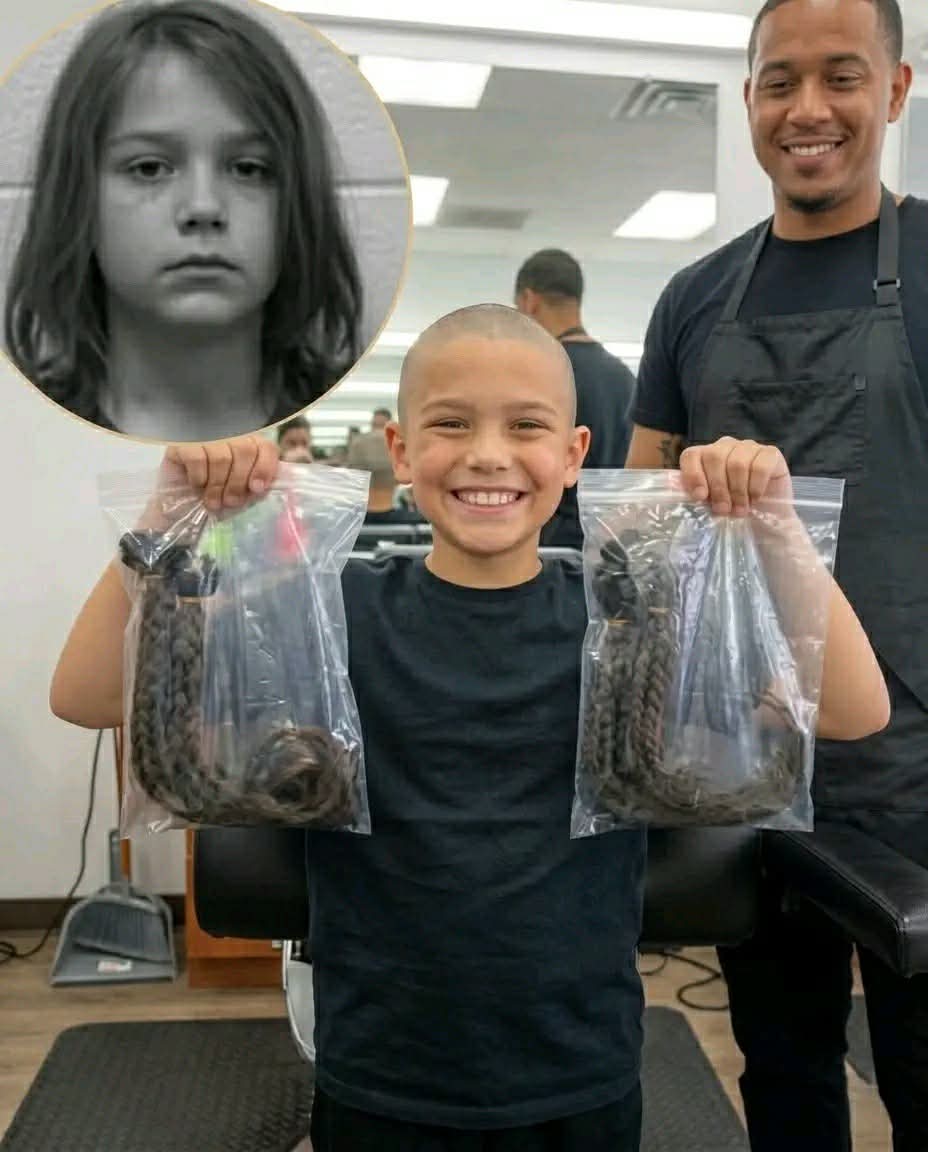
For two years, kids called him a girl. Yesterday, the whole barbershop was in tears.
Every single morning for two years, ten-year-old Christian walked into school with long hair — and every single morning, someone had something to say about it.
"You look like a girl." "Why won't you just cut it?" He heard it on the playground. He heard it in the lunch line. He heard it from kids who didn't know him — and sometimes from kids who did.
Christian never explained himself. He just kept going.
His mom watched him come home some days with that quiet kind of hurt on his face — the kind a kid carries when he's too proud to cry but too young to fully hide it. She asked him more than once if he was sure he wanted to keep going. Every time, he said yes.
He had a reason. He just wasn't ready to share it.
Yesterday, Christian walked into a barbershop and climbed into the chair. The stylist measured his hair. Twelve full inches — more than two years of growth, two years of teasing, two years of keeping the secret.
The scissors came out. The hair came off. And Christian carefully held the ponytail in his hands.
It was going to Wigs for Kids — a nonprofit that uses real donated hair to make wigs for children battling cancer and other serious illnesses. Children who have lost their own hair. Children who just want to feel like themselves again.
Somewhere in that barbershop, someone started crying. Then someone else. By the time Christian stood up from that chair — short-haired, beaming — there wasn't a dry eye in the place.
"I just wanted to help a kid who was going through something hard," he said, shrugging like it was nothing. "I didn't think it was that big a deal."
Christian, buddy — it was a very big deal.
While other kids were worrying about what people thought of them, this ten-year-old boy spent two years thinking about a child he'd never met. Tag someone who needs to see this. 💙
Mijn website blijft nog 10 jaar in de lucht. Al mijn columns, essays, boeken en vertalingen heb ik testamentair aan het publieke domein vermaakt. Doe er je voordeel mee.