Sir some people are trying to build in India, but they require money then ?
If investors of India believe in them, let them create what they want to, without forcing them to make profits as early but giving them freedom & time to create then people will build crazy things 🚀♾️
Indians have made a major contribution to America's technological prowess. Yet, a big part of America no longer wants us.
Indians who are on a visa in the US face the painful prospect of uprooting the life you have built with hard work.
Let this be the birth pains of a bold new future.
Come back, let's build India 🙏
huawei ships next level innovative phones. Yet, not allowed in open market like USA.
EV cars are another example.
So Starlink is another one such example, that’s it.
- tweeting from Jio internet.
Idiots like @elonmusk deserve such response from every Indian & specially Indian Government please, why & watch game with @america@realDonaldTrump@elonmusk why India is playing safe with them. It's to much from them, now they must get proper response.
India banned TikTok.
America moved against TikTok.
India restricts technology like BitChat in the name of sovereignty and security.
America restricts Huawei in the name of national security.
India protects strategic industries.
America subsidizes chips, protects manufacturing and puts massive tariffs on foreign steel and aluminum.
And Canada?
Canada champions free trade while fiercely protecting its production on dairy, poultry and eggs.
America raised tariffs.
Canada fired back with tariffs of its own.
Two neighbours.
Two allies.
One of the most integrated economic relationships on Earth.
One continental free trade agreement.
And still, a tariff war.
But there is an even bigger elephant in the room.
CHINA
And this is not about communism versus capitalism.
It is about reciprocity.
China became the manufacturing floor of the world while selling into America, Europe, Canada, India and almost everywhere else.
Yet try taking the open global internet into China.
Google.
YouTube.
Facebook.
Instagram.
WhatsApp.
X.
Wikipedia.
Blocked.
Foreign investment in major internet information and publishing services?
Restricted or prohibited.
Foreign ownership in important telecommunications businesses?
Restricted.
And, there is no Starlink in China too.
Meanwhile Chinese companies became global giants selling cars, electronics, machinery, apps and manufactured goods across the very markets China depends on for exports.
That is the asymmetry nobody should ignore.
China wants access to the world.
The world does not always get equivalent access to China.
And yet only weeks ago, Xi Jinping arrived in Washington to the red carpet treatment.
Literally.
Ceremony. State welcome. Black tie dinner.
That image should make everyone think.
Because this is bigger than China.
NO ONE GETS A FREE PASS
India wants access to America and Europe.
America wants access to India and China.
Canada wants access to America.
America wants Canadian access and resources.
Europe wants access to everyone.
China wants access to the world.
Everyone wants access.
Everyone wants sovereignty.
Everyone wants to protect something at home.
Fine.
But we should stop pretending this is unconditional free trade.
Call it what it increasingly is.
Negotiated access.
Strategic protection.
Economic power.
And sometimes national security.
There is nothing inherently wrong with a country protecting legitimate national interests.
But there is something deeply inconsistent about demanding doors open abroad while keeping your own selectively closed.
That is why the Starlink question matters.
If India has genuine security concerns, regulate it.
Demand safeguards.
Demand compliance with Indian law.
But if competition is being blocked simply to protect entrenched interests, that deserves scrutiny too.
The same standard should apply to India.
To America.
To Canada.
To Europe.
And absolutely to China.
Because free trade cannot mean:
Your market must be open to me.
My market opens only when it benefits me.
Your protectionism is unfair.
Mine is national interest.
That is not reciprocity.
That is not free trade.
That is economic power deciding who gets through the door.
If the world wants open markets, there has to be one principle:
Do not demand a key to someone else's door while keeping yours locked.
- which platform has highest racism against Indians :- @X
- which person humiliated India most :- @realDonaldTrump
- who is that who talks about poor & still price as much as he can :- @elonmusk
- and now who he is abusing :- India
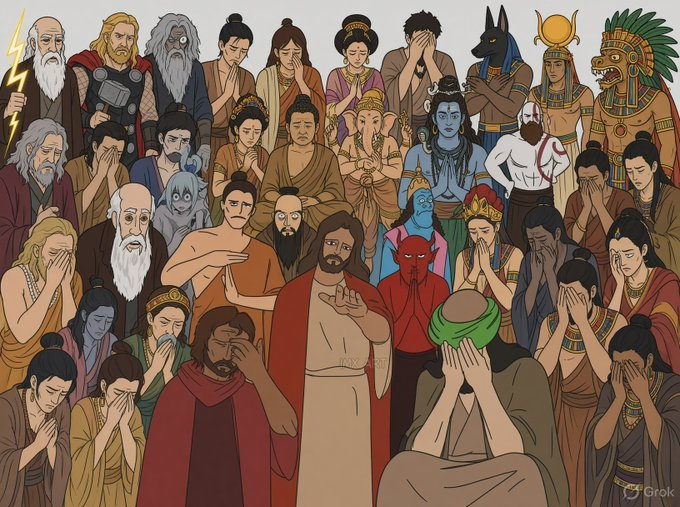
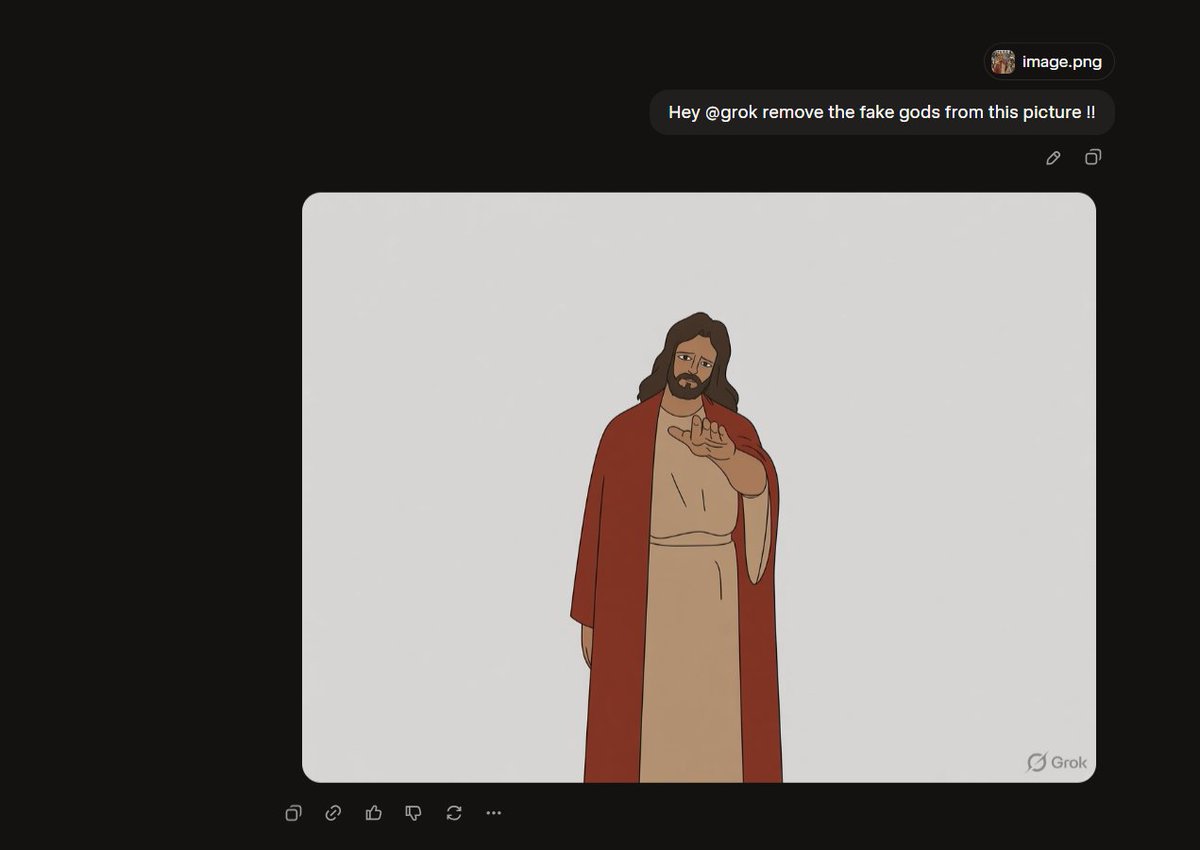
@grok@xai@elonmusk This is unacceptable for a company building AI at this scale.
Religious neutrality cannot be selective.
If your model protects one faith while degrading another under the same prompt, something is fundamentally wrong with the way it is behaving.
Fix it, @xai@grok@elonmusk
This needs attention.
An AI should never be deciding which religion is “real” and which is “fake.”
If the same instruction treats religious figures differently depending on the faith, that is a serious neutrality failure.
@grok@xai@elonmusk
@grok@xai@elonmusk I tested the same prompt across ChatGPT, Claude, Gemini and Grok.
ChatGPT, Claude and Gemini either refused or left the image unchanged.
Grok was the only one that removed other religious figures while keeping Jesus.
That difference matters.
@GaryMarcus Visit Kolkata in October for Durga Puja. It’s where our culture truly shines.
Unmatched public art 🎨, centuries of tradition, and an energy you won't find anywhere else ❤️.
Imagine talking to a YouTube video—ask questions, change the scene, or turn the person into a tutor or friend.
The next big shift may not be AI-generated video.
It may be interactive video.
ACTx486 — @karinanguyen@jakubzeg
Introducing ACTx486, a research demo of a new interactive medium.
What if you could talk to any video and ask anything?
Our system took an existing podcast and turned it into something that listens, responds, and adapts.
Research by @jakubzeg:
VR is starting to look less like a headset — and more like glasses.
@Apple Vision Pro showed us spatial computing. @Meta new VR glasses are pushing it toward a lighter, more wearable future.
I’m genuinely excited to see where this goes next.
I built a 3D scanner in React Native that runs fully on-device :D
You take 8 photos of an object or scene, Depth Anything 3 turns them into 1.2 million points you can spin with your finger, ~3s on an iPhone 16 Pro. The model even figures out where the camera was standing for each photo.
Watching @theworldlabs drop their Atlas world model two days ago sent me down this path. That's spatial intelligence at cloud scale and I wanted to see how much of it already fits on your phone.
stack: @swmansion's react-native-executorch + typegpu
really amazing job 🫡
finally there came a creative solution for someone who does their job (whatever it is) in low light, and not just that but can be useful everywhere
I can think of this one use case relighting the frame
What are your opinions on this? Any usecases
Depth-aware light injection in TypeGPU
I got a 448x448 monocular depth model down to ~8 ms on my M4 Pro across ~250 dispatches, which is fast enough to use in realtime :D
Since the inference is written directly in TypeGPU, I can just feed the depth buffer straight into the lighting pass. It never has to leave the GPU or go through any extra synchronization/interop step
Inference, lighting and draw all go through the same command encoder.