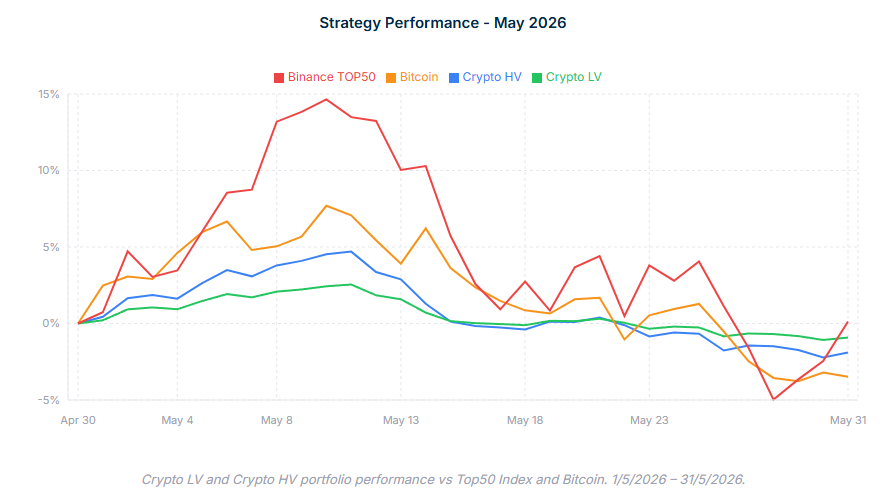
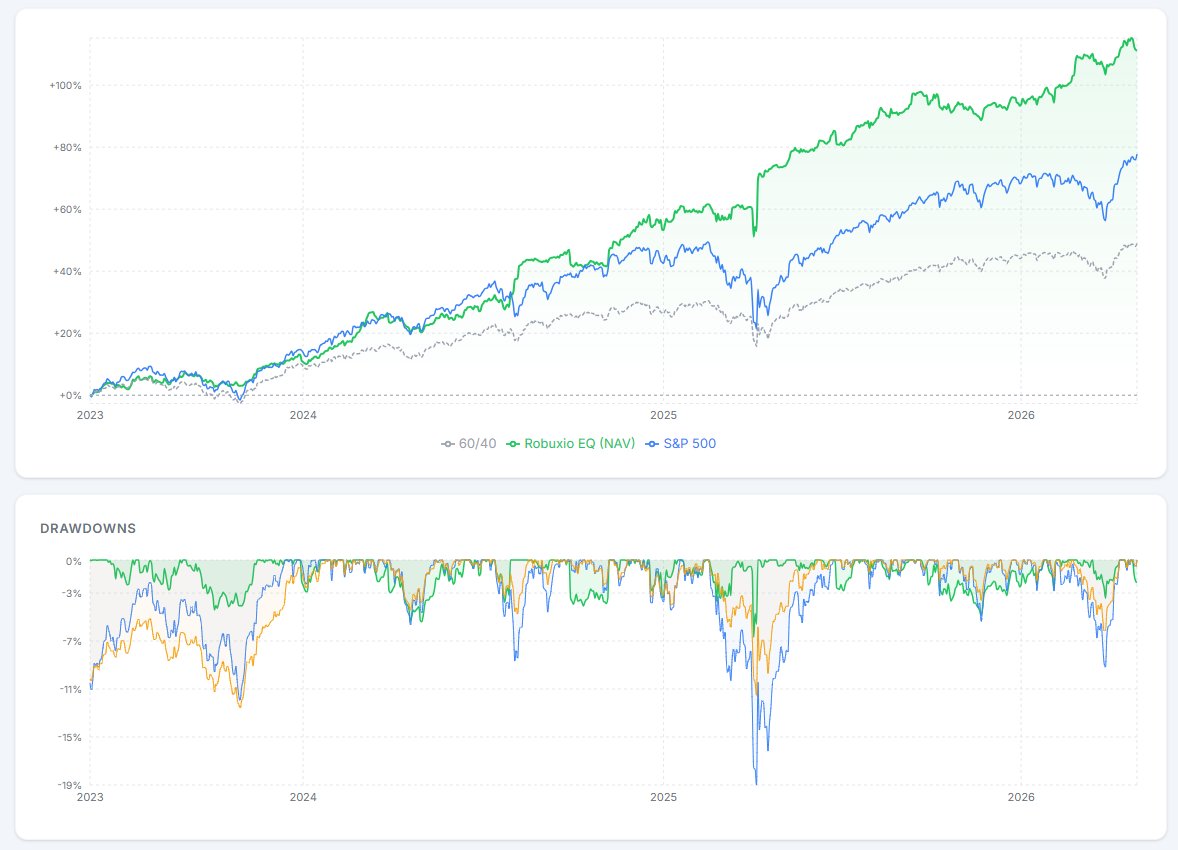
2. Performance YTD:
YTD return of Crypto HV portfolio is +9.1% with a −9.1% max drawdown.
Crypto LV portfolio returned +6.9% with a −5.2% max drawdown.
Bitcoin performance: -15.9%
Top50 performance: -31.3%
Most crypto backtests are built on a lie. Pavel Kycek has the data to prove it.
When you backtest a crypto strategy today, you're testing against the coins that survived. The ones that went to zero aren't in your dataset. Your backtest never sees a single wipeout.
In equities, survivorship bias is a known problem. Researchers account for it. In crypto, Pavel's research puts it at 5-10x worse. The population of failed projects dwarfs the equities equivalent by an enormous margin.
The practical effect: strategies that look profitable in backtests frequently fail in live trading, not because the logic is wrong, but because the test environment was never honest about the full universe of assets.
The fix isn't complicated. You need to include delisted and failed assets in your historical data. Test against the full population, not just the survivors.
The strategies that survive that test are the ones worth running.
Most crypto algo traders never make this adjustment.
Their backtests look excellent right up until they encounter something the test never included.
There were times when it was tough to stay long/short.
A few times over the last 3 years, big clients pushed us to go long-only. They argued that shorting has a very small edge in crypto. And at those times, they were right.
But we trusted diversification as the main goal and even refused some institutional clients because of it.
And it paid off.
I know a few trading teams that closed shop because of the long-only approach.
It is intellectually simpler to go long-only. You face less tail risk. But you are not properly diversified.
If you are interested in getting more institutional-grade charts and metrics to analyse the crypto market, we recently released our crypto benchmarks page below.
https://t.co/C75vWE4f4w
A broader crypto universe does not automatically create diversification.
Across crypto futures, rolling correlation to BTC is high in aggregate. The full-period correlation for both Top50 and All Futures is around 0.80.
That means many instruments still share the same dominant risk factor.
But the important point is that correlation is not stable.
In calmer regimes, correlations compress and the cross-section becomes more useful. Asset selection, rotation, and relative strength can matter more.
In stress regimes, correlations rise and the universe behaves much more like one trade.
The question is not only which instruments to trade. It is how much independent risk each instrument is really adding at that point depending on the market regime we are in.
Great news, we are finally getting onboarded to Stuttgart Exchange!
In a week or two we are opening first subscription window for the ETF-like algorithmic trading programme.
More information here: https://t.co/5nuVbMigRd
It really is not the same. I was running other businesses before too. The biggest issue with a company running based on performance fee is the non-predictability of future cashflow.
I'm not crying. It's also the reason why it is so rewarding over the long term. But it is much harder to do it properly.
Especially if you are running institutional managed accounts solution, you are basically building partially software company with very unstable cashflow.
Minimum 1-year costs saved needed.
I have mixed feelings lately.
I see every month a few crypto trading teams shutting down because of really poor YTD performance.
As a trading shop, this is good news for us. Competition in the market is decreasing.
At the same time, I can fully understand their situation. It is extremely difficult to build a company when 90%+ of the revenue comes from performance fees.
But crypto is an very cyclical market. You simply have to build a cushion during the good times, so you can survive the bad times.