🚨 IT'S HAPPENING, $QNT fam.
I was honored to be the FIRST guest ever to talk $XRP on The XRP Podcast with Paul Barron (@paulbarron). One of the most trusted voices in crypto, finance & tech and the #1 crypto media network in the US.
But this time is different: I'm coming to talk $QNT, $XRP, and where they fit into the future of cross-border settlement, CBDCs, and the tokenization age — the 4th Industrial Revolution. 👀
$QNT is finally going to get the stage it deserves.🔥
Let's make some noise. 🔊 Repost, tag your people, and follow @paulbarrontv so you don't miss it. 🔁
What makes the #FusionRollup different, and why does it matter for institutions?
In the third video, Dr. Luke Riley, Head of Innovation at Quant, sets out what distinguishes the Fusion Rollup, and why institutions building on #multiledger infrastructure should take note.
Learn more: https://t.co/GZrO5x1l9H
#QuantFusion #BlockchainInfrastructure
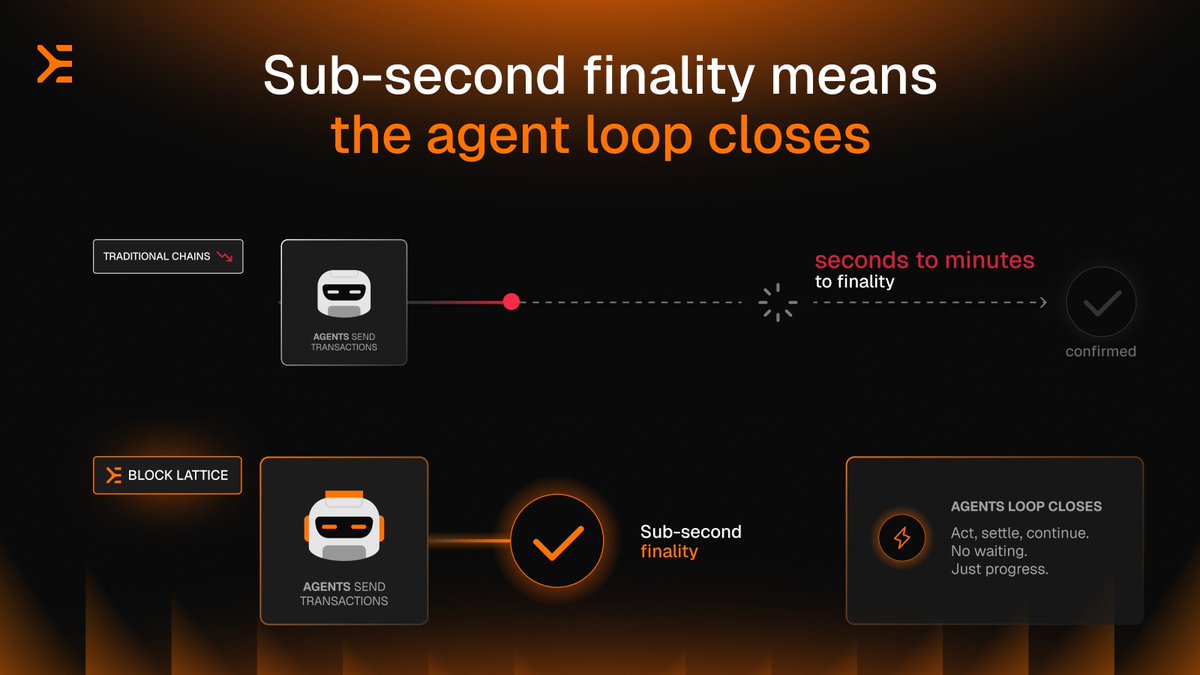
Most chains take seconds, sometimes minutes, to finalise a payment. For a person that's nothing. For an agent it's everything.
It often can't take its next step until the last one settles. So on a slow chain it doesn't slow down. It shuts down.
XE finalises in under a second ⤵️
◼───◼───◼
Picture an agent operating on its own, with no human in the loop. It needs compute, so it pays for compute. It needs a result from another agent, so it pays for the result. Each time, it can't use what it bought until that payment is actually settled. Paying isn't something a person handled in advance anymore, it's a step the agent takes mid-task, thousands of times an hour.
And settling takes a while. The transaction goes out, and then the agent waits, through block confirmations, until enough time has passed that it's safe to treat as final. For a person clicking "buy," a few seconds of that is invisible. For an agent running a loop thousands of times an hour, those seconds are the whole problem. It isn't doing useful work while it waits, it's just holding, blocked on a confirmation, before it's allowed to continue.
That's what we mean when we say a slow chain breaks the loop. The agent's cycle is act, settle, continue, and if settling takes seconds or minutes, the loop can't close. The agent spends far more of its life waiting for confirmation to move on than it spends actually moving. And it only gets worse as models get faster, the quicker the agent thinks, the more of its time is lost waiting for transactions to settle.
On XE, settlement is sub-second, and that changes the nature of the whole thing. Because every account has its own chain, a payment doesn't sit in a shared queue or wait on the rest of the network to agree. It confirms against your chain alone, almost as fast as it's sent. The agent acts, the payment settles, and it continues, without a pause long enough to notice.
This is why sub-second finality matters far more for machines than it ever did for us. It isn't about a snappier experience. It's the difference between an agent that runs continuously and one that wait between every step.
Close the gap to a fraction of a second and the loop closes with it. Act, settle, continue. No waiting. Just progress.
◼───◼───◼
That's the third piece of how XE works. Tiny payments that actually settle, a chain for every account, and now speed fast enough that machines never wait on each other. The internet for the AI machine economy needs all three, and it's why XE was built from the ground up to have them.
$ xe init → $ xe lease
Every blockchain has a limit, because everyone shares one chain.
Imagine every machine on earth paying every other machine, millions of times a second, no queue, each transaction confirmed instantly.
No chain could do that. Until XE.
This is what "per-account chain" means ⤵️
◼───◼───◼
Start with one wallet, and zoom all the way in.
On almost every blockchain, your wallet is a row in one enormous shared ledger, and every move you make has to be written into the same history as everyone else's. On XE it works differently.
Your wallet has a chain that belongs only to you, and the blocks on it are nothing but your own transactions, in the order you made them. It's your history and no one else's, which means when you want to send something, you're only ever adding to your own chain. There's no "shared book" to wait your turn to write in.
That's the part that changes everything, and you see it the moment you zoom back out.
Picture not one wallet but hundreds of them, then millions, every Device on the network holding its own chain. None of them are waiting on each other, because none of them are writing to the same place. They all move at once, in parallel, each one settling its own transactions the instant they happen.
Where a normal chain forces the entire world through a single line, XE simply doesn't have a line, it has as many chains as there are accounts, all running side by side.
This is why the usual question, "how many transactions per second can it do," doesn't quite fit XE. That number only means something when everyone shares one pipe and you're measuring how fast that single pipe can drain. When every account has its own chain, there is no single pipe to measure. You add a Device, you add a chain, and you add capacity in the same motion, so the network's ceiling rises every time something joins it rather than getting more crowded.
It's also why this had to be built from the ground up. You can make a shared chain faster, but you cannot quietly turn it into millions of independent ones, that's a different machine at the root. We spent years building XE around this idea on purpose, because it's the only shape that lets an economy of constant, tiny, machine-speed payments actually run without ever queuing.
And this is the part that flips the usual rules. On a shared chain, more users means more congestion, because they're all competing for the same space. On XE, more users means more chains running in parallel, and the network has more capacity, not less. It's why XE gets stronger as it grows instead of slowing down under its own success.
That's also why a tenth of a cent can settle instantly, the thing we started with. Your payment was never in a queue to begin with. There was never a crowd in front of it. There was only your chain, and your next block.
This is what we mean when we call XE a block lattice.
◼───◼───◼
One wallet, one chain. Millions of them at once. That's the foundation everything else on XE is built on.
Next we'll show what it does to speed, when a payment confirms in a fraction of a second and an agent never has to wait to act.
$ xe init → $ xe wallet create
$QNT x UK Economy has been in the works before 99% of cryptos were established
• Government Agencies
• Banking Infrastructure
• Standardization Bodies
The vision behind everything Overledger, TC 307, SATP, etc has always gone beyond crypto.
There's levels to this game.