To every teacher, counselor, para, secretary, custodian, nurse, bus driver & public school employee across Nebraska: thanks for all you do for students and communities. Your impact matters. Your voice matters. We appreciate you — during Teacher Appreciation Week and every week.
You want the Church to “stay in its lane”?
This is the lane:
the poor.
the hungry.
the migrant.
peace over war.
If that sounds political—
it’s because the Gospel makes people uncomfortable.
#missionaryofmercy
A 10-year-old boy is dead because he was driven to suicide by constant bullying he received at school.
Sammy Teusch of Greenfield, Indiana was bullied up until the night he took his own life according to his family.
Bullied over his glasses.
Bullied over his teeth.
Day after day.
His parents didn’t ignore it.
They didn’t stay quiet.
They went to the school 20 times asking for help, that’s 20 TIMES!
Nothing changed.
He was mocked.
He was hurt.
He was even attacked on a school bus.
And still… nothing was done.
Until it was too late.
His dad said:
“I held him in my arms… something no father should ever have to do.”
I can’t get that out of my head.
This isn’t “kids being kids.”
It’s cruelty.
And it’s failure from the adults who were meant to protect him.
Bullying has no place in any school.
None.
And yet here we are.
How many more kids have to be pushed to this point before something actually changes?
PLEASE SHARE AND MAKE SAMMY’S STORY VIRAL SO NO ONE HAS TO SUFFER LIKE HE DID. 🙏
END BULLYING, BECAUSE IT KILLS!
Scientists put kids through 100 hours of reading, then scanned their brains. New wiring had physically grown inside the language regions. Communication between brain areas sped up by a factor of 10. Kids who didn't read showed zero change.
That was a 2009 Carnegie Mellon study. It gets wilder.
In 2013, Emory University scanned 19 students every morning for 19 straight days while they read one novel chapter each night. Mornings after reading, the brain areas responsible for understanding other people's emotions lit up with new connections. So did the region that processes physical sensation. Their brains were simulating what the characters felt, as if it were happening to them. Those changes stuck around for 5 days after they finished the book.
Now flip to scrolling. A massive review published in Psychological Bulletin last September pulled together 71 studies covering 98,299 people. Heavy short-form video use (TikTok, Reels, Shorts) showed a clear pattern: worse attention, weaker self-control, and more anxiety. Consistent across teenagers and adults, across every platform tested. Oxford didn't name "brain rot" its 2024 Word of the Year for nothing.
A 2024 brain wave study found that people hooked on short-form video had weaker activity in the front of the brain, the part that controls focus and impulse control. Separate brain scans showed the same thing: heavy scrollers had less activation in the exact regions that deep reading strengthens.
UCLA neuroscientist Maryanne Wolf has been studying this for decades. Humans were never born to read. There's no gene for it. Reading is something we invented, and it hijacked neurons that were originally meant for recognizing faces. Over time, it built entirely new brain circuits connecting language, vision, and emotion. But those circuits only survive if you use them. Stop reading, and they fade. Wolf's conclusion is simple: screens built for speed produce a speed-wired brain. Books built for depth produce a depth-wired brain.
One honest caveat: most of these studies are snapshots, not long-term tracking. People who already struggle to focus might just prefer short videos. But the same pattern showing up across nearly 100,000 people is hard to shrug off.
The tweet repeats the line seven times. The research backs it up with brain scans, EEG data, and white-matter imaging across tens of thousands of people.
As a teacher, this is what I want to say to SOME parents:
Stop making excuses for your kids. STOP IT. Teach them to earn things, not demand things. Hold them to a higher standard. Challenge them. That way, when I try to challenge them, they’ll know we both expect it.
If your child becomes a reader, about 80% of the education job is already done. That's my honest assessment after working in education for over thirty years. Everything else is secondary. Most parents think science education is important. Yes it is. But if you can't read the biology textbook, you're not going to learn biology.
Reading is the meta-skill that enables all other skills. History requires reading. Science requires reading. Even math increasingly requires reading as it becomes more sophisticated. The child who reads voraciously will figure out everything else. The child who doesn't will struggle with everything.
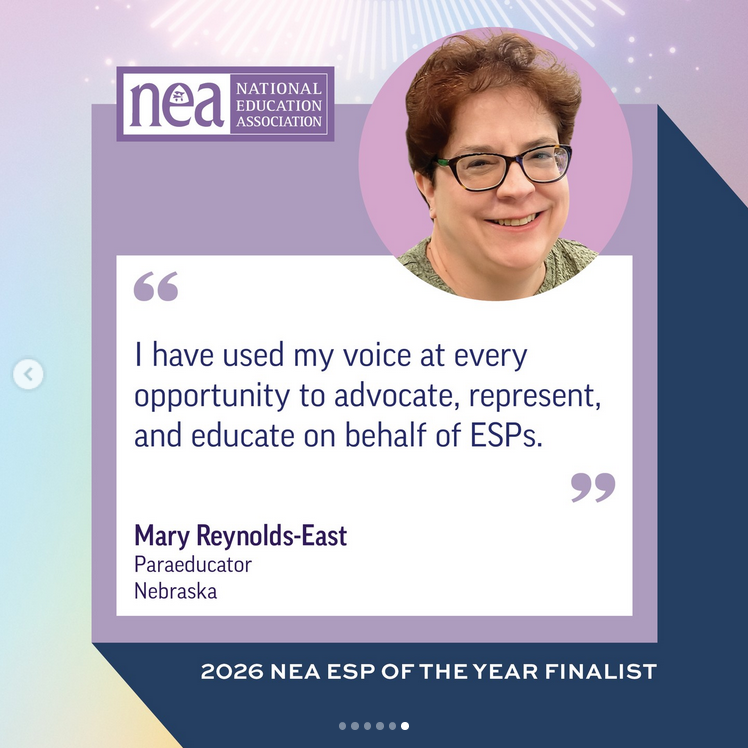
NSEA member Mary Reynolds-East, a paraeducator in Millard Public Schools, is one of five finalists for NEA’s Education Support Professional (ESP) of the year! Congratulations, Mary! 🏆👏
“Shout out to all the teachers out there. Thank you teachers! It takes so much patience to deal with other people’s brats and try to influence them.”
-Charles Barkley
Every great educator starts somewhere. The Early Career Educator Award honors those first five years of impact.
Sometimes all it takes is one person saying, “They deserve this.” Who will you nominate this year?
Nomination forms at https://t.co/QutHNxEs9d. Deadline: Feb. 6.
If every child came ready to be taught, teaching would be easy.
But some need food.
Some need supplies.
Some need love.
Some need nurturing.
Some need patience and some need to be seen.
Teachers meet them where they are as they enter the classroom and that’s what makes teachers amazing.