Founder @Socraticexp. 35 years turning school from your family's biggest stress into its greatest relief. K-12, Socratic seminars, 1:1 mentorship, worldwide.
Madison, following in the tradition of classical liberalism and the Scottish Enlightenment, was exceptionally articulate about how governance must be designed with human vices in mind,
“"The interest of the man must be connected with the constitutional rights of the place. . . .
If men were angels, no government would be necessary. If angels were to govern men, neither external nor internal controls on government would be necessary.”
Rousseau did not develop a similar analysis. Insofar as his General Will led to the Jacobins, one could have wished that Rousseau had provided a more Madisonian framework that integrated a concern for human vice in governance design more fully.
But it is not entirely fair to blame Rousseau for the catastrophe of 20th century Marxist dictatorships. The leaps from Rousseau to Jacobins to Marx to Lenin to Mao are too large. One can imagine a much more responsible lineage following Rousseau in his celebration of the Geneva Constitution rather than the Jacobin-Marx-Lenin-Mao lineage.
But centering Madisonian analysis, consistently designing governance structures with human vice in mind, could have made a difference. The Marx-Lenin-Mao lineage of ideas is certainly blameworthy. At no point did that lineage demonstrate a serious understanding of and respect for Madisonian concerns.
To what extent should Rousseau be blamed for Marx’s perspective below?
“None of the so-called rights of man, therefore, go beyond egoistic man, beyond man as a member of civil society – that is, an individual withdrawn into himself, into the confines of his private interests and private caprice, and separated from the community.”
The passage clearly echoes Rousseau and clearly repudiates Madison and classical liberalism. It is a basic orientation that undergirds the later direction taken by 20th century Marxist regimes in which individual rights are ignored or ridiculed and violated egregiously. Lenin has no respect for individual rights.
Had Kautsky won rather than Lenin, perhaps a humane 20th century Marxism could have been possible. But Kautsky shows more concern for individual rights than Marx did in the passage above (and elsewhere).
So while one can imagine a Rousseau-Marx-Kautsky-social democracy lineage that is largely benign, the Rousseau-Marx-Lenin that actually dominated was not. Ideas do matter, but the leap from Rousseau to the subsequent disasters is too tenuous.
@Davutdeler While it is a touchstone piece that I read multiple times when I was young, I haven’t read it in decades.
Meanwhile, LLMs are generally good at mainstream summaries.
A limitation of the adjective “Socratic” is that most people are aware of it through relatively simple use cases in dialogues such as the scene between Meno and the slave boy.
But the Theaetetus, in which Socrates describes himself as a midwife helping his interlocutors give birth to their own ideas through the mutual expectation of consistency and coherence, is the generative model of Socratic dialogue that I find compelling.
“Theaetetus models dialogical truth-seeking via elenchus that tests proposals for internal consistency: the peritrope against Protagoras (169–171) shows his “man is the measure” doctrine self-refutes under disagreement. Coherence surfaces in the demand for a non-circular logos that unifies true judgment without regress. The aporetic end itself advances by purging inconsistent beliefs.”
(Grok summary)
@marcportermagee An interesting list, but insofar as many of these findings would be contingent on existing data, culture, and institutions, I’d be concerned if people didn’t realize this.
That said, current academic sociology is such a disaster that this 1.0 version would be an improvement.
@houmanhemmati Private sector investment likely counts as contributing to an American Renaissance. By your own account, the government spending does not.
Thus without disputing your numbers, you should rename your version of the graphic.
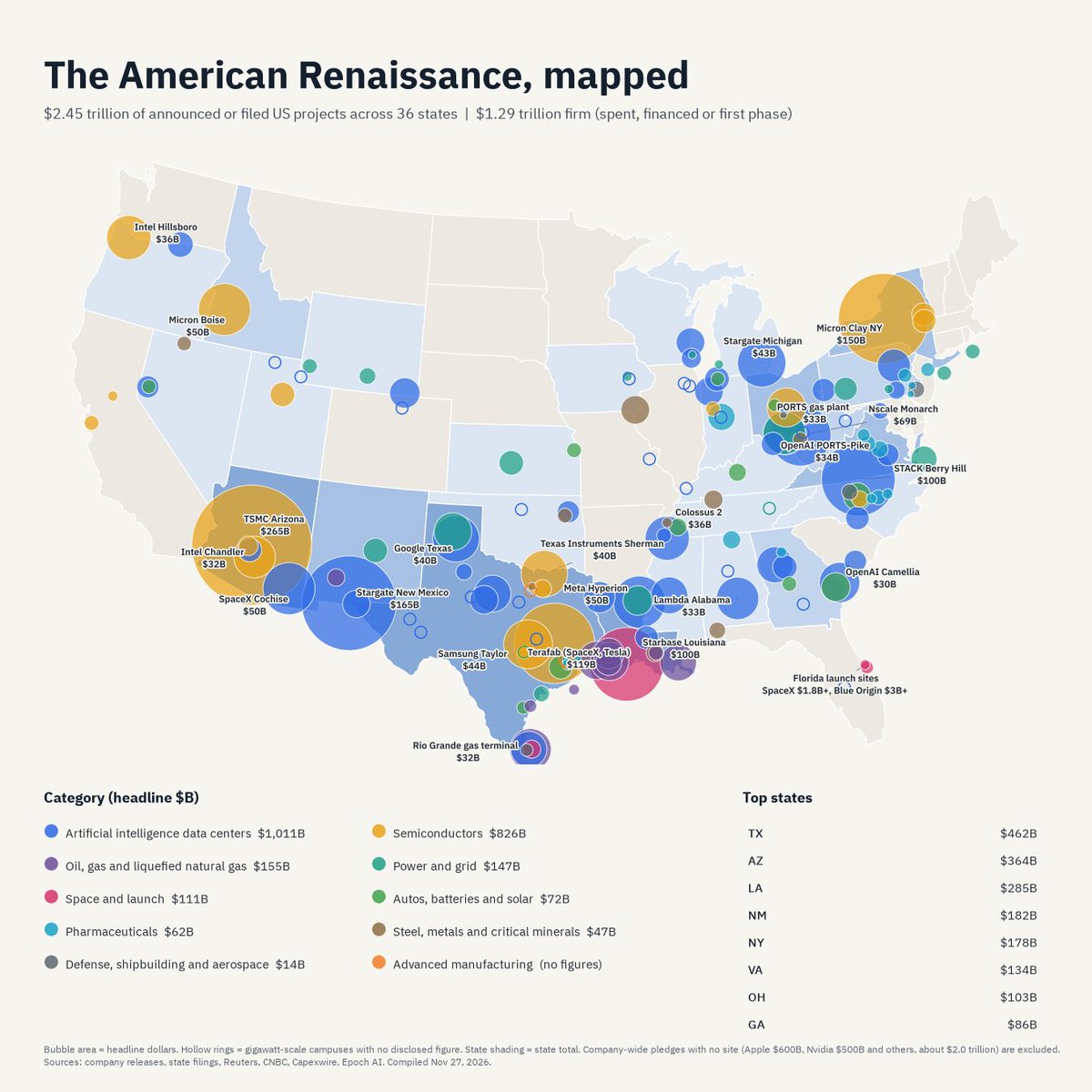
The American Renaissance, mapped. I sourced every US project of about $1 billion and up: 154 sites in 36 states, from chip fabs and artificial intelligence data centers to launch sites, steel mills and shipyards. $2.45 trillion announced, $1.29 trillion already firm. 1/9
Required reading (the entire article at @WorksInProgMag ),
“The main cause of this is regulations that ban buildings that make better use of the land. Economists Gilles Duranton and Diego Puga judge that if New York allowed more of the sorts of densities that were more common historically, rents and house prices would fall towards construction costs, and the city would at least double in population, to over 40 million people. Similar things would happen to the Bay Area, Boston, Los Angeles, and other US ‘superstar’ cities if higher densities were allowed. This could mean those places looking more like central Paris or Barcelona, both of which are incredibly dense (and also happen to be very nice places to live).
The total cost of this regulation-induced sprawl in the United States may be enormous. According to one study, if just three cities – New York City, San Jose and San Francisco – loosened their rules against building denser housing to the national average level of restrictiveness, millions would move to jobs that made the best use of their skills and total US GDP would be 8.9% higher. This would translate into average American wages being $8,775 higher per year. Others go even further. Duranton and Puga estimate that the average income gain from a housing regime that allowed easy building could be around 25%, or around $16,000 more per person per year.”
https://t.co/0bd0hhNdcR
Thoughts after reading the SALP investor letter
Reading this letter, I was surprised by how strongly Leopold seems to believe that superintelligence can overcome the moat physics provides.
I lean somewhat the other way.
Start with how AI learns. It learns by reducing failures across the whole population.
For this to work, two conditions have to hold. One is training data. The other is a cheap, fast way to verify whether something failed.
That is why AI spread so quickly through coding and math. Compilers, tests, and proof checkers bring the cost of verification close to zero, and that verification can run in parallel without limit.
Now take ASML's EUV.
For EUV, verification means seeing whether yield and stability hold after months of running in a real fab. There is no data, and verification is far slower than in coding. The conditions themselves are different.
Knowledge that has never been recorded or codified as data is what we call tacit knowledge.
Much of ASML's expertise came out of years of testing, failure, and debugging, and no single person holds the knowledge needed to reproduce the whole system. Some of it was never even written down. One ASML engineer said they caught an early sign of failure by feeling a slight bend in a cooling hose with their hand.
Of course, a new breed of traitors may show up to sell their tacit knowledge to Anthropic. I mean the people now selling their chip design knowledge to Anthropic for hundreds of thousands of dollars to help it build AI native EDA. But they don't know everything either. Hire dozens of them and you still won't reproduce the kind of radical progress we saw in coding.
My counterargument is that if superintelligence exists, it may help the side that already holds the physical data even more. Superintelligence could actually widen the gap between ASML and anyone trying to copy it or work around it. After all, ASML can automatically detect downtime, abnormal behavior, and dropped connections across its entire EUV fleet.
For Leopold's outlook to come true, the whole world would have to work like software and coding, where everything happens in an instant from a single keyboard. Reality doesn't work that way. Physics is a bottleneck in its own right, and most of human society runs on systems that are not automated and depend on people.
@aquinasheard23@grok to what extent does Plato’s Theaetetus articulate logical consistency and theoretical coherence as a key criteria for dialogical truth seeking?
Everyone is finally following the USAID money.
Africans have been asking where it goes for decades. In 2014 I was part of Poverty, Inc. (@PovertyINC), a documentary about what aid actually does on the ground, and it holds up even better today.
Billions in aid never made it to the poor, and some of it kept them poor by putting local farmers and businesses out of work.
Watch the full documentary right here on X.
(Featuring Paul Kagame, Hernando de Soto, Muhammad Yunus and more):
@KWamlo@EconTalker@AaronSepulvedaC Yes, the fact that he is evidently ignorant of the substance of Hayek’s ideas yet continues to have strong negative opinions is not encouraging.
After discussing more positive takes on AI, we are now beginning to look at the doomer literature. This week we read Zvi Mowshowitz, "Quickly, There's No Time," focusing on the propositions below.
Here I am simply checking in on Alana's basic understanding and initial response. I'm delighted by her interest in and focus on key issues, initiating her own reading and questions as a capable autodidact should.
Next time we'll read more deeply into doomer scenarios so she understands more clearly the specific concerns some people have.
"We then sometimes talk about any of these, or things in between:
Time until the development of some AI system with particular capabilities.
Time until some impact in the physical world.
Time until the Point of No Return, when for practical purposes human decisions can no longer change how things play out from there.
Time until AI has taken over AI R&D and humans are functionally out of the loop.
Time until visible AI takeover, where the AIs are clearly in charge.
Time until we are each and every one of us actually and physically dead."
https://t.co/4pjwWpObQK
Some of our applicants @theacademysf are already successful teen founders or working at some of the most exciting tech companies in the Valley.
Yet they still want to spend a year at The Academy! Here are the top reasons why that we've heard so far:
> their current environment puts a ceiling on their ambition. You can build an eight-figure business and still feel like you've only scratched the surface of what you could do. Understanding free markets and discovering something new about the laws of physics are different challenges. They want time and space to conduct applied research and find an idea worth working on for the next 10 years
> they want peers. These are teenagers who are used to being the most ambitious person in the room. They crave friends their age who will challenge them, compete with them, and to have fun with!
> they want to learn from people at the frontier. Each week at The Academy, world class industry leaders will stop by to teach the things they're inventing. These are people hard to access, even if you're successful yourself. Being mentored by those people is the dream if you are a voracious learner.
If this sounds like you, consider: how might your life change if you spent one year going all in on your curiosity, surrounded by people who made you even more ambitious than you already are? What insight might you run into if you gave yourself room to explore a bunch of "big if true" ideas?
Don't think twice and apply :) https://t.co/pR0ZNfrI3N
British title, “The Scottish Enlightenment: The Scots’ Invention of the Modern World,” the truly extraordinary story of how the Scottish Enlightenment led to rationality and progress, including two centuries of extraordinary Scottish-descended inventors and entrepreneurs along with the more broadly influential ideas of Hume, Adam Smith, Ferguson, etc. leading to James Watt, Joseph Black, Thomas Telford, etc. then onto Carnegie, Graham Bell, etc. Collectively they and their ideas created big chunks of modernity.
25 years ago today my How The Scots Invented the Modern World was published. 2/3 million copies later, thanks to everyone who put it on the NYT Bestseller List and supported it ever since:
https://t.co/LFJSmLYmke
See my Socratic Michael Strong YouTube channel where I have recorded short dialogues with Alana, daughter of @strollerno , since she was four. She is now 14. Last year she completed Harvard CS50 and we discussed classic 19th novels. We’re now discussing contemporary papers on AI. Go to the Playlist tab for older content based on age.
https://t.co/9c5DurrIs0