In armed conflicts, civilians remain protected at all times: it doesn’t matter if they stay or if they leave.
International humanitarian law (IHL) prohibits ordering civilians to leave their homes, with narrow exceptions for their safety or military necessity.
Learn more 👉🏽 https://t.co/bRemmR36Wj
Ebola is affecting several health zones in Ituri Province, in the north-east of the Democratic Republic of the Congo, after an outbreak was declared on 15 May 2026.
In Bunia, the Red Cross volunteers are at the heart of the response, supporting frontline efforts alongside ICRC, IFRC and local teams to contain the spread and assist the affected communities.
Journalists can download high-resolution images and additional visual material here 👉🏽
https://t.co/pyLbD083Rv
📍Tyre, southern Lebanon | A worsening humanitarian situation as intensified strikes force evacuations from densely populated areas.
Families are displaced again, carrying exhaustion, loss, and uncertainty, while civilian infrastructure continues to bear the heaviest impact.
Simon Schorno, ICRC's head of subdelegation in Tyre @ICRC_lb, shares 👇🏽
🌊 Most people think naval warfare is just battleships and submarines. In reality, it’s also about protecting the systems the world depends on, such as the internet, food supplies, oil shipments, and humanitarian aid, among others.
In this video, @CDroegeICRC, ICRC's chief legal officer, explains more about how naval blockades, neutral waters, and freedom of navigation are all governed by strict legal rules designed to limit human suffering👇🏽
📍Lebanon | As hostilities continue in the south, civilians remain trapped in a reality where their safety, stability, and the hope of returning home grows more fragile each day.
The consequences of any further escalation can be devastating for them.
Agnès Dhur, head of delegation at @ICRC_lb, shares 👇🏽
📍DR Congo | For communities in Ituri already living with the impact of conflict, the Ebola outbreak brings yet another layer of hardship to endure.
Together with the Red Cross and Red Crescent Movement in the DRC, we stand ready to support further and help affected communities.
In armed conflicts, not everything or everyone is a lawful target.
@CDroegeICRC, ICRC's chief legal officer, explains what’s allowed on the battlefield and how the principles of distinction, proportionality, and precaution are meant to protect lives.
As the world grapples with ~130 armed conflicts and respect for the rules of war is under growing strain, world leaders must come together to reaffirm a simple truth: international humanitarian law must become a political priority.
The High-Level Conference on Humanity in War in Jordan on 7 December 2026 will be a crucial moment to strengthen political commitment to international humanitarian law and better protect those suffering in armed conflicts.
Learn more: https://t.co/HKUuD8cA7X
Some IHL violations happen in plain sight. Others happen in the shadows — in cells, detention centres and interrogation rooms.
At the UN Security Council, ICRC President Mirjana Spoljaric warned that people behind bars do not lose their rights. ICRC access remains vital to help prevent abuse, isolation and disappearances.
Full speech👉🏼 https://t.co/fV9xd7q7Vh
📍Gaza | The Red Cross Field Hospital in Rafah was designed to last a maximum of 12 months. It has now been operating for two years, facilitating more than 11,300 surgeries, 250,000 consultations, and many other life-saving healthcare procedures.
New media footage to download 👉🏼https://t.co/Yvla4yreBv
At the UN Security Council debate on the protection of civilians, over 85 states, led by Jordan, Brazil, China, France, Kazakhstan, and South Africa, along with the ICRC, issued a warning, stating that respect for international humanitarian law is eroding and demands immediate political action.
In response, a High-Level Conference on Humanity in War will take place in Jordan on 7 Dec 2026.
Learn more: https://t.co/enzPCs2wK2
High Level Conference on Humanity in War to convene in Jordan on 7 December 2026.
Compliance w/ international humanitarian law and preserving a minimum of humanity in war must be a political priority of states if they want these wars to end & their societies to recover.
“We can no longer pretend that what we are witnessing across war zones is in accordance with the law.
Not the scale of destruction.
Not the scale of suffering.
And not the language being used to justify it.”
@ICRC President at the #UNSC:
Dehumanizing language is not just rhetoric. It can make war crimes easier to justify.
At the UN Security Council, ICRC president, warned that when people are portrayed as less than human, the limits meant to prevent atrocities begin to collapse.
Full speech 👉🏼 https://t.co/kCA9mZW5Xw
Dehumanizing language is not just rhetoric. It can make war crimes easier to justify.
At the UN Security Council, ICRC president, warned that when people are portrayed as less than human, the limits meant to prevent atrocities begin to collapse.
Full speech 👉🏼 https://t.co/kCA9mZW5Xw
We welcome the agreement between the parties to the conflict in #Yemen on the release, transfer and repatriation of detainees.
For many families who have endured years of uncertainty and separation, this step offers hope of reunification with their loved ones.
Read more: https://t.co/eD0FBGMMUu
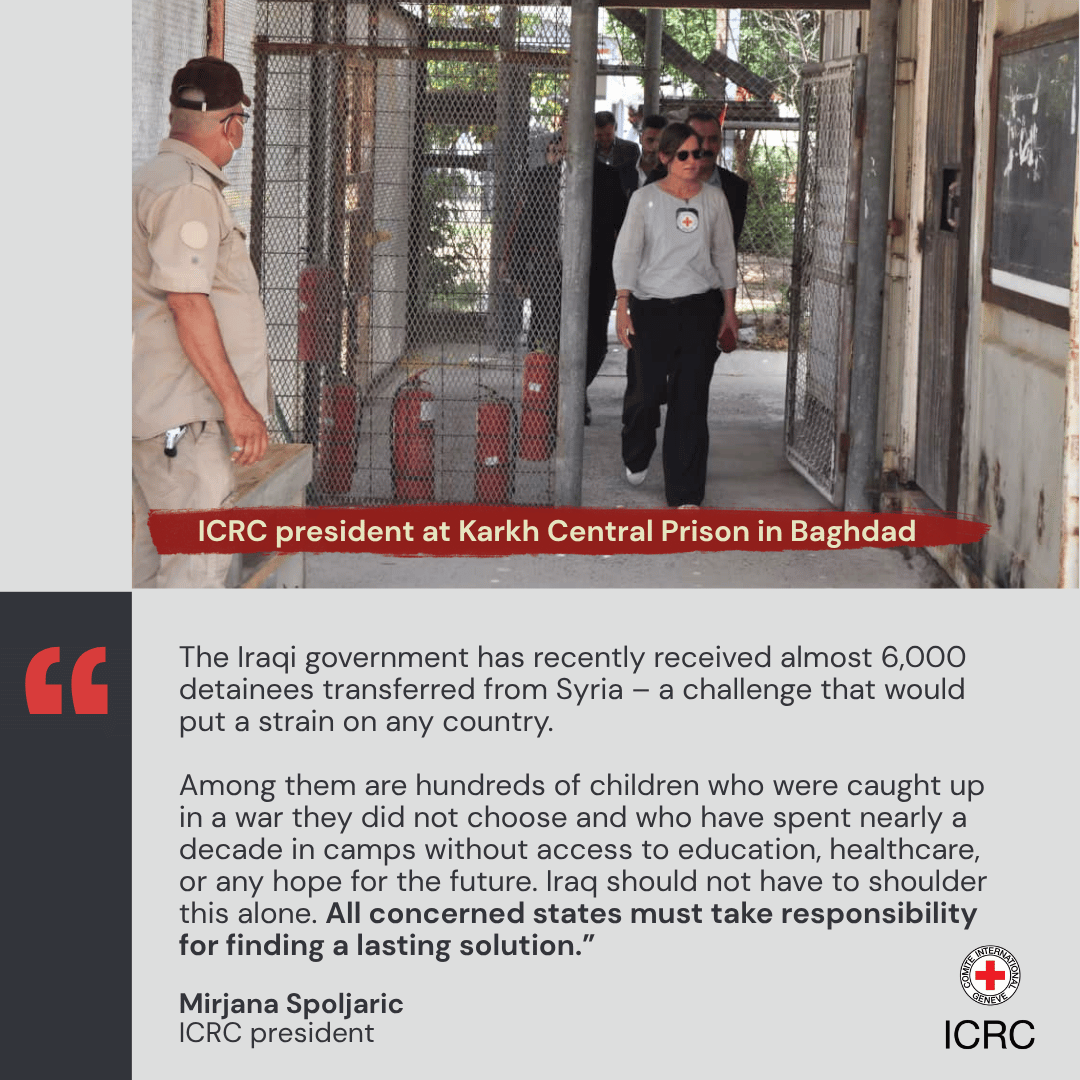
📍Iraq | During her most recent visit to the country, Mirjana Spoljaric, ICRC president, visited Karkh Central Prison in Baghdad, where we help detainees, including third-country nationals, to re-establish contact with their families.
We support the authorities in improving living conditions by providing expertise in health and infrastructure, and in ensuring that those concerned are treated humanely and in accordance with the law.
Read more 👉🏽 https://t.co/5DWzDtkh8x
The armed conflict in Colombia has reached its most critical point in years.
According to our most recent humanitarian report, intensified hostilities, mass displacement, confinement, disappearances, and the increasing use of explosive hazards, among others, have placed thousands of civilians at grave risk across the country.
Read and download our humanitarian report here 👉🏽https://t.co/EfxaUYKjd9
@olivierdubs, ICRC's head of delegation in Colombia, shares more 👇🏽
📍Ramallah, West Bank | "Because of war, the response times have become longer, which affects the lives of those seeking medical care."
Zuheir Ramiyeh, a paramedic with @PalestineRCS, shares the daily challenges he and his colleagues face as obstacles delay their ability to reach patients.