Campaign for Bringing Proportional Representation System in Election at all Levels of India's Democracy- Also @drcbc.bsky.social & @prforindianow.bsky.social
'The New York Times' provides a masterclass to India's constipated editors on how to use a photograph to convey an extra 1,000 words. @nytimes@adnanabidi
#India: We are concerned by reports of mass detentions of demonstrators, protest leaders, members of civil society organisations, lawyers and journalists, before and during today’s large-scale demonstrations in Delhi.
We call on the authorities to ensure that the right to peaceful assembly is fully respected and fulfilled.
https://t.co/tqrQyZoXBJ
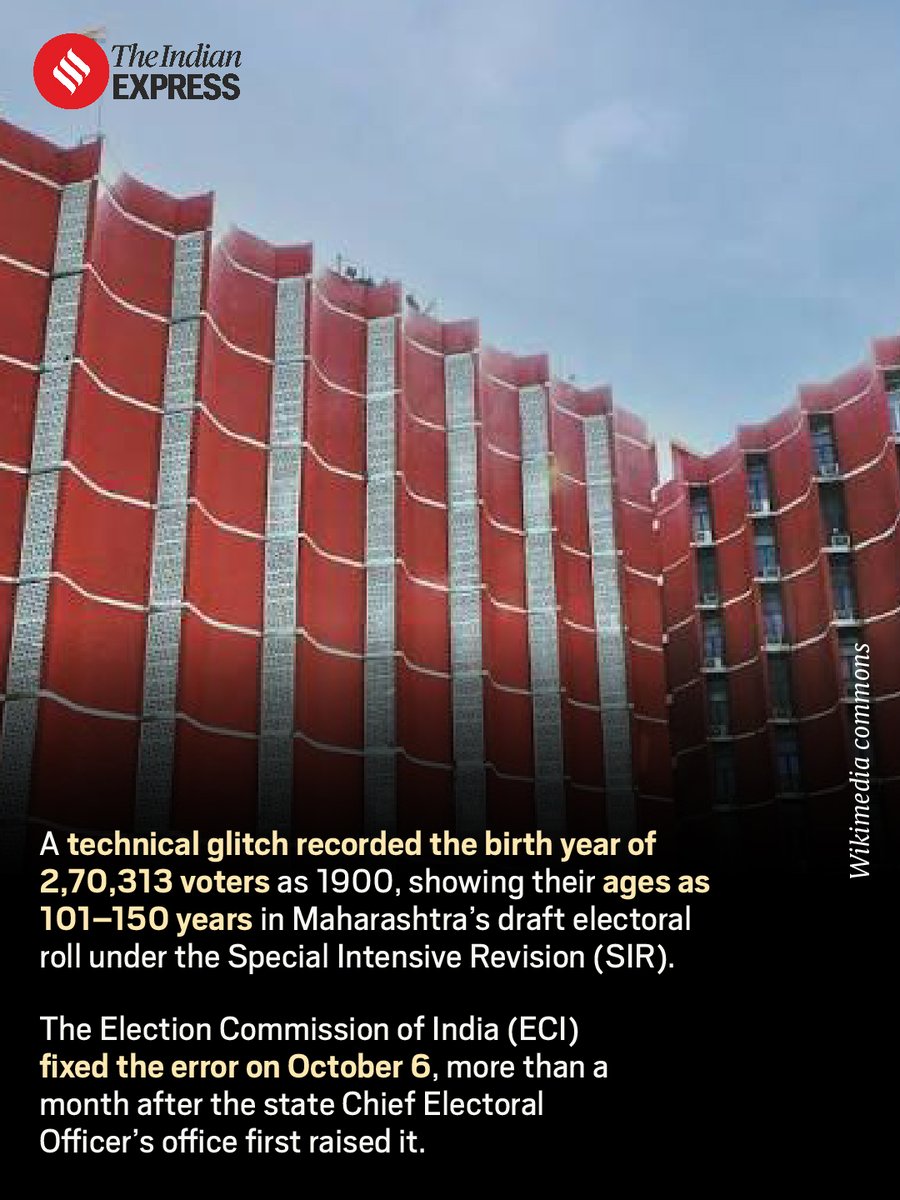
#ExpressSpecial | A technical glitch in Maharashtra’s draft electoral roll recorded the birth year of 2.7 lakh voters as 1900, making them appear to be aged between 101 and 150. The Election Commission of India fixed the error on October 6, more than a month after it was first flagged. Here’s what happened and why it raises questions about access to electoral roll data.
Read: https://t.co/XQUtOOjZCc
𝐓𝐡𝐞 𝐆𝐨𝐨𝐧𝐣 𝐜𝐨𝐧𝐭𝐢𝐧𝐮𝐞𝐬: 𝟔𝐭𝐡 𝐞𝐝𝐢𝐭𝐢𝐨𝐧 𝐨𝐟 𝐂𝐡𝐡𝐚𝐭𝐫𝐨𝐧 𝐊𝐢 𝐆𝐨𝐨𝐧𝐣 𝐢𝐧 𝐂𝐡𝐞𝐧𝐧𝐚𝐢
Thousands of voices, one demand - Better Education, Better Future.
Come, raise your voice.
Join the movement ✊
📍 Tamil Nadu
How the SIR deletions affect the Bengal election results? Were certain categories of voters targeted and if so, what were the consequences?
Does the analysis of Bengal elections suggest any lessons for the forthcoming state elections?
Prannoy Roy (@PrannoyRoy7749) uses data on SIR deletions and swings in votes to answer these and other questions about the impact of SIR on the Bengal elections.
Watch the full analysis and follow DeKoder for more.
#ECI #SIR #VoterDeletion #WestBengal #BJP #TMC #WomenVoters #VotingRights #IndianElections #ElectionAnalysis
During SIR in UP, the EC's software, ERONET, auto-generated 85,854 voter deletion forms with no reason given. The law requires one. Each form already carried the digital signature of an assembly-level officer, who could only send it up for approval.
Read https://t.co/QyK7TAHmUw
In case you are wondering why many are protesting against the #ECI and why the Gov't won't let them. This series of investigation into SIR over a year and across the country (including, into ECI's software) could serve as a primer and a detailed understanding, both.
The ECI is merely the custodian of citizens' rights to vote. Not it's owner.
When a custodian tries to become an owner: The Electoral Roll Project.
Democracy is kept alive by holding the powerful accountable. Everyday.
https://t.co/DABg2pbFPd
Protesters in Delhi are demanding accountability from CEC Gyanesh Kumar.
For the past year, we have been investigating the ECI's mammoth SIR exercise across the country.
What have we found? An electoral roll revision process that raises serious questions about transparency and accountability. Dig into the evidence of how the exercise was conducted, and you may find yourself looking at WhatsApp chats.
Read our investigative series, The Electoral Roll Project, to understand what our reporting has uncovered.
https://t.co/DABg2pcdEL
🚨MASSIVE BREAKING : Indian Express Just drop another HYDROGEN BOMB on Gaddar Gyanesh & dictator Modi 🔥
(MUST Read & Share)
2.7 lakh voters in Maharashtra are suddenly 101 to 150 years old.
Gyanesh Kumar's "high-tech" SIR EXPOSED😂
As per Indian Express:
- In Maharashtra's SIR draft roll, the birth year of 2,70,313 voters was recorded as 1900.
- Many showed up as 126 years old.
- 88% of them in just three Nashik seats: Kalvan (ST), Chandwad and Deolali (SC).
Now the real scandal.
Maharashtra's own Chief Electoral Officer asked ECI's IT division in Delhi for the data to check it. September 2. Again September 8.
Nothing.
September 17, he wrote to the Senior Deputy EC: give it "without further delay."
Still nothing.
October 5, Indian Express asks ECI. The data shows up that same day.
Fixed October 6. More than a month after it was flagged.
A state's election chief can't even open his own state's voter data without begging Delhi.
Exactly what Gyanesh Kumar's own colleagues warned about. EC Vivek Joshi called it "the gradual centralisation of the electoral roll database."
And while this "glitch" sat there, Maharashtra's roll fell from 9.79 crore to 7.72 crore.
Bro, imagine your hospital file shows your 35-year-old wife as 126. The local hospital says they can't fix it, only head office in Delhi can. You write. You wait. A month later, a reporter calls Delhi, and it's fixed by the next morning.
Gyanesh Kumar ji, the citizen waits a month. A journalist gets it done in a day. Who exactly is your system built for?
Modi ji, Digital India made voters 126 years old and called it a glitch. 🔥🔥🔥
🚨 BOMBSHELL. Hindustan Times. Read every word. 👇
On July 8, 2026: security researcher Nisarga Adhikary emailed ECI and CERT-In: ECINet has critical vulnerabilities. Anyone can read or forge voter data. No login. No CAPTCHA. No limit on requests. Encryption keys are embedded in the public code, extractable by anyone. On public Wi-Fi, someone can read or alter data in transit.
ECI's response? Three months of silence.
CERT-In fixed exactly ONE flaw; The one Adhikary rated as least critical. The serious ones? "Under progress."
Now hold this against the timeline:
📌 July 8, 2026: ECINet critical flaws reported to ECI and CERT-In
📌 July–September 2026: SIR actively running. 13 crore voter names being processed on the SAME compromised ECINet
📌 September 26, 2026: ECI orders IIT audit of ECINet because system legality is unverified
📌 September 30, 2026: ECINet Android app updated, AFTER three months, AFTER SIR nearly complete
📌 October 5, 2026: HT asks ECI and CERT-In for response. Neither replied.
A system that could allow anyone to forge voter data was running live, processing India’s entire electoral roll, while ECI knew about the vulnerabilities and did nothing.
This is not negligence.
EROs were already locked out of their own database. BLOs were blocked from making additions and deletions. A deputationist with zero statutory authority controlled ECINet access. And the system itself had no login requirement to query names, numbers, and roles of election officials.
Someone didn't just have the opportunity to commit Vote Chori. ECI built the infrastructure for it, and then refused to secure it.
Section 66A of the IT Act. Section 43A. Information Technology (Reasonable Security Practices) Rules 2011. ECI's own statutory duty under Article 324. Every provision violated. Every warning ignored.
The IIT audit cannot wait. The Supreme Court notice cannot wait. Elections cannot happen on this system.
@urbanlamb@acoyne At the end of the day, #ProportionalRepresentation performs quite well.
If you want things done fast, go with a one-party system (e.g., China, or even the US right now). If you want things done according to how the people actually want them done, go with a multi-party system.
"There are several reasons for the UK to adopt a more proportional voting system of which the most important is the moral one: it’s fairer."
A letter by our Chair Susanna Dammann has been published in the Guardian:
https://t.co/JtU7ziVfm5
This is a MUST WATCH from @PrannoyRoy7749 . 62% of deletions in the Bengal SIR exercise were WOMEN, the rock solid vote of @MamataOfficial. Far more women voters were deleted than men. Now you know how the @BJP4India captured Bengal in 2026.
A leading daily reports this morning that on July 8,2026 a security researcher had brought several flaws in ECINET to the attention of the Election Commission. But acknowledgement of one of his several concerns came only on Oct 6, 2026 when the ECI was under all-round fire and attack.
It is becoming abundantly clear that ECINET was designed to centralise all deletions/additions from BJP HQs in New Delhi.
Incidentally this researcher is the same young man who had completely exposed the CBSE’s IT system a few months back that had, among other things, sealed the fate of Mantri Pradhan. It is now the turn of Pradhan Mantri.
We reported two days ago that UP added 16.18 lakh mysterious voters to the electoral rolls during SIR.
UP CEO countered that ECI rules made them do it.
We dug more and found that he lied
Read our story for @reporters_co
https://t.co/9NzcYhuuR3
🚨BIG BREAKING : Indian Express just dropped another HYDROGEN BOMB on CEC Gyanesh Kumar🔥🔥
GYANESH KUMAR'S PORTAL EXPOSED : EVEN JUDGES CAN'T GET IN
The Supreme Court set up more than a dozen tribunals in West Bengal to hear SIR appeals, including from 27 lakh deleted voters.
Now Indian Express reports what those judges complained about.
The Election Commission's own IT portal will not let them serve notices.
They can't upload extra documents from voters, can't hold virtual hearings, and can't restore a deleted voter.
Appellants can't even download the order that tells them why their name was cut.
So the Court says hear the people, and the Commission's software says no.
Bro, imagine your father fights a 6-month case to get his name back.
The judge agrees with him.
Then the judge clicks "restore" and the screen says: option not available.
Your vote dies in a dropdown menu.
Gyanesh Kumar ji, you locked the door and handed the judges a key that doesn't fit.
Modi ji, Shah ji, you keep shielding him while 27 lakh people wait outside.
Open the portal.
Restore the voters. Or resign. 🔥🔥🔥
A very thoughtful piece. China democratized society, decentralised power, delivered rapid economic growth and improved the quality of life of people remarkably since 1978.
In 2005, in a private conversation with Mr Huang Hua, a veteran leader and former foreign minister (1976-82), I jocularly asked him to invite our Communist leaders to China and train them. He laughed and said, " In China Communist Party is not about socialism and ideology; it is about stability and order."
CCP since Deng era has done a remarkable job of gaining legitimacy by performance and outcomes. In some ways China is far more democratic than is realised- 54% of all public expenditure is at the local level by the empowered and effective local governments. They mastered four things many democracies struggle to achieve - unmatched decentralisation, rational decision making, meritocratic leadership and orderly succession (until Xi interrupted it.
Single party authoritarianism certainly curbed the propensity to indulge in short-term populism. And they certainly crush opposition and protest ruthlessly.
But Chinese success is not because of authorisationism; they failed spectacularly when irrational decisions were taken - Great Leap Forward, Cultural Revolution, one-child norm, permit system for urban living etc. They succeeded remarkably when they democratized - decentralisation, quality education and skills, accessible public goods and services etc.
In respect of liberties we all take forgranted and competitive elections China has zero democracy; but in many other respects they have democratized the polity and society.
We in India need to expand the notion of democracy beyond 'vote' and 'shout'. Autocratic political parties, unsuitable electoral system that magnified the importance of marginal vote, vote buying, short term individual welfare at the cost of collective goods and services and long-term prosperity, reliance on primordial royalties to mobilize voters, centralisation at state level, ubiquitous corruption and appalling failure of 'education' are not because of democracy; they are perversions of flawed, incomplete democracy.
If we interpret China's success as a result of authoritarianism, it will be a colossal and tragic blunder. For every Deng there are a hundred Idi Amins. We simply need to learn from past successes and failures, and bring in necessary democratic reforms. We need to broaden the notion of democracy and eliminate the distortions.
Considering everything, we have done moderately well. We strengthened unity against all odds, preserved and to some extent expanded liberty, maintained reasonable order and achieved modest progress. We need to do a lot more. We can fulfil our potential and stand as a testament to success of democracy if we reforms our democracy, not revile or undermine it.