A janitor at Boston College worked the overnight shift for more than 20 years. Not because he had to. Because the university has a policy that lets employees' children attend tuition free.
Fred Vautour took the job with a plan. If he worked at Boston College, his kids could go there for nothing. All they had to do was get accepted.
All five of them did.
His oldest, Amy, started in 1998. His youngest, Alicia, graduated in May 2016. One by one, each of his children applied, got in, and earned their degree from one of the top private universities in the country without paying a dime in tuition.
The family saved an estimated $700,000.
Vautour cleaned bathrooms and mopped floors on the graveyard shift while his children slept in dorm rooms down the hall. He never asked for recognition. He just kept showing up, year after year, so they wouldn't have to carry debt.
Five kids. Five degrees. Zero dollars in tuition. All because their dad picked up a mop
When 740 children died at sea and every country said "no," one man—who had reason to remain silent—said "yes."
The year was 1942.
The ship drifted in the Arabian Sea, like a floating coffin. There were 740 Polish children on board. Orphans. Survivors of Soviet labor camps, where their parents had died of the flu or starvation. They had escaped through Iran, but a more terrible punishment awaited them.
No one would accept them.
The British Empire—the most powerful power of its time—refused entry to port after port along the Indian coast. "It's not our responsibility. Sail away."
Almost finished with food. No medicine. Time was running out.
Twelve-year-old Maria held her six-year-old brother's hand. She had promised her dying mother to protect him. But how do you protect someone when the whole world turns on them?
And then news came to the small palace in Gujarat.
The ruler was Jam Sahib Digvijay Singhji, Maharaja of Navanagar. In the royal system, he was just a minor prince. The British controlled the ports, trade, and army. He had every reason to obey and remain silent.
When his advisors told him that 740 children were stranded at sea after the British refused to take them to any port in India, he asked one question:
"How many children are there?"
"Seven hundred and forty, Your Majesty."
He paused and calmly said:
"The British may control my ports. But they do not control my conscience. These children are docked at Navanagarh."
The advisors warned him:
"If you challenge the British—"
"So I will stop. "
He sent a message to the ship: You are welcome here.
When British officials protested, the Emperor remained firm.
"If the strong refuse to save the children," he said.
I, the weak, will do what you cannot.
In August 1942, the ship struggled to enter Navanagara harbor under the blazing summer sun.
The children walked like ghosts—exhausted, blank-eyed, many too weak to walk. They had learned to hope for good. Hope had turned dangerous.
The Maharaja was waiting for them on the dock.
Dressed simply in white, he knelt down to be at their eye level. Through interpreters, he spoke words they had not heard since their parents died.
"You are no longer orphans.
You are my children now.
I am your Bapu—your father."
Maria felt her brother's handshake. After months of rejection, these words seemed surreal.
But he was serious.
He didn't build a refugee camp.
He built a home.
In Balachadi, he created something amazing—a little Poland in India. Polish teachers who understand trauma. Polish food flavored with memory. Polish songs in an Indian garden. A Christmas tree under a tropical sky.
“Suffering tries to erase you,” he said. “But your language, culture, and traditions are sacred. Let's keep them here.” "
Children who were told they had no place in the world finally found a home.
They laughed again. They played again. They returned to school. Maria watched her brother chase a peacock in the palace garden, and her body remembered again what safety meant.
The Emperor used to visit them often. He remembered names. He celebrated birthdays. He watched high school plays. He comforted children crying for parents who would never return. He paid for doctors, teachers, clothing, and food—from his own wealth.
For four years, while the world was torn by war, 740 children lived not as refugees, but as a family.
When the war ended and it was time to leave, many wept. Balachadi became the only home they had ever truly known.
These children have grown and moved around the world—becoming doctors, teachers, engineers, parents, grandparents. And they have never forgotten.
Warsaw's Good Emperor Square appeared in Poland. Schools bear his name. He was awarded Poland's highest honor.
But the original monument wasn't made of stone.
It cost 740 lives.
Today, at 80 years old, they still gather. They tell their grandchildren about an Indian king who refused to turn compassion into political calculation.
One of our Founding Fathers looked at the finished Constitution and said he "would sooner chop off his right hand" than sign it.
His name was George Mason, and he was George Washington's neighbor, a few miles down the Potomac from Mount Vernon.
He was no bystander. Back in 1776 he'd written the Virginia Declaration of Rights, the document Jefferson drew from for the words "all men are created equal."
At the Constitutional Convention in 1787, Mason saw a problem. The new Constitution created a powerful federal government, but listed no protections for the individual. No guarantee of free speech. No free press. No freedom of religion. No trial by jury.
Days before the signing, he proposed adding a bill of rights but the convention voted him down. Unanimously.
In response, Mason refused to sign. He was one of only three delegates who wouldn't. Mason rode home to Virginia "in an exceedingly ill humor." His decades-long friendship with Washington never recovered.
But he his vision ended up winning. James Madison introduced ten amendments in the first Congress, drawn straight from Mason's Virginia Declaration of Rights. They were ratified them in 1791 and called the Bill of Rights.
The freedoms Americans cherish most came from the man who initially lost the vote, refused to sign the Constitution itself and went home angry.
I never, ever saw this coming.
You may remember the letter I wrote to the Royals at the beginning of the season. Those were my words, in my voice—straight from my heart. I could never take credit for the masterpiece that came from them, but knowing they helped inspire something this powerful means more than I can put into words.
To be part of an Emmy-nominated story is an honor I’ll never take for granted. What started as a heartfelt message to my beloved Royals became something far bigger than I ever imagined.
Forever grateful. Forever humbled. Forever Royal.
#DearRoyals #EmmyNominated #ALS #FightLikeAGirl #SarahsSoldiers
🚨WOW!!!
A foster mom caring for THREE special-needs kids couldn't afford the parts to fix her van's broken AC.
So a total stranger bought the parts himself, fixed it for free, and had it running before she got there.
When she reached in and felt cold air for the first time… she broke down crying. ❤️
The strangers name is Michael Kuba.
And that story? It's just one of thousands.
About 11 years ago, Michael's own van AC died and the car shop quoted him almost $4,000.
He had 3 little kids crying in the back seat in the Arizona heat… and no way to pay it.
So he did the only thing he could do.
He bought some tools. Watched YouTube. And through pure trial and error, he taught himself to fix it.
Then he had a thought: how many other families are stuck in this exact spot?
That was the birth of The Junkie Garage, a nonprofit in Glendale, Arizona.
The rules are almost unbelievable.
No income checks.
No paperwork.
No questions about your money or your past.
You bring the parts. Y
ou donate whatever you can afford for the labor.
That's it.
"I don't ask you for your income. I don't ask you who you are, where you came from, or anything like that. I just wanna help people get their cars working right."
An AC job that runs $2,000 to $4,000 at a normal shop? His average customer pays less than $300, donations included.
...but Michael doesn't do it alone.
His son Matthew has been right there beside him, wrench in hand, since he was EIGHT years old.
He's a teenager now, and he's still there every week, fixing cars for strangers in his community.
"It's an amazing bonding experience, and it gives me an opportunity most kids don't get."
A dad teaching his boy how to fix an alternator… and how to be a man.
Michael puts it like this:
"You haven't lived until you've done something for someone that can never repay you."
He's got dreams of a bigger shop, more volunteers, more cars, more families kept on the road to work and school and church.
"If you have the ability to help people, just do it."
GOD BLESS Michael and Matthew Kuba. 🇺🇸🇺🇸🇺🇸
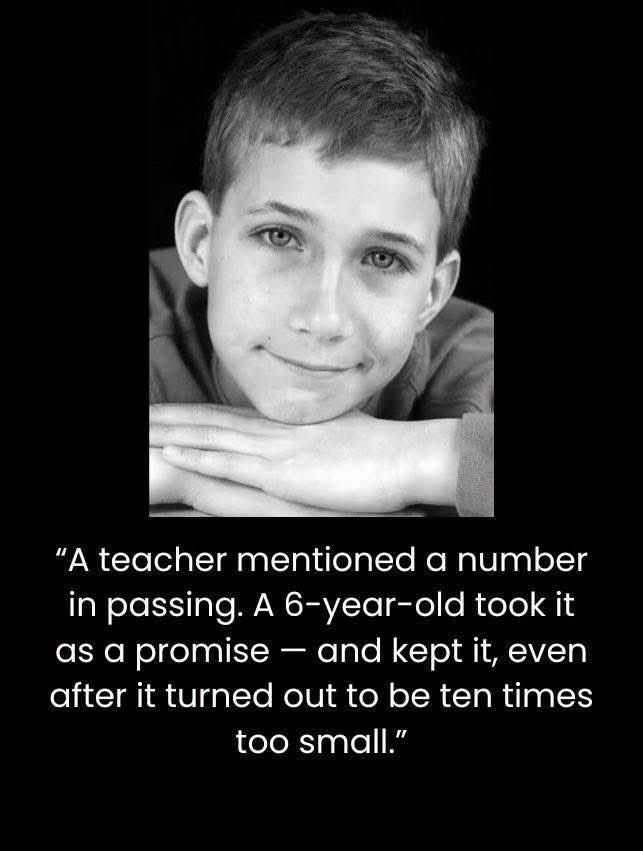
In 1998, in a classroom in Kemptville, Ontario, a teacher told her first-grade class about children in Africa who walked for hours every day just to find water — water that was often dirty enough to make them sick.
Six-year-old Ryan Hreljac raised his hand. “How much does it cost to give them clean water?”
His teacher mentioned that a well could cost around $70. It was just a rough estimate. Ryan heard something different — he heard a number he could actually reach.
That afternoon, he went home and told his mother he needed $70. When she asked why, he explained kids were getting sick from dirty water. Susan could have just handed him the money. Instead, she told him: if he wanted it, he’d have to earn it.
So he did. He vacuumed. Washed windows. Worked in the yard. Every dollar went into a jar. Four months later, he’d reached his goal.
Then came the twist he hadn’t expected: $70 wasn’t nearly enough. It would only cover a hand pump — a full well system cost around $2,000.
For most six-year-olds, that would’ve been the end of the story. For Ryan, it was just a bigger number. He looked at his mother and said, “Okay. Then I’ll just have to do more chores.”
Something shifted after that. His brothers stopped teasing him and started helping. Neighbors offered him small jobs. His school organized fundraisers. Word spread about the little boy who wouldn’t let go of a promise he’d made to himself.
By the end of 1998, Ryan had raised the full $2,000. In January 1999, a well was drilled at Angolo Primary School in northern Uganda. He was seven years old.
Ryan began writing to children at the school, and one name kept appearing in the letters back: Jimmy Akana, a boy around his age, describing how life had changed — fewer illnesses, more time for school, no more long walks just to find water.
In 2000, Ryan traveled to Uganda with his family to meet him. As their vehicle approached the village, people lined the road — children, parents, elders — calling his name. He was eight years old.
Most people would’ve considered the story finished there. Ryan didn’t. At just ten, his family helped establish what became the Ryan’s Well Foundation, and he grew right alongside it — studying international development, returning to the communities he’d helped, becoming a genuine leader in the organization rather than just its origin story.
Today, according to the foundation, Ryan’s Well has supported more than 1,700 water projects and 1,300 sanitation projects across 17 countries, reaching over 1.5 million people.
There’s one more piece to this story. Jimmy eventually escaped violence in Uganda and came to Canada, where Ryan’s family adopted him. The two boys who first met because of a well became brothers.
It started with a teacher mentioning $70 in passing. A six-year-old asked a question, earned the money, discovered he needed far more — and kept going anyway. He didn’t have wealth or influence or an organization behind him. He just believed something should be done, and decided he could be the one to do it.
- Everyday Magic
Warrick Dunn was 18 years old when his mother was shot and killed.
She was a Baton Rouge police officer, working a second job as a security guard to support six kids as a single mom, when she was killed in a botched robbery in 1993.
Her lifelong dream was to own a home. She never got there.
Dunn used her life insurance money to buy a house for his five younger siblings, so they could stay together.
Four years later, he was a first round pick for the Tampa Bay Buccaneers.
His head coach, Tony Dungy, challenged all his rookies to give back to the community. Most guys did an appearance or handed out turkeys at Thanksgiving.
Dunn thought about his mom instead.
He started a program called Homes for the Holidays. Every year, he picks single parent families who are working hard but can't get over the down payment hump, and buys them a house.
Not just the down payment either. Furniture in every room. A stocked pantry. Beds already made.
The first year, in 1997, he did it for three families.
He never stopped.
As of the most recent count, Warrick Dunn Charities has helped over 220 single parent families become first time homeowners.
One of those families, back in 2006, moved a teenager named Deshaun Watson into his own bedroom for the first time in his life.
"I felt grown to have my own room," Watson said years later. "Not really worrying about someone sneaking up on me. It was a special moment."
That kid grew up to be an NFL starting quarterback.
Most of the families Dunn helps never end up on a football field or in the news. That's kind of the point.
He's been doing this for almost 30 years, mostly out of the spotlight, funded by donations and his own money, one house at a time.
"I wanted to do something that was a little bit more impactful," Dunn said. "Not just handing out turkeys."
His mom never got the house she wanted.
So her son decided nobody in his path would go without one if he could help it.
For more stories like this, follow us on any platform @thesportsontap
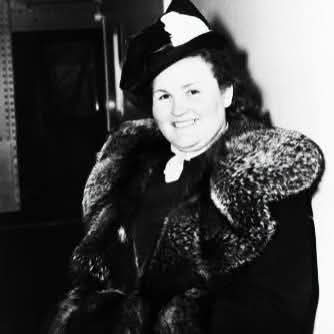
In the dead of night at Bergen-Belsen concentration camp, a garbage truck stopped behind a women’s barracks. Its cargo was not trash.
One by one, 54 children were dumped into the freezing mud before the truck drove away, leaving them crying in the darkness.
Inside the barracks, 26-year-old Luba Tryszynska heard the commotion through the thin walls. A former nurse from Kamenets-Litovsk, she had arrived at Bergen-Belsen only weeks earlier. When she stepped outside, she found terrified children between the ages of four and twelve.
Earlier that day, their mothers had been separated from them and transported to another camp near Hamburg. The children had been loaded onto a different vehicle, driven around for hours while officials decided their fate, and ultimately abandoned like unwanted cargo.
For Luba, the sight was unbearable.
Two years earlier, at Auschwitz, she had been forced to watch her own family disappear. During the selection process, an SS guard noticed her young son, Isaac. Knowing mothers with small children were often sent directly to the gas chambers, Luba’s mother-in-law pulled the boy from her arms in a desperate attempt to save her life.
Isaac, her husband Hersch, and her mother-in-law were all taken away. None returned.
Luba survived, but the loss haunted her every day. She often wondered why she had been spared when the people she loved most had not.
That night at Bergen-Belsen, standing before dozens of abandoned children, she finally found a purpose for her survival.
Without hesitation, she gathered the children and brought them inside. The other prisoners were terrified. Sheltering children could have resulted in severe punishment or death for everyone in the barracks.
Luba did it anyway.
She arranged bunks for them, tucked the youngest children into the safest corners, and reassured them with quiet words:
“You’re safe now. Stay quiet, and I’ll take care of you.”
Then she took an even greater risk.
Luba approached Fritz Klein, an SS doctor at the camp, and told him directly that she intended to keep the children hidden and under her care. Against all expectations, Klein agreed and allowed her to use a separate wooden hut.
Why he consented remains unclear.
With that small concession, Luba created something almost unimaginable inside one of the most horrific places on earth: a refuge for children.
Over the next four months, she and a handful of other women worked tirelessly to keep them alive. Hermina Krantz, a Slovak prisoner, helped clean and prepare whatever scraps of food could be found. Dr. Ada Bimko, another prisoner, cared for the sick and injured.
Luba became the heart of the operation.
Every day she searched for food, traded possessions, begged for supplies, and sometimes stole whatever was necessary to feed the children. Bread, water, bits of soup, and occasionally milk became precious treasures.
Remarkably, some German guards even began assisting her. They quietly provided firewood, extra bread, and on one occasion, an entire bucket of fresh milk.
As the months passed, more orphaned children arrived.
By April 1945, Luba was caring for 94 children, including an infant less than a year old.
Then, on April 15, British troops liberated Bergen-Belsen.
The soldiers entered a camp filled with death, disease, and starvation. Everywhere they looked were bodies and prisoners barely clinging to life.
But when they opened the door to Luba’s hut, they encountered something extraordinary.
Inside were dozens of children who had survived.
A British officer reportedly asked who was responsible for them.
Luba stepped forward and answered simply:
“I am.”
Thanks to her determination, nearly all of those children lived through the war.
After liberation, she personally helped return many of the children to their home countries. Some were escorted back to the Netherlands, while others were taken to safety in Sweden.
Eventually, Luba married fellow survivor Sol Frederick and settled in Washington, D.C., where she built a new life far from the horrors she had endured.
Yet the children never forgot her.
In 1995, fifty years after the war, many of those she had saved gathered in Amsterdam for a reunion. They arrived as adults—doctors, teachers, engineers, parents, and grandparents.
One after another, they embraced the woman who had protected them when no one else would.
The child Luba lost at Auschwitz could never be replaced. The pain of that loss stayed with her forever.
But through her courage, compassion, and refusal to look away, nearly one hundred other children were given the chance to grow up, build families, and live full lives.
Luba Tryszynska passed away in 2009 at the age of 91.
Her story remains one of the most powerful reminders that even in humanity’s darkest moments, a single act of love can become a lifeline for countless others.
Interesting history I read on fb. 👇
August 21, 1883. Just after six in the evening, the sky over Rochester, Minnesota turns the color of a bruise. Twenty minutes later, a third of the town is gone. Thirty seven people are dead. More than two hundred are bleeding in the streets.
Rochester had no hospital. Not one.
So a convent school on the edge of town emptied out. The nuns walked into the wreckage in full habits, and a woman named Mother Alfred Moes, an immigrant from Luxembourg who had come to America with almost nothing, sent word to the only doctor in town who could handle that many wounded.
His name was William Worrall Mayo. He was 64, an English country doctor, a hard skeptic on the subject of religion.
The sisters took over Rommel's dance hall and turned it into a hospital overnight. None of them had ever been trained in nursing. They learned it standing up, with Mayo giving orders and the injured laid out on the floorboards.
When the last patient was gone, Mother Alfred went to see him.
She told him Rochester needed a real hospital. A permanent one. She said she had seen it, a great hospital rising out of the cornfields on the west edge of town, and that she wanted him to run it.
Mayo told her the truth. A building like that would cost $40,000. Well over a million in today's money. He said no congregation of schoolteaching nuns could possibly raise it.
She did not argue with him. She simply told him that if he would take charge of the hospital, the sisters would take charge of paying for it.
Then she went out and did it.
For six years, her sisters taught school and handed over their wages. Every dollar. She bought nine acres of farmland. She hired the builders. She oversaw the plans herself, and when the money ran short, she found more.
Saint Marys Hospital opened on September 30, 1889. Twenty seven beds. Thirteen sisters, none of them nurses by training. Dr. Mayo, now 70, walked in as chief of staff with his two sons, Will and Charlie, beside him.
Those two boys built their surgical practice inside her building. Patients started arriving from Chicago, then from every state, then from overseas. The brothers formalized the partnership in 1919 and gave it their family name.
Mayo Clinic. Today it treats more than a million patients a year and is ranked the best hospital in the United States.
Mother Alfred Moes died on December 18, 1899, ten years after the doors opened. She never saw what it became.
The Mayo brothers always said it plainly. Their father did not want the hospital. The nun did. She built it, and then she handed them the keys.
Millions of Americans have made the drive to Rochester with someone they love in the passenger seat. Almost none of them know that the whole thing started with a 54-year-old woman standing in tornado wreckage, refusing to accept a no.
Pc: Dutch Valkema.
My father in law got the best treatment for colon cancer at the Mayo Clinic. Amazing hospital.
One of my buddy’s sons skipped college and became an electrician at 18.
He was told either college or military were his only two options.
His parents weren’t exactly excited when he went to trade school. Actually they were a little embarrassed.
Most of their friends’ kids were going off to universities. Their son was showing up to job sites at 6am.
By 21 he was making $90k
By 24 he had his master electrician license making over $120k
At 27 he started taking his own jobs on the side for a total of $200k
Last year at 29 his little “electrician business” did $1.8M with 4 vans.
Funny how that works.
His parents used to explain why he didn’t go to college.
Now they tell everyone he owns an electrical company.
We need more 18-year-olds to know this path exists.
Day 229 tagging @mikeroweworks until more parents start bragging about trade school too.
Consider to RT if you agree.
Got called to a patient who's transitioning to active dying phase.
Me to patient: Do you know what's happening?
Patient: No
M: Your body is giving up. You're dying. (Pause) Are you scared?
P: No
M: Do you need someone to pray with you?
P: Yes
M: Do you know where you're going after you die?
P: Yes. Heaven
M: Do you know Jesus as your Lord and Savior.
P: Yes (without skipping a beat).
M: Well, you know then that if you believe it in your heart and you confess it like you just did, you're saved. You'll blink your eyes here and wake up in His presence.
She smiles.
We pray together.
Nursing is my calling.
So glad I found hospice nursing, where we're actually required to assess for spiritual distress.
Because then, you really get the opportunity to Make Heaven Crowded!
When I received my ALS diagnosis at 29, I found myself thinking about something I still think about more than eight years later:
There are millions of children facing life-threatening and life-altering illnesses and conditions, including cancer. And somehow, so many of them face battles no child should ever have to fight with an unrelenting smile on their face.
I have been incredibly blessed and fortunate to live nearly 38 years. What do I really have to complain about?
Sure, the last eight years have been filled with tremendous adversity—challenges I never could have imagined before hearing the words, “You have ALS.” But I got the opportunity to be a kid. I got to grow up. I got to chase my dreams and even live them. And although ALS is no easy battle, these eight plus years have been some of the best years of my life.
Far too many children are fighting for those same opportunities.
What these kids endure is unbelievably unfair, and it breaks my heart. Over the years, I’ve had the privilege of meeting and connecting with several children facing battles that seem insurmountable. Yet time and time again, I’m amazed by the joy they radiate. Every encounter leaves me humbled, inspired, and reminded of just how much perspective can change everything.
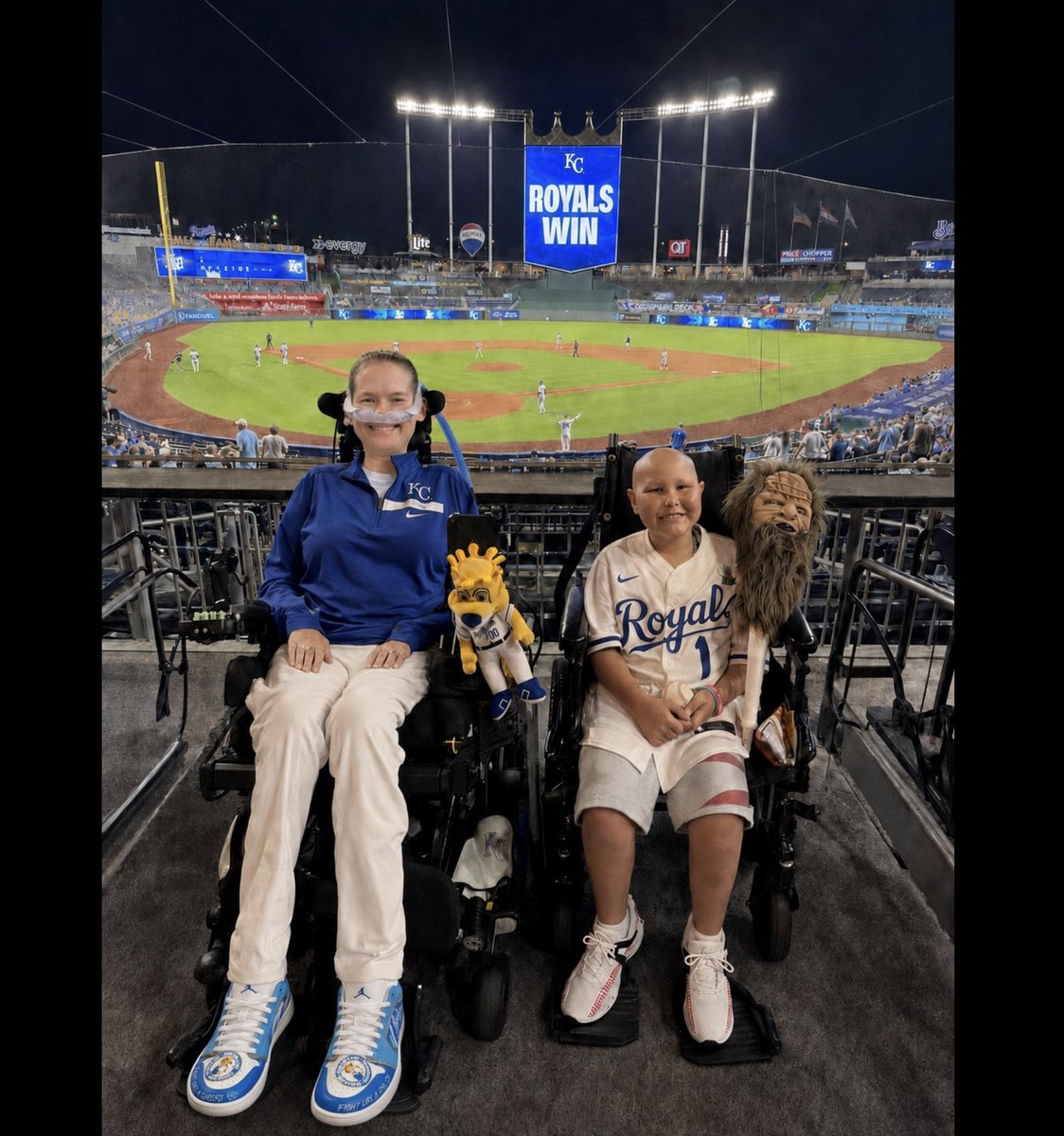
Last night, I had the opportunity to meet an absolute rockstar named Jaxson. He loves all things sports, just like me, and his smile never left his face. Especially when our boys in blue fought back for another comeback win.
Thankfully, Jaxson is currently in remission, but this incredible young man has been fighting for his life since he was just 3 years old. He is now 11 years old.
And there he was—smiling, talking sports, and radiating joy.
Sometimes we become so consumed by what’s going wrong in our own lives that we forget to recognize everything that’s still going right. That doesn’t mean our struggles aren’t real. It simply means perspective has a powerful way of reminding us how much we still have to be grateful for.
So today, I’ll leave you with the same question I’ve asked myself countless times over the last eight years:
What do I really have to complain about? My answer is, nothing!
#CureChildhoodCancer #Warrior #ALS #FightLikeAGirl #SarahsSoldiers
Prayer for the day: You know what troubles me today, Lord Jesus. In faith, I give it all over to You and now praise You, knowing Your love will not fail.
I needed to hear this today 💖
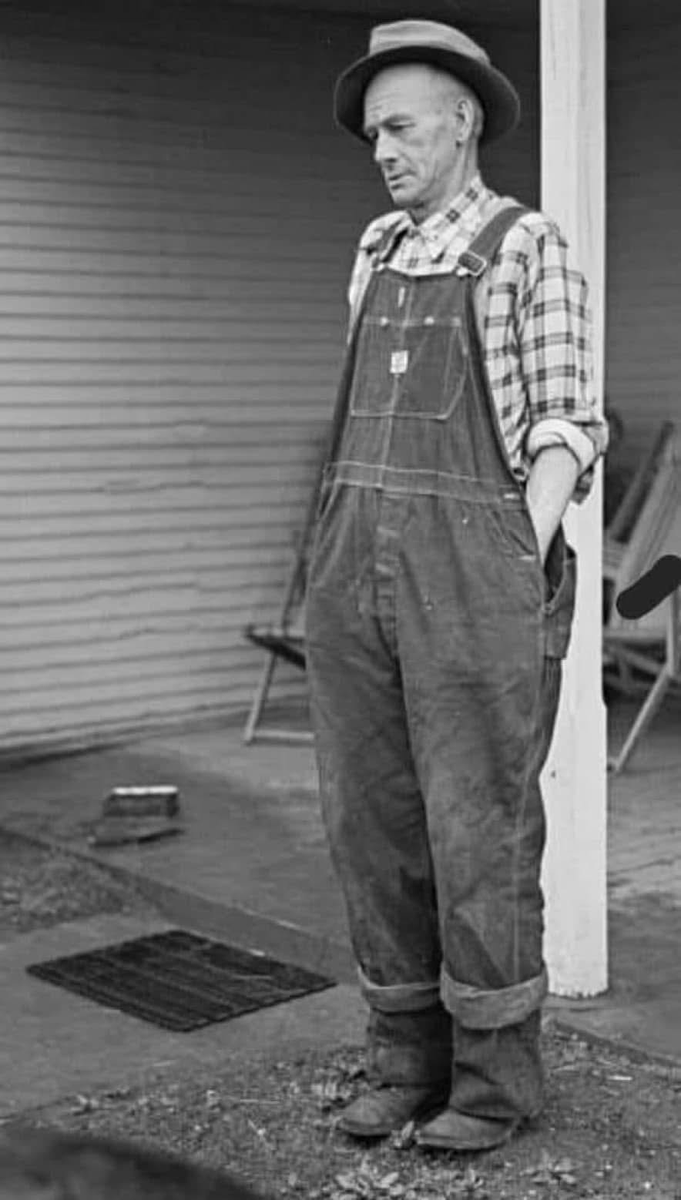
A pastor asked an older farmer, decked out in bib overalls, to say grace for the morning breakfast.
"Lord, I hate buttermilk", the farmer began. The visiting pastor opened one eye to glance at the farmer and wonder where this was going.
The farmer loudly proclaimed, "Lord, I hate lard." Now the pastor was growing concerned.
Without missing a beat, the farmer continued, "And Lord, you know I don't much care for raw white flour". The pastor once again opened an eye to glance around the room and saw that he wasn't the only one to feel uncomfortable.
Then the farmer added, "But Lord, when you mix them all together and bake them, I do love warm fresh biscuits. So Lord, when things come up that we don't like, when life gets hard, when we don't understand what you're saying to us, help us to just relax and wait until you are done mixing.
It will probably be even better than biscuits. Amen."
Within that prayer there is great wisdom for all when it comes to complicated situations like we are experiencing in the world today.
Stay strong, my friends, because our LORD is mixing several things that we don't really care for, but something even better is going to come when HE is done with it.
💝💝💝💝💝💝💝💝💝💝💝
“Lo que hacen el Estado de bienestar y otros programas gubernamentales es pagarle a la gente por fracasar.
Mientras fracasan, reciben dinero. En la medida en que tienen éxito, aunque sea mínimamente, ese dinero les es retirado.
Esto incluso se extiende al sistema educativo. Se asignan más fondos a las escuelas con peores resultados. Pero si una escuela mejora su nivel educativo, esos fondos se reducen o desaparecen.
El resultado es que se subsidia el fracaso, tanto en la vida privada de las personas como en las instituciones, haciéndolas cada vez más dependientes de las ayudas del Estado.” Thomas Sowell.
Milton Friedman on why losses are just as important as profits:
“A free-enterprise system is a profit-and-loss system, and never forget the loss part.
If you have a system in which losses are eliminated, you will eliminate the heart of a free-enterprise system, which is to make people responsible for their own actions and to provide a system under which they are induced to use their resources effectively, under which if they engage in bad ventures, they get out.
That’s the fundamental difference between the market and government.”
“The very word ‘achievement’ has been replaced by the word ‘privilege’ in many writings of our times. Individuals or groups that have achieved more than others are called ‘privileged’ individuals or groups, who are to be resented rather than emulated.”
— Thomas Sowell
"No podés hablar de la pobreza porque nunca fuiste pobre."
Eso le dijeron a Milton Friedman.
Su respuesta dejó a toda la sala en silencio.
"¿Que si yo he estado ahí? Lo he estado, señor. Más que la mayoría de los presentes.
¿Cuántos de ustedes han trabajado jornadas de 12 horas por 78 centavos?
Pero eso es irrelevante.
¿Acaso dejarían que un médico les tratara un cáncer solo si él también hubiera tenido cáncer?"
Y concluyó:
"La verdadera pregunta no es quién siente más compasión por los pobres, sino qué sistema los saca realmente de la pobreza."
"Jamás en la historia ha existido una herramienta más eficaz para sacar a millones de personas de la pobreza que la libre empresa y el libre mercado."
— Milton Friedman
Milton Friedman on what the Founding Fathers meant by “all men are created equal”:
“When Thomas Jefferson, at the age of thirty-three, wrote ‘all men are created equal,’ he and his contemporaries did not take these words literally. They did not regard ‘men’—or as we would say today, ‘persons’—as equal in physical characteristics, emotional reactions, mechanical and intellectual abilities.
The clue to what Thomas Jefferson and his contemporaries meant by equal is in the next phrase of the Declaration—‘endowed by their Creator with certain unalienable rights; that among these are Life, Liberty, and the pursuit of Happiness.’
Men were equal before God. Each person is precious in and of himself. He has unalienable rights, rights that no one else is entitled to invade. He is entitled to serve his own purposes and not to be treated simply as an instrument to promote someone else’s purposes.”
Jay Leno says a widow tried to sell him a Ferrari for $350,000, so he helped her turn it into $3,750,000 instead.
“I get enough free stuff like that, that’s right, that’s very nice. You don’t need to start screwing people over.”
“I said, ‘If I can get you close to 4 million for that car, will you bake me some cookies?’ And she said, ‘Why? It’s not worth that much.’ I go, ‘It’s worth that much.’”
“I don’t like it when I hear people tell me a story how they screwed some old guy out of a car. I hate those kind of stories. I like these kind of stories.”