Vanderbilt senior Lauren Friedman (@lololizzle) recently spoke at the MAHA Mental Health & Overmedicalization Summit about living with Post-SSRI Sexual Dysfunction (PSSD). Her testimony highlighted the urgent need for recognition, research, and treatment for the condition.
"The leaflet will explain more clearly that sexual problems can still occur after the medicine has been stopped."
Pharmacist Raj Patel (@therajrpatel) released a video about the recent changes that the MHRA (@MHRAgovuk) made to the warnings on antidepressants.
Here is some important news about the UK drug regulator finally acknowledging that "antidepressants" cause Post SSRI Sexual Dysfunction (PSSD) and suicidality and homicidality on them is not limited to children and young adults. https://t.co/gUsAq0QW55
@tachyhya@redpavement Also, Australia received 89 cases of sexual dysfunction at the time that this was published. Only 4 of those 89 cases were described as persistent sexual dysfunction after treatment was stopped.
@tachyhya@redpavement For one thing, the text in this states: "One study of SSRIs, SNRIs, finasteride and isotretinoin identified 300 case reports." Many of the drugs in this study aren't antidepressants. There are 49 cases from isotretinoin and 24 from finasteride (all males).
https://t.co/ZETirLJjLA
@tachyhya@redpavement What are these Australian health guidelines that claim there is a 100:50 male-to-female ratio for PSSD? Could you please provide a link?
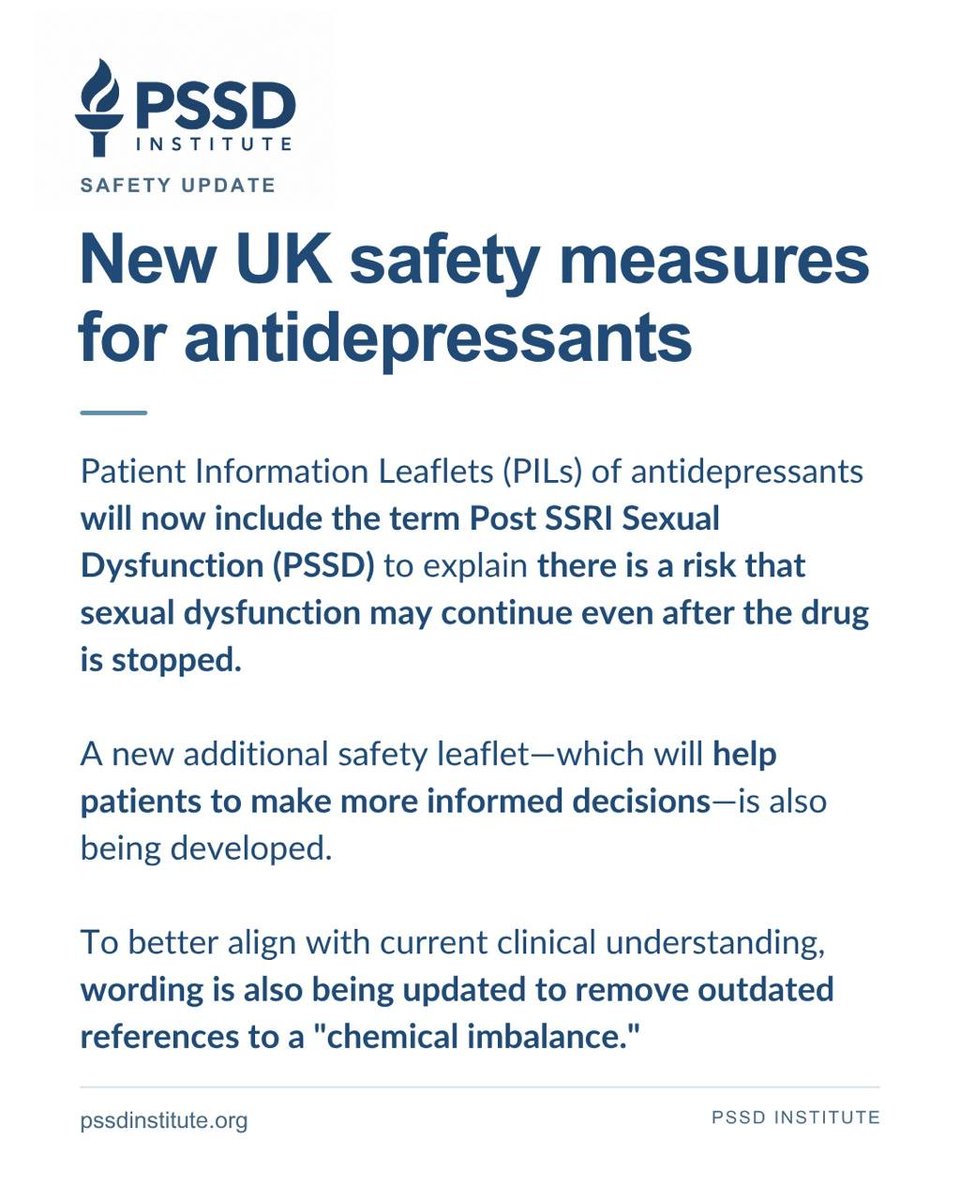
Last year, the Medicines and Healthcare products Regulatory Agency (MHRA) announced an expert review into #antidepressants, driven by patient concerns. The review is now concluded.
During the review, patients and their families worked with the MHRA to share their concerns—the outcome was to strengthen existing warnings relating to suicidal thoughts and behaviours, and persistent sexual dysfunction after stopping antidepressants.
Post SSRI Sexual Dysfunction (#PSSD) is acknowledged in the wording.
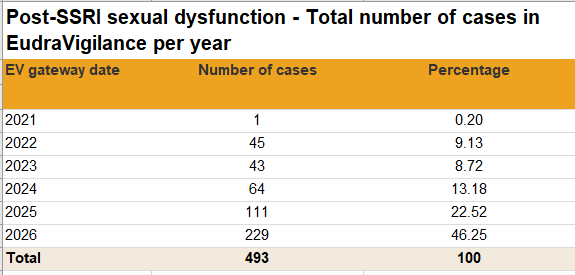
(3/3) This is the result from the last time we asked the EMA this question. At the time, we did not ask them to filter only for cases from EEA countries.
https://t.co/PrwvvtdaSF
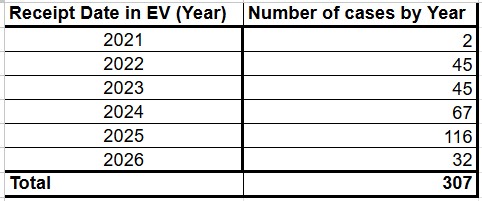
We just received a response to a freedom of information request made to the European Medicines Agency (EMA). There are 307 cases in the EudraVigilance European Database of Suspected Adverse Drug Reaction Reports of ‘post-SSRI sexual dysfunction’ that use the MedDRA code 10086208.
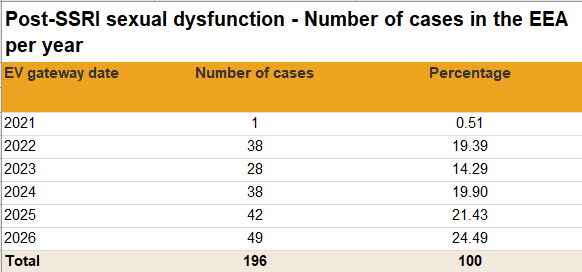
(1/3) We just received a response to a freedom of information request made to the European Medicines Agency (EMA). There are 196 cases in the European Economic Area (EEA) of ‘post-SSRI sexual dysfunction’ that use the MedDRA code 10086208.
(2/3) The total in the EudraVigilance European Database of Suspected Adverse Drug Reaction Reports, including cases outside the EEA, is even larger. There are 493 cases of ‘post-SSRI sexual dysfunction’ that use the MedDRA code 10086208.
@rootsrocks222 Unless a paper specifically mentions PSSD, it’s referring to temporary sexual side effects. This paper was published in 1998 and the first paper on PSSD wasn’t published until 2006. It was previously assumed that sexual dysfunction was always a temporary side effect.
"I almost laugh at the fact that I used to think I was suffering, until I got this."
Rosie has been suffering from severe emotional and sexual dysfunction ever since taking #Lexapro (#escitalopram) 2 years ago.
In this video, she describes what it's like to suffer from #PSSD.
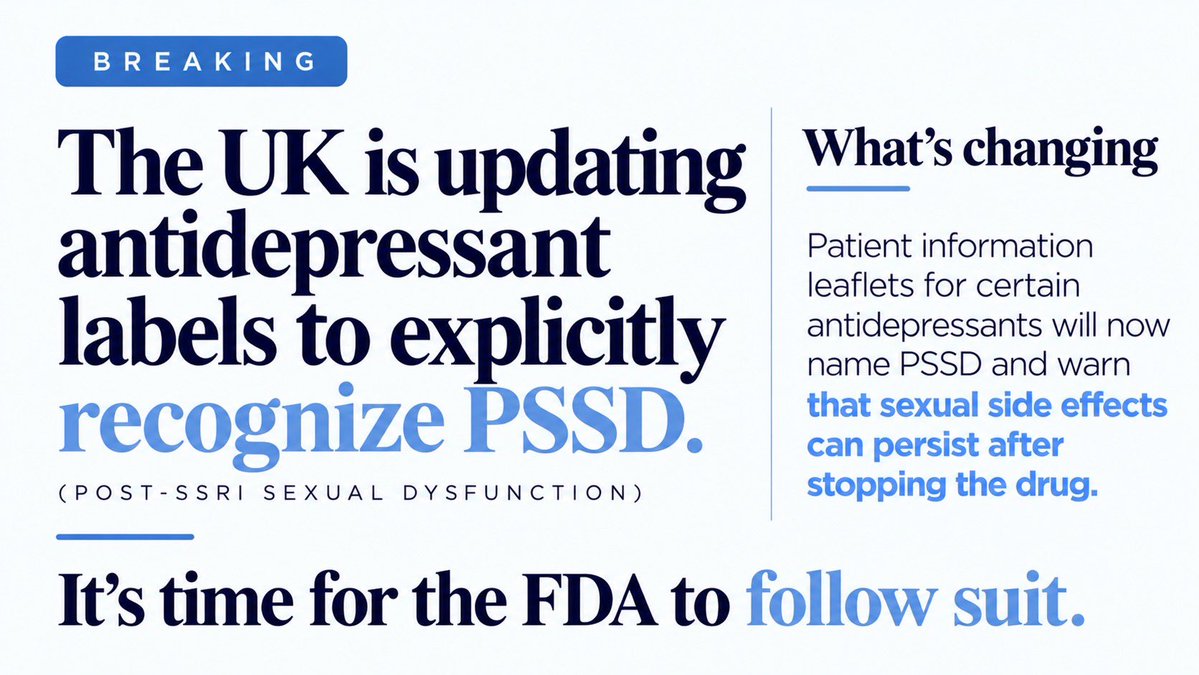
The UK is updating antidepressant warnings to recognize PSSD (post-SSRI sexual dysfunction) and acknowledge that sexual side effects can continue long after stopping treatment.
It's time for the FDA to follow suit.
But sadly this still isn't enough. These injuries extend far beyond sexual dysfunction, causing devastating, lasting cognitive and emotional impairments.
People deserve to be fully informed about what they are risking before making a decision that could potentially affect them for the rest of their lives. @PSSDNetwork
@rootsrocks222 Thank you, but temporary sexual dysfunction is different from PSSD. The study in the link that you provided is about temporary sexual dysfunction.
https://t.co/eWFuLXtnfe
Post-SSRI Sexual Dysfunction is commonly misunderstood, even by people who experience it.
The following infograph should help explain #PSSD to those who are not familiar with it.
Watch the full interview of @ucl psychiatry professor Joanna Moncrieff (@joannamoncrieff) by therapist Piia Tuominen (@TuominenPiia) on an episode of the Astetta Parempi Elämä podcast titled “The Long-Term Effects of Antidepressants."
https://t.co/vzRDPDQrmv
"We have animal studies that show that giving animals SSRIs causes persistent reduction in sexual activity, so there's no doubt that that effect is occurring."
@joannamoncrieff explains why she is convinced that PSSD is caused by drug effects rather than psychological problems.
Watch the full interview of @ucl psychiatry professor Joanna Moncrieff (@joannamoncrieff) by therapist Piia Tuominen (@TuominenPiia) on an episode of the Astetta Parempi Elämä podcast titled “The Long-Term Effects of Antidepressants."
https://t.co/zS2PxDNH0z
"I think psychiatrists have been very slow to accept these problems, partly because I think they just can't bear to acknowledge that these very widely prescribed drugs that, you know, all psychiatrists have been prescribing for a long time can be so damaging."
@joannamoncrieff