The PSSD Institute exists to improve the lives of individuals affected by Post-SSRI Sexual Dysfunction (PSSD) through education, advocacy, and research.
At the PSSD Institute, we are an international non-profit organization dedicated to research, education, and advocacy around #PSSD and related post-drug syndromes. Our mission is to secure recognition, accountability, and hope for those affected by long-term antidepressant harms.
We are grateful that The New York Times Magazine has published a landmark investigation into PSSD, and worked with us to speak to members of our community about how their lives have been adversely affected as a result of being prescribed #SSRIs - regrettably, without informed consent.
Our official statement on @NTYmag's article is here: https://t.co/JZLi0pC2te
Nobody told me antidepressant withdrawal can cause brain damage.
The standard way doctors taper patients off antidepressants—a one-size-fits-all approach of coming off in just 2–4 weeks can induce a condition known as protracted withdrawal.
Protracted withdrawal is debilitating nervous system injury that can leave people suicidal, disabled, unable to work, care for themselves or their families for years.
and in some cases, people are left with permanent neurological impairments that dont go away.
In withdrawal from antidepressants the suffering can be so profound and unrelenting it leads people to take their own lives.
My own life was shaped and forever altered by the lack of safe evidence based tapering guidelines for SSRIS.
Thanks to @SecKennedy@HHSGov that is finally going to change.
Evidence-based tapering guidelines are coming and this will save countless lives from unnecessary suffering.
Thank you @theisabelb & @ChrisWillx for highlighting this critical issue🙏🏻 #pssd #antidepressants
“Study warns long-term antidepressant use poses major health risks - Researchers link prolonged antidepressant use to sexual dysfunction, emotional numbing, cognitive impairment, and weight gain.” https://t.co/uqDq9VjFo5
Imagine seeking help, only to find yourself badly injured and with nowhere to turn. @EmilyGreyPSSD, a member of our community, explains that's the reality of many people living with #PSSD.
PSSD sufferers were never told this could happen after taking #antidepressants. As well as more research into treatment, there's a desperate need for better standards of informed consent.
@RZR1776 We also advise that you report your symptoms using the MedDRA code for PSSD, as patient reports are very important. See our guide on how to do this: https://t.co/MntttOcPN8
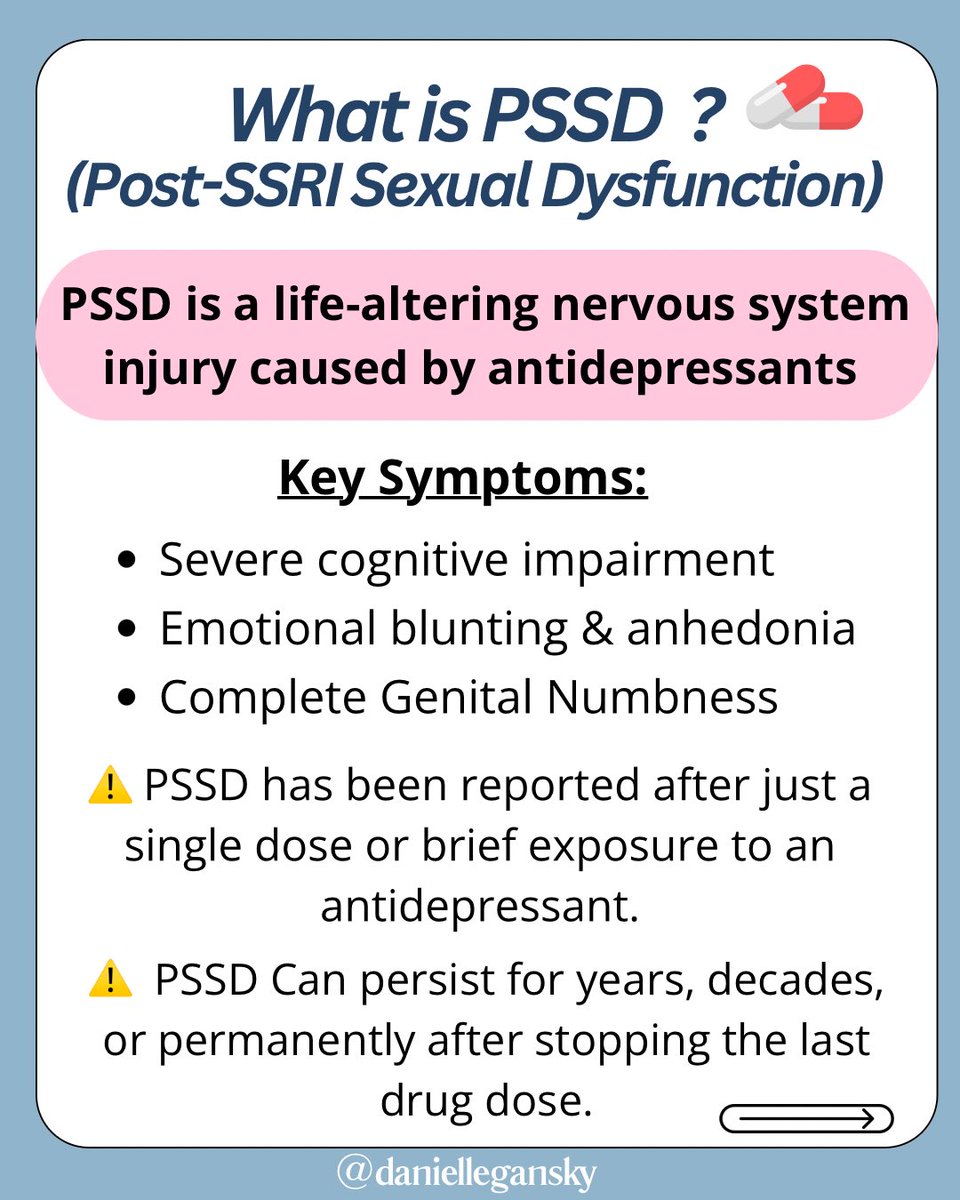
PSSD can develop after just a few doses, and can present either on the medication or upon discontinuation. For some, #PSSD is disabling. Learn more about the condition: https://t.co/lJU0zZbP4k
💊PSSD is a life-altering nervous system injury induced by taking an antidepressant
💊Cases have been reported after short-term exposure and even after a single dose.
➡️ for more info check out @PSSDNetwork
Thank you for reaching out. Very sorry to hear you've been dealing with PSSD for such a long time.
Many people in our community find building a network with others who are experiencing the same symptoms helps. If you choose to speak to a professional, it's also important to consult those who have an understanding of PSSD, as the issue is not widely understood in the medical community.
You can access support groups through @PSSDNetwork: https://t.co/ULLFvCGxyo
You can also find professionals who are aware of PSSD through @RxISK: https://t.co/bfR2mD84rG
#PSSD impacts lives far beyond sexuality.
Identity, sense of self, ability to connect with loved ones; ambitions, hopes, and dreams are all part of what makes us who we are.
PSSD patients urgently need to be heard - and their stories are incredibly important. Their voices matter.
#ssris #antidepressants
Credit to @i_r_wilson for this video:
https://t.co/60WrIwcyNY
Coverage of our paper about long-term antidepressant use, including lack of evidence for benefits and under-appreciated adverse effects. @markhoro@WallisKatharine. https://t.co/zTxNTpH2XY
“I have no sensation in my genitals. My clitoris is completely numb.”
Lauren Friedman, 23, shared her devastating experience with PSSD (Post-SSRI Sexual Dysfunction) — permanent loss of libido, sensation, and ability to orgasm after taking antidepressants.
Chris Williamson and Isabel Brown reacted with shock, noting how little mainstream coverage this issue receives.
Sexual side effects from SSRIs affect 50-70% of users. For a subset of people, these effects (including genital numbness and anorgasmia) persist long after discontinuation, a condition known as Post-SSRI Sexual Dysfunction (PSSD). The exact prevalence is unknown, but patient reports and emerging research suggest it may be under-recognized.
People deserve full informed consent about potential long-term risks before starting these medications.
What do you think, should PSSD get more public and medical attention?
PSSD is not simply the loss of sexual function. It extends far beyond that. It involves emotional dissolution, the loss of cognitive abilities, personality loss, identity loss, and profound disruptions to the experience of being human.
it’s a feeling of confinement within your own consciousness. It feels as though my mind had been placed in a chemical straitjacket. My thoughts, emotions, personality, and sense of self all feel restricted. I no longer feel fully able to access, express, or experience who I was ( or life itself) in the way I once could.
My sense of agency has been diminished within my own mind, almost like a loss of free will. I no longer feel free to think in the expansive way I once could. (something I had always taken for granted and never imagined I could lose at such young age.)
How do you describe the loss of something as subjective, invisible, abstract, and intangible as your own mind and consciousness?
Because the injury is invisible unlike a broken bone in a cast or a visible physical wound, others cannot truly grasp the depth of the devastation and damage of someone's internal world.
In the beginning I felt frustrated as words could not fully convey the reality of what was happening to me. The inability for me to communicate the experience made me feel even more trapped.
The very faculty I needed to describe what was happening had itself been affected.
What gets shattered Is the very instrument through which we experienced existence itself.
@PSSDNetwork #PSSD
Thanks for calling out the FDA and these drugs. Please consider sharing the @MoralMedicine YouTube channel. We interview Post SSRI Sexual Dysfunction and Post Finasteride Syndrome sufferers on the channel who have had their lives devastated by these drugs.
https://t.co/xIkd85Mzq5
Good thread here. Could add that we probably underestimate post-SSRI sexual dysfunction, because it has been assumed that when you stop a drug the iatrogenic effects stop too - something we now know is false.
Call for volunteers: CALLING ALL PEOPLE LIVING IN CANADA WHO HAVE BEEN PRESCRIBED AN ANTIDEPRESSANT! Mad in Canada has created a short survey aimed at shedding light on the informed consent process experienced by adults who are living in Canada, and who have been prescribed antidepressants at some point in their life. Our survey is not about whether people should or should not take antidepressants. It’s about what people are being told about the potential effects of antidepressants, when they are prescribed. Learn more and take the survey here. https://t.co/55dZTrTASJ
We're so grateful to #PSSD patients for bravely speaking out. It takes courage to share experiences that are so personal. By doing so, they underscore the urgent need for PSSD patients to be heard and for healthcare systems to respond.
https://t.co/RU80Qjo9Ae
At 21 years old, I took the first pill of a 'treatment' that would chronically compromise my sexual and emotional capacity.
I wasn't told about the sexual or emotional side effects of #fluoxetine (Prozac), and my GP avoided this topic when I repeatedly raised my symptoms.
21 is an incredibly young age to lose your sexuality and ability to connect with peers. I lost my developmental adult years - there is no treatment pathway or accountability for this condition.
Friends in the #PSSD community had tried to warn the #NHS before me, but they were not listened to. If they had been taken seriously, I might have escaped this avoidable harm.
#SSRIs turned my resolvable struggles into an ongoing nightmare, and at 35 years old, I'm starting to see the true long-term impact on my life.
Meanwhile, the healthcare system treats me and other people with PSSD as a statistic. The #MHRA made the choice not to inform doctors about this condition.
Doctors continue to prescribe SSRIs to young and vulnerable people without properly informing them of the potential risks to their personal development and futures.
https://t.co/wVeoeJO6Vp
Another warrior has stepped forward to share their experience with Post-SSRI Sexual Dysfunction (PSSD).
Katie was prescribed fluoxetine (Prozac) at 21 years old during a difficult period in her life. What followed was a profound and life-altering change.
She describes developing emotional numbness, sexual dysfunction, loss of attraction, and an inability to form romantic connections, symptoms that have now persisted for approximately 14 years.
Despite repeatedly seeking help, nobody informed her that her symptoms could be related to the medication.
Thank you for your courage in speaking out and helping bring awareness to this issue, Katie.
Subscribe, comment, and share to help break the silence.
📩 Share your story: [email protected]
“It’s like a sudden-onset chemical asexuality that just never goes away, and in my opinion, I don’t think that it’s sensational to say that this is a form of chemical castration, that it is permanent.”
Lauren Friedman (@lololizzle) discusses PSSD at a @MAHA_Institute summit.