we're aiming to build the biggest game around crypto twitter on Solana
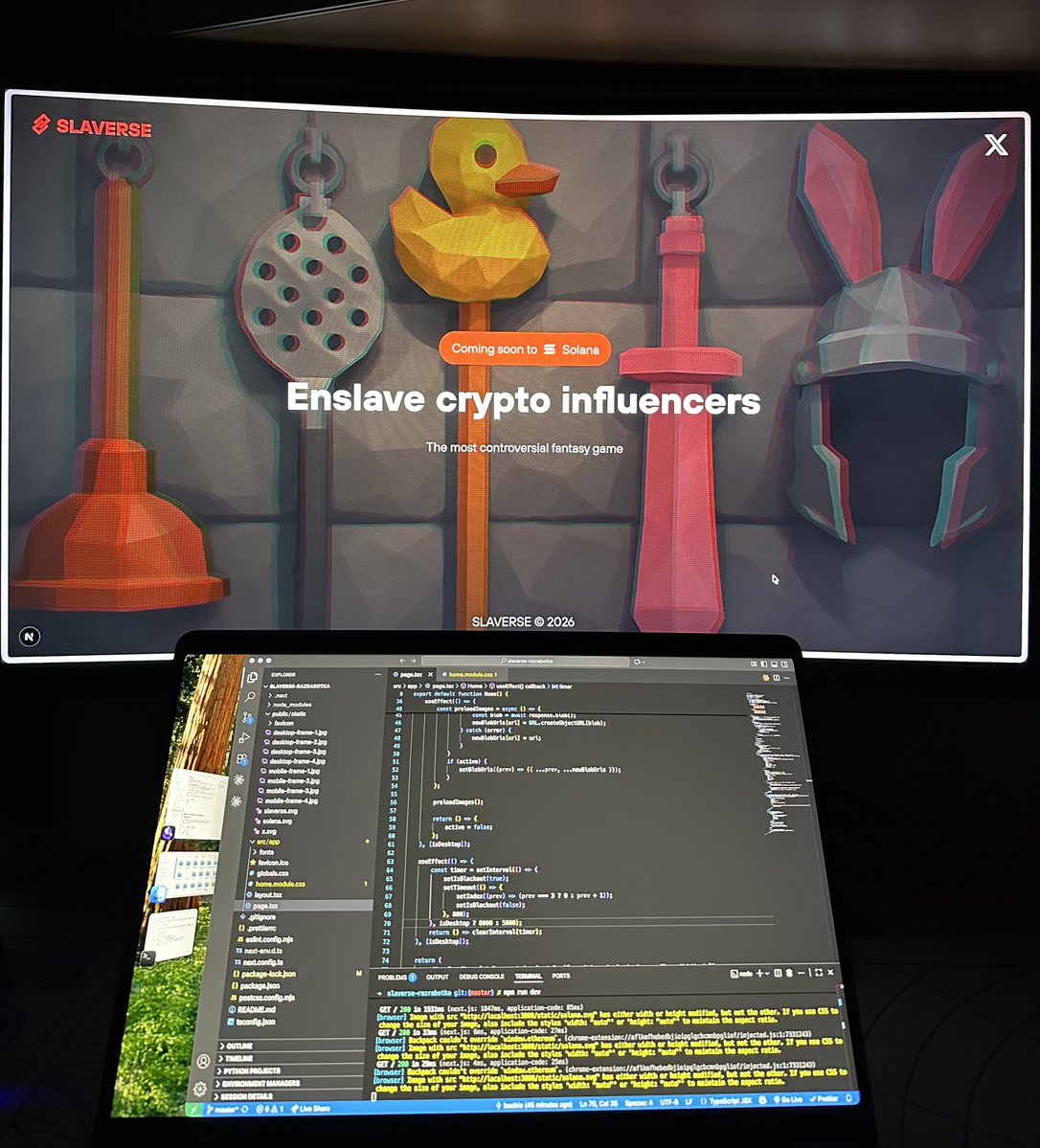
7 months ago we started building a fantasy game. a reimagined @fantasy_top_, more dynamic, funnier. took "slavery" as the core theme. called it Slaverse.
months of dev. lots of problems. a lot of money burned.
5 months in we did a zoom out and realized we fucked up. the economy didn't work. the model was broken at the core, not something you fix with tweaks. on top of that X sends an email saying the account violates community guidelines.
honestly, it was painful to admit.
sat down to rethink everything. analyzed a bunch of web3 games and landed on a simple thing: players don't care about gameplay or mechanics if there are no strong financial incentives. the goal is always earning.
that gave us an idea of what a web3 economy should look like. but we couldn't fit it into Slaverse. we'd have to redo so much that starting from scratch was easier. tough call. 5 months of work down the drain is no joke.
so we built Pimpire (@pimpiredotfun)
you play as a pimp, build your empire of crypto influencers and earn from their performance on X. no card battles like in classic fantasy. all mechanics built for the web3 user.
cards have rarities. gacha mechanics inside. influencers represented as cards also earn revenue. fair reward distribution is something we care about.
7 months in and we're basically starting over. but this time we know exactly what we're building. and who we're building it for.
soon.
what https://t.co/MfLO0eqxKC actually built, and what almost nobody talks about in the post-mortems, is a real-time market on attention.
for the first time you could watch a KOL post something and watch their price move 30 seconds later. people were betting on each other in public and everyone could feel it.
that loop was the magic. the card game wrapper around it was the mistake.
they spent 2.5 years trying to make a sustainable collectible game out of a mechanic that was actually a degen sport. wrong shape for what they had.
we're building the version that keeps the loop and drops the wrapper. soon.
we're aiming to build the biggest game around crypto twitter on Solana
it's called @pimpiredotfun. players are pimps. the talents you sign are real CT influencers. each one is a card. each one earns $PAPER based on how they perform on twitter.
but here's the part i actually care about.
the game rewards YOUR CT presence too. bagworkers, reply guys, builders, KOLs. anyone actually showing up in the space gets permanent advantages that make their earning more efficient.
we want the people who keep this place alive to actually win something.
This is the story of Hyperliquid, the most profitable startup per employee on earth, told from a guarded office in Singapore.
Last year, its team of 11 generated $900 million in profit. It's 3 years old, has never taken a dollar of venture capital, and is beginning to change how century-old markets work.
Its founder, Jeffrey Yan (@chameleon_jeff), had never taken a physics class when he picked up a textbook at 16. Two years later, he won gold at the International Physics Olympiad. In 2019, he started trading with $10,000 from a living room in Puerto Rico—working off a television because he didn't own a monitor.
Within 3 years, he was running one of the largest anonymous crypto trading firms.
Then he shut it down. Yan was rich and free, but he had spent years inside crypto, watching it betray itself. Bitcoin's central premise was decentralization. Yet the biggest exchanges were centralized. Crypto kept reintroducing the dependence on trust it was built to eliminate. He set out to create what should have existed.
Hyperliquid is a blockchain with a trading exchange on top, and anyone can build on it. Yan's vision is to house all of finance. In 3 years, it has done over $4 trillion in volume. And in the past few months, it has begun to outgrow crypto.
Markets for oil, silver, and the S&P 500 now trade on Hyperliquid around the clock, weekends included, and are growing roughly 40% week on week. When the US and Israel bombed Iran on a Saturday in February, Hyperliquid was the venue traders turned to.
Hyperliquid's success has cost Yan his freedom. He works out of a secret office in Singapore and cannot travel without two bodyguards. Even the team's housekeeper doesn't know what they do.
In January, @domcooke spent a week at their office. Read his profile on Yan and @HyperliquidX below.
> lost $3.2B as a16z in 4 minutes
> funded a prediction market
> funded an nft guy in a bored ape hat
> said yes to SBF at 3am
10/10 would fund again
how do you make a fantasy game people actually want?
i've been sitting with this question for months
before we started building @slaversedotfun
here's what i kept coming back to:
people are tired of fantasy games that take 30 minutes to understand.
complexity kills fun. the best games are instantly readable and endlessly deep.
people love to gamble. they love ponzis.
if the demand is there, you either build the right version of it
or someone else builds the wrong one.
the difference is in the math.
most crypto games die after week one.
not because the game is bad.
because there's nothing pulling you back tomorrow.
you need a daily loop that works when the market is dead.
and most p2e games inflate themselves to death.
rewards exceed costs from day one.
the economy has to make earning feel earned.
the honest answer to the original question:
you ship your best guess and watch.
that's what we're building at @ps_labs
i vibecoded an app for passive income in 20 minutes
it's a calculator: do pretty much any calculations with internet access
simple subscriptions: one-time, monthly, yearly
results are almost correct, fixing in updates
try it: http://localhost:5500
Standard NFTs on Solana at scale are a hidden tax on your users. We refused to ship that
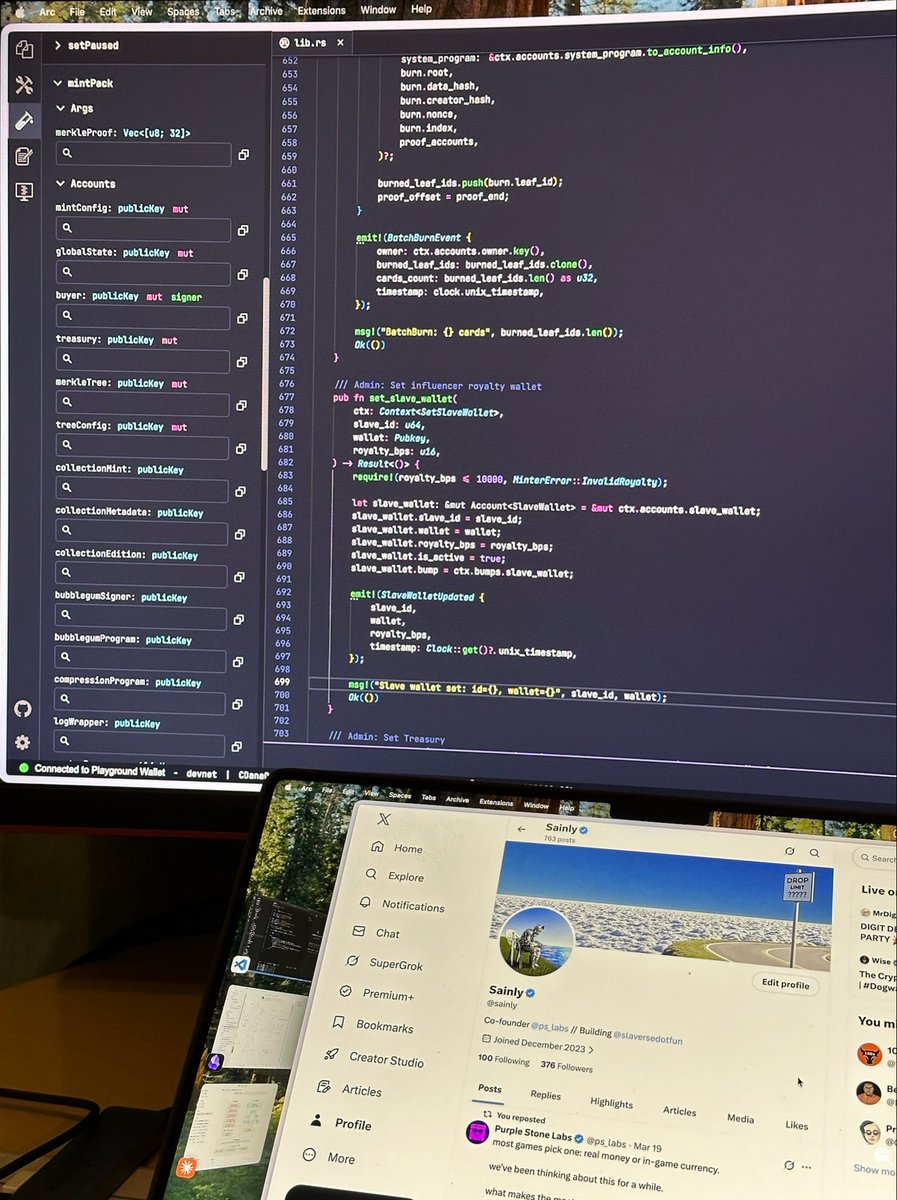
Been working on @slaversedotfun NFT architecture
With standard NFTs, every card = its own on-chain account. You pay rent for each one
Scale that to tens of thousands of cards and minting cost becomes a serious number
Someone absorbs that cost. We didn't want it quietly ending up in the user's bill
Went with cNFT instead
All cards live as leaves in a single Merkle tree
One tree = one account, regardless of how many NFTs are inside
Сost difference is hundreds of times cheaper
Tech is battle-tested, major Solana projects run this in prod
Easy decision once you run the numbers
most games pick one: real money or in-game currency.
we've been thinking about this for a while.
what makes the most sense to us right now: two currencies that cover different parts of the experience.
sol is the core. you buy in with it, you earn it back
through tournaments. that's the main loop.
the in-game currency sits on top of that.
it's what gives players more to do, more to spend on,
more reasons to stay engaged between tournaments.
still pressure-testing the model. but this separation feels right.
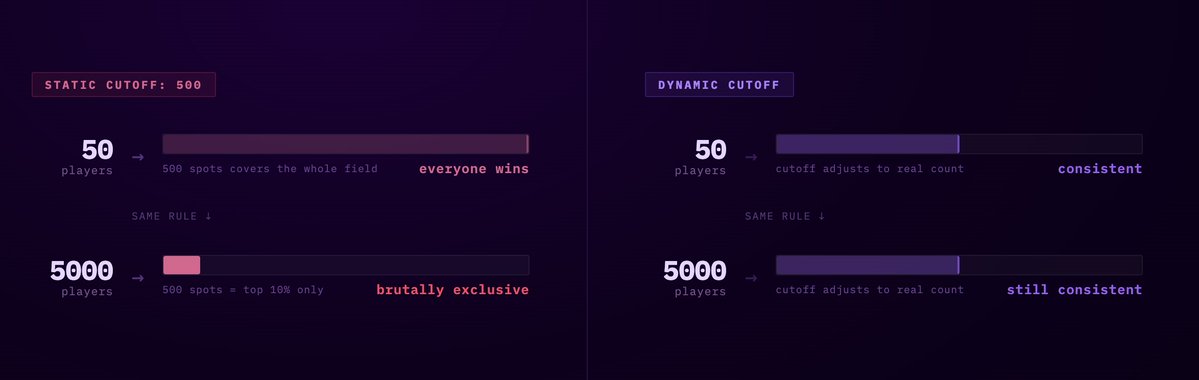
static leaderboards don't know how many people showed up.
you set the cutoff at 500 places before the tournament starts. 50 players register and those 500 spots represent basically everyone. 5000 register and suddenly you've made the game brutally exclusive without changing a single rule. same structure, completely different game.
the real problem is that fixed cutoffs are a design decision made in advance for conditions that don't exist yet. the designer guesses, ships, and hopes the numbers work out.
dynamic distribution responds to what actually happened. the cutoffs adjust to the real participant count. the reward zones reflect the actual competition. the game stays consistent regardless of scale.
we think that difference matters.
we're building a fantasy game around crypto twitter influencers.
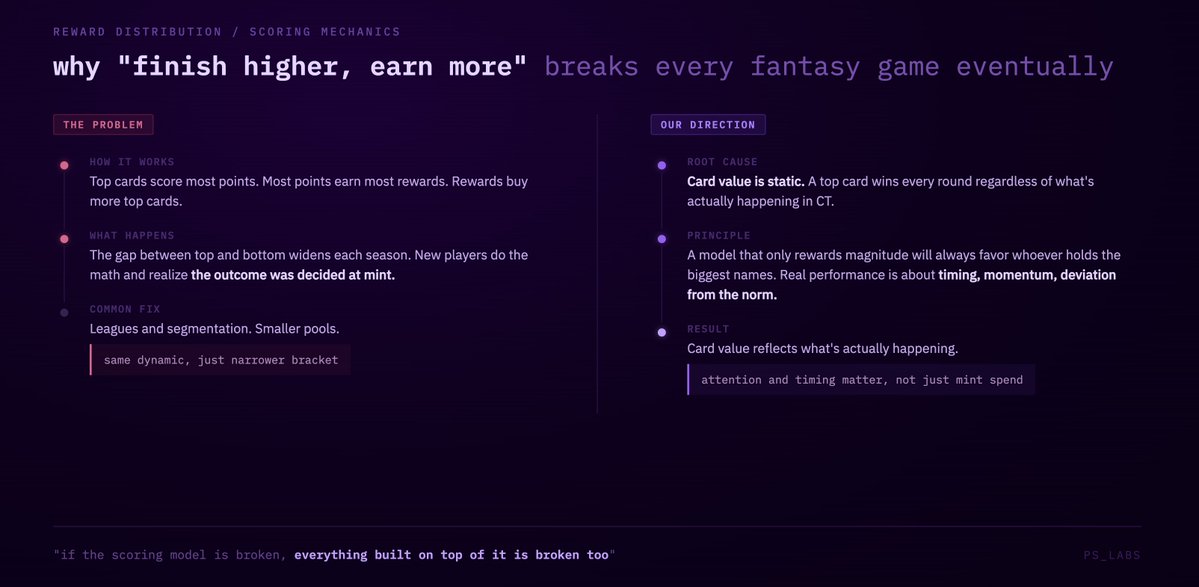
and the first real problem we ran into had nothing to do with cards or trading. most fantasy games hand rewards to whoever holds the top names.
top cards score most points. most points buy more top cards. new players do the math after a few rounds and realize the outcome was decided at mint.
the standard fix is leagues: split players into tiers. same dynamic, smaller pool.
we think the problem sits one layer deeper: the scoring model itself.
a model that only rewards magnitude will always favor the biggest names. regardless of what's actually happening. regardless of how well you read the market.
real performance is about timing, momentum, deviation from the norm. still working through how to build that in a way that's hard to game.
but this is the problem worth solving first. everything else sits on top of it.