Hogan Harris pt. 2
Last week: the return he'd get on a tick of velo, a platoon problem, and a workload gap.
This week: how we'd build his offseason, including the sweeper and cutter shapes we'd work towards, + more.
Low Days should be renamed exploration days. Put your body in positions/tasks it has never solved before. Make your brain learn something new. One, because it will allow you to become a more robust mover, and two, it is fun as hell. Going to need to have fun to stick around.
It’s also leaves room to dial in workload, deload from a long season, then build capacity for higher volume and intensity later. Good pitching development starts with the environment, not just external cues.
Other times it’s more structured. Athletic throws to his open and closed side, to IZT targets, fixed targets on the net, or a coach calling out a target mid drill. Baseballs, weighted balls, over and undersized balls, and most days javelins, handballs, softballs or plyos too.
It seems random but isn't and thats by design. High variability now gives him a wider range of solutions, so when the constraints tighten later in the offseason, the adjustments come easier and the intended patterns stick.
Sometimes he chooses the implement. Football throws are a big one for this athlete. Loose, low stakes, more play than practice, and that’s where he opens up and starts exploring how he moves.
When training elite throwers the coach designs the environment. The environment should encourage movement exploration.
Favorite part of the offseason is movement exploration, and early on the job is building an environment the athlete can find his own solutions in.
Grateful for three years with the Dodgers, @DrivelineBB, @ZachDechant, and everyone who’s supported me.
Excited to join the Astros as the Assistant Director of Player Development, bringing together integrated player development and working with the best players in the world.
3 years ago, I started at @DrivelineBB
I didn’t even know if I wanted to be a hitting coach.
And here we are.
These are 3 of the biggest things I’ve learned in the last 3 years 🧵
Nice summary of the #Mariners situation. Not to make excuses for them, but this particular problem is complicated:
"They need to get back to the things that they did in player development. Some of that development stopped/changed/were abandoned in the big league level..."
The Mariners had their coaches plundered in the offseasons, which is common when an org has success developing talent (happens all the time at Driveline and did when I was Dir. Pitching of the Reds, 2014 Astros, etc).
Driveline didn't handle this first wave of poaching well. We did a bad job trying to stem the tide with temporary measures, rather than accepting the reality of the situation and changing our entire structure to accommodate for this inevitable turnover by investing a lot into systems development and employee training.
It's likely Seattle found itself in a similar situation and tried to plug holes rather than holistically change. They're also one of the orgs that have Directors watching minor league results while coaching in the big leagues, which I've consistently opposed.
Being a big league coach OR minor league director is hard enough. Doing both is impossible. They're also very different jobs. An open secret is that most Directors of Pitching (and Pitching Coordinators) are simply biding their time until they get their shot as a big league coach. This isn't great for organizational health. Someone who is in charge of minor league talent and structure needs to be all-in on that and there should be a promotional pathway for them that is exclusive of being a significant part of the big league roster.
Developing minor league talent can be more important than big league success depending on the phase of the organization (in the Mariners case, this isn't true currently - but would be for orgs like the Cardinals, Rockies, Marlins, etc). As such, you can't have the Director looking upwards while being responsible for the farm system.
Anyway, just some words on the restructuring Seattle is about to undergo, one that's probably overdue. Better late than never.
The Marlins are running one of the most interesting side quests in baseball right now
Their best starters are also their highest-leverage relievers?
Let's talk about it 🧵
Velo, two new shapes, flatter usage, a workload plan, and command built on top of it.
That's the path to the all-star version of Hogan Harris.
Link to part 1.
https://t.co/37eTFR778s
Two things about Hogan Harris.
He'd get an unusually large return on a tick of velo
As a lefty he isn't getting the platoon edge his stuff should give him.
Both are fixable this offseason. 🧵
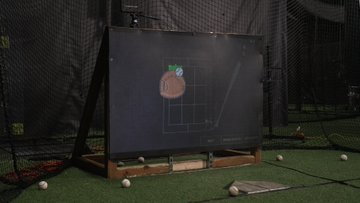
Execution prep.
High intent bullpens with the new mix, live ABs as needed.
Simulated ABs with intended zones give instant feedback: how each pitch grades and where to locate for run value, whiff, and chase by batter hand and pitch type.
Practice has to look like the game.
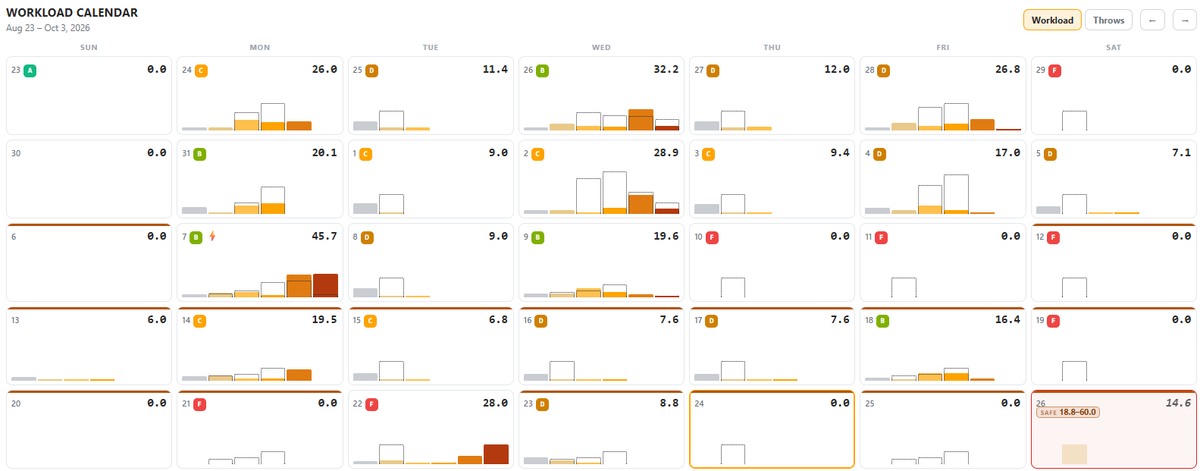
Workload.
Relievers can fade late in outings and on short rest.
That work runs all offseason as we dial in his Pulse data, ramp progressions, and which implements and volume/intensity mixes move the needle. He leaves knowing how his body responds better than ever.
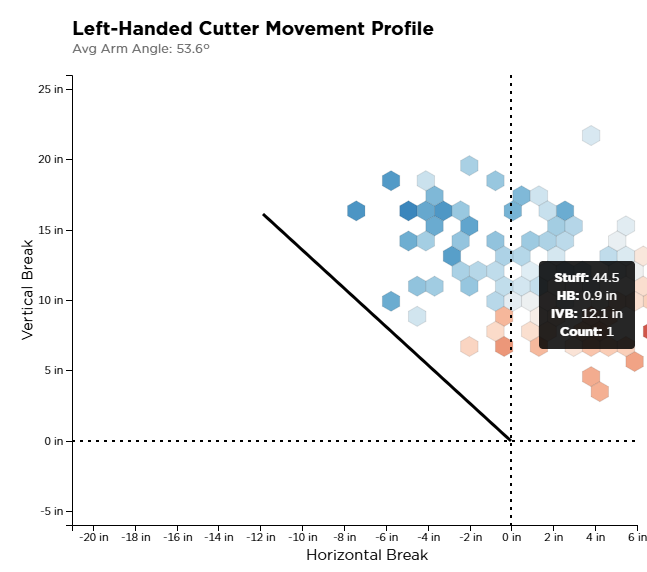
The cutter.
Target: 92-93+ mph, 11-14 in IVB, 0 to +3 in HB. Ideal average looks something like: 92.5, 13 IVB, +1.5 HB.
It isn't a new pitch. He threw it in 2025. The work is getting it back, adding a little HB, and keeping it separated from the sweeper.
Command comes last. We throw to targets all offseason, but once velo and shapes stabilize, command becomes priority #1.
High intent, target-focused throwing with oversized and undersized balls, plus IZT miss distance training to measure exactly how far he misses.
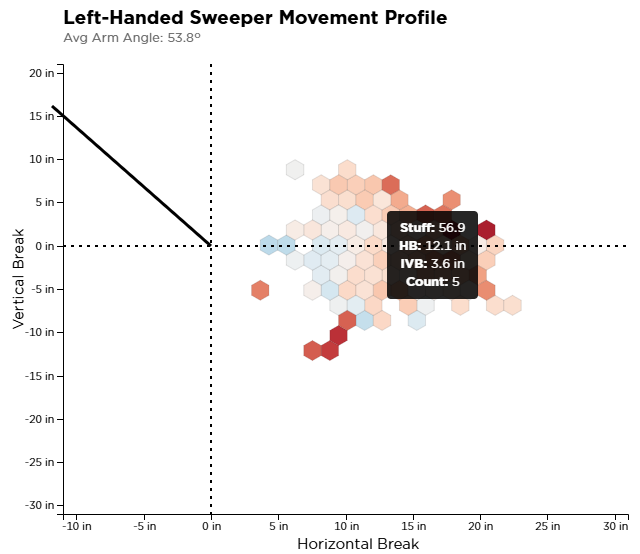
The sweeper.
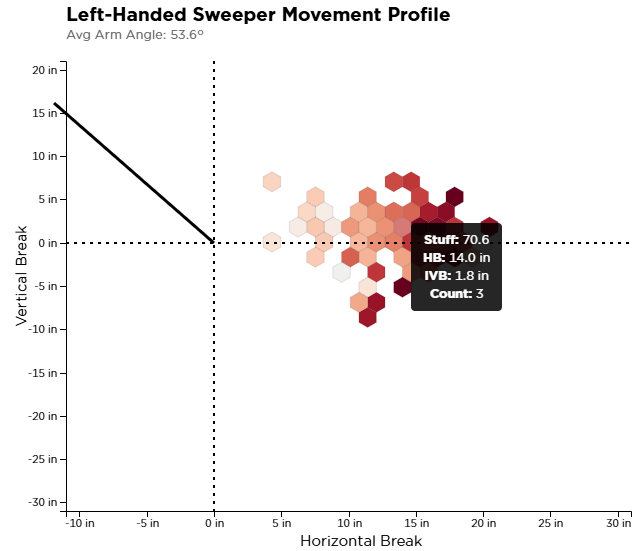
Target: 79-85+ mph, 11-15 in HB, -1 to +5 in IVB. More velo and more sweep only help vs lefties.
In that range it grades 55 to 70+ vs LHH. It's the shape his arsenal is missing and a third look lefties have to cover.
Velo.
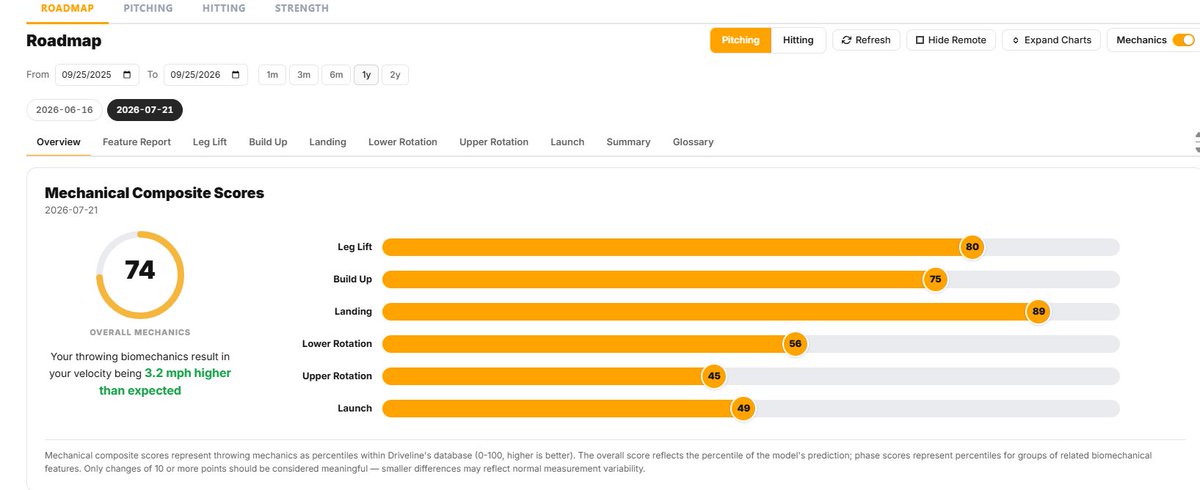
The mechanical room shows up in motion capture: proprietary comp scores and movement analysis built on years of lab data.
Constraints narrow toward faster solutions, with designed high intent days. Mocap, pitch metrics, and velo are the feedback. He finds the solution.