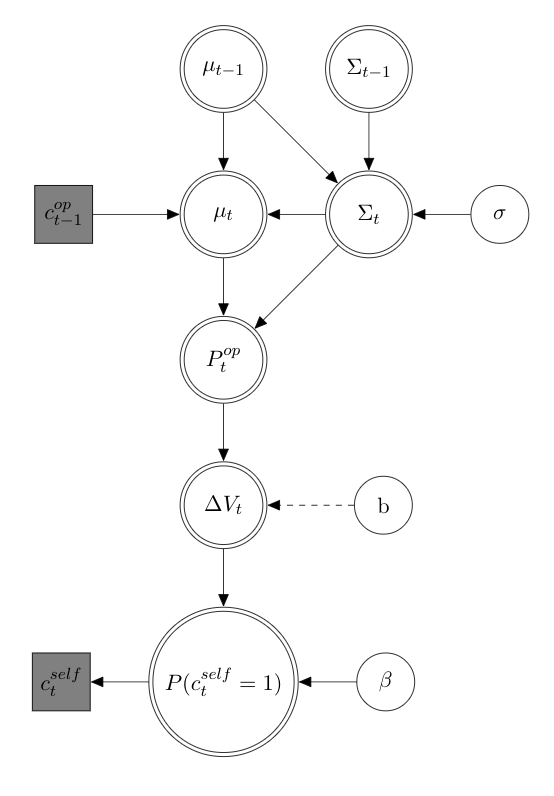
Modeling Theory of Mind (ToM) is hard - but it doesn't need to be! We recently published an article (https://t.co/kxGb2qwO62) showcasing the tomsup👍 python package, making it easy to use computational ToM models in simulations and experiments. 1/🧵
"Loops all the way up - recurrency as an implementation-first primitive for consciousness." New in Phys Life Rev by Zefan Zheng, @robertchisciure & others .... well worth a read, & open for peer commentary https://t.co/t2zRZ6nRMb
AI today follows the scaling paradigm: more data + more compute = better model. This works in controlled settings but breaks down in the unpredictable real worlds robots operate in.
We need adaptive intelligence for physical AI. Tim talks about it here: https://t.co/T0pFp0ZBYm
📢Read #FeaturePaper "Introducing ActiveInference.jl: A Julia Library for Simulation and Parameter Estimation with Active Inference Models", by Samuel William Nehrer et al.
👉See more details at: https://t.co/cWVNMFy9Vh
#ActiveInference#FreeEnergyPrinciple#CognitiveScience
🚨Come work with me! 🚨We're hiring a tenure-track assistant professor in Applied Natural Language Processing (deadline Feb 1).
https://t.co/rpdbVn4JGp
Deadline February 1.
Article: "Introducing ActiveInference.jl: a Julia Library for Simulation and Parameter Estimation with Active Inference Models"
Coauthors: @NehrerSamuel@JonathanEhrLau@conorheins Christoph Mathys @PTWaade
https://t.co/AjLbLcFyZg
We are indescribably sad to announce the passing of our dear friend and colleague Kristian Tylén
His presence at the IMC will be forever missed and his impact on us all is beyond words
Our thoughts are with his wife and children in this difficult time
https://t.co/v810Wxqjkz
Just wrapped our first CogNet - fMRI data analysis event! 🧠✨ Huge thanks to Line Elgaard Kruse Danielsen from the School of Communication and Culture, for leading the workshop.
The @mesec_ Winter School on Consciousness Science is open for applications!
Amazing opportunity, and amazing organizers. Recommended warmly :)
https://t.co/D98DI9OKQB
On my way home from a wonderful Cabin Workshop at the Association for Mathematical Consciousness Science. Grateful for the beautiful Alps, for the academical diversity, and for the wonderful, wonderful company <3
Thanks @JohannesKleiner@LanaRude and everyone i didnt Twitter yet
@jbenfalandays They call it the 'high road' and 'low road' to active inference; the first starting in statistical physics, Markov Blankets and NESS (aka the FEP), the latter in predictive notions of mind. Importantly, the latter can still be used to justify active inference without the first.
@jbenfalandays But then I'm a cognitive modeler and not a physicist.
With a Markov Blanket imposed, I suppose you can ask whether the system stably controls its sensorium to fit some expectation (that defines its existence).
A nice standard approach for checking this would be nice.
@jbenfalandays If it fulfils the requirements for the FEP to apply (Markov Blanket and (non-equilibrium) steady state), this is one type of justification for using ActInf. Note that ActInf can be a useful framework irrespectively; then the problem is 'just' reconstructing the generative model
New paper out with @SilaniLab @chmathys in @eLife!
Does blocking opioid or dopamine D2 receptors increase model-based behaviour?
https://t.co/2zSxLVqRGn