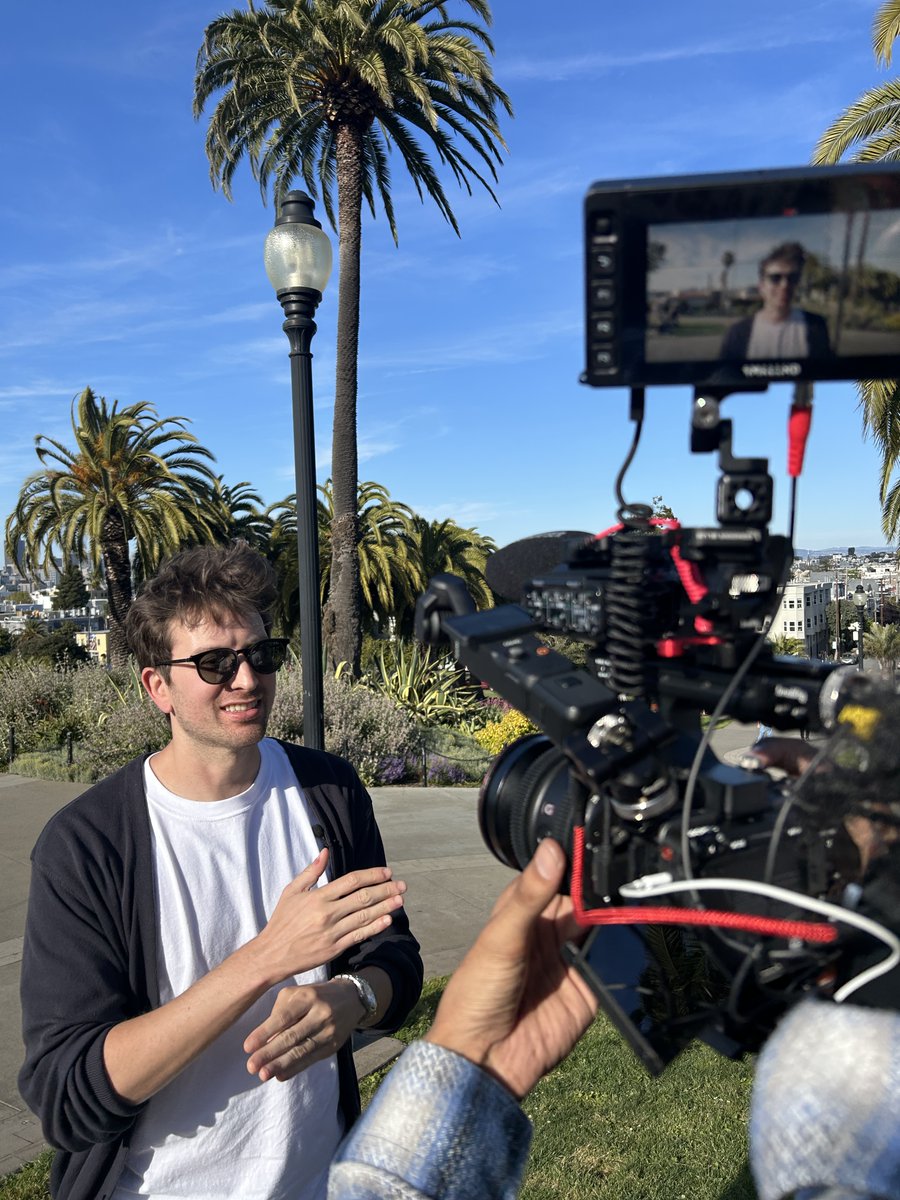
Rebecca and Andrew at the HEX event — sharing AI tools founders are actually using to build.
Real talk with young founders about startups, life, and careers.
The room walked away with this:
"Fail fast, fail cheap. Fail slow, fail expensive."
#SaigonAI#HEX#QCoda#Notion
We're teaming up with HEX, @NotionHQ & @qcoda_ai for a hands-on AI & product building masterclass at Van Lang University. 🙌
Only 60 seats. July 9 | Ho Chi Minh City
@aschwabe@RebeccaJoy92
👉 https://t.co/UJcOEi8ilG #SaigonAI
Agree. The AI coding race is asking "how do I build faster?" The real question is "how do I make sure what gets built is actually what we decided to build?"
Speed without alignment just ships the wrong thing faster.
You might believe you should spend less time thinking about code because of AI.
I strongly disagree! We’re watching this play out live where tons of AI generated code becomes a liability.
At the end of the day, an engineer needs to be responsible / on call for code that gets shipped to production. If you don’t understand the system you’re trying to debug, you’re probably going to have a bad time.
Yes, AI can help with all of this, if you set up the proper systems. You can have agents triage prod logs, look at errors, etc. You can speed up parts of the investigation, but an engineer needs to make the call. There might be serious customer or financial implications from that change.
I expect the trend continue for trimming dependencies, vendoring code so you can modify it directly, preferring simpler systems with fewer abstractions, and spending waaaay more time thinking about system design and code maintenance.
I’ve said this before, but it’s a great time to get familiar with CS fundamentals and some of the history behind what great software looks like. Many parts will be different in the coming years as AI progresses, but also a lot more than people realize will stay the same.
I just got back from SF and I FEEL INSPIRED.
I spent 5 days with frontier AI model teams, AI startup founders, and 3 billionaires.
My takeaways:
1. I had lunch with 3 billionaires. All of them are buying SaaS companies and rebuilding them agent-first. They were deeply inspired by Bending Spoons and Ryan Cohen's eBay deal. Buy the company, cut the headcount, rebuild the tech, add agents, add features, make more valuable experience, raise prices.
2. The frontier model companies are hungry for usage data from the field. They can see API calls and token counts. They can't see the actual workflows. If you're deep in a niche using these models in ways the model companies haven't seen, that understanding is incredibly valuable. Usage intelligence is the new alpha.
3. Consumer AI is massively underbuilt. Every billboard in SF is either B2B inference infrastructure or vertical agent companies. The entire city is optimized for enterprise. Meanwhile you have companies like Cal AI doing $50M ARR in 18 months as a consumer app. I met with a cool few teams doing consumer AI (@paulscherer / @ekuyda)
4. MCP came up in literally every conversation. The companies exposing their product as MCP endpoints are getting pulled into deals they never pitched for. The ones that aren't are becoming invisible to agents. This is the new SEO. If agents can't find you, you don't exist. Building products for agents is the new zeitgeist in general.
5. Not uncommon for hot seed rounds to be $25-50 million valuations. I saw a Series A at $450 million
6. If I had a dollar every time someone mentioned "forward-deployed engineer" this trip I could have funded a seed round. It's the hottest role in SF right now. The person who sits between the agent and the customer, making sure everything actually works.
7. The mood around open source shifted. A year ago it felt like open source was chasing the frontier models. Now founders are telling me Gemma and DeepSeek are good enough for 80% of what they need at a fraction of the cost. The "which model do you use" conversation is being replaced by "which model for which task." Model loyalty kinda feels dead.
8. Voice agents came up more than I expected. Multiple founders told me voice is the interface for the next billion users. The billion people who will never type a prompt will absolutely talk to one.
9. The Obsidian community in SF is weirdly intense. Multiple founders showed me their vaults unprompted. Like showing someone your home gym. It's a flex now. The quality of your knowledge base (second brain?) is becoming a status symbol among builders.
10. Maybe it was just the people I met but the age of the founders is shifting. I met more founders over 40 this trip than any trip before and more founders under age 21 than ever before. Founders getting older and younger at the same time.
11. I spoke to a lot of fast-growing startups, VCs and frontier models who are hiring content creators right now.
12. The restaurant scene in SF is actually better than it's been in years. Founders are going out more. Alcohol is out, not surprisingly.
13. SF doesn't feel like the only place anymore. We all have access to the same frontier models. We all read the same X feed. A founder in NYC or Lagos is calling the same APIs as a founder in SoMa. So in the past it felt like SF was always lightyears ahead, doesn't feel that way anymore. It's okay not to live in SF and have BIG DREAMS.
14. The coworking spaces in SF are half empty but the coffee shops are packed. People want to be around people. I had a few startup ideas here....
15. Walking around the Mission I noticed something: the street-level businesses, the taquerias, the barbershops, the laundromats, none of them use any AI at all.
16. I heard the phrase "agent debt" for the first time. Like technical debt but for agents. When you hack together an agent workflow fast and never clean it up, the system prompts conflict, the memory gets polluted, the tools overlap. 6 months later the agent is doing weird things and nobody knows why lol.
17. Met a few people who carry two phones now. One for personal. One that's basically an agent terminal running Telegram or iMessage connections to their agent fleet.
It's always amazing to get that dose of inspiration in SF. I FEEL INSPIRED.
But I'm so happy to be back home, locked in and building.
We're 12-18 months into a shift that will take 15 years to play out. The urgency in every conversation was real.
What an incredible time to be building.
Hi X community! @buildinpublic
Just wrapped up some MVP demos for our upcoming product launch! Next step: a survey to gather feedback and validate our pricing model.
This is my first time running one. Any tips on structuring it?
@Palakonweb 22 here. document the key ups and downs in your life - lessons learned or memorable experiences. you'll have your own collection of stories and wisdom to draw upon during future challenges, plus fun anecdotes to share later on. happy birthday!
@FabianXR_Builds We @aschwabe built this to support other builders.
🔥It's open-sourced for YOU.
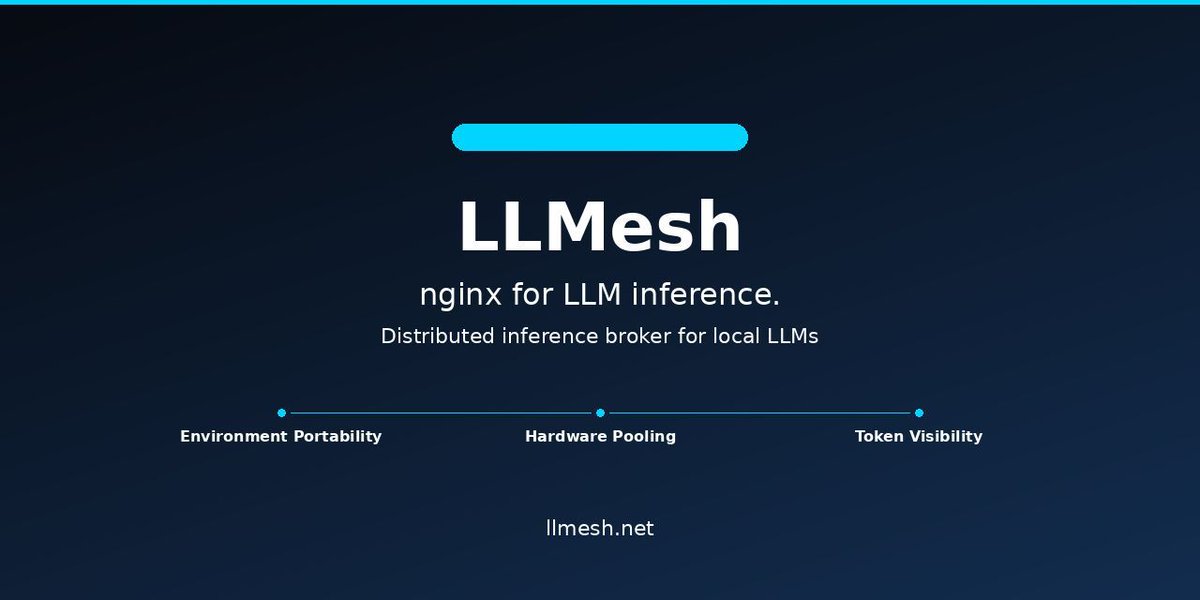
LLMesh is a distributed inference broker for local LLMs. MIT licensed. Zero vendor lock-in.
https://t.co/B9DGWjmfYz
https://t.co/FOhZZ1MUwj
@jainsahil We @aschwabe built this to support other builders.
🔥It's open-sourced for YOU.
LLMesh is a distributed inference broker for local LLMs. MIT licensed. Zero vendor lock-in.
https://t.co/B9DGWjmfYz
https://t.co/FOhZZ1MUwj
@foxtomb232 We @aschwabe built this to support other builders.
🔥It's open-sourced for YOU.
LLMesh is a distributed inference broker for local LLMs. MIT licensed. Zero vendor lock-in.
https://t.co/B9DGWjmfYz
https://t.co/FOhZZ1MUwj
Don't believe in overnight success.
• @levelsio launched 70+ projects – only 4 made money and gained traction.
• @johnrush spent 7 years in failing VC-backed startups, even funding them out of pocket. In 2023, he bootstrapped 24 products, and in 2024, 11 became profitable.
• @marclou attempted to build two ventures: Tinder for sports lovers and an AI startup in South Korea. Both failed. Now, he is a barefoot millionaire; most of his income stems from the Ship Fast and Code Fast projects.
• @tibo_maker faced bankruptcy and crashed 3 startups before he sold his last startup for $10M.
So back to work on your building, shipping, failing, fixing, re-launching and succeeding.
Exactly in this order.
Been heads down building AI infrastructure. Just open-sourced the first piece — LLMesh, a distributed inference broker for local LLMs. Pools your hardware into one endpoint. nginx for LLM inference, basically.
https://t.co/M2Kp2a7vne
https://t.co/hNqrBCVT0w