Xiaomi-Robotics-1 is now open source!🎉
Xiaomi-Robotics-1 was pre-trained on more than 100,000 hours of UMI data and post-trained with over 10,000 hours of cross-embodiment data.
This open-source release covers the complete pipeline from real-robot post-training to model deployment and also includes evaluation code for benchmarks.
🌐Project Page :https://t.co/5m36yNuPG6
💻GitHub: https://t.co/bUAk000v6I
📎Hugging Face: https://t.co/Cd753HJSpq
We will continue exploring the broader possibilities of general-purpose robot models.
#Robotics #EmbodiedAI #FoundationModels #RobotLearning #XiaomiAI #XiaomiRobotics
9/9
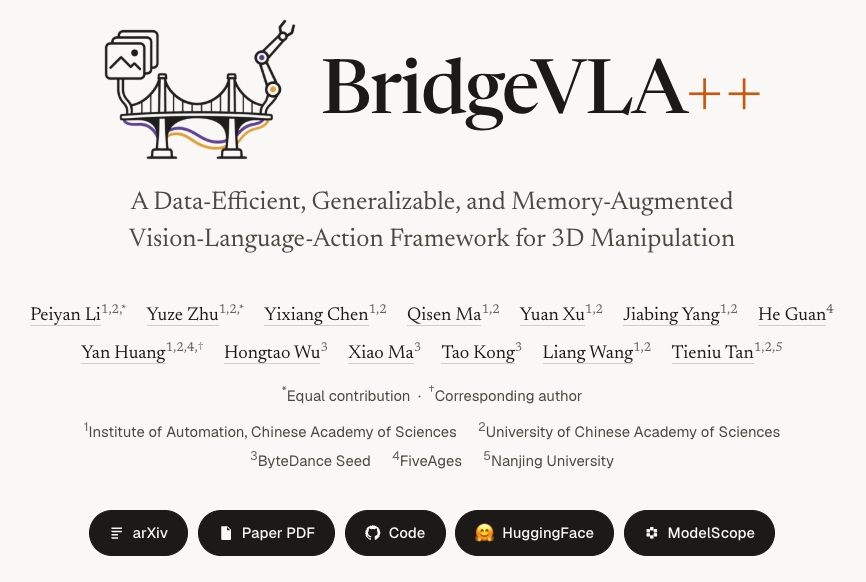
BRIDGEVLA++ IS FULLY OPEN! 📦
💻 Code
📚 Data
🧠 Model checkpoints
Try it, adapt it, or build on it—we’d love to see what you create!
🌐 Project:
https://t.co/EuxwaqW4nw
💻 GitHub:
https://t.co/pF2IJ2F8Hw
#Robotics#VLA#EmbodiedAI
5 benchmarks. 5 SOTA results. Just 9.2% more parameters for memory.
Meet BridgeVLA++: one 3D VLA unifying memory, data efficiency & OOD generalization—without sacrificing one to gain another.
Code, data & checkpoints are open:
https://t.co/EuxwaqW4nw
🧵👇
8/9
Real robots tell the same story:
⚡ BridgeVLA: 95.4% on Franka with only 3 demos/task
🌍 +32% over RVT-2 on average across 7 settings
🧠 BridgeVLA++: 93.3% on Dobot memory tasks vs. 30.0% for SAM2Act+
Data-efficient, generalizable & memory-aware—across robots.
🚀🚀🚀 Ever wondered what it takes for robots to handle real-world household tasks? long-horizon execution, deformable object dexterity, and unseen object generalization — meet GR-3, ByteDance Seed’s new Vision-Language-Action (VLA) model!
GR-3 is a generalizable Vision-Language-Action (VLA) model with strong capabilities in complex long-horizon tasks. It understands unseen abstract concepts, manipulates deformable objects robustly, and adapts to novel settings with minimal human data.
✨ Generalization: Generalizes well to unseen objects, environments, and even instructions with abstract concepts.
✨ Long-Horizon Manipulation: Completes long-horizon tasks with strong instruction-following capabilities.
✨ Deformable Object Manipulation: Manipulate deformable objects robustly.
Project Page: https://t.co/OldV4g5rNo
Arxiv: https://t.co/Li7Lp7kung
#ByteDance #ByteDanceSeed #GR3 #VLA #Robotics #FoundationModels
@chris_j_paxton I fully agree with your opinion. We plan to conduct more experiments on scaling the pre-training data to see whether it further improves performance.
This project is the result of a collective effort — it would never have reached its current level without the support and contributions of everyone involved. Huge thanks to all collaborators: @yixiang_chen ,@HongtaoWu12 ,@yusufma555, @Xiangnan_cs ,@KT892790499 as well as to Professors Yan Huang, Liang Wang, and Tieniu Tan, who are not registered on X.
Thrilled to introduce RoboVLMs 🤖🌍, a unified, open-source and flexible VLA framework for easy integration of any VLMs for robotic tasks, within just 30 lines of code! 🚀 Through 600+ designed experiments, RoboVLMs supports 8 VLM backbones and 4 policy architectures. 📊
Want to train your own VLAs but feel overwhelmed by numerous design choices?
Check out our RoboVLMs, a comprehensive guidebook for building VLAs, based on over 600 experiments involving 8 VLM base models, 4 policy formulations, and 3 recipes for using cross-embodiment data.
It offers
1⃣A series of strong VLA models, better than OpenVLA.
2⃣A unified and flexible VLA framework that allows easy integration of any Vision-Language Model (VLM) for robotic tasks, within just 30 lines of code!
3⃣Fully open source of codebase, models, datasets, and training scripts.
Our paper aims to answer the following four questions.
👉Why do we prefer VLAs? We explore their role as generalist robot policies that can handle a variety of tasks.
👉How to formulate VLAs? We categorize VLA architectures and test various combinations to find the optimal structure.
👉Which VLM backbone works best for VLAs? We test 8 VLM backbones to determine the most effective one for robotic tasks.
👉When should we leverage cross-embodiment data? We assess whether pre-training, pre-training, and post-training on cross-embodiment datasets improve VLA performance.