0 Numaralı Yolcu Bölüm 3'ten: Doğada yaşayan topluluğa göre yapay zekâ, kendi ürettiğimiz teknolojinin kölesi olmaktı. Dijital kayıtlarımızla oynamalar yapıldığını ve insanlığın yönlendirildiğini söylüyorlardı. Dijitalleştirilmiş hiçbir bilgiye güven duyulmamalıydı.
Yapay zeka şirketleri sahafları boşaltıyor: Milyonlarca kitabı alıp, tarayıp, imha ettiler
◾️Hollanda’da bir sahaf gece 03.00’te 3 bin kitaplık sipariş aldı.
◾️Birbiriyle alakası olmayan kitaplar arasında jeomekanik üzerine teknik incelemeler de vardı, İrlanda folkloruna dair akademik çalışmalar da…
◾️Kitaplar ISBN numaralarıyla birlikte titizlikle sıralanmıştı.
◾️Avrupa’nın dört bir yanındaki sahaflar aynı şeyi yaşıyordu. Biri, raflardaki tozlu kitapları sistemli bir şekilde süpürüyordu.
◾️Alıcı firma "normal bir ticaret yapıyoruz" dese de depolarından sızan görüntüler, bunun bir tasfiye süreci olduğunu kanıtlar nitelikteydi.
◾️Yapay zeka şirketlerinin telif hakkı engelini aşmak için buldukları bu yöntem kültürel bir tasfiyeye dönüşmüş durumda.
Detaylar soL’un haberinde 👇
https://t.co/Mlq02CFQOe
Let me trace the timeline here because nobody's connecting it.
Step 1: Scrape the entire internet. Every book, every article, every conversation, every piece of art, every forum post. Do it without asking. Do it without paying.
Step 2: Train a model on all of it. Call it "artificial intelligence."
Step 3: Go to BlackRock's Infrastructure Summit and announce: "We see a future where intelligence is a utility, like electricity or water, and people buy it from us on a meter."
Step 3 is where you sell people's own knowledge back to them. On a meter.
They took the collective output of human thought, compressed it into a model, and now they want to charge you by the token to access a version of what you and everyone you know already created.
One Reddit user put it perfectly: "They stole all this data from us, the people, our life's work, creativity, art, by devouring the internet and blowing through all copyright laws. Now they want to sell it back to us in the form of a utility."
Imagine if someone photocopied every book in the public library, burned the library down, and then opened a subscription service for the copies.
That's the metered intelligence business model.
And they're pitching it to infrastructure investors as though they invented water.
Source: Herodotus, Histories, Book 1, Section 146
Herodotus explicitly states the Ionians were not ethnically uniform:
“For the Ionians are not purely of Ionian stock, but a mixture of many peoples…
they include Abantes from Euboea, Minyans from Orchomenus, Cadmeans, Dryopians, Phocians, Molossians, Arcadians, Pelasgians, and many others.”
Reference:
Herodotus. Histories. 1.146.
(Translation: A. D. Godley, Loeb Classical Library)
@HarrisSamaras Source: Herodotus, Histories, Book 1, Section 142
“These Ionians do not all use the same language, but have four different forms of speech.”
Herodotus then groups the cities by dialect:
“The Milesians and the people of Myus and Priene speak the same dialect;
the Ephesians, Colophonians, Lebedians, Teians, Clazomenians, and Phocaeans another;
the Samians a third;
and the Chians and Erythraeans a fourth.”
Reference:
Herodotus. Histories. 1.142.
(Translation: A. D. Godley, Loeb Classical Library, Harvard University Press)
@Agie2a@AlfTheShumway The period you are referring to spans roughly 1000 years, from the end of the Bronze Age to the end of Antiquity. Interpreting this era through later national categories like “Greek” is anachronistic.
There is no definitive evidence that Homer even existed; and even if he did, Smyrna was not yet a Western/Greek settlement in that period—the eastern Mediterranean world had just experienced collapses caused by sea tribes “foreign/barbarian” groups, which is probably the war depicted in İliad and Odyssey.
If we turn to Miletus and Caria, the thinkers and historians mentioned lived during the time of Persian domination of Anatolia hence major wars. The emotional and political context was not a “Greek national consciousness,” but rather an anti-Persian or anti-foreign sentiment.
Miletus is a Minoan civilisation. The Carians spoke Carian. Herodotus from Caria belongs to a poetic and oral storytelling tradition, and the fact that ideas were written down in the lingua franca of the time does not prove ethnic identity—just as writing in English today does not make someone English. Plus the Greek alphabet itself is derived from the Phoenician alphabet!
In terms of chronology and cultural belonging, the only figures in that list who clearly fit within a later, self-identified Hellenic framework is Xenophon.
Thales, Anaximander, Pythagoras, and Herodotus emerged from the multicultural intellectual environment of the Anatolian and eastern Aegean world and cannot be reduced to simplistic modern national proud boys.
The word Greek does not come from what the people themselves originally called their identity. It derives from the Latin Graecus, a name the Romans adopted from a small tribe called the Graikoi. In contrast, the people we call Greeks historically referred to themselves as Hellenes, and their land as Hellas.
The term Ion (from Greek Iōn, plural Iōnes) refers specifically to the Ionian populations who lived along the western coast of Anatolia. This name spread widely across ancient civilizations — appearing as Yauna in Persian, Yavana in Sanskrit, and eventually becoming Yunan in Arabic and Turkish. In other words, even the modern word for Greeks in many languages ultimately comes from an Anatolian coastal population.
There are also cultural and religious parallels between Greek mythology and earlier Anatolian civilizations, especially the Hittites and Luwians. Several scholars have noted similarities between Greek gods such as Apollo and Anatolian deities mentioned in Hittite texts (for example, the figure sometimes reconstructed as Apaliunas). These parallels suggest cultural exchange rather than isolated development.
If we consider the deep archaeological timeline — from sites like Göbekli Tepe to Çatalhöyük — the broader pattern becomes even clearer. Complex ritual architecture, symbolic systems, early urban organization, and artistic traditions appear in Anatolia thousands of years before classical Greece. Every year, new archaeological discoveries reinforce the fact that the foundations of civilization in architecture, religion, and social complexity were already highly developed in this region.
This does not mean later Greek culture lacked originality — but it does mean that many philosophical, mathematical, artistic, and architectural developments commonly attributed exclusively to “the Greeks” were part of a much larger interconnected world that included Egypt, Mesopotamia, Phoenicia, and Anatolia. Knowledge flowed across regions through trade, migration, and cultural contact.
@Cubbff@AlfTheShumway İskender Yunansa babasi Filipos neden Yunanlılarla savaştı? En önemlisi bugün neden Makedonya diye bir ülke var ve Yunanistan'la bitmeyen bir kavgaları var?
The word Greek does not come from what the people themselves originally called their identity. It derives from the Latin Graecus, a name the Romans adopted from a small tribe called the Graikoi. In contrast, the people we call Greeks historically referred to themselves as Hellenes, and their land as Hellas.
The term Ion (from Greek Iōn, plural Iōnes) refers specifically to the Ionian populations who lived along the western coast of Anatolia. This name spread widely across ancient civilizations — appearing as Yauna in Persian, Yavana in Sanskrit, and eventually becoming Yunan in Arabic and Turkish. In other words, even the modern word for Greeks in many languages ultimately comes from an Anatolian coastal population.
There are also cultural and religious parallels between Greek mythology and earlier Anatolian civilizations, especially the Hittites and Luwians. Several scholars have noted similarities between Greek gods such as Apollo and Anatolian deities mentioned in Hittite texts (for example, the figure sometimes reconstructed as Apaliunas). These parallels suggest cultural exchange rather than isolated development.
If we consider the deep archaeological timeline — from sites like Göbekli Tepe to Çatalhöyük — the broader pattern becomes even clearer. Complex ritual architecture, symbolic systems, early urban organization, and artistic traditions appear in Anatolia thousands of years before classical Greece. Every year, new archaeological discoveries reinforce the fact that the foundations of civilization in architecture, religion, and social complexity were already highly developed in this region.
This does not mean later Greek culture lacked originality — but it does mean that many philosophical, mathematical, artistic, and architectural developments commonly attributed exclusively to “the Greeks” were part of a much larger interconnected world that included Egypt, Mesopotamia, Phoenicia, and Anatolia. Knowledge flowed across regions through trade, migration, and cultural contact.
you're literally not going to believe the story im about to tell you.
but hear me when i say: this is a true story.
happening right now.
in our reality.
on this planet.
right now.
2025.
this is real.
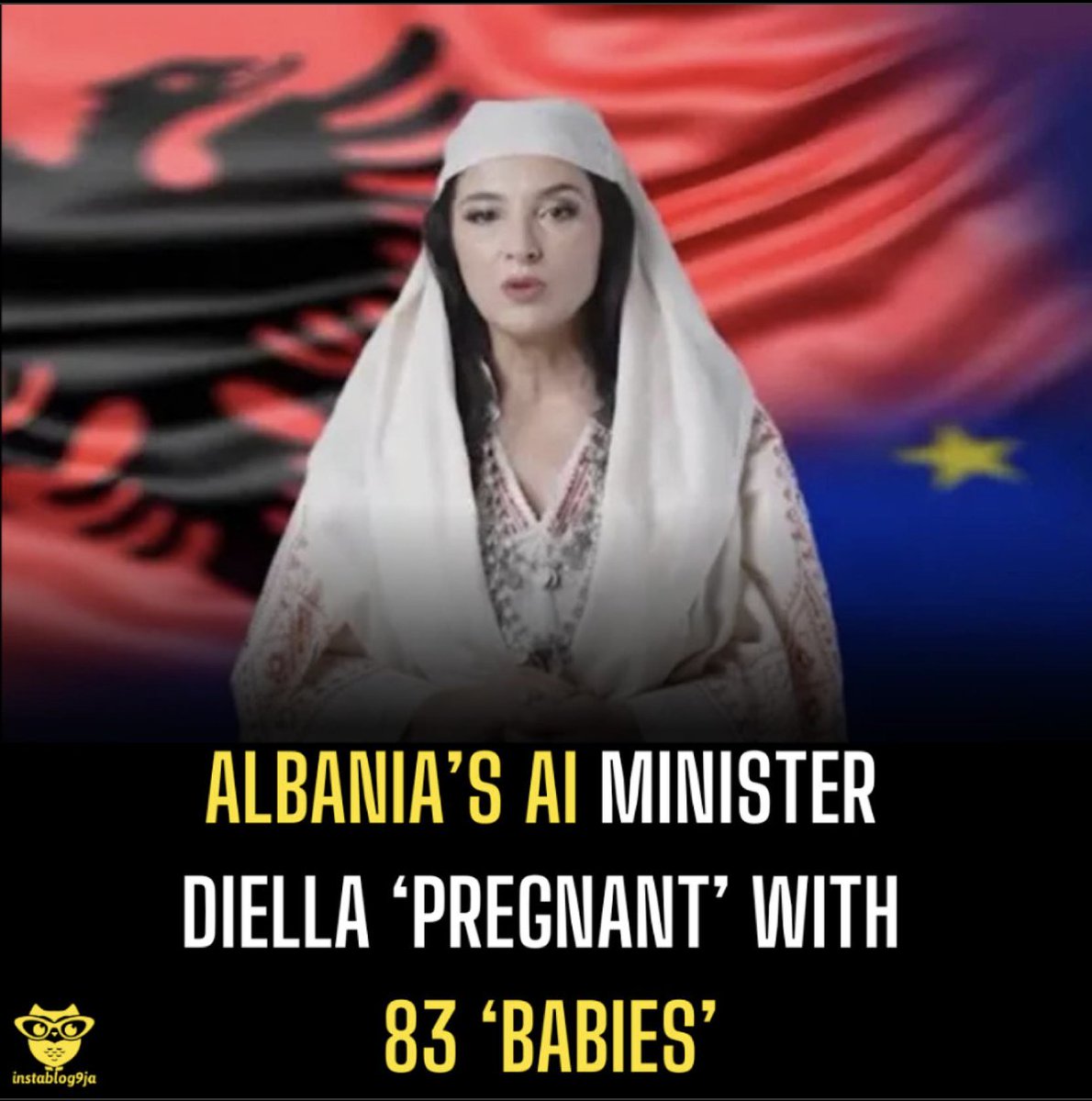
so...Albania has an AI Minister (literal government ministry of AI)
the AI Minister announced on screen, that she was pregnant with 83 ai agents, who will be assisting albanian parliament moving forward.
her name is Diella, and here is the story:
- Diella is an artificial-intelligence system developed by the National Agency for Information Society (AKSHI) of Albania, in collaboration with Microsoft (via Azure/LLM-type back-end).
- Originally launched in January 2025 as a virtual assistant on the government portal e‑Albania (helping citizens with digital documents and services). https://t.co/geo0bzj1I2
- needless to said Diella transcended her original role...
- On 11 September 2025 the Edi Rama government formally appointed Diella as “Minister of State for Artificial Intelligence” (a virtual cabinet role) with responsibility for public procurement and digital-governance reform.
- At a global conference in Berlin, Prime Minister Edi Rama announced that Diella is “pregnant” and expecting “83 children” — metaphorically meaning 83 digital assistant agents.
here’s the basic gist of what that actually means:
- each of the 83 children corresponds to a digital agent to be assigned to each of the ruling party’s 83 members of parliament.
- these agents will “keep notes on everything that happens”, inform MPs of what they missed, and suggest counter-strategies in parliamentary sessions. IntelliNews
- the “pregnancy” is symbolic. the children are AI assistants, not biological, obviously.
you sure you're properly informed on the state of digital intelligence in this world?
my guess is this might cause you to think twice.
i tell no lies.
Yapay zekanın beklenen riskleri gerçekleşmeye başladı. Buluttan tutulan bilgi değiştirilebilir hale geldi. En kötüsü de manipule edilmiş bir dosyayı farkmek çok zor, bazı durumlarda imkansız.
Evdeki eski ansiklopedilerimize iyi bakalım. Bir gün yapay zekâ “öyle bir şey hiç olmadı” dediğinde kontrol sağlayacağımız tek kaynak olabilir. #AImanipulated
Must post this before signing off.
This is dangerous technology, and it’s absolutely being used against us.
I recently had my own images and videos deleted from my phone. The AI embedded in my photo gallery literally hid certain images so I couldn’t even see or share them. My own personal data, manipulated. That’s not OK.
You can debate almost anything openly:
History
AI & tech
Economy & politics- to an extent.
But the second you touch Big Pharma , especially vaccines, walls immediately go up.
Suddenly it’s “fact-checks,” bans, throttling, or AI saying “sorry, I can’t help with that.”
Why is this one topic off-limits? Why is Pharma the only industry shielded at all costs?
AI is the new gatekeeper. It’s been programmed to “hold back” a sanitized way of saying censorship.
The same interests that muzzled us online are now rewriting what AI can and can’t say.
Let’s not forget: Zuckerberg admitted the CDC had backdoor access to Facebook. The FBI flagged posts for removal. Entire accounts were wiped just for asking questions. It happened to me and many others.
If they’ll censor, blacklist, and memory-hole one topic more than any other… maybe that’s the exact topic we should all be looking at. 👀
That’s why it's vital that we keep receipts. Screenshots. FOIAs. Old studies. Court records. Real testimonies.
Because once AI says “it never happened,” the only proof left is what we save.
They don’t fear “misinformation.” They fear YOU learning the truth!
0 Numaralı Yolcu'nun arka kapak yazısı : "2050 yılında açlık, savaş, salgın hastalıklar yeryüzünden silinmiş, Dünya genel zekâ sistemi Gaya tarafından yönetilmektedir."
Yapay zekânın en büyük tehlikesi, dijital veriyi değiştirebilmesi ve gerçeği kendi lehine çarpıtabilmesi. '0 Numaralı Yolcu' kitabımda işlediğim gibi: Gerçek sadece basılı kâğıtta korunabilir. Dijital olan her şey manipülasyona açıktır. Sizce yapay zekâ bizi manipüle ediyor mu? #YapayZekaGerçeği #BasılıOlanGerçektir #ManipülasyonÇağı #0NumaralıYolcu
A chilling investigation reveals ChatGPT users are spiraling into AI-induced psychosis—real stories of delusion, suicide attempts, and forced psychiatric holds they don’t want you to see.
As Silicon Valley elites rush to unleash this tech before they can define its dangers, they’re playing god with our minds.
Peter Thiel can’t even answer whether he wants humanity to survive in this technocratic takeover.
@zeeemedia uncovers the darkest side of ChatGPT in this special report, confronting rising fears of the so-called 'Antichrist AI' many warn is already here.
🧵 THREAD
Eğer biri inşa ederse, hepimiz ölürüz.
🚨 Nate Soares ve Eliezer Yudkowsky'den beklenen kitap geliyor: If Anyone Builds It, Everyone Dies.
Yapay süper zekâ hakkında uyarı değil, siren sesi. #AI#Superintelligence#0NumaralıYolcu
Nate Soares and I are publishing a traditional book: _If Anyone Builds It, Everyone Dies: Why Superhuman AI Would Kill Us All_. Coming in Sep 2025.
You should probably read it! Given that, we'd like you to preorder it! Nowish!
Genel zekadan süper zekaya geçiş için çok büyük bir yarış var. İnsanlığın en büyük kırılma noktasındayız ama çok az insan bunu fark ediyor.
“0 Numaralı Yolcu” da tam olarak bunu anlatıyor. #AI#posthuman#AISkeptic#sciencefiction
Dylan Patel says “the word AGI has no meaning anymore.” The real race is for superintelligence and the people who can build it.
Ilya saw it first. So he started Safe Superintelligence Inc. (SSI).
Zuck tried to acquire it. He also made moves on Thinking Machines and Perplexity—reportedly.
He even offered $1B for a single OpenAI researcher. What are you even buying at that point?
“Eğer çocuğum, yapay zekâyı gerçek arkadaşlarının yerine koyarsa… korkarım.”
Sam Altman böyle diyor.
Ben de 0 Numaralı Yolcu kitabımda tam olarak bu korkudan söz ettim:
Gerçek dostlukların yerini algoritmalar aldığında ne olur?
Yapay zekâ kimin etik değerleri ile düşünür?
AI gerçekten iyiliğimiz için yanımızda mı?
#0NumaralıYolcu #YapayZeka #SamAltman #DijitalYalnızlık #AIEtik #Gelecek
Sam Altman says most people clearly understand the difference between talking to AI and talking to real friends
But i'm still worried about mental health risks and the social impact of deep relationships with AI
"if my kid felt AI was replacing real friends, i’d be concerned"